Artificial intelligence has moved from experimental projects to everyday business systems. You now see AI helping to detect fraud, forecast demand, analyze medical images, recommend products, automate document workflows, write software, and answer customer questions.
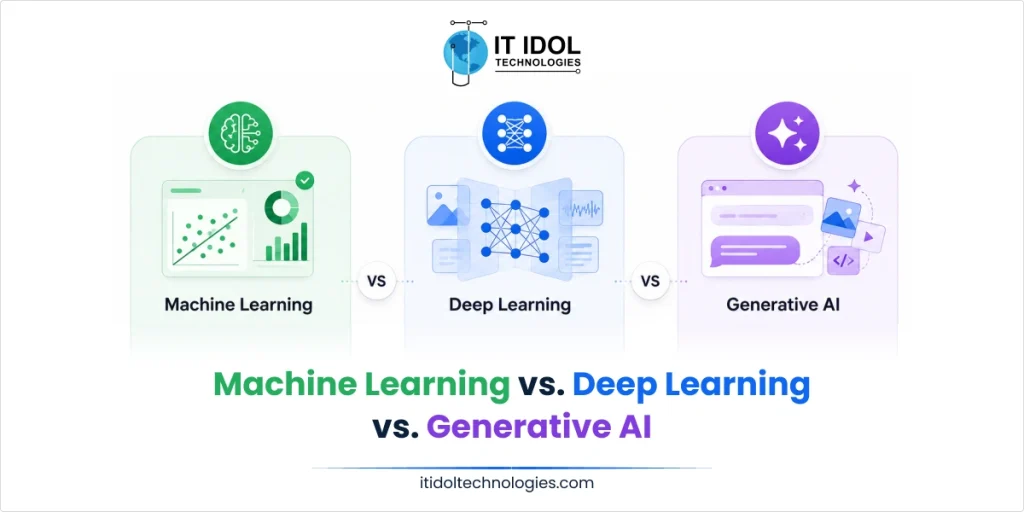
However, one question often creates confusion: What is the difference between machine learning, deep learning, and generative AI? These technologies are related, but they solve different problems. Machine learning is often best at prediction and pattern detection. Deep learning handles complex data such as images, speech, and video. Generative AI creates new content and supports natural-language interactions. Choosing the wrong approach can increase development costs without improving results. So, before you invest in an AI initiative, you need to understand what each technology does well and where it fits.
What Are Machine Learning, Deep Learning, and Generative AI?
Think of artificial intelligence as the broad category. Machine learning sits within AI, deep learning sits within machine learning, and most modern generative AI systems rely heavily on deep learning.
Machine learning allows software to learn patterns from data and make predictions or decisions without developers having to program every possible rule. For example, you can train an ML model on historical transaction data to identify suspicious payments. You can also use ML for sales forecasting, customer churn prediction, dynamic pricing, credit scoring, and predictive maintenance. Common approaches include supervised, unsupervised, semi-supervised, and reinforcement learning.
What Is Deep Learning (DL)?
Deep learning is a specialized form of machine learning that uses multi-layer neural networks to identify complex patterns. It becomes especially useful when you work with large amounts of unstructured data, including images, audio, text, sensor data, and video. Healthcare organizations can use deep learning to analyze medical images. Manufacturers can use computer vision to identify product defects. Logistics companies can process complex operational signals to improve planning.
What Is Generative AI (GenAI)?
Generative AI creates new content based on patterns learned during training. That output can include text, code, images, audio, video, summaries, and structured responses. Large language models, or LLMs, power many popular GenAI applications. Businesses use them for knowledge assistants, document processing, customer support, coding assistance, content generation, and workflow automation. Companies exploring these applications increasingly use specialized Generative AI development approaches to connect foundation models with private data, applications, and business rules.
How Machine Learning, Deep Learning, and Generative AI Fit Within Artificial Intelligence
The relationship is easier to understand as a hierarchy:
Artificial Intelligence → Machine Learning → Deep Learning → Many Modern Generative AI Systems
Still, you should not assume that newer means better. A traditional ML model may outperform a large generative model for structured prediction. Likewise, deep learning may be the better choice for image classification, while GenAI may fit a conversational knowledge assistant. The right technology depends on your problem.
Machine Learning vs. Deep Learning vs. Generative AI: Key Differences at a Glance
Traditional ML can work effectively with smaller, structured datasets. Deep learning usually benefits from much larger datasets. GenAI presents another option. Instead of training a foundation model from scratch, you can use an existing model and connect it to your data through retrieval-augmented generation, or RAG, fine-tuning, or APIs.
Computing Power and Infrastructure Requirements
ML models can often run with modest infrastructure. Deep learning training may require GPUs or specialized accelerators. Generative AI can also create significant inference costs because each user request consumes computing resources.
Output: Prediction vs. Recognition vs. Content Generation
This distinction often gives you the fastest way to choose:
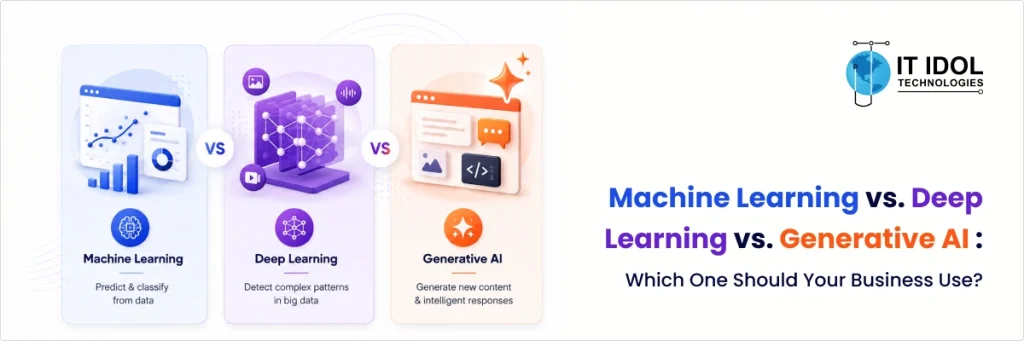
ML predicts. Deep learning recognizes complex patterns. Generative AI creates.
The boundaries overlap, but this rule provides a useful starting point.
Explainability, Accuracy, and Control
Traditional ML models can often provide clearer explanations for predictions. Deep learning and GenAI systems can be harder to interpret. Generative models also introduce risks such as hallucinations, where the system produces confident but incorrect information. Therefore, regulated industries such as healthcare and FinTech need stronger validation, monitoring, and human oversight.
Development, Training, and Operational Costs
Cost depends on data preparation, model choice, infrastructure, integration, inference volume, monitoring, and maintenance. A smaller ML model may solve a forecasting problem at a fraction of the cost of a generative model. Your goal should be to use the simplest approach that reliably solves the business problem.
How Does Machine Learning Work?
Machine learning starts with data. You train an algorithm using historical examples, evaluate its performance, and then use the trained model to make predictions on new data.
Supervised, Unsupervised, Semi-Supervised, and Reinforcement Learning
Supervised learning uses labeled examples and works well for classification and prediction.
Unsupervised learning finds patterns without predefined labels, making it useful for clustering and anomaly detection.
Semi-supervised learning combines limited labeled data with larger amounts of unlabeled data.
Reinforcement learning trains systems through actions, feedback, and rewards.
Common Machine Learning Models and Algorithms
Common algorithms include linear and logistic regression, decision trees, random forests, support vector machines, gradient boosting, and clustering algorithms. The best algorithm depends on your data and goal, not on which technology receives the most attention.
Where Traditional Machine Learning Still Outperforms Generative AI
Traditional ML remains highly effective for structured business problems. If you need to predict customer churn, detect payment fraud, estimate delivery times, forecast inventory, or calculate risk scores, ML can provide faster, cheaper, and more predictable results than GenAI.
How Does Deep Learning Work?
Deep learning uses artificial neural networks to learn patterns through layers of mathematical operations. Each layer processes information and passes a representation to the next layer.
Neural Networks and How They Learn Complex Patterns
During training, a neural network compares predictions with expected results and adjusts internal parameters to reduce errors. Over many training cycles, the network learns useful patterns without developers manually defining every feature.
CNNs, RNNs, and Transformers Explained
Convolutional neural networks, or CNNs, became widely used for image analysis. Recurrent neural networks, or RNNs, were developed for sequential data. Transformers transformed natural language processing by efficiently modeling relationships across long sequences. They now power many LLMs and multimodal AI systems.
When Deep Learning Is a Better Choice Than Traditional Machine Learning
Deep learning makes sense when your application depends on complex unstructured data. Examples include medical imaging, speech recognition, visual quality inspection, facial recognition, natural language processing, and autonomous perception systems. However, if your dataset is small and structured, traditional ML may still be more practical.
How Does Generative AI Work?
Generative AI learns patterns from large datasets and uses those patterns to produce new outputs. For LLMs, the system processes text as tokens and predicts likely sequences based on context.
Large Language Models, Foundation Models, and Multimodal Models
Foundation models are trained on broad datasets and can support many downstream tasks. LLMs specialize in language-related tasks, while multimodal models can work across text, images, audio, and video. This provides businesses with a common AI layer across many applications.
Transformers, Tokens, Embeddings, and Model Training
Transformers help models understand relationships between tokens across context. Embeddings convert information into numerical representations. These representations help systems identify semantic similarity, which is especially useful for search and RAG applications.
RAG vs. Fine-Tuning vs. Prompt Engineering
Prompt engineering guides a model through instructions and context. RAG retrieves relevant information from trusted sources before generating an answer. Fine-tuning adjusts a model using specialized training data. For many enterprise applications, RAG offers a practical starting point because you can connect an existing model to current business information without retraining the entire model.
How Generative AI Differs From Predictive AI
Predictive AI answers questions such as, “What is likely to happen?”
Generative AI answers questions such as, “What should I create or explain based on this context?”
Modern applications increasingly combine both.
Machine Learning vs. Deep Learning vs. Generative AI: Which One Should Your Business Use?
Start with the business outcome rather than the technology.
Choose Machine Learning for Prediction, Forecasting, and Structured Data
Use ML for demand forecasting, fraud detection, churn prediction, pricing, lead scoring, predictive maintenance, and risk analysis.
Choose Deep Learning for Complex Images, Audio, Video, and Pattern Recognition
Use deep learning when you need computer vision, speech recognition, medical image analysis, visual inspection, or advanced pattern detection.
Choose Generative AI for Content, Knowledge, Conversational, and Reasoning Applications
When a Hybrid ML, Deep Learning, and Generative AI Architecture Makes More Sense
You do not always need to choose one. A FinTech platform could use ML to calculate fraud risk, deep learning to analyze identity documents, and GenAI to explain flagged cases to analysts. A hybrid architecture can assign each task to the technology best suited to handle it.
Real-World Use Cases of ML, Deep Learning, and Generative AI Across Industries
In healthcare, ML can predict patient risks, deep learning can analyze medical images, and GenAI can assist with documentation and knowledge retrieval.
In FinTech, companies use ML for fraud and credit risk, deep learning for complex anomaly detection, and GenAI for document analysis and employee assistance. Organizations exploring this area should also consider how AI supports FinTech compliance and risk management.
In retail and e-commerce, ML supports demand forecasting and recommendations, while GenAI can power conversational shopping and product content.
In manufacturing, predictive models can anticipate equipment failures, computer vision can detect defects, and GenAI assistants can help technicians access maintenance knowledge. These applications are already shaping practical AI and ML use cases in manufacturing.
In logistics, AI supports route optimization, demand forecasting, ETA prediction, and supply chain planning.
In education, AI can support adaptive learning, assessment, tutoring, and administrative workflows.
For SaaS companies and startups, AI can become part of the product itself through copilots, recommendations, automation, and intelligent workflows.
Cost of Machine Learning vs. Deep Learning vs. Generative AI
AI cost extends beyond model development.
Data Collection, Preparation, and Training Costs
You may need to collect, clean, label, secure, and govern data before development begins. Poor-quality data can make even an advanced model ineffective.
Cloud, GPU, API, and Inference Costs
Deep learning and GenAI may require GPUs, cloud infrastructure, vector databases, model APIs, and monitoring systems. Inference costs also grow with usage, so a successful prototype can become expensive at production scale if architecture decisions are weak.
Build vs. Buy vs. Fine-Tune: Which Approach Is More Cost-Effective?
You should rarely train a foundation model from scratch unless you have a strong technical and financial reason. For many businesses, APIs, open-source models, RAG, and targeted fine-tuning offer a more practical path.
How to Evaluate ROI Before Investing in an AI Solution
Measure a business metric before you measure model sophistication. Track outcomes such as hours saved, fraud losses reduced, conversion improvement, downtime prevented, support costs reduced, or revenue generated.
What Is Changing in ML, Deep Learning, and Generative AI in 2026?
Several developments are changing how businesses approach AI.
Smaller and Specialized Models Are Challenging the “Bigger Is Better” Approach
Smaller models can offer lower latency, better cost control, and easier deployment for focused tasks. You no longer need the largest available model for every application.
Multimodal AI Is Combining Text, Images, Audio, Video, and Enterprise Data
Multimodal systems can process several data types within one workflow. This creates practical opportunities in healthcare, commerce, manufacturing, education, and customer service.
Generative AI and Predictive ML Are Converging in Enterprise Applications
Businesses are combining predictive models with natural-language interfaces. Instead of showing users a risk score alone, for example, a system can explain the score and recommend a next action.
AI Agents Are Moving GenAI From Content Generation to Workflow Execution
AI agents can interact with tools, retrieve information, call APIs, and complete multi-step tasks. However, autonomy requires controls. Organizations exploring AI agent development need clear permissions, audit trails, evaluation systems, and human approval for high-impact actions.
Edge and On-Device AI Are Expanding Privacy-Sensitive Use Cases
Smaller models can increasingly run on phones, industrial devices, and local infrastructure. This can reduce latency and keep sensitive data closer to its source.
AI Costs Are Falling, but Scaling Enterprise AI Still Requires ROI Discipline
Model access may become cheaper, but production AI still requires integration, security, evaluation, monitoring, data pipelines, and ongoing maintenance. A cheaper model does not automatically create a cheaper AI system.
Why AI Projects Fail: What Businesses Should Avoid
Many failures start before model development. Common mistakes include choosing GenAI when traditional ML would work better, starting with a model instead of a business problem, relying on poor data, ignoring hallucinations or bias, and underestimating integration costs.
Another major problem is pilot paralysis. A demo works, but the team never defines ownership, production architecture, KPIs, security, or scaling requirements. Understanding why AI projects fail in real-world implementations can help you identify these risks before committing significant resources.
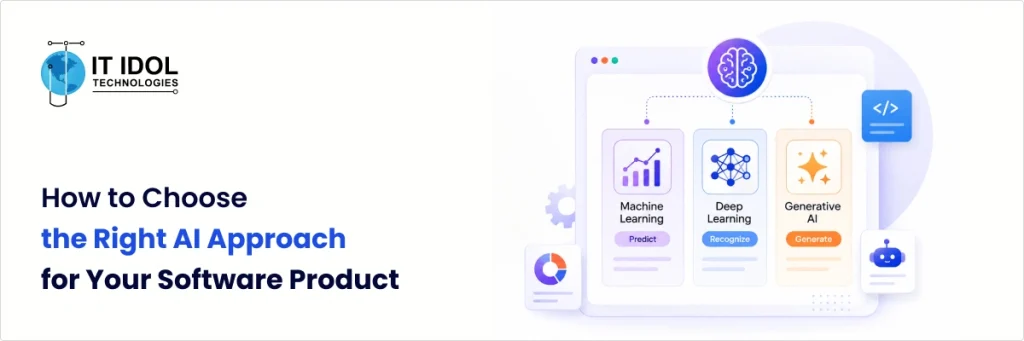
How to Choose the Right AI Approach for Your Software Product
Use a structured decision process.
Step 1: Define the business problem and measurable outcome.
Step 2: Assess your data type, volume, quality, access, and privacy requirements.
Step 3: Match the problem to ML, deep learning, GenAI, or a hybrid architecture.
Step 5: Plan security, compliance, model evaluation, governance, and human oversight before production.
Step 6: Start with a high-value use case and measure actual business results.
If your organization needs help making these decisions, an experienced AI and ML development partner can help assess feasibility, architecture, integration requirements, and production costs before you scale.
The Future of Machine Learning, Deep Learning, and Generative AI
Generative AI will not make traditional machine learning obsolete. Instead, the technologies are becoming parts of larger AI systems. A future enterprise application might use ML to predict an event, deep learning to interpret unstructured information, GenAI to explain the result, and an AI agent to execute an approved action.
This shift makes architecture more important than chasing a single model. For most organizations, the future of enterprise AI is likely to be hybrid. The winning approach will be the one that delivers the required accuracy, speed, cost, security, and business value.
Conclusion: ML, Deep Learning, or Generative AI: Which Is Right for Your Business?
Machine learning, deep learning, and generative AI solve different classes of problems. Choose machine learning when you need reliable predictions from structured data. Choose deep learning when you need to process complex images, audio, video, or large-scale patterns. Choose generative AI when you need content generation, conversational experiences, knowledge assistance, or natural-language interaction.
More importantly, do not choose AI based on popularity. Start with the problem. Evaluate your data. Define measurable results. Then select the simplest technology that can deliver those results reliably. If you are evaluating where AI fits into an existing product or planning a new AI-enabled application, IT IDOL Technologies can help you assess the use case, select an appropriate architecture, and build an implementation plan focused on measurable business outcomes rather than AI for its own sake.
Machine learning mainly learns patterns to make predictions or classifications. Deep learning uses multi-layer neural networks to process complex data. Generative AI creates new outputs such as text, images, code, and audio.
Most modern generative AI systems use deep learning, which is itself a subset of machine learning. However, generative modeling as a concept includes several technical approaches.
Neither is universally better. ML is often better for structured prediction and classification, while GenAI is better suited to content generation, natural-language interaction, and knowledge-based applications.
No. Traditional ML remains highly effective for forecasting, fraud detection, recommendation systems, risk scoring, anomaly detection, and many structured-data problems.
It often is. Deep learning generally requires more data, computing resources, and specialized infrastructure. However, actual costs depend on model size, training requirements, deployment architecture, and usage.
Yes. Many advanced AI systems combine them. For example, ML can generate a risk score, deep learning can analyze documents, and GenAI can explain findings through a conversational interface.
There is no standard price. Cost depends on data readiness, model choice, integrations, infrastructure, security, compliance, user volume, and maintenance. A focused ML application can be much less expensive than a large enterprise GenAI platform.
You should evaluate business value, data readiness, model accuracy, security, privacy, compliance, infrastructure, integration, operating costs, human oversight, and measurable ROI. The best AI strategy starts with a valuable problem, not a trending model.
Deval Rathod
Founder & CEO
|
Deval Rathod is the Founder and CEO of IT IDOL Technologies, a custom software development company. With over a decade of experience in software engineering, solution architecture, and technology leadership, she has worked across custom software development, enterprise applications, AI & ML, and digital transformation. Her expertise includes guiding technology teams, designing scalable software solutions, and helping businesses evaluate and implement emerging technologies. She contributes insights on software engineering, artificial intelligence, enterprise technology, and digital transformation.