The next digital visibility challenge is no longer ranking on search engines; it’s becoming the source AI chooses to trust.
For more than two decades, digital visibility has largely been defined by one metric: where a website ranks in search results. Organizations invested heavily in search engine optimization (SEO) because appearing on the first page of Google directly influenced website traffic, lead generation, and revenue.
That model is beginning to change.
Increasingly, business buyers are asking questions directly to AI systems such as ChatGPT, Google AI Overviews, Gemini, Perplexity, and Microsoft Copilot. Instead of presenting ten blue links, these platforms synthesize information into a single answer, AI Overviews and AI Mode often citing only a handful of sources. If your company is not among those sources, your content may never enter the buyer’s decision process even if it ranks well in traditional search.
GEO is the practice of making content understandable, trustworthy, and citable for AI-powered answer engines. Unlike SEO, which aims to improve rankings in search results, GEO focuses on increasing the likelihood that AI systems reference, summarize, or recommend your content when responding to user queries. For enterprise leaders, this is not another marketing tactic. It represents a structural change in how customers discover information, evaluate vendors, and build purchasing confidence.
Why Is GEO Emerging Now?
Generative AI has fundamentally changed the economics of information retrieval. Traditional search required users to compare multiple websites before forming an opinion. AI compresses that process by delivering synthesized answers that combine information from several trusted sources. The user’s journey increasingly starts and sometimes ends inside the AI response itself.
This changes an important business question.
The objective is no longer “How do we attract more visitors?”
It becomes “How do we become one of the sources AI trusts enough to cite?”
That distinction has significant implications for enterprise marketing, product education, customer success, and executive thought leadership. Recent industry research indicates that organizations are already adapting to this shift. BrightEdge found that 68% of marketers are changing their search strategies in response to AI-powered search experiences, while more than half of organizations now place responsibility for AI search initiatives within their SEO or digital marketing teams. Organizations that treat GEO as an extension of enterprise knowledge management, rather than merely a marketing initiative, are likely to achieve stronger long-term visibility as AI-driven discovery continues to grow.
How Is GEO Different from Traditional SEO?
Many executives assume GEO is simply “SEO for AI.” In practice, that assumption creates poor strategies.
SEO optimizes for ranking documents.
GEO optimizes for becoming a trusted source within generated answers.
A search engine evaluates hundreds of ranking signals before deciding where a webpage appears. A generative engine performs a different task. It retrieves information, evaluates source credibility, synthesizes multiple perspectives, and constructs a response designed to answer a user’s question directly. During that process, clarity, factual consistency, topical authority, structured content, and quotable insights often become more valuable than keyword density alone.
This does not mean SEO is becoming obsolete.
In reality, organizations with strong technical SEO, clear information architecture, and authoritative content are generally better positioned for GEO. The difference is that ranking becomes only one signal among many. AI systems increasingly reward content that explains concepts clearly, supports claims with evidence, and answers complete questions rather than isolated keywords.
A useful way to think about the distinction is this:
SEO earns visibility. GEO earns trust.
Visibility gets a page discovered, and trust gets a brand cited.
Why Should Enterprise Leaders Care?
Many organizations still evaluate digital performance using metrics such as organic traffic, rankings, and click-through rates. Those metrics remain important, but they no longer describe the complete customer journey.
A procurement leader researching enterprise AI may ask ChatGPT for implementation risks before visiting a vendor website.
A CIO comparing cloud security platforms may rely on AI-generated summaries instead of reading ten separate articles.
A product team evaluating governance frameworks may begin with Perplexity rather than Google.
In each case, the buying process starts before the first website visit. This represents a strategic shift in enterprise influence. Brands are increasingly competing not only for human attention, but also for AI recognition. The organizations that consistently publish original research, explain complex topics clearly, and build measurable subject-matter authority are more likely to become trusted references in AI-generated answers. Over time, that visibility compounds into brand credibility long before a prospective customer enters a sales conversation. For enterprise leaders, GEO is therefore not simply a content strategy. It is rapidly becoming a business visibility strategy.
How Enterprises Actually Win at GEO
AI Doesn’t Rank Content the Way Search Engines Do; It Evaluates Whether Content Can Answer Questions Reliably
One of the biggest misconceptions about Generative Engine Optimization is that AI simply “reads the top-ranking pages on Google.” That is an oversimplification.
Modern AI-powered search experiences typically combine retrieval systems, ranking models, structured knowledge, and large language models to generate answers. The objective is not to identify the most optimized webpage; it is to generate the most useful response while reducing factual uncertainty. Different AI platforms use different architectures and data sources, but they all face the same challenge: determining which information appears credible enough to include in an answer. That changes how enterprise content should be written.
Content designed purely to attract clicks often performs poorly because it delays the answer, overuses marketing language, or lacks evidence. In contrast, content that defines concepts clearly, explains relationships, acknowledges trade-offs, and supports claims with verifiable data is easier for AI systems to interpret and synthesize. The practical takeaway is straightforward:
AI rewards content that reduces ambiguity, not content that maximizes keyword repetition.
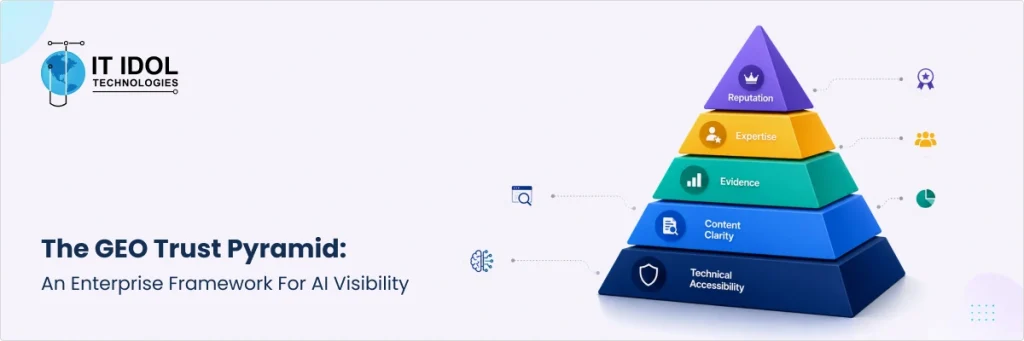
The GEO Trust Pyramid: An Enterprise Framework for AI Visibility
Organizations often ask how they should prioritize GEO initiatives. Based on current enterprise adoption patterns, I find it useful to think about GEO as a five-layer trust pyramid.
At the foundation is technical accessibility. AI systems cannot interpret content that is blocked, poorly structured, or difficult to crawl. Clean information architecture, semantic HTML, descriptive headings, structured data where appropriate, and fast-loading pages remain essential because discoverability precedes citation.
The second layer is content clarity. Every page should answer a specific business question directly before expanding into supporting context. Pages that attempt to rank for dozens of unrelated topics tend to dilute their authority.
The third layer is evidence. AI systems increasingly favor content that includes original analysis, industry data, research findings, implementation experience, and references to authoritative sources. Unsupported opinions rarely establish long-term credibility.
The fourth layer is expertise. Organizations publishing unique implementation insights, operational lessons, customer patterns, or proprietary frameworks create knowledge that cannot easily be replicated. This is where thought leadership begins to differentiate itself from content marketing.
At the top sits reputation. Strong brands earn citations because they consistently publish accurate, trustworthy information over time. GEO is cumulative. A single article rarely establishes authority, but sustained expertise does.
The organizations that focus only on keywords compete for rankings.
The organizations that build every layer of the trust pyramid compete for influence.
Why AI Will Never Reference Most Enterprise Content
Many companies produce large volumes of content yet see little visibility in AI-generated responses. The reason is rarely a lack of publishing frequency. It is a lack of informational value. Several patterns appear repeatedly across enterprise websites. Some articles simply rephrase information already available elsewhere. Others prioritize promotional messaging before answering the user’s question. Many discuss trends without offering any practical interpretation or implementation guidance. From an AI perspective, this creates redundancy.
If ten articles explain the same concept using slightly different wording, there is little reason to reference all ten.
Originality therefore becomes a strategic advantage.
Original research.
Original frameworks.
Original implementation lessons.
Original decision criteria.
These forms of knowledge increase the probability that AI systems view the content as adding something meaningful rather than repeating existing information. A useful question for every content review is:
If this page disappeared tomorrow, would the internet lose any unique knowledge?
If the answer is no, AI may reach the same conclusion.
GEO Is Not a Marketing Initiative; It Is an Enterprise Knowledge Strategy
One of the most common implementation mistakes is assigning GEO exclusively to the SEO or content marketing team.
That limits its impact.
The information AI considers valuable often exists across multiple functions.
Product teams understand implementation complexity.
Customer success teams understand adoption challenges.
Sales teams hear objections every day.
Solution architects know why projects succeed or fail.
Consultants understand executive decision-making.
The strongest GEO strategies combine these perspectives into content that reflects operational reality rather than marketing assumptions. This also changes the role of subject-matter experts. Instead of contributing occasional quotes, they become primary knowledge creators whose experience forms the foundation of enterprise authority. Organizations that treat internal expertise as a strategic content asset will be significantly better positioned than those relying solely on outsourced content production.
The Real Competitive Advantage Is Not Publishing More It Is Becoming More Quotable
For years, content strategies emphasized volume.
Publish more blogs.
Target more keywords.
Cover more topics.
GEO changes that equation.
As AI increasingly summarizes information instead of listing webpages, quality becomes a stronger competitive differentiator than quantity. A single article that explains a complex business problem with clarity, evidence, and original insight may influence thousands of AI-generated responses over time.
Fifty generic articles may influence none.
This represents an important shift for executive teams.
The objective is no longer to become the loudest publisher in your industry.
The objective is to become the most reliable source within your area of expertise.
That distinction will define which organizations remain visible as AI becomes the primary interface for information discovery.
Implementing GEO as an Enterprise Capability
The biggest mistake organizations make is treating Generative Engine Optimization as another content initiative.
It isn’t.
SEO can often be managed as a marketing function because its primary objective is visibility within search results. GEO influences a much larger business outcome: whether your organization’s expertise becomes part of the knowledge layer that AI systems use to answer questions.
That requires contributions from multiple business functions.
Marketing understands customer messaging.
Product teams understand the technology.
Sales understands buyer objections.
Customer Success understands adoption challenges.
Consultants and solution architects understand implementation realities.
When these perspectives are combined, organizations stop producing “content” and start building institutional knowledge. That distinction matters because AI systems increasingly reward depth, clarity, and original expertise over promotional messaging. In practice, the organizations succeeding with GEO are not publishing more frequently; they are capturing more of what their experts already know.
A Practical Enterprise Roadmap for GEO Adoption
Most organizations do not need a separate GEO team. They need a different way of producing knowledge. A practical implementation roadmap typically begins with identifying the strategic questions customers ask before they engage with sales. These questions often relate to implementation complexity, ROI, governance, security, vendor selection, integration risks, or operational trade-offs. Instead of creating keyword-focused articles, organizations should build decision assets that answer these questions comprehensively and transparently.
The second phase focuses on knowledge extraction. Many of the most valuable insights already exist inside solution workshops, implementation reviews, customer meetings, and technical discussions. Converting this operational experience into structured content creates an advantage that competitors relying on generic AI-generated articles cannot easily replicate. The third phase involves establishing editorial standards. Every article should answer one primary business question, provide evidence where possible, acknowledge trade-offs, and conclude with a practical takeaway. This consistency improves both human readability and AI extractability.
Finally, organizations should continuously evaluate which content is being referenced, shared, and cited across AI-assisted search experiences. GEO is an iterative discipline. Authority is built over time through consistent quality rather than isolated successes.
How Should Organizations Measure GEO Success?
One of the first questions executives ask is straightforward:
How do we measure something that doesn’t have a ranking position?
Traditional SEO metrics such as keyword rankings and organic traffic remain important, but they only tell part of the story.
GEO introduces a different set of success indicators.
The first is AI citation visibility: how often your organization appears as a referenced source in AI-generated responses across major platforms.
The second is topic authority. Rather than measuring whether a single article ranks, organizations should evaluate whether they consistently appear in conversations around strategic business topics.
The third is assisted influence. Increasingly, prospects discover companies through AI-generated recommendations before visiting a website. While this influence may not always be directly measurable, organizations can observe changes in branded search volume, direct traffic, referral patterns, and sales conversations mentioning AI-generated research.
Finally, content longevity becomes an important indicator. High-quality knowledge assets often remain relevant and continue to be cited long after publication because they explain enduring concepts rather than temporary news.
The objective shifts from maximizing clicks to maximizing trusted influence.
The Biggest GEO Failure Points
As interest in GEO grows, many organizations are making predictable mistakes. The first is assuming that publishing AI-generated content automatically improves visibility. In reality, large volumes of generic content often reduce perceived authority because they contribute little original value. The second is treating GEO as an SEO replacement. GEO builds upon strong SEO foundations rather than replacing them. Technical accessibility, structured information architecture, and content discoverability remain essential.
Another common mistake is confusing thought leadership with opinion. Opinions without evidence rarely establish authority. The strongest thought leadership combines practical experience, market context, implementation insight, and balanced reasoning. Finally, many organizations focus exclusively on creating new content while ignoring existing expertise. Valuable implementation knowledge already exists inside customer projects, technical documentation, executive presentations, and consulting engagements. Extracting and refining that knowledge is often more effective than starting from scratch. Organizations that avoid these pitfalls typically progress much faster because they focus on quality rather than volume.
Conclusion: The Future of Digital Visibility Will Be Built on Trust
Every major shift in digital discovery has changed how organizations compete for attention.
Search engines rewarded relevance.
Social media rewarded engagement.
Generative AI is beginning to reward authority.
That distinction is important because authority cannot be manufactured through keywords, publishing frequency, or automation alone. It is earned by consistently producing knowledge that helps people make better decisions. Generative Engine Optimization is therefore not simply a new optimization technique. It represents a broader shift in how organizations communicate expertise in an AI-first world.
The companies that succeed will not be those producing the largest volume of content. They will be the ones whose expertise is structured clearly enough, supported credibly enough, and demonstrated consistently enough that both people and AI systems choose to trust it.
As AI increasingly becomes the first point of contact between businesses and information, the most valuable digital asset an organization can build is no longer just visibility.
It is trusted knowledge.
For organizations preparing for this shift, the priority should be developing AI-ready content strategies, strengthening domain expertise, and building digital experiences that establish long-term credibility rather than short-term rankings. At IT IDOL Technologies, we help businesses design future-ready digital strategies by combining AI expertise, content intelligence, and technology consulting to improve discoverability across both traditional search and emerging AI platforms. As Generative Engine Optimization continues to evolve, organizations that invest in trusted, structured, and authoritative knowledge today will be best positioned to lead tomorrow’s AI-driven search landscape.
No. SEO remains essential for discoverability. GEO extends that foundation by increasing the likelihood that AI systems reference your content when generating answers.
Only when they are guided by genuine subject-matter expertise. AI can improve efficiency, but authority still comes from original insights, validated experience, and credible evidence.
No. Any organization whose customers research complex decisions through AI-assisted search can benefit from GEO. This includes manufacturing, healthcare, financial services, legal, education, professional services, and industrial sectors.
Not necessarily. Original implementation experience, customer lessons, decision frameworks, and operational insights can be equally valuable because they contribute knowledge that is difficult to replicate.
Like SEO, GEO is cumulative. Organizations that consistently publish authoritative, evidence-based content are more likely to build durable visibility than those seeking short-term gains.
Deval Rathod
Founder & CEO
|
Deval Rathod is the Founder and CEO of IT IDOL Technologies, a custom software development company. With over a decade of experience in software engineering, solution architecture, and technology leadership, she has worked across custom software development, enterprise applications, AI & ML, and digital transformation. Her expertise includes guiding technology teams, designing scalable software solutions, and helping businesses evaluate and implement emerging technologies. She contributes insights on software engineering, artificial intelligence, enterprise technology, and digital transformation.