Most automation budgets go wrong at the same point: someone decides to buy “AI” when what they actually need is a scheduled script, or they buy RPA when what they actually need is a system that can make a judgment call. The three approaches solve different problems, and confusing them is an expensive mistake, not because the technology fails, but because it gets applied to the wrong job.
This guide breaks down what actually separates AI agents, RPA (robotic process automation), and traditional automation not in abstract definitions, but in terms of what each one can and can’t do, what it costs to maintain, and where it creates real business value. You’ll also get a decision framework you can use directly, a look at how these three approaches typically map onto different industries, and the mistakes that show up most often when businesses choose the wrong layer.
What Actually Separates AI Agents, RPA, and Traditional Automation
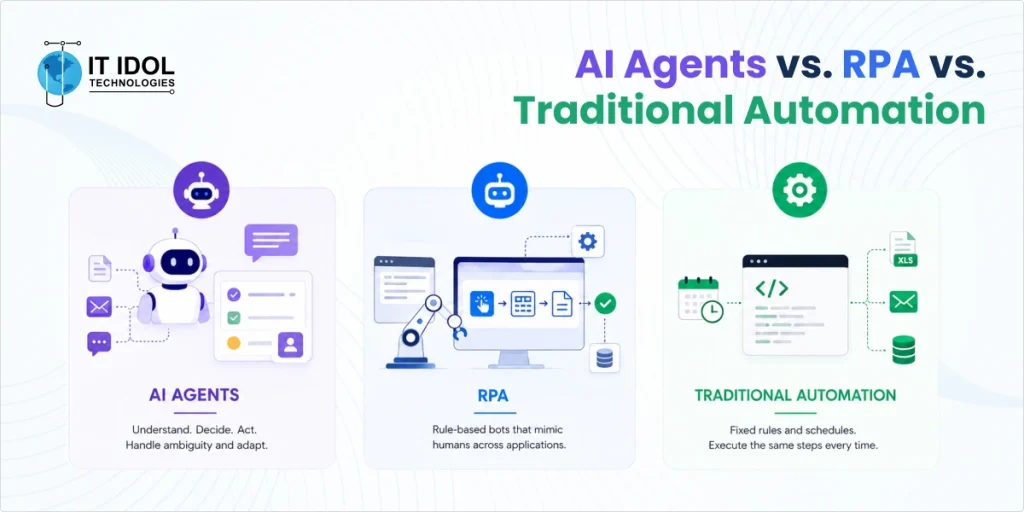
The real distinction isn’t about how “advanced” a tool sounds. It’s about one question: does the system need to make a judgment call, or does it just need to execute a fixed set of steps? Traditional automation and RPA both execute rules; they don’t interpret anything. AI agents are built to interpret input and decide what to do next, which is a fundamentally different capability with a different risk profile.For a broader technical explanation of how agents process inputs, reason, use tools, and take actions, see Google Cloud’s overview of agentic AI architecture
Traditional Automation: Rules Without Judgment
Traditional automation covers scripts, scheduled jobs, macros, and simple if-this-then-that logic. Think of a nightly job that pulls sales data into a report, an email that fires automatically when an order ships, or a spreadsheet macro that formats a file the same way every time. There’s no interpretation happening; the system does exactly what it was told, every time, and nothing more.
The strength here is predictability. If the input format never changes, traditional automation is cheap to build, easy to maintain, and rarely breaks. The weakness is equally clear: the moment an input arrives in an unexpected format, the process either fails outright or produces a wrong result silently, because there’s no logic in place to notice the deviation.
RPA: Rules at Scale, Still No Judgment
RPA bots operate at the interface level, clicking buttons, copying fields, and moving data between systems the same way a person would, but faster and without breaks.IBM provides a useful overview of how RPA combines software automation with UI interactions to perform repetitive tasks across enterprise applications. This matters most when systems don’t have APIs to talk to each other directly, which is common with older platforms in health care, banking, and manufacturing. RPA became popular precisely because it lets businesses connect legacy systems without rebuilding them.
The catch is that RPA is still following a fixed script; it just does it across a user interface instead of through code. If a vendor changes a button’s position or a field’s label, the bot breaks. And because each new process usually needs its own bot, organizations that adopt RPA broadly often end up maintaining a large, brittle fleet of bots that each need individual attention when something upstream changes. This is a real cost that’s frequently underestimated during initial rollout planning.
AI Agents: Judgment Layered on Top of Action
AI agents are built on language models capable of reading unstructured input an email, a support ticket, a scanned form, a chat message and deciding what to do about it. Instead of following a fixed script, an agent reasons through the situation: is this a billing question or a technical issue? Does this document look complete, or is something missing? Should this be escalated, or can it be resolved automatically?
This is the meaningful upgrade over RPA: agents can handle exceptions and ambiguity that would stop a rule-based bot cold. The trade-off is that agents introduce a small amount of non-determinism; they won’t always reach the same conclusion on a borderline case the way a fixed rule would. That’s exactly why agent-based systems need clear guardrails, defined escalation paths, and human review on higher-stakes decisions,Organizations evaluating AI systems can also refer to the NIST AI Risk Management Framework, which provides guidance for managing AI risks throughout the design, development, deployment, and evaluation lifecycle. rather than being left to run fully unsupervised on anything consequential.
Side-by-Side Comparison
Here’s how the three approaches stack up across the dimensions that actually matter for a buying decision:
Bots that mimic human clicks/keystrokes across screens and systems
Models that interpret input, reason, and choose actions dynamically
Handles unstructured data
No
Limited (screen scraping only)
Yes — text, email, PDFs, chat, images
Makes judgment calls
No
No
Yes, within defined guardrails
Adapts to exceptions
Breaks on deviation
Breaks on UI/format changes
Can reason through many exceptions
Maintenance overhead
Low, if rules stay stable
Rises sharply as bot count grows
Moderate — needs monitoring and guardrail tuning
Typical time to value
Fast (days to weeks)
Moderate (weeks to months)
Moderate to slower (needs testing for reliability)
Best failure mode
Fails loudly and predictably
Fails silently until someone checks output
Can fail confidently — needs verification checkpoints
When Traditional Automation Is Still the Right Call
Don’t let the hype around AI agents talk you out of the cheapest, most reliable option when it’s genuinely the right fit. Traditional automation makes sense whenever a process is high-volume, predictable, and unlikely to change a scheduled inventory report, an order confirmation email, a recurring data export. If the rules are stable and the inputs are consistent, adding an AI layer only adds cost and unpredictability without adding value.
• Good fit: fixed-format reports, scheduled notifications, simple data transfers between systems that already integrate cleanly
• Not a good fit: any process where input format varies, where a human currently has to “use judgment” even in a small way, or where exceptions are common
When RPA Makes Sense (and When It Becomes a Liability)
RPA earns its place when you’re stuck connecting systems that weren’t built to talk to each other a common reality in health care with older EHR platforms, in finance with legacy core banking systems, and in manufacturing with ERP tools that predate modern APIs. In these cases, RPA can deliver value quickly without the cost of replacing the underlying systems.
Where RPA becomes a liability is at scale. Each new process typically needs its own bot, and each bot needs monitoring, updating, and re-testing whenever the systems it touches change. Organizations that automated dozens of processes with RPA over several years often find themselves maintaining a fragile bot army that costs more in upkeep than it saves in labor a pattern worth checking for honestly before adding more bots rather than after.
When AI Agents Create Real ROI
AI agents make the most sense where a process is exception-heavy, involves unstructured input, or requires a judgment call that currently sits with a person. That includes triaging inbound customer messages by intent and urgency, reviewing flagged transactions for signs of fraud, summarizing clinical intake notes for a provider’s review, or replanning a delivery route when conditions change mid-transit.
It’s worth being direct about a common misconception: AI agents are not a wholesale replacement for RPA or traditional automation. In most real deployments, agents work best layered on top of, not instead of, the deterministic steps that must be exact, like posting a financial transaction or updating a regulated record. The agent handles the judgment call; a fixed, auditable process still handles the parts that need to be perfectly consistent every time.
Industry Snapshot: Where Each Approach Fits Today
The right mix depends heavily on the industry and the specific process. Here’s a general starting point across common sectors; treat this as a directional guide, since the right fit always depends on your specific systems and risk tolerance:
Handling customer queries that need judgment, not scripts
FinTech
Scheduled statements, batch transaction jobs
Moving data between core banking and reporting tools
Flagging unusual transactions for human fraud review
E-Commerce
Order confirmations, cart abandonment emails
Updating product listings across marketplaces
Personalizing responses to product questions at scale
Education
Enrollment confirmations, grade exports
Transferring records between student information systems
Reviewing application documents for completeness
Manufacturing
Scheduled maintenance alerts, batch reports
Pulling data from ERP into spreadsheets
Interpreting sensor anomalies to recommend next steps
SaaS
Usage reports, renewal reminders
Syncing billing data across tools without APIs
Triaging support tickets by intent and urgency
Logistics
Shipment status emails, scheduled manifests
Re-keying data between carrier and warehouse systems
Replanning routes when conditions change mid-transit
Startup
Basic notification and reporting workflows
Rarely worth the maintenance cost at small scale
Handling variable, judgment-heavy tasks with a small team
Common Mistakes When Choosing Between These Three
1. Calling RPA “AI” internally. This sets expectations the tool can’t meet and leads teams to expect judgment calls a rule-based bot was never built to make.
2. Deploying agents where the answer must be 100% deterministic every time, such as regulatory filings or exact financial postings, instead of keeping that logic rule-based and auditable.
3. Skipping human-in-the-loop review for agent decisions that carry real business or compliance risk, on the assumption that “AI” means “accurate.”
4. Underestimating the ongoing maintenance cost of a growing RPA bot fleet, which tends to rise faster than most initial business cases account for.
5. Trying to rip out working RPA processes and replace them with agents all at once, instead of a phased approach that tests agent reliability on lower-stakes processes first.
A Practical Decision Framework
Before choosing a layer, walk through these questions in order:
1. Is the input structured and consistent every time? If yes, traditional automation is likely sufficient.
2. Does the task require interpreting unstructured information or making a judgment call? If yes, traditional automation and RPA alone won’t be enough.
3. Is the regulatory or financial risk high enough that the outcome must be identical every time? If yes, keep that step rule-based, even if an agent handles the surrounding context.
4. Do you already have RPA bots handling this reliably? If so, the question is whether to augment them with an agent for exception handling, not necessarily to replace them.
5. What’s your tolerance for occasional error in exchange for handling ambiguity? Agents reduce manual judgment work but need monitoring and clear escalation paths, not a hands-off deployment.
How These Approaches Work Together
In practice, mature automation stacks rarely rely on just one of these. A typical pattern looks like this: traditional automation runs the stable, high-volume backbone; RPA bridges systems that don’t have direct integrations; and an AI agent sits at the point where judgment is actually needed, reading unstructured input, deciding how to route it, and handing off the deterministic parts to the rule-based systems underneath. The goal isn’t to pick a winner between the three. It’s to put each one where its strengths actually apply.
If your organization is currently choosing between these approaches for a specific process, it usually helps to map the process step by step and identify exactly where judgment enters the picture; that single point is often where the right architecture decision gets made.
Where to Go From Here
Choosing between AI agents, RPA, and traditional automation isn’t really about picking the most advanced technology; it’s about matching the tool to where judgment actually enters a process. Get that mapping right, and each layer does exactly the job it’s suited for, without adding unnecessary cost or risk.
If you’re weighing these options for a specific process whether it’s customer intake, transaction review, or connecting systems that don’t talk to each other IT IDOL Technologies works with teams across health care, retail, fintech, e-commerce, education, manufacturing, SaaS, logistics, and startups to map out which layer fits, and where custom software, AI development, or automation actually moves the needle. A short process walkthrough is usually enough to see where the real opportunity sits.
Not in the way the term is generally used. RPA follows fixed rules at the interface level; it doesn't interpret unstructured input or make judgment calls the way an AI agent does. Some RPA platforms now bundle AI features, like document extraction, but the core bot logic is still rule-based.
Rarely, and not all at once. Agents are strongest at handling exceptions and judgment calls, while RPA and traditional automation remain efficient for the deterministic, rule-based parts of a process. Most organizations end up combining them rather than fully replacing one with the other.
Initial RPA implementation is often cheaper for a single, well-defined process. The costs that catch organizations off guard tend to show up later, in ongoing bot maintenance as systems change. Agent-based systems can have a higher upfront build and testing cost but lower long-term maintenance if the process itself changes frequently.
Yes, especially for decisions with financial, legal, or compliance consequences. Agents should generally operate with defined guardrails and an escalation path to a human reviewer for borderline or high-stakes cases, rather than running fully unsupervised.
Traditional workflow automation executes a fixed sequence of steps with no interpretation. AI agents read input, reason about what it means, and decide what action to take next, which allows them to handle variation and exceptions that would break a traditional workflow.
Yes, for any process that's high-volume and consistently structured. It remains the cheapest and most reliable option when there's no real judgment call involved, and adding AI to a purely rule-based process usually adds cost without adding value.
If the process regularly involves unstructured input, exceptions, or a decision that currently requires a person to "think it through," that's a strong signal an agent is a better fit than a rule-based bot.
Industries with high volumes of unstructured input and frequent exceptions tend to see the clearest early value: customer support in retail and SaaS, document and intake review in health care and education, and transaction review in FinTech are common starting points.
The main risk is treating an agent's output as final without review in a context where the outcome must be identical and auditable every time. In regulated processes, it's generally safer to have the agent assist with interpretation while keeping the actual compliance-critical step rule-based and reviewed.
Traditional automation is typically the fastest to deploy, often days to a few weeks. RPA implementations usually take weeks to a few months depending on the number of systems involved. AI agent deployments vary the most, since reliability testing and guardrail design take real time to get right before a full rollout.
Deval Rathod
Founder & CEO
|
Deval Rathod is the Founder and CEO of IT IDOL Technologies, a custom software development company. With over a decade of experience in software engineering, solution architecture, and technology leadership, she has worked across custom software development, enterprise applications, AI & ML, and digital transformation. Her expertise includes guiding technology teams, designing scalable software solutions, and helping businesses evaluate and implement emerging technologies. She contributes insights on software engineering, artificial intelligence, enterprise technology, and digital transformation.