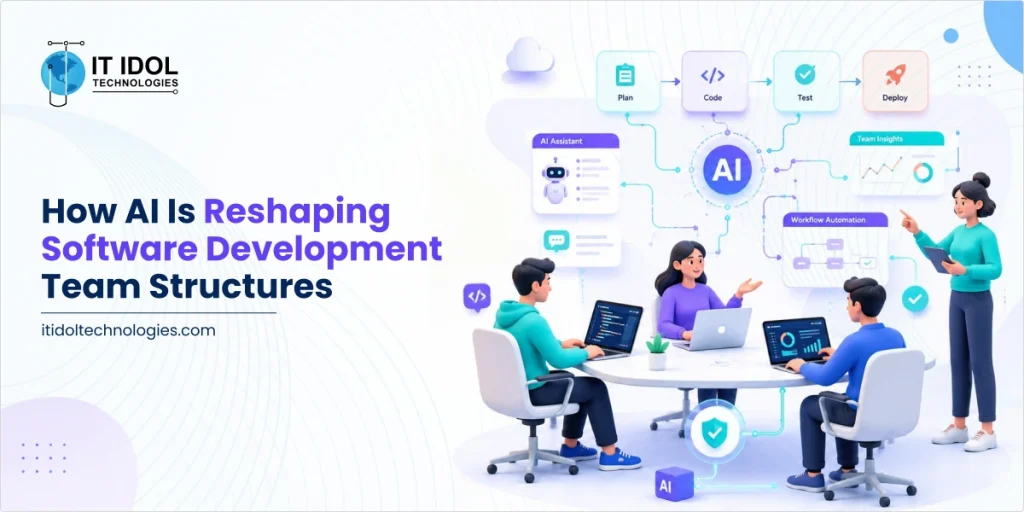
AI is not simply accelerating software development; it is fundamentally redistributing how work is owned, executed, and scaled across teams. The most important shift is not productivity per developer, but the collapse of traditional role boundaries and the emergence of smaller, more outcome-oriented units.
Organizations that treat AI as a tooling upgrade will see incremental gains; those that redesign team structures around AI-native workflows will see nonlinear improvements in speed, cost, and decision quality.
Why Traditional Software Team Structures Are Breaking Down
Conventional software teams were designed around specialization and sequential workflows. Product managers define, designers conceptualize, engineers build, QA validates, and DevOps deploys. This structure assumed that each stage required distinct human expertise and time-intensive handoffs. AI disrupts that assumption by compressing the effort required at each stage and enabling a single individual to operate across multiple layers of the stack.
In practice, AI-assisted development reduces the marginal cost of execution. A developer using AI copilots can generate production-ready code, write tests, and even scaffold infrastructure within hours instead of days. Similarly, product managers can prototype features using AI tools without waiting for engineering cycles. This breaks the logic of large, functionally segmented teams.
The result is a structural tension: organizations built for coordination overhead are now operating in an environment where coordination is the bottleneck. Teams that fail to adapt often experience paradoxical slowdowns despite faster tools because their processes still assume scarcity of execution capacity.
Takeaway: AI eliminates the need for rigid functional silos; organizations that retain them will experience diminishing returns despite adopting advanced tools.
What Replaces Functional Silos: The Rise of AI-Native Pod Structures
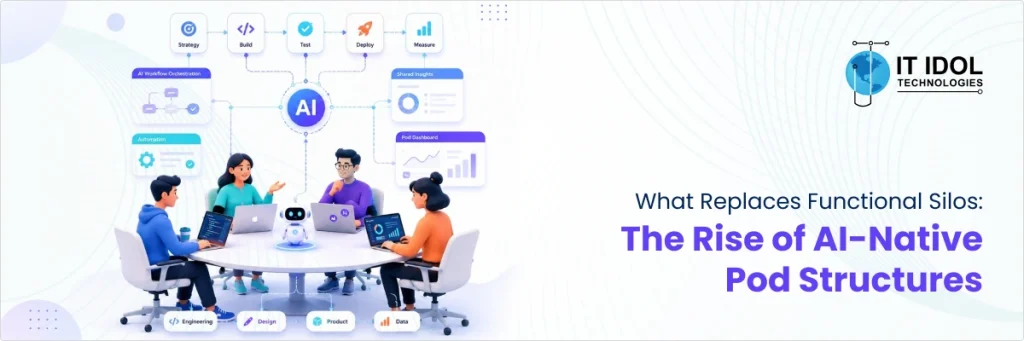
AI-native organizations are shifting toward small, autonomous “pods” that own outcomes end-to-end. These pods typically consist of 2–5 individuals who collectively cover product thinking, design, engineering, and deployment, with AI augmenting their capabilities across all layers.
The defining characteristic of these pods is not cross-functionality alone, but decision ownership. Instead of handing off work between departments, pods operate as self-contained units responsible for delivering measurable business outcomes such as a feature release, a growth experiment, or a system optimization.
In execution, this model works because AI reduces the dependency on deep specialization for routine tasks. For example, a backend engineer can use AI to generate frontend components, while a designer can leverage AI to create interactive prototypes. This does not eliminate expertise, but it changes how it is applied. Experts focus on high-leverage decisions rather than repetitive execution.
However, this structure requires a shift in leadership mindset. Managers must move from resource allocation to outcome orchestration, ensuring that pods are aligned with strategic priorities without micromanaging their execution.
Takeaway: High-performing teams are evolving into small, AI-augmented pods that own outcomes end-to-end, reducing coordination overhead and increasing execution speed.
How Roles Are Evolving (Not Disappearing)
AI is not removing roles; it is redefining them around judgment, context, and oversight rather than execution. The most visible change is the elevation of “decision density” within each role: fewer people are required, but each individual is responsible for more critical decisions.
Engineers, for instance, are shifting from writing code line-by-line to reviewing, validating, and orchestrating AI-generated outputs. Their value lies in system design, architectural integrity, and risk management rather than raw coding throughput. Similarly, product managers are moving closer to execution, using AI to validate ideas through rapid prototyping and experimentation.
A new category of roles is also emerging: AI orchestrators or “model operators” who specialize in designing prompts, workflows, and guardrails for AI systems. These roles bridge the gap between technical and business functions, ensuring that AI outputs are aligned with organizational goals.
At the same time, quality assurance is becoming more integrated into the development process. AI can generate tests and identify edge cases, but human oversight remains critical for validating business logic and user experience.
Takeaway: Roles are becoming more strategic and decision-focused, with AI handling execution while humans provide context, judgment, and accountability.
What Happens to Middle Management and Coordination Layers
One of the most significant and often overlooked impacts of AI is the reduction of coordination overhead. In traditional teams, middle management plays a critical role in aligning functions, managing dependencies, and ensuring delivery timelines. AI reduces the need for many of these coordination tasks by enabling faster, more autonomous execution at the team level.
This does not mean middle management becomes obsolete, but its function changes. Instead of managing tasks and timelines, managers must focus on strategic alignment, capability building, and risk mitigation. They become enablers rather than controllers.
In practice, organizations that fail to redefine middle management often experience resistance to AI adoption. Managers may perceive AI as a threat to their role, leading to underutilization of tools or unnecessary process complexity. Conversely, organizations that reposition managers as strategic leaders see smoother transitions and better outcomes.
A common failure pattern is maintaining legacy approval processes in an AI-accelerated environment. When execution cycles shrink from weeks to days, multi-layered approvals become a bottleneck that negates the benefits of AI.
Takeaway: AI reduces the need for coordination-heavy management, shifting leadership roles toward strategy, enablement, and risk governance.
How AI Changes Hiring and Talent Strategy
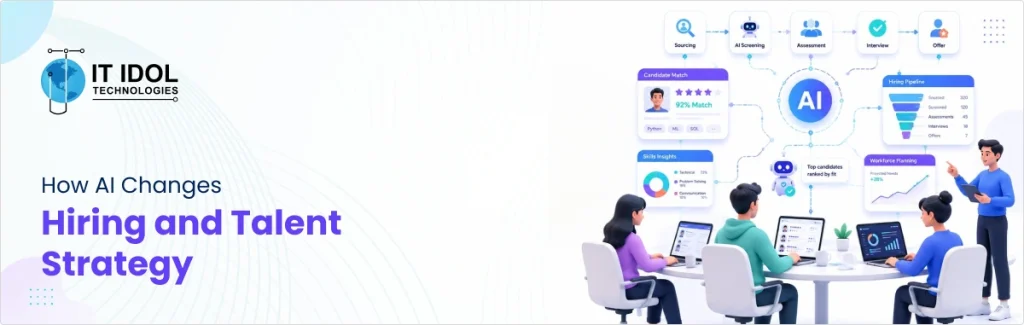
AI-driven team structures require a fundamentally different approach to hiring. Instead of optimizing for narrow specialization, organizations must prioritize adaptability, systems thinking, and the ability to work effectively with AI tools.
The most valuable individuals are not necessarily the most experienced in a specific domain, but those who can operate across domains and leverage AI to amplify their impact. This shifts hiring criteria toward problem-solving ability, learning agility, and comfort with ambiguity.
In execution, this often leads to smaller teams with higher leverage per individual. A team of five AI-augmented developers can outperform a traditional team of fifteen, provided they are structured effectively and aligned with clear objectives.
However, this also introduces new risks. Over-reliance on AI can lead to skill degradation if teams do not maintain a strong foundation in core principles. Organizations must balance efficiency gains with ongoing skill development to avoid long-term capability gaps.
Takeaway: Hiring strategies must shift from specialization to adaptability, prioritizing individuals who can leverage AI to operate across multiple domains.
What New Risks and Failure Points Emerge
AI-enabled team structures introduce a new set of risks that are often underestimated. The most critical is the illusion of productivity; teams may appear to move faster because they are generating more output, but without proper validation, this can lead to increased technical debt and system fragility.
Another key risk is loss of shared understanding. When AI handles large portions of execution, team members may lose visibility into how systems are built, making it harder to debug issues or maintain code over time. This is particularly problematic in complex systems where implicit knowledge plays a critical role.
Security and compliance risks also increase, as AI-generated code may introduce vulnerabilities or fail to meet regulatory requirements. Organizations must implement robust review processes and guardrails to mitigate these risks.
Finally, there is a cultural risk: teams that over-index on AI may undervalue human expertise, leading to poor decision-making in situations where context and judgment are critical.
Takeaway: AI increases execution speed but also amplifies risks; organizations must invest in validation, governance, and knowledge retention to sustain long-term performance.
How to Transition from Traditional Teams to AI-Native Structures
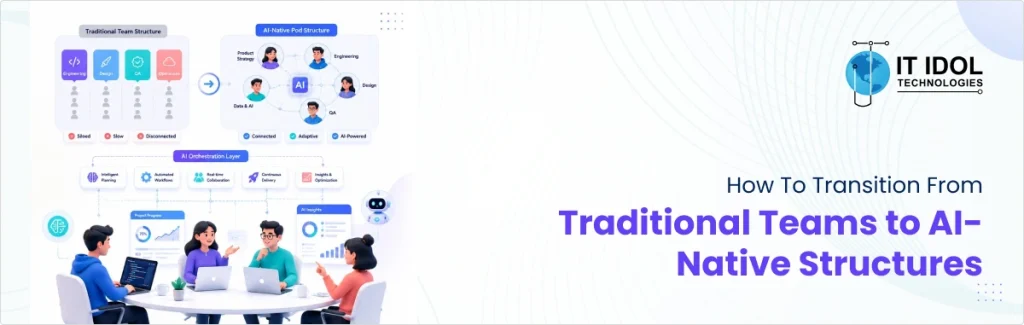
Transitioning to AI-native team structures is not a one-time transformation but an iterative process. Organizations that succeed typically start with pilot teams, experimenting with AI tools and pod-based structures in controlled environments before scaling across the organization.
A practical approach involves identifying high-impact use cases where AI can deliver immediate value, such as reducing development cycle time or improving feature experimentation. These use cases serve as proof points that build confidence and drive broader adoption.
Leadership plays a critical role in this transition. Clear communication of objectives, alignment on success metrics, and investment in training are essential to ensure that teams can effectively leverage AI. Without this, adoption often remains superficial, with tools being used inconsistently or ineffectively.
Importantly, organizations must be willing to redesign processes, not just layer AI on top of existing workflows. This includes simplifying approval mechanisms, redefining roles, and aligning incentives with desired outcomes.
Takeaway: Successful transformation requires iterative experimentation, strong leadership alignment, and a willingness to redesign processes around AI capabilities.
What Actually Drives Success in AI-Reshaped Teams
The organizations that benefit most from AI are not those with the most advanced tools, but those that fundamentally rethink how teams are structured and how work is executed. Success is driven by three factors: reducing coordination overhead, increasing decision ownership at the team level, and maintaining strong governance to manage risks.
AI shifts the bottleneck in software development from execution to decision-making. Teams that can make faster, better decisions while leveraging AI for execution will outperform those that remain constrained by traditional structures.
In practice, this means building smaller, more autonomous teams, redefining roles around judgment and context, and investing in systems that ensure quality and alignment. It also requires a cultural shift toward experimentation, continuous learning, and accountability.
The future of software development is not about replacing humans with AI, but about designing organizations where humans and AI operate as an integrated system. Those who understand and act on this will not only move faster but will build more resilient, adaptable, and competitive organizations.
Final Takeaway: AI does not just change how software is built it changes who builds it, how teams are structured, and what capabilities define competitive advantage.
FAQ’s
1. How is AI changing software development team structures?
AI is shifting software teams from task-based execution models toward more strategic and collaborative operating structures. As repetitive development work becomes automated, teams are increasingly focusing on architecture, validation, workflow management, and product innovation.
2. Why are enterprises restructuring development teams around AI capabilities?
Organizations are restructuring teams to improve productivity, accelerate delivery cycles, and optimize operational efficiency with AI-assisted workflows. This shift allows businesses to reduce coordination overhead while enabling smaller teams to manage larger development outputs.
3. How does AI impact the roles of software engineers?
AI reduces the amount of time engineers spend on repetitive coding, debugging, testing, and documentation tasks. Developers are increasingly expected to focus on system design, decision-making, governance, and validating AI-generated outputs.
4. Will AI reduce the size of software development teams?
AI may reduce dependency on large execution-heavy teams for certain workflows, but enterprises still require skilled engineers for oversight, architecture, security, and business-critical decisions. The structure of teams is changing more significantly than the overall demand for technical expertise.
5. How are cross-functional teams evolving with AI adoption?
AI is enabling closer collaboration between engineering, QA, DevOps, product, and operations teams by automating coordination tasks and streamlining workflows. This is leading to more integrated and outcome-focused team structures across enterprises.
6. What new roles are emerging in AI-driven software teams?
Organizations are increasingly introducing roles focused on AI governance, workflow orchestration, prompt engineering, AI operations, automation strategy, and model oversight. These roles help manage the integration of AI systems into enterprise development environments.
7. How does AI improve productivity within development teams?
AI improves productivity by accelerating coding assistance, automated testing, documentation generation, infrastructure management, and issue resolution. Teams can deliver software faster while spending more time on strategic and high-value engineering activities.