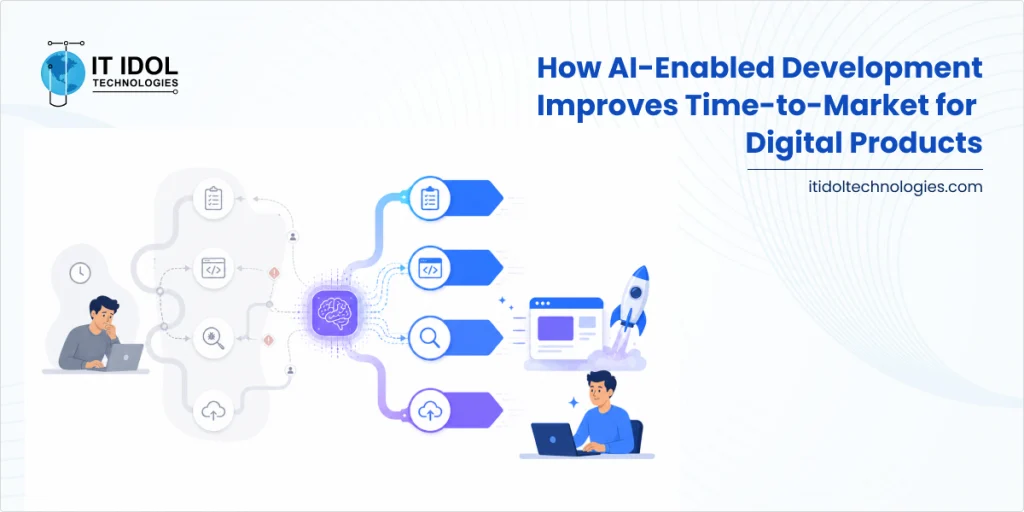
Time-to-market is not primarily a function of team size or engineering velocity; it is a function of decision latency.
AI-enabled development compresses that latency across the entire product lifecycle, from ideation to deployment, by reducing the cost of exploration, accelerating feedback loops, and automating execution layers that traditionally slowed teams down.
Why Time-to-Market Is Fundamentally a Decision Problem
Faster delivery is often misdiagnosed as a tooling issue when it is actually a coordination and decision-making bottleneck. AI changes time-to-market because it reduces the friction of arriving at validated decisions.
In traditional development environments, each stage requires gathering requirements, design, development, and QA, which introduces delays caused by human interpretation, rework, and dependency management. Teams wait for clarity before acting.
AI reverses this pattern by enabling parallel exploration. Product managers can simulate feature trade-offs, engineers can generate working prototypes instantly, and QA teams can preemptively identify edge cases through AI-generated test scenarios.
In practice, this means decisions that once required meetings, documentation cycles, and cross-functional alignment can now be validated in hours. A feature idea can move from concept to interactive prototype in a single working session, allowing stakeholders to react to something tangible rather than abstract specifications.
The Takeaway: AI improves time-to-market not by making teams work faster, but by making decisions cheaper, earlier, and more reversible.
How AI Compresses the Product Discovery Phase
The discovery phase is traditionally where timelines expand unpredictably. Market research, user interviews, competitive analysis, and feature prioritization create ambiguity that delays execution. AI reduces this ambiguity by structuring and accelerating insight generation.
AI systems can synthesize large volumes of qualitative and quantitative data, customer feedback, support tickets, and usage analytics into actionable patterns. Instead of manually interpreting fragmented signals, product teams can identify high-impact opportunities with greater confidence and speed.
More importantly, AI enables rapid hypothesis testing. Teams can generate multiple product concepts, simulate user journeys, and evaluate potential outcomes before committing engineering resources.
This shifts discovery from a linear process to an iterative loop where ideas are continuously refined based on simulated and real-world feedback.
A common implementation pattern is “AI-assisted product framing,” where initial product requirements are co-developed with AI tools that challenge assumptions, highlight gaps, and propose alternative approaches. This reduces the risk of building the wrong product, a major hidden contributor to delayed time-to-market.
The Takeaway: AI shortens discovery timelines by converting unstructured inputs into structured decisions and enabling rapid hypothesis validation before development begins.
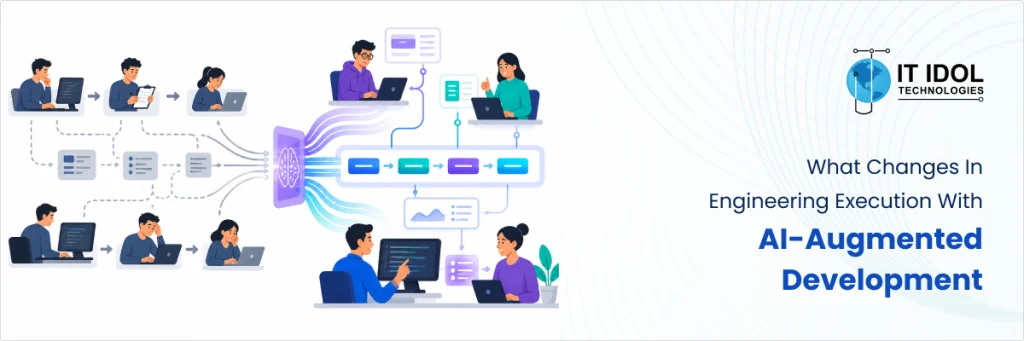
What Changes in Engineering Execution with AI-Augmented Development
The most visible impact of AI is in engineering, but the real advantage is not code generation; it is execution fluidity.
AI-assisted coding tools reduce the time required to implement features, but more importantly, they reduce the cognitive overhead of switching between tasks. Engineers spend less time on boilerplate, debugging repetitive issues, and navigating unfamiliar codebases. This allows them to focus on architectural decisions and complex problem-solving.
In real-world teams, this manifests as a shift from “ticket completion” to “problem resolution.” Engineers can iterate faster, explore alternative implementations, and refactor code continuously without incurring significant time penalties. The result is not just faster development, but cleaner, more adaptable systems.
However, this acceleration introduces a new constraint: quality control. AI-generated code can introduce subtle inconsistencies or security vulnerabilities if not governed properly. High-performing teams address this by embedding AI-aware review processes, where human oversight focuses on validating intent and system integrity rather than line-by-line code inspection.
The Takeaway: AI accelerates engineering by reducing execution friction, but its real value emerges when teams redesign workflows to prioritize outcomes over tasks.
How AI Transforms Testing, QA, and Release Cycles
Testing and QA are often the silent bottlenecks in time-to-market. Even when development is fast, release cycles slow down due to manual testing, incomplete coverage, and late-stage defect discovery.
AI changes this dynamic by enabling continuous, intelligent testing. Test cases can be generated automatically based on code changes, user behaviour patterns, and historical defect data. This increases coverage without increasing manual effort.
More importantly, AI enables predictive QA. Instead of reacting to bugs after they occur, teams can identify high-risk areas of the codebase before deployment. This shifts QA from a reactive function to a proactive one.
In deployment pipelines, AI can optimize release strategies by analyzing system performance, user impact, and rollback risks in real time. This allows teams to move from rigid release schedules to adaptive deployment models where features are rolled out based on readiness rather than arbitrary timelines.
The Takeaway: AI reduces time-to-market by making quality assurance continuous and predictive, eliminating the traditional bottleneck between development and release.
Where AI Creates Bottlenecks Instead of Removing Them
AI does not automatically improve time-to-market. In many organizations, it introduces new forms of friction that offset its benefits.
One common issue is over-reliance on AI without process adaptation. Teams adopt AI tools but continue operating with legacy workflows, leading to mismatches between speed and governance. For example, faster code generation without corresponding improvements in review processes can create backlogs in QA and security validation.
Another challenge is context fragmentation. AI tools are only as effective as the context they receive. In organizations with poor documentation, unclear requirements, or fragmented systems, AI outputs can become inconsistent or misleading. This increases rework rather than reducing it.
There is also a skill gap. AI-augmented development requires engineers and product managers to think differently, focusing on problem framing, prompt design, and system-level thinking. Without this shift, teams may use AI superficially, gaining marginal speed improvements without meaningful impact on time-to-market.
The Takeaway: AI introduces new bottlenecks when organizations fail to align processes, context, and skills with its capabilities.
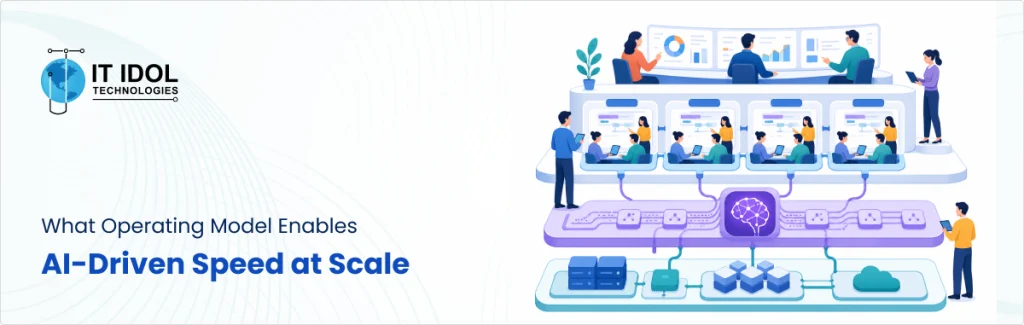
What Operating Model Enables AI-Driven Speed at Scale
The organizations that consistently achieve faster time-to-market with AI do not treat it as a tool; they embed it into their operating model.
A key characteristic of these organizations is “continuous delivery thinking.” Instead of planning large releases, they structure work into small, independently deployable units. AI supports this by enabling rapid iteration and validation at each stage.
Another critical factor is cross-functional integration. AI reduces the need for strict handoffs between teams. Product, design, engineering, and QA can collaborate in real time using shared AI-driven artifacts, prototypes, simulations, and test scenarios. This eliminates delays caused by sequential workflows.
Governance also evolves. Instead of rigid approval processes, organizations implement guardrails, automated checks, policy-driven constraints, and real-time monitoring that allow teams to move quickly without compromising quality or compliance.
In practice, this operating model requires investment in infrastructure, data quality, and team training. Without these foundations, AI adoption remains fragmented and fails to deliver systemic speed improvements.
The Takeaway: Sustainable time-to-market gains from AI require an operating model built around continuous delivery, cross-functional collaboration, and automated governance.
How to Measure the Real Impact of AI on Time-to-Market
Measuring time-to-market improvement is more complex than tracking delivery speed. AI changes multiple variables simultaneously, making traditional metrics insufficient.
Effective measurement focuses on cycle time reduction across the entire product lifecycle. This includes time from idea to prototype, prototype to production, and production to user feedback. AI should reduce each of these intervals.
Another critical metric is decision throughput, the number of validated decisions a team can make within a given timeframe. Higher decision throughput indicates that AI is effectively reducing uncertainty and enabling faster progress.
Quality metrics must also be considered. Faster delivery is only valuable if it does not increase defect rates, technical debt, or customer dissatisfaction. AI-driven teams often track “defect escape rate” and “post-release rework” to ensure that speed does not compromise quality.
Finally, organizations should evaluate adaptability, the ability to respond to new information or changing requirements. AI should enable faster pivots, not just faster execution of predefined plans.
The Takeaway: The true impact of AI on time-to-market is reflected in reduced cycle times, increased decision throughput, and sustained quality under faster delivery conditions.
Conclusion
AI-enabled development improves time-to-market when it is used to compress decision cycles, not just execution timelines. The organizations that benefit most are those that rethink how products are built from discovery to deployment, rather than simply adding AI tools to existing workflows.
In practice, success depends on three factors. First, the ability to structure problems clearly so that AI can generate meaningful outputs. Second, the discipline to integrate AI into end-to-end workflows, ensuring that speed gains in one area do not create bottlenecks in another. Third, the commitment to continuous learning, as teams adapt their skills and processes to fully leverage AI capabilities.
The result is not just faster delivery, but a fundamentally different approach to building digital products, one where iteration is continuous, decisions are data-driven, and time-to-market becomes a strategic advantage rather than a constraint.
The Final Takeaway: AI does not eliminate the complexity of product development; it redistributes it. Organizations that understand and manage this redistribution are the ones that achieve sustained, measurable improvements in time-to-market.
AI-enabled development refers to the integration of artificial intelligence across the software development lifecycle to automate coding, testing, design, and deployment tasks. It includes tools for code generation, predictive analytics, automated QA, and intelligent DevOps, enabling teams to accelerate delivery while maintaining quality.
AI shortens time-to-market by automating repetitive tasks (such as code generation and testing), improving decision-making through predictive insights, and enabling parallel workflows. This reduces development cycles, minimizes rework, and accelerates release timelines without proportionally increasing team size.
AI delivers the highest impact in requirements analysis (through pattern recognition), coding (via generative AI), testing (automated test creation and execution), and deployment (predictive DevOps and anomaly detection). The cumulative effect across these stages significantly compresses delivery timelines.
Yes. AI improves quality by identifying defects earlier through automated testing, static code analysis, and anomaly detection. It also ensures consistency in code standards and reduces human error, allowing faster delivery without compromising reliability or performance.
Generative AI accelerates development by producing code snippets, documentation, and even full modules based on prompts. This reduces manual effort for developers, speeds up prototyping, and enables faster iteration cycles, especially in early-stage product development.
AI analyzes large datasets, including user behaviour, system performance, and historical development metrics, to provide actionable insights. This helps product and engineering teams make faster, data-driven decisions on features, prioritization, and release strategies.
Faster time-to-market allows businesses to capture market opportunities earlier, respond quickly to customer demands, and gain a competitive advantage. It also reduces development costs, improves ROI, and increases the ability to iterate based on real user feedback.
Key challenges include integration with legacy systems, data quality issues, model governance, and skill gaps within teams. Organizations must also establish clear AI strategies, ensure ethical use, and implement robust monitoring to fully realize time-to-market benefits.
Deval Rathod
Founder & CEO
|
Deval Rathod is the Founder and CEO of IT IDOL Technologies, a custom software development company. With over a decade of experience in software engineering, solution architecture, and technology leadership, she has worked across custom software development, enterprise applications, AI & ML, and digital transformation. Her expertise includes guiding technology teams, designing scalable software solutions, and helping businesses evaluate and implement emerging technologies. She contributes insights on software engineering, artificial intelligence, enterprise technology, and digital transformation.