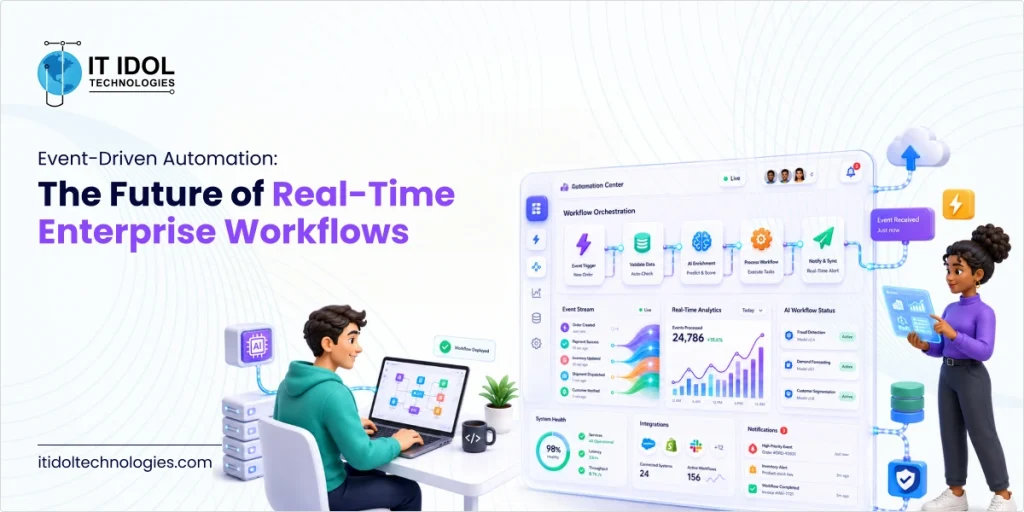
There is a version of this conversation that happens in every large organization at some point in the modernization journey. A senior technical leader walks into a room with a slide deck showing what the architecture could look like: decoupled services, real-time event streams, automated workflows firing the moment something meaningful happens in the business.
The business case almost writes itself: faster response times, fewer manual handoffs, processes that run the moment a trigger fires rather than waiting for the next scheduled job. The room nods. Budget gets approved.
Then reality arrives.
Event-driven automation is genuinely powerful enough that the enterprises getting it right are building operational capabilities their competitors cannot match. But the industry conversation around it has become dangerously optimistic.
Vendors sell decoupling as a destination rather than an ongoing discipline. Architects present event streaming as the obvious replacement for batch processing without confronting the cost of operating at scale. Leaders approve transformation programs without understanding that the hardest problems in event-driven systems are not technical; they are organizational and procedural.
The result is that most enterprises end up with a fragmented collection of event-driven components that create more coordination overhead than the batch jobs they replaced. At the same time, the teams that built them are too deep in operational firefighting to step back and ask why.
The real question event-driven automation forces is not “should we adopt this pattern?” Most enterprises at sufficient scale genuinely should. The real question is far more uncomfortable: “Have we built the organizational conditions in which this pattern can actually function?” The answer, for most organizations, is: not yet.
Real-Time Is Not the Goal. Appropriate Latency Is.
The most persistent and costly assumption in enterprise automation programs is that real-time processing is inherently superior to batch. It isn’t. It’s faster, and for specific workflows, that speed has direct business value. But speed carries a tax, and most organizations are paying it without fully accounting for the bill.
The most common mistake organizations make when adopting event-driven approaches is assuming that real-time is always better. The moment teams see event-driven automation delivering value in one domain, there is organizational pressure to apply it everywhere.
Inventory updates, financial reconciliation, compliance reporting, HR record changes, procurement approvals, all get swept into the real-time mandate without any honest analysis of whether the latency reduction creates measurable business value or just operational complexity.
Here is the underlying reality: real-time systems introduce continuous operational responsibility. They require infrastructure that is always running, always consuming resources, always generating costs. They introduce complexity around event ordering, late-arriving data, and correctness guarantees that batch systems simply do not have to handle.
When a batch job fails, you know it failed. When an event is lost, delayed, or processed out of sequence in a distributed stream, tracking down the failure requires dedicated observability infrastructure that most enterprises have not built before they needed it. Debugging asynchronous event flows is materially harder than debugging synchronous request-response systems, and the complexity scales non-linearly with the number of services involved.
A financial institution doing nightly reconciliation across transaction records from multiple systems does not benefit from real-time event processing. It benefits from reliable, auditable batch processing with exactly-once semantics and clear failure recovery. Forcing that workflow into an event-driven model adds infrastructure overhead, introduces ordering complexity, and buys nothing in return. Conversely, that same institution’s fraud detection system has a latency requirement measured in milliseconds, and batch processing would be operationally absurd.
The decision framework that actually works in practice is to define the latency threshold at which a business outcome degrades, not the latency threshold that is technically achievable. If a 30-second delay in processing a customer order creates a material customer experience problem, real-time automation is justified.
If a four-hour delay in generating a compliance report creates no operational risk, batch remains the right tool. A healthier strategy is to treat batch processing as the default and justify streaming only when latency creates measurable business value. That inversion of the default rather than the vendor-driven assumption that real-time is always modern and batch is always legacy is where most enterprises recover substantial engineering capacity they had been consuming on complexity that delivered nothing.
The Architecture Is the Easy Part. The Contracts Are Where Teams Fail.
When an event-driven system breaks down in a mature enterprise and it will the failure is rarely in the event broker. Kafka, AWS EventBridge, Google Cloud Pub/Sub: these are stable, well-engineered platforms. The failure is in the event schema. Specifically, what happens when one team changes an event schema without coordinating with the twelve downstream services consuming it?
This is the event sprawl problem, and it is the primary reason large-scale event-driven automation programs lose coherence as they grow. Without clear standards for event definition, naming, and schema evolution, event sprawl leads to chaotic, unmanageable systems with data inconsistencies and integration challenges. It also destroys team velocity.
When any service can publish any event structure and any consumer silently adjusts or silently breaks, the shared understanding that makes distributed systems workable disintegrates. Engineers start treating every upstream event as a trust problem rather than a reliable contract.
The organizations that have built durable event-driven systems, ING Bank, Netflix, Unilever, companies large enough to have felt this problem at scale, have invested heavily in schema governance before they needed it. ING Bank’s adoption of schema registries to manage evolution across thousands of event types found that enforcing backward compatibility was essential to keeping their payments platform stable across multiple countries.
That is not a technical insight. It is an organizational insight: the event schema is a contract between teams, and like any contract, it requires formal management, versioning, and enforcement.
What governance of event schemas actually looks like in practice is unglamorous. It is a centralized event catalog that every team is required to publish to before shipping. It is AsyncAPI documentation as a mandatory artifact, not an optional afterthought.
It is a review process with real authority to reject schema changes that break backward compatibility. And it is senior engineering leadership willing to slow down feature delivery to maintain schema discipline, which is where most organizations fail not because they lack the tools, but because the short-term pressure to ship features consistently overwhelms the long-term cost of schema debt.
Teams that skip this layer typically discover its importance six to eighteen months into scaling, when the event mesh has grown complex enough that no single engineer understands the end-to-end flow of any given business transaction.
At that point, rebuilding governance on top of an ungoverned system is an order of magnitude harder than building it first. The lesson is not new, but it is reliably ignored: robust event governance, including a centralized event catalog and clear ownership, must be established from the start. It does not get easier once the system is running.
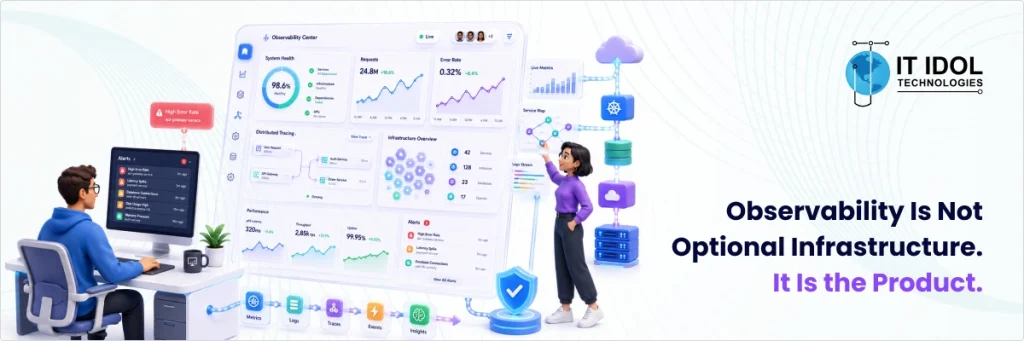
Observability Is Not Optional Infrastructure. It Is the Product.
There is a category of enterprise decisions that looks like a cost optimization until the moment it becomes an outage. Deferring observability investment in an event-driven system is that decision.
In a synchronous request-response system, a bug typically has a clean stack trace. The call fails, the failure surfaces, and the location of the problem is usually obvious. In an event-driven system, a business transaction may traverse dozens of events across six or eight services before it completes or fails silently.
Troubleshooting a single business transaction in an event-driven system may span dozens of events traversing multiple services, requiring dedicated tracing and observability infrastructure to achieve any visibility at all.
Without that infrastructure, debugging becomes an archaeological exercise: reconstructing what happened by correlating timestamps across service logs, hoping that correlation IDs were correctly propagated, and accepting that the answer may not be recoverable.
This is not a theoretical risk. It is a regular operational experience for engineering teams running event-driven systems without distributed tracing. The consequences extend beyond engineering pain. When a business process fails silently when an event is published but never consumed, when a consumer processes an event incorrectly but returns no error, when a dead-letter queue fills up without alerting anyone, the business impact can accumulate for hours or days before anyone notices.
In financial services, that latency in failure detection has regulatory implications. In e-commerce, it translates directly into unfulfilled orders and a degraded customer experience. In healthcare operations, it can affect patient-facing workflows with real consequences.
The operational investment required is specific: distributed tracing instrumented across every service in the event chain, consumer lag monitoring on every subscription, dead-letter queue alerting configured before any service goes live, and schema validation at the consumer boundary so malformed events are caught immediately rather than propagating failure downstream.
Platforms like Confluent Control Center and observability tools like Datadog and New Relic have expanded significantly to cover Kafka and EventBridge-based systems, making this infrastructure more accessible than it was three years ago. Accessible, however, does not mean automatic. It still requires deliberate investment and engineering discipline to instrument correctly.
The framing that works for getting this investment approved is straightforward: observability in an event-driven system is not overhead. It is the mechanism by which business process reliability is managed. Without it, the system is a black box, and no executive should accept a black box running core business workflows.
When “Decoupled” Becomes “Ungoverned”: The Organizational Failure Mode
Event-driven architecture’s most celebrated property is loose coupling, the ability for services to operate independently, evolve separately, and scale without requiring synchronized change across teams. This is real, and it is genuinely valuable. It is also the property that, misunderstood, creates the most expensive problems at enterprise scale.
Loose coupling between services is an architectural property. It is not a management property. The moment it is interpreted as “teams can do whatever they want without coordination,” the architecture’s benefits invert. Services start publishing events that duplicate functionality already covered elsewhere. Event naming conventions drift.
Multiple teams build separate consumers for what should be shared infrastructure. The event mesh, which was designed to reduce coupling, becomes a dependency tangle only when the dependencies are implicit rather than explicit, making them far harder to reason about.
Event sprawl, the uncontrolled proliferation of events, leads to chaotic, unmanageable systems in large organizations that interpret architectural autonomy as organizational autonomy. The irony is that the larger the organization, the more discipline the event-driven model requires, not less.
At a small scale, with two or three teams and a handful of services, loose coupling genuinely buys you independence. At enterprise scale, with dozens of teams and hundreds of event types, the coordination overhead of maintaining event contracts across organizational boundaries requires formal governance that looks, in many ways, like the centralized integration it was meant to replace.
This is where the organizational design question becomes as important as the architectural one. EDA requires a significant cultural shift and organizational structures that may need to evolve to support product-centric teams owning specific business capabilities and event streams.
In practice, that means teams need clear ownership of the events they publish, not just the services they run. It means event streams need product owners, not just service owners. And it means the engineering culture needs to treat event schema changes with the same seriousness as API contract changes, because that is exactly what they are.
The governance model that actually scales in enterprises is one where the event catalog is a first-class product artifact, schema evolution goes through a review process with real teeth, and ownership boundaries are enforced at the organizational level before they become architectural emergencies.
Gartner’s emerging Business Orchestration and Automation Technologies (BOAT) model reflects exactly this consolidation pressure. The market is recognizing that distributed event-driven systems require centralized governance layers to remain coherent as they scale.
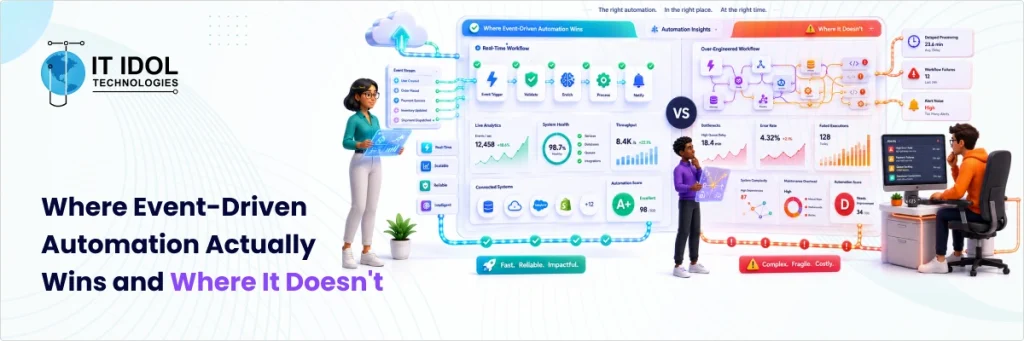
Where Event-Driven Automation Actually Wins and Where It Doesn’t
The business cases where event-driven automation delivers unambiguous value share a specific set of characteristics: high event volume, time-sensitive response requirements, multiple independent consumers needing the same event signal, and workloads that naturally decompose into discrete, stateless actions.
Fraud detection, order fulfillment orchestration, real-time inventory adjustments, infrastructure monitoring and automated remediation, customer behavior-triggered personalization, these are architecturally well-suited to event-driven patterns, and the organizations that have built them this way have measurable operational advantages.
MIT Technology Review’s analysis of SAP’s 2025 research on EDA in enterprise environments highlights that retailers using event-driven architecture for inventory management and omnichannel experiences, manufacturers monitoring production lines for supply chain visibility, and financial institutions detecting fraud instantaneously are all realizing tangible operational value.
The pattern in these cases is consistent: a business condition changes, multiple systems need to respond immediately, and the response logic for each system is independent enough that coupling them synchronously would create brittleness rather than reliability.
The cases where event-driven automation routinely underperforms expectations are equally consistent. Workflows with strong sequential dependencies, where step B genuinely cannot begin until step A has fully completed and been validated, are architecturally mismatched to eventual consistency.
Processes with complex compensating transaction requirements, where a downstream failure needs to cleanly reverse upstream state changes, require careful orchestration that event choreography makes significantly harder to reason about.
Reports, aggregations, and workflows where the business requires a guaranteed, auditable snapshot of state at a specific point in time are frequently better served by batch processing with strong consistency guarantees than by attempting to derive correct state from a potentially incomplete or reordered event stream.
For systems that are small, with a single team and few consumers, event-driven architecture simply pays a complexity tax for benefits that won’t materialize. The decoupling advantage is proportional to the number of independent consumers and the organizational independence of the teams managing them. In a monolithic system or a small microservices environment with close team coordination, the ceremony of event schemas, brokers, and consumer management adds friction without adding value.
The executive decision here is not whether to invest in event-driven automation; it is where. A portfolio approach that identifies the specific workflows where real-time response creates measurable business value, applies the architecture there deliberately, and continues to use batch processing where it serves the workload correctly is consistently more successful than a top-down mandate to move all automation to event-driven patterns.
Gartner’s prediction that by 2026 over 90% of global enterprises will have adopted some form of event-driven architecture should not be read as validation for universal adoption, it reflects the reality that most large organizations have at least some workflows where the pattern fits. The discipline is knowing which ones.
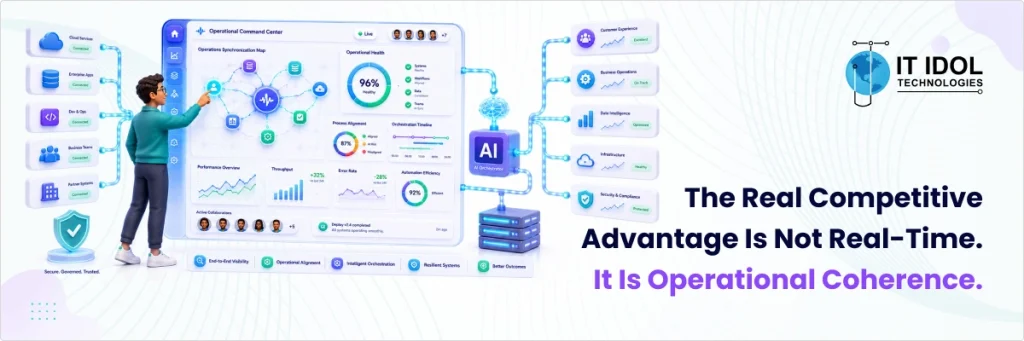
The Real Competitive Advantage Is Not Real-Time. It Is Operational Coherence.
The enterprises building durable advantage from event-driven automation in 2026 are not the ones that moved the most workloads to event-driven patterns the fastest. They are the ones who built the organizational and technical infrastructure, schema governance, observability platforms, ownership models, and latency decision frameworks that allow event-driven systems to operate coherently as they scale.
That infrastructure is not glamorous. It does not make for compelling vendor case studies. But it is the difference between an event-driven architecture that becomes the operational backbone of a business and one that becomes a maintenance burden that the engineering organization is quietly trying to replace.
Event-driven execution requires auditable event capture, deterministic fallbacks, and predictable idempotency and retry behavior. Those are engineering requirements, but they are also business requirements because any automation system operating at enterprise scale will eventually encounter conditions that produce unexpected results, and the organization’s ability to detect, diagnose, and recover from those conditions is what separates acceptable operational risk from unacceptable exposure.
The leaders who get the most out of event-driven automation treat it as a platform investment, not a project investment. They fund the schema registry, the observability tooling, the governance process, and the operational training alongside the automation development itself.
They apply the pattern selectively, resisting the organizational pressure to declare event-driven architecture a universal standard before the supporting infrastructure is in place. And they measure success not by the number of workflows converted to event-driven patterns, but by the business outcomes those workflows deliver, which is, ultimately, the only measurement that justifies the investment.
Event-driven automation is not the future of enterprise workflows because it is technically elegant. It is the future because the competitive landscape now rewards organizations that can respond to business conditions in real time rather than on a schedule. But responding in real time is only valuable if the response is reliable, observable, and governed. Architecture without those properties is not a competitive advantage. It is scheduled work that arrives at unpredictable times, which, for most businesses, is the worst of both worlds.
At IT IDOL Technologies, we help enterprises design and implement event-driven automation platforms that are not only technically scalable but operationally sustainable. Modern real-time systems require far more than event brokers and streaming infrastructure; they demand strong schema governance, observability frameworks, resilient workflow orchestration, distributed system monitoring, and enterprise-grade operational discipline.
Our teams build Kafka and event-streaming architectures, real-time workflow automation systems, cloud-native integration platforms, event-driven microservices ecosystems, automation orchestration pipelines, and AI-powered operational workflows with a strong focus on reliability, governance, and long-term maintainability.
Whether organizations are modernizing legacy workflows, enabling real-time operational visibility, or building scalable enterprise automation ecosystems, IT IDOL Technologies helps transform event-driven architecture from a technical initiative into a measurable business capability.
FAQ’s
1. What is event-driven automation in enterprise systems?
Event-driven automation is an architectural approach where systems automatically respond to business events the moment they occur.
Instead of relying on scheduled processing or manual intervention, workflows are triggered in real time by events such as:
customer transactions
inventory changes
operational alerts
payment confirmations
or system-generated signals
This enables enterprises to automate workflows dynamically across distributed systems and applications.
2. Why are enterprises adopting event-driven architecture?
Enterprises are adopting event-driven architecture because modern business environments increasingly require faster operational responsiveness.
Event-driven systems help organizations:
reduce workflow latency
improve real-time decision-making
automate distributed processes
scale-independent services
and react to operational events immediately instead of waiting for scheduled execution windows
This is particularly valuable in industries where response time directly impacts customer experience, operational efficiency, or risk management.
3. Is real-time processing always better than batch processing?
No. One of the biggest misconceptions in enterprise modernization is that real-time processing is automatically superior.
Real-time systems introduce:
continuous infrastructure overhead
distributed system complexity
observability challenges
event ordering concerns
and operational coordination requirements
Batch processing often remains the better choice for:
reconciliation workflows
reporting systems
compliance operations
and workloads where low latency does not create meaningful business value
The right architectural decision depends on the business impact of latency, not simply technical capability.
4. What are the biggest challenges in event-driven automation?
The most significant challenges are usually operational and organizational rather than purely technical.
Common issues include:
event schema governance
event sprawl
distributed debugging
observability gaps
consumer coordination
and ownership ambiguity across teams
Without centralized governance and strong operational visibility, event-driven systems can become fragmented and difficult to manage at scale.
5. Why is observability important in event-driven systems?
In event-driven architectures, business transactions often move across multiple services asynchronously.
Without observability infrastructure, failures can become extremely difficult to detect and diagnose.
Enterprises typically require:
distributed tracing
consumer lag monitoring
dead-letter queue alerting
schema validation
and centralized event visibility
to maintain operational reliability across real-time workflows.
Observability is not optional infrastructure in event-driven systems. It is fundamental to operational stability.
6. What industries benefit most from event-driven automation?
Event-driven automation is particularly effective in industries where real-time responsiveness creates measurable operational value.
Common sectors include:
financial services
eCommerce
logistics
healthcare
SaaS platforms
manufacturing
and telecommunications
Use cases often include:
fraud detection
inventory synchronization
customer notifications
infrastructure remediation
order orchestration
and operational monitoring systems
7. How can enterprises successfully implement event-driven workflows?
Successful implementation usually starts with governance, not technology alone.
Organizations that scale event-driven systems effectively typically invest early in:
schema management
event ownership models
observability tooling
centralized event catalogs
operational monitoring
and workflow governance standards
A phased adoption strategy focused on high-value workflows generally produces better long-term outcomes than attempting enterprise-wide real-time transformation all at once.
Parth Inamdar is a Content Writer at IT IDOL Technologies, specializing in AI, ML, data engineering, and digital product development. With 5+ years in tech content, he turns complex systems into clear, actionable insights. At IT IDOL, he also contributes to content strategy—aligning narratives with business goals and emerging trends. Off the clock, he enjoys exploring prompt engineering and systems design.