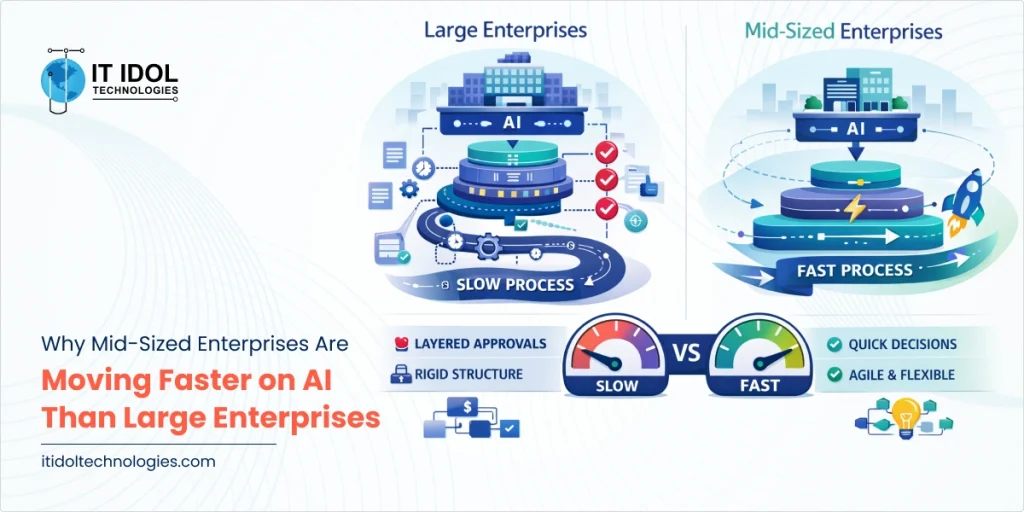
If you look at where AI is actually getting deployed not announced, not piloted, but running in production there’s a clear pattern. Mid-sized enterprises are consistently moving faster than large enterprises. This isn’t about budget. Large organizations have significantly more capital, access to talent, and vendor relationships. On paper, they should be leading. But in practice, mid-sized companies are shipping faster, iterating more aggressively, and getting to measurable outcomes sooner. The reason comes down to how systems, decisions, and constraints interact in real environments. AI adoption is less about access to technology and more about how quickly an organization can absorb uncertainty, restructure workflows, and operationalize new capabilities. That’s where mid-sized enterprises have an advantage.
Where AI Adoption Actually Slows Down
In large enterprises, the friction doesn’t show up at the idea stage. It shows up when you try to move from a working prototype to something that touches real systems. Most AI projects start the same way. A small team builds a proof of concept. It works well in isolation. The model performs as expected. Early stakeholders see value. Then integration begins.
This is where timelines expand. The system needs access to internal data through effective system integration. That data sits across multiple systems CRM platforms, internal tools, legacy databases. Each integration requires approvals, security reviews, and alignment with existing infrastructure. What looked like a two-week extension turns into months.
The issue isn’t technical feasibility. It’s the number of dependencies. In large organizations, systems are deeply interconnected, and any new component has to fit into an already complex environment. AI systems don’t operate in isolation; they rely on data, workflows, and outputs that touch multiple parts of the business. Every connection point introduces a delay.
The Weight of Existing Systems
Large enterprises don’t just have more systems; they have systems that have evolved over years, sometimes decades. These systems weren’t designed with AI integration in mind. In practice, this creates friction at multiple levels. Data is often fragmented or inconsistently structured. Even when data is available, it may not be usable without significant preprocessing. AI systems require clean, well-defined inputs. Getting to that state is often more complex than building the model itself.
There’s also the issue of system ownership. Different teams own different parts of the infrastructure. Coordinating changes across these boundaries takes time. Even small adjustments can require cross-team alignment. Mid-sized enterprises face similar challenges, but at a smaller scale. Their systems are fewer, less entrenched, and easier to modify. This reduces the effort required to integrate AI into existing workflows.
Decision-Making Speed Changes Everything
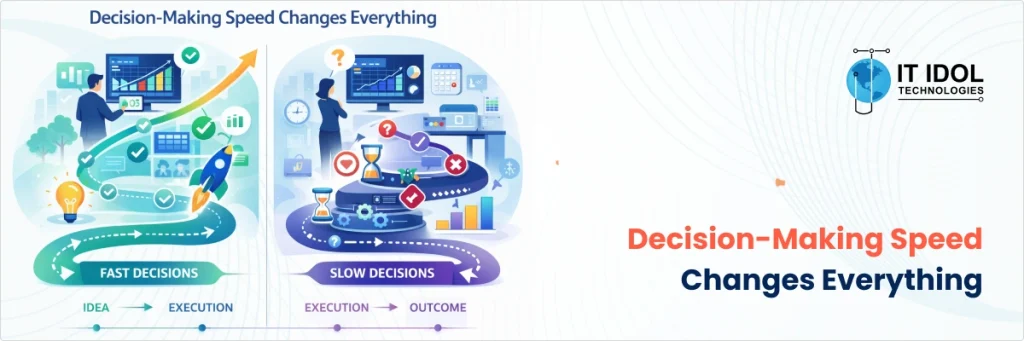
One of the less visible but more impactful differences is how decisions are made. In mid-sized organizations, decision-making tends to be more centralized. Fewer stakeholders are involved, and alignment happens faster. This allows teams to move from idea to implementation without extended delays. In large enterprises, decisions are distributed. Multiple teams need to agree. Risk assessments are more formalized. Budget approvals follow structured processes. Each step adds time. This matters because AI projects are inherently iterative. You don’t get everything right on the first attempt. You need to test, adjust, and refine. When each iteration takes weeks or months, progress slows significantly. Mid-sized enterprises can iterate faster because the feedback loop is shorter. They can test ideas in real environments, learn from results, and adjust quickly. This compounds over time, leading to faster overall progress.
Risk Tolerance in Practice
AI introduces uncertainty. Outputs are not always deterministic. Behaviour can vary based on inputs. Systems need to handle edge cases and failures gracefully. Large enterprises are more sensitive to this uncertainty. The cost of failure is higher. A system behaving unpredictably can impact a large number of users, affect brand perception, or introduce compliance risks. As a result, there is a stronger emphasis on validation, testing, and control. This is necessary, but it also slows down deployment.
Mid-sized enterprises operate with a different risk profile. While they still care about reliability, they are often more willing to deploy systems in controlled environments and improve them over time. They accept a certain level of imperfection in exchange for speed. This doesn’t mean they are reckless. It means they optimize for learning rather than certainty.
Where AI Systems Actually Get Stuck
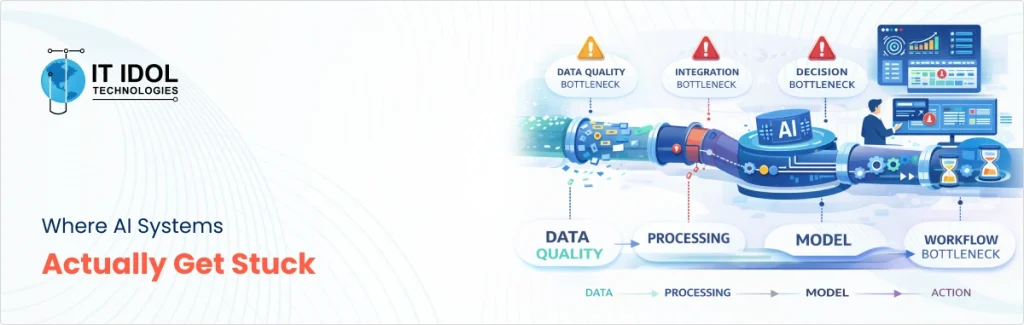
From an engineering perspective, most AI systems don’t fail because the model doesn’t work. They fail because they can’t be integrated effectively.
Common bottlenecks include:
Accessing and preparing internal data
Connecting to existing workflows
Handling edge cases in production
Managing latency and cost constraints
In large enterprises, each of these steps involves multiple layers of coordination. The technical work is only part of the effort. The rest is organizational. Mid-sized enterprises still face these challenges, but they can often resolve them faster because fewer layers are involved. Another issue is overengineering early in the process. Large organizations tend to design for scale and robustness from the beginning. While this is important, it can lead to systems that are too complex before their value is fully validated.
Mid-sized teams are more likely to start with simpler implementations. They build something that works, deploy it, and improve it incrementally. This approach leads to faster initial progress and earlier insights.
The Role of Architecture in Speed
Architecture decisions play a significant role in how quickly AI systems can be deployed. Architecture decisions play a significant role in how quickly AI systems can be deployed. In large enterprises, there is often a preference for standardized architectures. Systems need to align with existing frameworks, security policies, and infrastructure guidelines. This ensures consistency but can limit flexibility.
In mid-sized enterprises, architecture is often more adaptable. Teams can choose tools and approaches based on the specific problem rather than fitting into predefined structures. This allows for more efficient solutions. However, this flexibility comes with trade-offs. Systems may need to be restructured later as they scale. But in the early stages, the ability to move quickly often outweighs the need for long-term optimization.
Observability and Feedback Loops
Another area where differences emerge is in how systems are monitored and improved. Large enterprises typically have more advanced observability systems. They track performance, errors, and usage in detail. However, the process of acting on these insights can be slow due to organizational complexity. Mid-sized enterprises may have simpler monitoring setups, but they often act on insights more quickly. When an issue is identified, changes can be implemented without extensive coordination. This leads to tighter feedback loops. Problems are identified and resolved faster. Improvements are deployed more frequently. In AI systems, where behavior can change based on subtle factors, this ability to iterate quickly is critical.
The Talent Utilization Gap
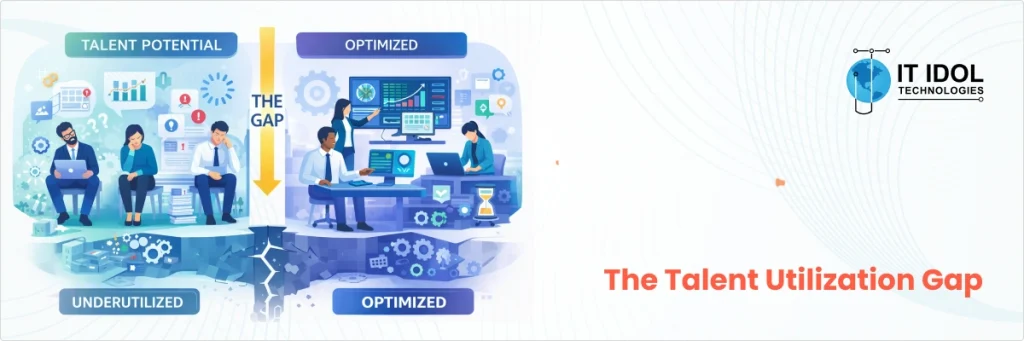
Both large and mid-sized enterprises have access to skilled engineers. The difference lies in how that talent is utilized. In large organizations, engineers often work within defined roles and responsibilities. Collaboration across teams is structured, and changes require coordination. This can limit how quickly ideas are implemented. In mid-sized enterprises, teams are often more cross-functional. Engineers, product managers, and business stakeholders work more closely. This reduces the gap between idea and execution. It also means that decisions are informed by a combination of technical and business perspectives, which can lead to more practical implementations.
The Trade-Off: Speed vs Stability
It’s important to recognize that moving faster is not always better in every context. Large enterprises prioritize stability, compliance, and scalability. These are valid concerns, especially when systems impact a large user base or operate in regulated environments. Mid-sized enterprises prioritize speed and adaptability. This allows them to explore opportunities and validate ideas more quickly. The difference is not about one approach being superior. It’s about how each organization balances these priorities. What’s changing, however, is the competitive landscape. Faster iteration cycles allow mid-sized enterprises to adopt AI in ways that create immediate value. Over time, this can translate into a significant advantage.
What This Means for AI Adoption Strategies
For large enterprises, the takeaway is not to abandon structure, but to identify where flexibility can be introduced. This might involve creating dedicated environments for experimentation, reducing dependencies for initial deployments, or streamlining decision-making processes for AI initiatives. For mid-sized enterprises, the challenge is to maintain speed while building systems that can scale. As adoption increases, the need for more structured architectures and processes will grow. In both cases, the focus should be on reducing friction between idea and execution.
The Shift That’s Already Happening
The assumption that larger organizations will naturally lead in AI adoption is being challenged by real-world outcomes. Mid-sized enterprises are not just experimenting; they are deploying, learning, and improving at a faster pace. Their advantage comes from fewer constraints, faster decision-making, and more adaptable systems. Large enterprises still have significant advantages in resources and scale. But without changes in how AI initiatives are executed, those advantages don’t automatically translate into faster progress.
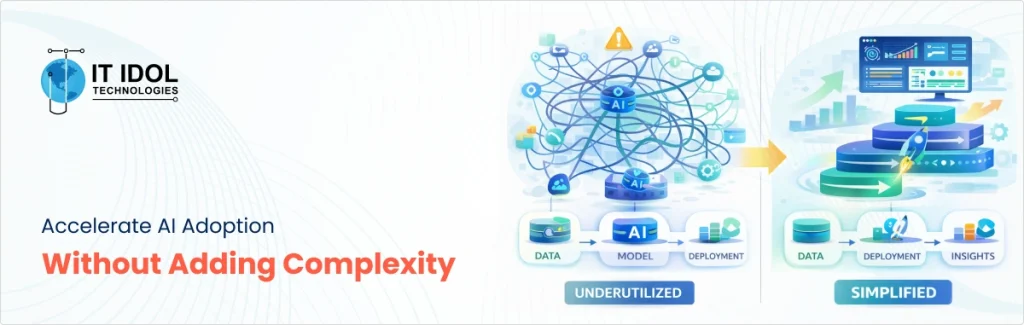
Accelerate AI Adoption Without Adding Complexity
Moving fast on AI isn’t just about adopting the latest models; it’s about building systems and processes that allow you to implement, test, and scale effectively. At IT IDOL Technologies, we work with organizations to reduce the friction that slows down AI adoption. From simplifying system integration to designing architectures that support rapid iteration, the focus is on helping teams move from experimentation to production without unnecessary delays. Whether you’re navigating complex enterprise environments or scaling AI within a growing organization, the right architectural approach can significantly impact how quickly you see results.
Connect with IT IDOL Technologies to accelerate your AI initiatives with systems designed for speed, reliability, and real-world execution.
Mid-sized firms operate with fewer layers of approval and less legacy complexity, allowing quicker decision-making. This enables faster experimentation and deployment of AI initiatives.
Flatter structures in mid-sized companies reduce internal friction. In contrast, large enterprises often require cross-functional alignment, slowing down implementation timelines.
Yes, large organizations typically rely on deeply integrated legacy systems. Integrating AI into these environments requires significant effort, testing, and risk management.
They are generally more willing to experiment because the cost of failure is lower and decision cycles are shorter. This agility gives them an edge in early adoption.
Large enterprises have more resources but also more constraints on how they are allocated. Mid-sized firms often use focused investments to drive faster, targeted AI outcomes.
Yes, stricter compliance, security, and governance requirements in large organizations slow down deployment. Mid-sized firms typically operate with more flexible frameworks.
Yes, but through more structured and scaled approaches. While slower to start, they often achieve broader and more sustainable impact once systems are fully integrated.
Deval Rathod
Founder & CEO
|
Deval Rathod is the Founder and CEO of IT IDOL Technologies, a custom software development company. With over a decade of experience in software engineering, solution architecture, and technology leadership, she has worked across custom software development, enterprise applications, AI & ML, and digital transformation. Her expertise includes guiding technology teams, designing scalable software solutions, and helping businesses evaluate and implement emerging technologies. She contributes insights on software engineering, artificial intelligence, enterprise technology, and digital transformation.