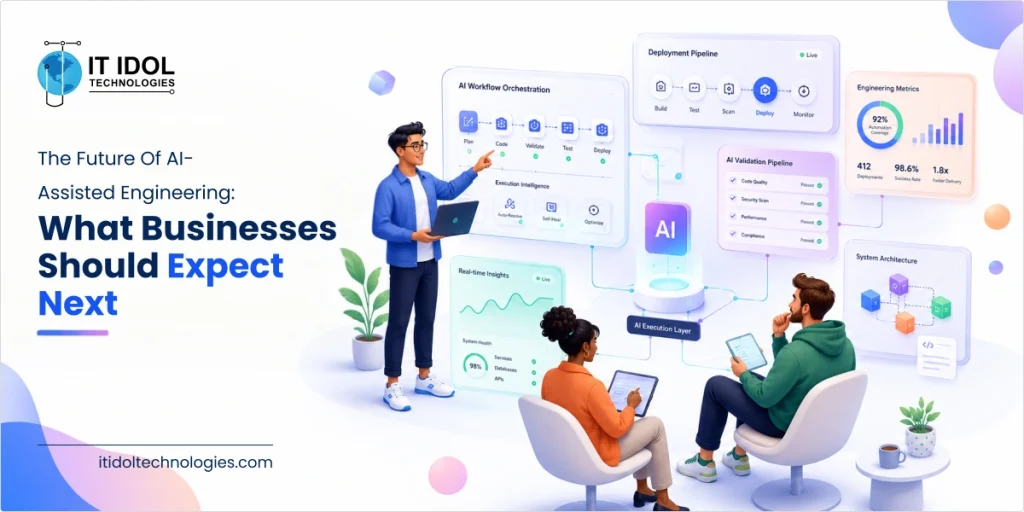
The next phase of AI-assisted engineering will not be defined by better code generation; it will be defined by how effectively organizations restructure execution around AI. Businesses that treat AI as a productivity tool will see incremental gains; those that treat it as an execution layer will fundamentally change how software is designed, built, and delivered.
What follows is not a speculative view of the future, but a grounded perspective based on how AI is already reshaping engineering workflows, decision-making, and organizational structures, and what that means for leaders making investment and strategy decisions today.
AI Will Become the Execution Layer, Not Just a Development Aid
AI is no longer limited to assisting developers with isolated tasks like writing functions or generating documentation. It is increasingly capable of executing multi-step workflows, translating requirements into system design, scaffolding architectures, generating test cases, and even orchestrating deployment pipelines.
In practice, this means engineering teams are shifting from “writing code” to “directing systems.” The role of a developer evolves into defining intent, constraints, and validation criteria, while AI handles the intermediate execution steps. This shift is already visible in environments where AI tools integrate directly into CI/CD pipelines, automating repetitive and structured tasks across the lifecycle.
However, this transition introduces a new dependency: the quality of outputs becomes directly tied to the clarity of inputs. Poorly defined requirements will now propagate faster and at scale. Organizations that lack strong product thinking or structured requirement frameworks will see amplified inefficiencies rather than gains.
The operational implication is clear: AI does not replace engineering rigor; it exposes its absence.
Takeaway: AI will compress execution cycles, but only organizations with disciplined input structures and validation systems will convert that speed into real business value.
Engineering Velocity Will Be Redefined by Decision Latency, Not Development Speed
Historically, software velocity was constrained by how fast engineers could write and ship code. With AI-assisted engineering, code generation is no longer the bottleneck. Instead, the limiting factor becomes how quickly teams can make decisions on architecture, priorities, trade-offs, and validation.
In real-world environments, delays rarely occur in coding; they occur in alignment. Product, engineering, and business teams often operate with fragmented context, leading to iterative back-and-forth cycles. AI accelerates execution, but it does not resolve ambiguity. In fact, it can amplify it by producing multiple viable outputs that require human judgment.
This creates a new operating model where decision-making frameworks become more critical than development frameworks. Organizations that invest in clear ownership models, decision hierarchies, and rapid validation loops will outperform those that rely on consensus-driven processes.
A useful mental model here is the “Decision-to-Deployment Ratio,” the time spent deciding versus the time spent executing. AI reduces execution time dramatically, so optimizing decision time becomes the primary lever for speed.
Takeaway: In AI-assisted engineering, the fastest teams are not those that code quickly, but those that decide quickly and correctly.
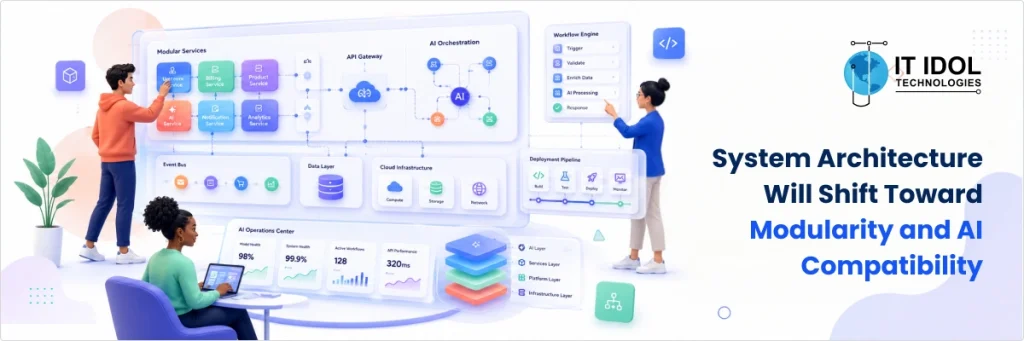
System Architecture Will Shift Toward Modularity and AI Compatibility
AI-assisted systems perform best in environments where components are modular, well-defined, and loosely coupled. Monolithic architectures limit AI’s ability to generate, test, and optimize code effectively because changes in one area create cascading dependencies.
As a result, businesses will increasingly adopt architectures that separate concerns across data, logic, and interface layers. This is not a new principle, but AI makes it non-negotiable. Modular systems allow AI tools to operate within bounded contexts, improving both accuracy and reliability.
In practice, this shift often begins with API-first design and event-driven architectures. These patterns create clear interaction points where AI can be applied, whether for generating services, monitoring events, or automating responses.
However, transitioning to modular architectures is not trivial. It requires upfront investment, refactoring legacy systems, and redefining integration patterns. Organizations that delay this transition may find that their AI initiatives are constrained by structural limitations rather than technological capability.
Takeaway: AI amplifies the value of modular architecture; without it, scalability and reliability gains from AI will remain limited.
The Role of Engineers Will Evolve from Builders to System Orchestrators
AI-assisted engineering does not eliminate the need for engineers; it changes what they are responsible for. The core skill shifts from writing code to designing systems, validating outputs, and orchestrating workflows across tools and platforms.
Engineers will spend more time defining constraints, reviewing AI-generated outputs, and ensuring that systems behave as intended under real-world conditions. This requires a deeper understanding of system design, edge cases, and failure modes.
In execution, this often manifests as a layered workflow: AI generates an initial implementation, engineers refine and validate it, and automated systems test and deploy it. The human role becomes one of oversight and judgment rather than manual construction.
This shift also changes hiring and team composition. Organizations will prioritize engineers who can think in systems, communicate clearly, and work across disciplines. Pure coding ability, while still important, becomes less of a differentiator compared to architectural and problem-solving skills.
Takeaway: The future engineer is not defined by how well they code, but by how effectively they design, guide, and validate AI-driven systems.
Quality Assurance Will Move Upstream and Become Continuous
One of the most significant risks in AI-assisted engineering is the rapid propagation of errors. When AI generates code at scale, small issues can quickly become systemic problems if not detected early.
This shifts quality assurance from a downstream activity to an upstream and continuous process. Testing is no longer a separate phase; it becomes embedded throughout the development lifecycle. AI-generated code must be validated in real time, with automated tests, monitoring systems, and feedback loops ensuring correctness.
In practice, this means organizations need to invest in robust testing frameworks, observability tools, and validation pipelines. It also requires redefining what “done” means; completion is not just about functionality, but about confidence in reliability and performance.
A common failure point is over-reliance on AI-generated outputs without sufficient validation. Teams that skip rigorous testing in the interest of speed often face costly rework and system instability.
Takeaway: AI increases the speed of both innovation and error propagation; continuous validation is the only way to ensure that speed translates into quality.
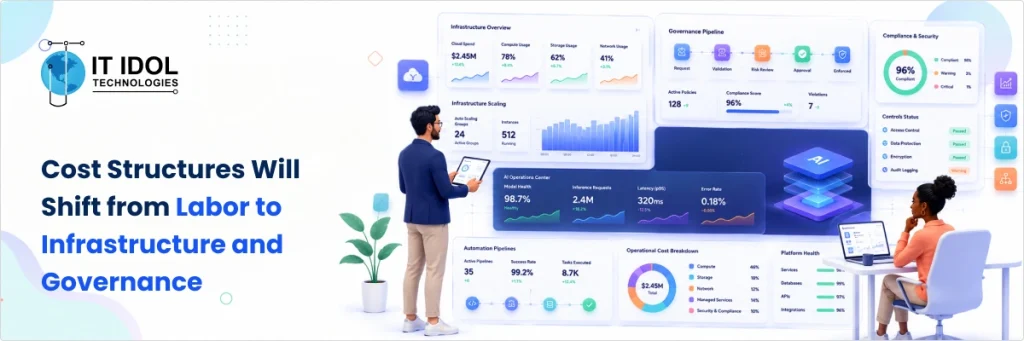
Cost Structures Will Shift from Labor to Infrastructure and Governance
AI-assisted engineering changes the economics of software development. While it reduces the need for manual coding effort, it introduces new costs in infrastructure, tooling, and governance.
Organizations must account for compute costs, model usage, integration overhead, and ongoing monitoring. Additionally, governance becomes a critical investment area, ensuring that AI-generated outputs meet security, compliance, and ethical standards.
In real-world scenarios, businesses often underestimate these costs. They focus on the productivity gains from AI while overlooking the operational expenses required to sustain it. This leads to misaligned expectations and budget overruns.
A more accurate approach is to evaluate AI investments through a total cost of ownership lens, considering both direct and indirect costs. This includes not only technology expenses but also the resources required for oversight, training, and process redesign.
Takeaway: AI reduces development effort but increases operational complexity; sustainable adoption requires a holistic view of cost and governance.
Competitive Advantage Will Come from Integration, Not Adoption
As AI tools become widely available, simply adopting them will not create differentiation. The competitive advantage will come from how effectively organizations integrate AI into their workflows, systems, and decision-making processes.
This integration requires alignment across multiple dimensions: technology, processes, and people. It is not enough to deploy AI tools; they must be embedded into the way teams operate, from requirement definition to deployment and monitoring.
In practice, this often involves redesigning workflows to incorporate AI at key points, training teams to work effectively with AI, and establishing feedback loops that continuously improve performance.
Organizations that treat AI as a standalone initiative will struggle to realize its full potential. Those that integrate it deeply into their operations will create compounding advantages in speed, quality, and scalability.
Takeaway: The value of AI is not in the tools themselves, but in how seamlessly they are integrated into the organization’s execution model.
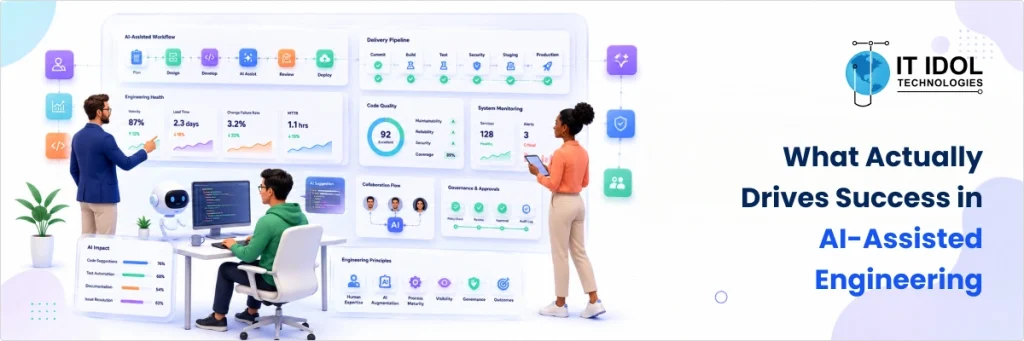
What Actually Drives Success in AI-Assisted Engineering
The future of AI-assisted engineering is not about replacing humans or automating development; it is about redefining how software is built and delivered. The organizations that succeed will be those that adapt their operating models, not just their toolsets.
Success will depend on a few critical factors: the ability to make fast and informed decisions, the discipline to define clear requirements, the willingness to invest in modular architectures, and the commitment to continuous validation and governance.
AI will continue to evolve, but its impact will always be mediated by how organizations use it. Technology alone does not create an advantage; execution does.
In practical terms, this means leaders must shift their focus from “what AI can do” to “how our organization executes with AI.” That is where the real transformation and the real opportunity lie.
FAQ’s
1. What is AI-assisted engineering?
AI-assisted engineering uses artificial intelligence to support software development, testing, deployment, and operational workflows. It helps organizations improve productivity, accelerate execution, and reduce repetitive engineering tasks.
2. How will AI-assisted engineering evolve in the future?
AI-assisted engineering is expected to move from coding assistance toward autonomous workflow execution and intelligent system management. Future AI systems will increasingly participate in end-to-end software delivery processes.
3. Will AI replace software engineers?
AI will automate repetitive engineering activities, but human expertise will still be essential for architecture, governance, security, and strategic decision-making. The future of engineering is likely to be human-AI collaboration rather than full replacement.
4. How can businesses prepare for AI-assisted engineering?
Businesses should modernize workflows, establish governance frameworks, and train teams to work alongside AI systems. Early adoption strategies can help organizations scale AI capabilities more effectively over time.
5. What are the benefits of AI-assisted engineering?
AI-assisted engineering can accelerate development cycles, improve software quality, reduce operational bottlenecks, and shorten time-to-market. It also helps enterprises scale engineering output more efficiently.
6. What risks are associated with AI-assisted engineering?
Common risks include inaccurate AI-generated code, security vulnerabilities, compliance issues, and overreliance on automation. Strong review processes and governance controls are essential for responsible AI adoption.
7. How will AI impact software engineering teams?
Engineering teams are expected to spend less time on repetitive execution tasks and more time on strategy, validation, and system design. AI will reshape developer responsibilities rather than eliminate engineering roles.
8. Which industries will benefit most from AI-assisted engineering?
Industries with large-scale digital operations, such as finance, healthcare, retail, manufacturing, and SaaS, are expected to benefit significantly. AI can help these sectors optimize complex workflows and accelerate software delivery.
9. How does AI-assisted engineering improve software delivery speed?
AI accelerates coding, testing, debugging, deployment, and documentation processes across development pipelines. This enables organizations to release products faster while improving operational efficiency.
10. What should enterprises expect from next-generation AI engineering tools?
Next-generation AI tools are expected to become more context-aware, workflow-integrated, and execution-focused. Enterprises will increasingly use AI systems that can coordinate and automate multi-step engineering operations.