AI-assisted software development is not simply a productivity enhancement; it fundamentally reshapes how software is conceived, built, validated, and owned. Organizations that approach it as a tooling upgrade quickly run into governance failures that are difficult to diagnose and even harder to reverse.
The issue is not that AI introduces risk; it is that existing governance models were never designed for a world where code is partially generated, decisions are probabilistic, and execution is increasingly delegated to systems rather than individuals.
What separates high-performing organizations from those struggling with AI adoption is not how aggressively they use AI, but how deliberately they redesign governance around it.
Accountability Does Not Disappear; It Becomes More Critical
One of the earliest and most underestimated governance challenges in AI-assisted development is the erosion of clear accountability. When AI contributes to code generation, the traditional ownership model begins to blur. Engineers are no longer writing every line, reviewers are not always validating intent, and systems are executing outputs that no single individual fully authored.
This creates a dangerous illusion of shared responsibility. In reality, shared responsibility often leads to no responsibility.
In operational environments, this becomes visible only when something breaks. A production defect tied to AI-generated logic exposes a fundamental gap: no one can clearly articulate who made the decision that introduced the issue. Was it the developer who accepted the suggestion, the team that approved AI usage, or the organization that deployed the system without deeper validation?
Organizations that manage this effectively enforce what can be described as “last-mile ownership.” Regardless of how code is generated, a clearly assigned human owner must take responsibility for its behaviour before it reaches production. This is not a philosophical stance; it is a structural requirement for maintaining control in complex systems.
The practical implication is simple but non-negotiable: AI can assist in creation, but accountability must remain human, explicit, and enforceable at the point of deployment.
Without Traceability, Governance Is an Illusion
If accountability defines who is responsible, traceability defines whether responsibility can be verified. In AI-assisted environments, traceability becomes the backbone of governance.
Unlike traditional development, AI introduces non-deterministic outputs. The same input can produce different results, and the reasoning behind those results is not always transparent. This breaks conventional audit models, which assume predictable inputs and reproducible outputs.
For decision-makers, this raises a critical question: how do you govern something you cannot reconstruct?
In practice, organizations that fail here lose the ability to audit decisions, investigate failures, or meet compliance requirements. This is particularly critical in regulated industries, where the ability to explain how a system arrived at a specific outcome is not optional; it is mandatory.
Mature teams solve this by embedding traceability directly into their development workflows. Every AI interaction becomes part of a decision record: what was asked, what was generated, how it was modified, and why it was accepted or rejected. This is not about storing excessive data; it is about capturing meaningful context that allows reconstruction of intent.
When traceability is implemented correctly, AI-generated contributions are no longer opaque artifacts. They become auditable elements within a governed system.
The takeaway is clear: governance is not possible without traceability, and traceability must be designed, not assumed.
Speed Amplifies Risk Unless Governance Is Engineered
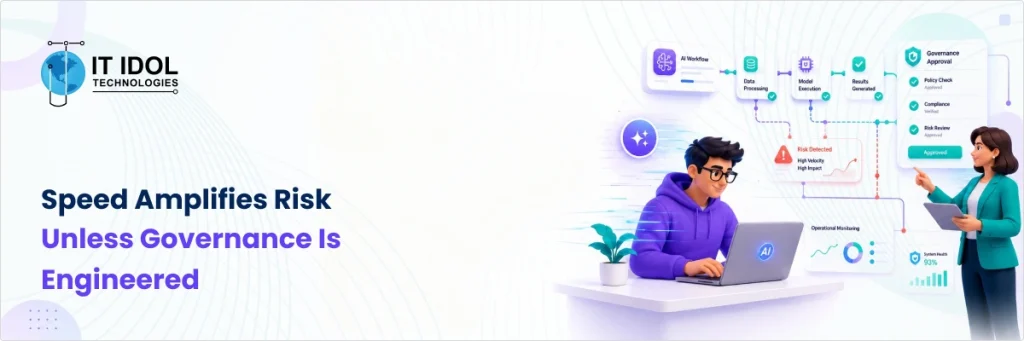
AI dramatically increases development velocity, but governance mechanisms do not scale automatically with that acceleration. This creates a widening gap between how fast software is produced and how effectively it is controlled.
The risk is not just that mistakes happen faster; it is that ungoverned decisions accumulate at scale.
In real-world systems, this manifests as architectural inconsistencies, hidden technical debt, and vulnerabilities introduced through seemingly valid but unverified code. AI-generated outputs often “look correct,” which reduces scrutiny and increases the likelihood of silent failure modes entering production.
Organizations that rely on traditional review processes quickly reach a breaking point. Manual oversight cannot keep pace with AI-driven output. At the same time, removing controls in favour of speed leads to systemic instability.
The solution lies in shifting from reactive governance to embedded governance. Instead of reviewing outcomes after they are produced, organizations must enforce constraints during generation and integration. This includes automated validation against architectural standards, real-time security checks, and policy-driven restrictions that shape what AI systems are allowed to produce.
When governance is engineered into the pipeline, speed no longer undermines control. Instead, it becomes a controlled advantage.
In practice, the organizations that scale successfully are not those that move fastest; they are those that ensure speed operates within enforceable boundaries.
Data and Intellectual Property Risks Are Systemic, Not Edge Cases
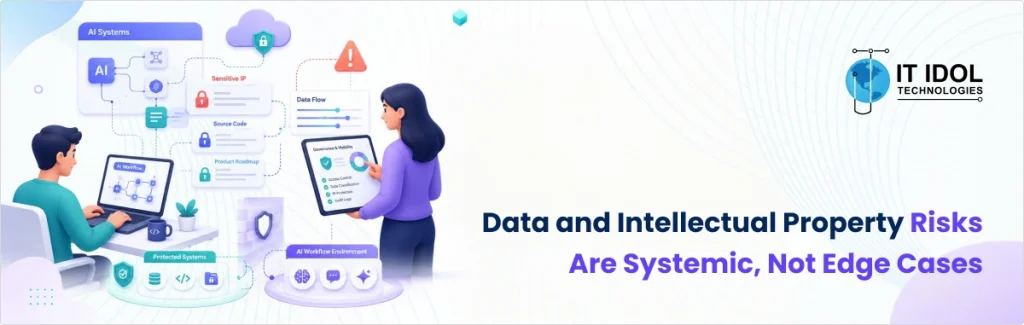
One of the most overlooked governance challenges in AI-assisted development is the exposure of sensitive data and intellectual property. This risk is often treated as a compliance checkbox when in reality it is a systemic vulnerability.
Every interaction with an AI system has the potential to expose proprietary logic, internal architecture, or sensitive business data. Developers, under pressure to deliver quickly, may input context into AI tools without fully considering where that data goes or how it is used.
At the same time, AI-generated outputs can introduce external risk. Code may inadvertently replicate licensed material, incorporate restricted patterns, or create dependencies that conflict with organizational policies.
These risks do not typically surface immediately. They accumulate silently until they manifest as legal, security, or reputational issues.
Organizations that manage this effectively establish clear data boundaries for AI usage. They define what information can be shared, where it can be processed, and under what conditions it can be used. More importantly, they enforce these boundaries through systems, not just policies.
This often includes the use of controlled AI environments, restricted prompt contexts, and monitoring mechanisms that detect potential violations before they propagate.
The key insight is that data governance in AI-assisted development is not about preventing misuse; it is about designing systems where misuse becomes structurally difficult.
Quality Assurance Must Shift from Trust to Proof
AI-generated code introduces a subtle but critical shift in how quality must be evaluated. Traditional quality assurance relies heavily on human judgment; developers and reviewers assess whether code appears correct and aligns with expected behaviour.
This model breaks down when applied to AI-generated outputs.
AI can produce code that is syntactically perfect and logically coherent, yet flawed in edge cases, performance characteristics, or security behaviour. Because the output appears polished, it often receives less scrutiny than manually written code.
This creates a false sense of confidence.
Organizations that adapt successfully move away from trust-based validation toward proof-based validation. Instead of asking whether the code looks correct, they require evidence that it behaves correctly under defined conditions.
In practice, this means expanding automated testing, introducing scenario-based validation, and continuously monitoring system behaviour in production. AI-generated code is treated as untrusted input until it has been rigorously validated.
Some teams go further by institutionalizing skepticism, explicitly requiring additional validation for AI-generated contributions in critical systems. This is not about distrusting AI; it is about recognizing its limitations and designing safeguards accordingly.
The result is a resilient quality model, not assumptive.
Governance Must Enable, Not Suppress, AI Adoption
A common organizational response to AI-related risk is to impose restrictive controls. Tools are limited, approvals are increased, and usage is tightly constrained. While this may reduce visible risk, it introduces a more dangerous dynamic: shadow adoption.
Developers, driven by productivity pressures, will find ways to use AI regardless of formal restrictions. When governance becomes overly rigid, it loses relevance and effectiveness.
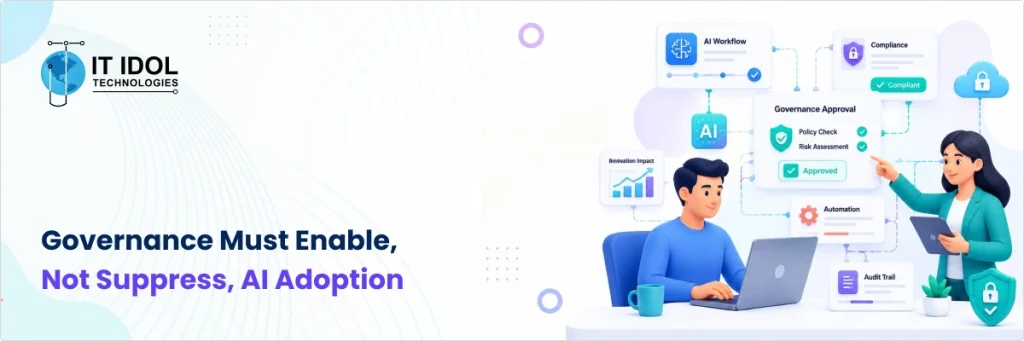
The organizations that succeed take a different approach. They focus on enabling AI usage within clearly defined and enforceable boundaries. Instead of asking “how do we limit AI?”, they ask “how do we structure its use so it remains controlled?”
This approach creates what can be described as bounded autonomy. Developers have the freedom to leverage AI, but within a system that ensures consistency, compliance, and safety.
This balance is not achieved through policy alone. It requires integrated toolchains, automated controls, and continuous feedback loops that evolve governance based on real usage patterns.
When done correctly, governance becomes an enabler of scale rather than a barrier to adoption.
Governance Is Ultimately an Organizational Design Problem
The final and often decisive factor in AI governance is organizational design. Governance failures rarely stem from technical limitations; they arise from misaligned responsibilities, unclear decision rights, and fragmented ownership.
In many organizations, AI governance is distributed across multiple functions: engineering defines standards, security manages risk, compliance enforces regulations, and product drives delivery. Without alignment, this creates gaps, redundancies, and conflicting priorities.
Effective organizations treat governance as a cross-functional system with clearly defined layers. Strategic leadership sets principles and risk appetite, operational teams translate those principles into enforceable controls, and execution teams integrate them into daily workflows.
More importantly, decision rights are explicitly defined. Governance is not about consensus; it is about clarity on who has authority over specific aspects of AI usage.
When governance is embedded into organizational structure, it becomes part of how work is executed. When it is layered on top, it becomes a source of friction.
The distinction determines whether governance scales or collapses under pressure.
What Actually Drives Governance Success in Practice
AI-assisted software development does not fail because of technological limitations; it fails because organizations attempt to apply outdated governance models to fundamentally new systems of execution.
The organizations that succeed recognize that governance must evolve from oversight to design. They do not rely on manual control mechanisms to manage AI; they build systems where control is inherent.
This includes maintaining explicit accountability, designing traceability into workflows, embedding governance into pipelines, enforcing data boundaries, validating outputs rigorously, and aligning organizational structures with execution realities.
The shift is subtle but critical: governance is no longer about monitoring what happens after decisions are made. It is about shaping how decisions are made in the first place.
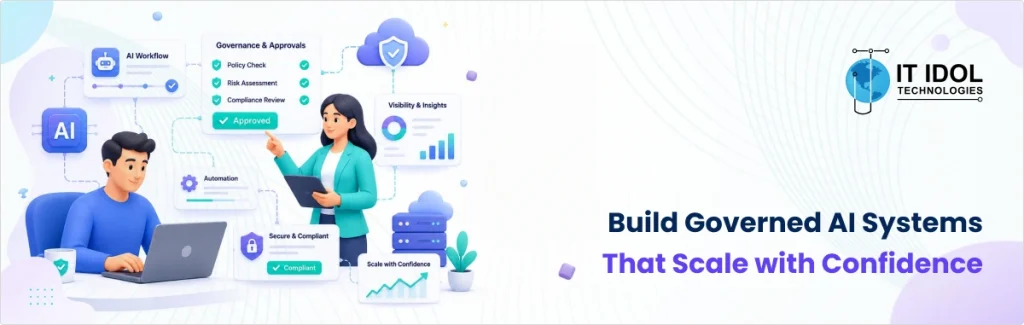
Build Governed AI Systems That Scale with Confidence
Organizations that treat AI governance as an afterthought will struggle to scale, regardless of how advanced their tools are. Those who treat it as a core design principle will unlock sustainable speed, quality, and control.
If you are navigating these challenges and looking to operationalize AI without compromising governance, partnering with the right execution-focused team becomes critical.
IT IDOL Technologies works with organizations to design, implement, and scale AI-assisted development environments that are not only high-performing but also governed by design. From embedding traceability into pipelines to building secure AI integration frameworks, the focus is on creating systems where innovation and control coexist.
The question is no longer whether to adopt AI in software development. The real question is whether your governance model is ready for it.
FAQ’s
1. What are the main governance challenges in AI-assisted software development?
AI-assisted software development introduces challenges related to security, compliance, code quality, accountability, and operational consistency. Organizations often struggle to establish clear policies for how AI-generated outputs should be reviewed, validated, and managed across development teams.
2. Why is governance important in AI-assisted engineering environments?
Governance helps enterprises maintain control over AI usage, reduce operational risks, and ensure compliance with internal and external standards. Without governance frameworks, AI adoption can lead to inconsistent development practices, security vulnerabilities, and unmanaged workflow automation.
3. How can AI-generated code create governance risks?
AI-generated code may contain inaccurate logic, security weaknesses, licensing concerns, or undocumented dependencies that developers might overlook. Enterprises require strong review mechanisms and validation processes to ensure generated outputs meet architectural, security, and compliance standards.
4. What role does security play in AI governance for software development?
Security is a critical component of AI governance because AI systems can unintentionally expose sensitive data, generate vulnerable code, or interact with unauthorized systems. Organizations must implement access controls, monitoring, and secure development practices when integrating AI into engineering workflows.
5. How does AI governance affect compliance and regulatory requirements?
AI governance helps organizations align development practices with industry regulations, data protection standards, and internal compliance policies. Proper governance ensures that AI-assisted workflows remain auditable, traceable, and aligned with enterprise risk management requirements.
6. Why do enterprises need standardized AI usage policies?
Standardized policies help ensure consistent AI adoption across teams, tools, and workflows. They define approved use cases, review processes, security guidelines, and operational boundaries that reduce fragmentation and improve governance at scale.
7. How can businesses maintain accountability in AI-assisted development workflows?
Organizations can maintain accountability by defining clear ownership models for AI-generated outputs and ensuring human oversight throughout the development lifecycle. Developers and engineering leaders remain responsible for validating, approving, and monitoring AI-assisted decisions and code changes.
8. What challenges arise when multiple teams use AI tools differently?
Inconsistent AI usage across teams can create fragmented workflows, uneven code quality, duplicated efforts, and governance gaps. Enterprises often face difficulties maintaining operational alignment when departments adopt AI systems without centralized oversight.