Enterprise QA has quietly hit a ceiling, and it’s not because of tooling limitations. Most large organizations already operate with mature automation frameworks, extensive test suites, and continuous integration pipelines. Yet production defects persist with uncomfortable regularity.
The constraint is no longer execution. It’s decision-making. Testing today is still largely reactive. Teams validate what they expect might fail, not what is most likely to fail. The result is a mismatch between effort and impact, with high coverage but limited precision.
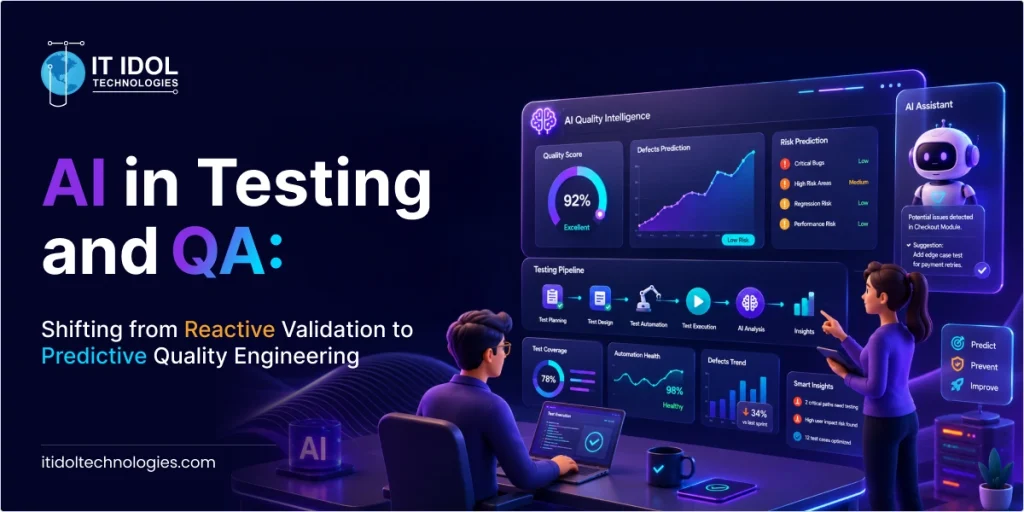
This is where AI is beginning to reshape the discipline. AI in testing and QA is not about accelerating existing processes. It introduces a fundamentally different model, one where testing is continuously guided by data, system behaviour, and probabilistic risk.
For engineering leaders, this marks a transition from automation-led QA to predictive quality engineering, where the objective is clear: reduce defects before they reach production, not after they are detected.
What AI in Testing and QA Actually Changes
At its core, AI-driven QA replaces static assumptions with dynamic intelligence. Traditional automation frameworks operate on predefined logic. Test cases are written, executed, and maintained based on known scenarios. While effective at scale, they struggle to adapt to evolving systems, unpredictable dependencies, and shifting usage patterns.
AI changes this by introducing learning systems into the testing lifecycle. Instead of simply executing scripts, AI models continuously ingest and analyse multiple streams of data, including historical defect logs, code changes, commit patterns, runtime behaviour, and user interactions. Over time, this creates a feedback loop where testing strategies evolve alongside the application itself.
The implication is significant: testing is no longer about validating completeness. It becomes an exercise in identifying risk with increasing accuracy.
Why Enterprises Are Reconsidering QA Through an AI Lens
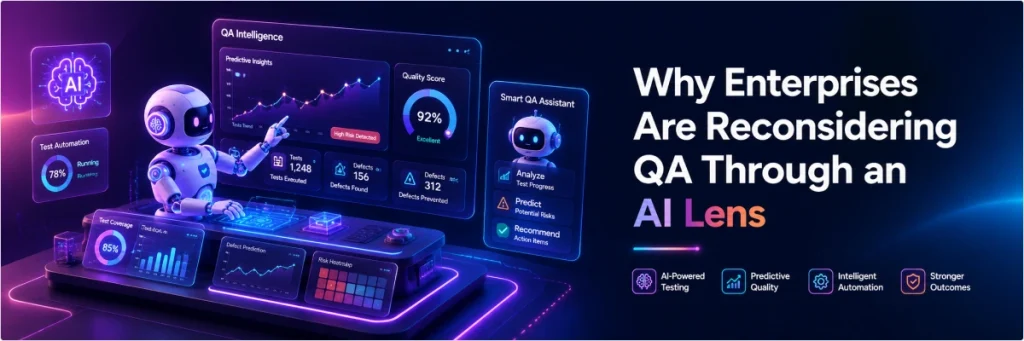
The urgency around AI in QA is not driven by hype; it’s driven by structural pressure. Modern enterprise systems are inherently more complex than their predecessors. Microservices architectures, distributed APIs, third-party integrations, and cloud-native deployments introduce layers of interdependence that static test cases cannot fully anticipate.
At the same time, release velocity has accelerated. Continuous delivery pipelines push frequent updates into production environments, compressing validation windows while increasing exposure to failure.
The cost of getting this wrong is rising. Production defects are no longer isolated technical issues; they directly affect revenue, regulatory compliance, and customer experience. In this context, the limitation of traditional QA becomes clear. It is not designed to prioritize. It treats all test cases with equal importance, even though not all failures carry equal risk.
AI addresses this gap by enabling risk-based testing, focusing effort where failure is both likely and impactful.
How AI Reduces Defects Before Production
The most important distinction to understand is this: AI does not reduce defects by increasing the volume of testing. It reduces defects by improving the quality of testing decisions.
The first shift is predictive defect identification. By analyzing historical patterns and correlating them with current code changes, AI models can estimate which components are most likely to fail in upcoming releases. This allows QA teams to move from blanket testing approaches to targeted validation.
The second shift is intelligent prioritization. Instead of executing entire test suites, AI dynamically selects and sequences test cases based on risk signals. This reduces redundancy while ensuring that critical paths are validated early.
The third shift lies in automation resilience. One of the persistent challenges in QA is script fragility; automation breaks when interfaces change. AI-driven systems mitigate this through self-healing capabilities, automatically adapting scripts to UI or API modifications. This significantly reduces maintenance overhead and prevents silent coverage gaps.
Finally, AI introduces anomaly detection into near-production environments. By continuously monitoring logs, performance metrics, and behavioural patterns, it identifies deviations that may not align with predefined test scenarios. These signals often surface issues that traditional testing would miss entirely.
Together, these capabilities transform QA from an execution-heavy function into an intelligence-driven system focused on prevention.
What Actually Differentiates AI-Driven QA from Traditional Models
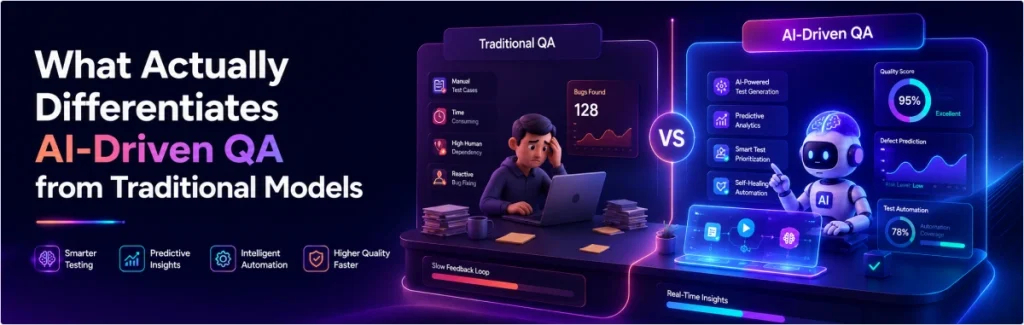
The shift from traditional QA to AI-driven QA is not incremental; it is architectural. In traditional models, testing is rule-based and deterministic. Defects are identified only after test execution, and coverage is often broad but inefficient. Maintenance becomes a significant burden as systems evolve, and decision-making is limited to pass/fail outcomes.
AI-driven QA, in contrast, is adaptive and probabilistic. It identifies risk before execution, focuses coverage on high-impact areas, and continuously refines its understanding of the system. Maintenance overhead decreases due to self-healing mechanisms, and scalability improves in distributed environments.
Most importantly, AI introduces decision intelligence into QA. It provides visibility into risk, enabling leadership teams to make informed release decisions based on likelihood and impact, not just test completion metrics.
Building an Enterprise-Grade AI QA Framework
Adopting AI in QA is not a matter of plugging in a tool. It requires a structured framework that integrates data, models, systems, and decision-making layers. It begins with the data foundation. AI models are only as effective as the data they learn from.
Organizations need structured and accessible defect logs, test execution histories, and code repository insights. Without this, predictions remain superficial.
On top of this sits the model layer. This includes defect prediction models, test optimization algorithms, and anomaly detection systems. These models continuously improve as they are exposed to more data and evolving system behaviour.
The integration layer ensures that AI insights are not isolated. They must connect seamlessly with CI/CD pipelines, DevOps workflows, and observability tools. Without integration, even the most accurate predictions fail to translate into action.
Finally, the decision layer operationalizes AI outputs. This is where risk scoring, test prioritization, and quality metrics become visible to engineering and business leaders, enabling better release governance.
Together, these layers form the backbone of predictive quality engineering.
The Build vs Buy vs Custom Decision
One of the most critical decisions enterprises face is how to implement AI in QA. Building in-house offers control and strategic differentiation, but it comes with high costs and longer timelines. Off-the-shelf tools provide speed but often lack the flexibility required for complex enterprise environments.
Increasingly, organizations are converging on a middle path: custom AI solutions developed in partnership with specialized providers.
This approach allows enterprises to align AI capabilities with their specific system architecture, domain requirements, and compliance constraints, areas where generic tools typically fall short.
Selecting the Right AI QA Partner
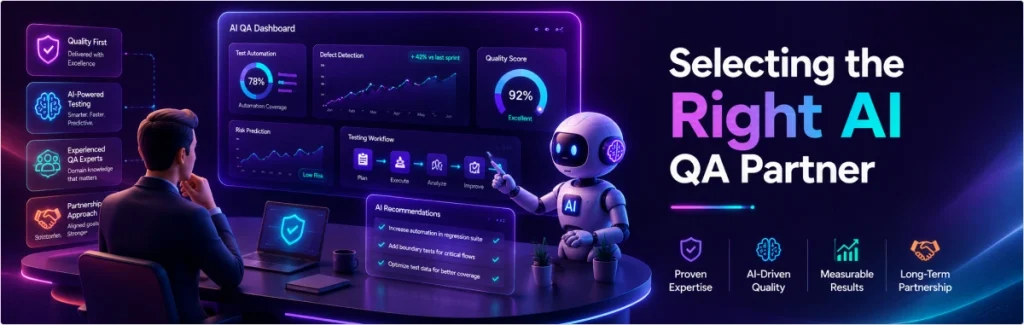
The effectiveness of AI-driven QA depends heavily on execution. Organizations must evaluate their readiness across multiple dimensions. Data quality is foundational; without clean, well-governed data, even advanced models will underperform.
Equally important is alignment with business outcomes. The success of AI in QA should be measured in terms of reduced defect leakage, faster release cycles, and improved deployment confidence, not just technical metrics. Integration capability is another critical factor. AI solutions must operate within existing ecosystems rather than requiring disruptive changes.
Finally, customization is non-negotiable for most enterprises. QA processes are deeply intertwined with business logic and regulatory requirements, making one-size-fits-all solutions insufficient.
Common Pitfalls in AI-Driven QA Adoption
Despite its potential, many organizations struggle to realize value from AI in QA, not because of technological limitations, but because of strategic missteps.
A common mistake is treating AI as a standalone tool rather than an integrated system. Without embedding it into workflows and decision processes, its impact remains limited. Data quality is another frequent challenge. Incomplete or inconsistent datasets undermine model accuracy, leading to unreliable outputs.
Some organizations also fall into the trap of over-automation, focusing on execution speed without prioritization. This recreates the same inefficiencies AI is meant to solve. Equally problematic is the lack of alignment between QA and business risk. Without a clear understanding of what matters most, even intelligent systems can optimize for the wrong outcomes.
Finally, organizational readiness is often underestimated. AI adoption requires not just technical change, but cultural and process transformation.
Strategic Takeaway
AI in testing and QA is not about doing more; it is about deciding better. Enterprises that embrace this shift move from reactive validation to predictive quality engineering. The result is not just fewer defects, but a fundamentally more reliable and scalable approach to software delivery.
The competitive advantage lies in precision. Organizations that can identify and address risk before it manifests in production will outperform those that rely on coverage alone. The path forward is clear. Success will not come from adopting tools in isolation, but from building integrated, data-driven QA systems supported by structured execution and tailored solutions.
In the end, AI does not replace QA; it elevates it into a strategic function at the core of modern software engineering.
FAQ’s
1. What is AI-driven testing and QA?
AI-driven QA uses machine learning and data analysis to predict defects, optimize test execution, and prioritize high-risk areas, shifting testing from static validation to dynamic, intelligence-led processes.
2. How does AI help reduce defects before production deployment?
AI analyzes historical defects, code changes, and system behavior to identify high-risk areas, enabling teams to focus testing efforts where failures are most likely to occur before release.
3. Why is traditional QA insufficient for modern enterprise systems?
Traditional QA relies on predefined test cases and equal coverage, which struggles to keep up with complex, distributed architectures and rapid release cycles, often missing critical failure points.
4. Does AI replace manual testing in QA processes?
No, AI augments manual testing by automating repetitive tasks and providing risk insights, allowing testers to focus on complex scenarios, edge cases, and exploratory validation.
5. What are the key benefits of implementing AI in QA?
Organizations typically see reduced defect leakage, faster testing cycles, improved test efficiency, lower maintenance effort, and higher confidence in production releases.
6. What challenges should organizations expect when adopting AI in QA?
Common challenges include poor data quality, integration complexity, lack of process maturity, and the need for organizational change to align workflows with AI-driven decision-making.
7. How should enterprises approach AI implementation in QA?
A structured approach is essential, starting with data readiness, followed by model development, seamless integration into DevOps pipelines, and aligning QA outcomes with business risk and performance goals.