AI and Machine Learning have moved beyond hype; they’re now essential drivers of competitive advantage. Whether you’re a CIO at a Fortune 500 company, a CTO leading a fast-scaling startup, or a business owner exploring automation, you know that the right tools can make or break your AI journey. But here’s the challenge: the AI/ML landscape is evolving at breakneck speed. New platforms, frameworks, and APIs emerge every quarter, promising better accuracy, faster processing, and easier integration. The question isn’t whether to adopt them; it’s which ones will deliver measurable results.
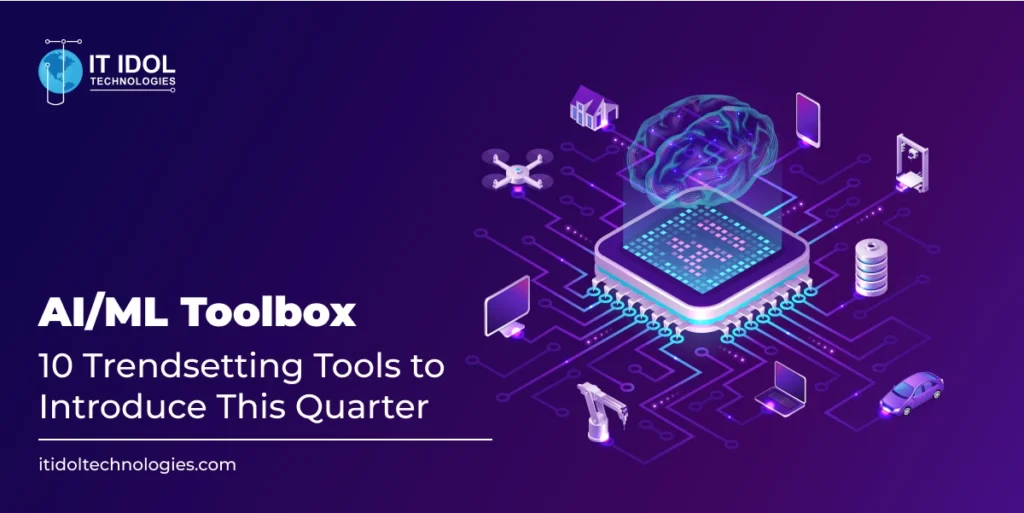
In this guide, we’ll unpack 10 trendsetting AI/ML tools that are making waves right now. These are not just “nice-to-have” technologies; they’re tools that can transform how your teams build models, analyze data, and deploy AI-driven solutions. Along the way, we’ll explore real-world use cases, adoption tips, and a roadmap to help you introduce these tools effectively this quarter.
Why This Topic Is Urgent Right Now
The AI/ML sector is in the middle of its fastest adoption cycle ever. According to IDC, global AI spending will hit $500 billion by 2027, growing at an annual rate of over 19%. Gartner reports that 41% of enterprises have already deployed AI in at least one function, while another 33% are in pilot phases.
Three trends make this quarter a pivotal moment for AI tool adoption:
Generative AI maturation — Models like GPT-4, Claude, and Gemini are driving sophisticated applications beyond text, including image generation, code completion, and autonomous decision-making.
AI democratization — Tools now require less coding expertise, empowering business analysts, marketers, and domain experts to build AI solutions.
Competitive urgency — Early adopters are reporting significant cost savings, faster product launches, and higher customer engagement.
If you wait too long, your competitors may leap ahead not because they have bigger budgets, but because they’re leveraging the right AI/ML toolbox at the right time. This growing competitive pressure is also one reason mid-sized enterprises are moving faster on AI.
The 10 Trendsetting AI/ML Tools You Should Introduce This Quarter
Below are ten tools making a real impact in enterprise and startup environments. Each section includes what it does, why it matters, and how to implement it effectively.
1. TensorFlow – The All-Purpose ML Framework
TensorFlow remains a cornerstone for building and training machine learning models. Developed by Google, it supports everything from deep learning to reinforcement learning and plays an important role in building intelligent systems.
Why it’s trendsetting now:
The latest TensorFlow versions integrate seamlessly with Keras and offer improved GPU acceleration, making it easier to train massive models faster.
Actionable Use:
Build custom neural networks for predictive analytics.
Deploy trained models to mobile and edge devices using TensorFlow Lite.
2. PyTorch – Developer-Friendly Research to Production
PyTorch has grown from a research favorite to a production-ready framework. Meta’s backing and strong community support mean rapid innovation.
Why it’s trendsetting now:
Dynamic computation graphs allow more flexibility during model experimentation—critical for R&D teams iterating quickly.
Actionable Use:
Prototype models in research, then transition them to deployment with TorchServe.
Integrate with Hugging Face for NLP tasks.
3. Hugging Face Transformers – Pre-Trained Models at Your Fingertips
Hugging Face offers a massive library of pre-trained models for NLP, vision, and multimodal tasks.
Why it’s trendsetting now:
It drastically reduces development time by letting you fine-tune powerful models instead of training from scratch.
Actionable Use:
Deploy sentiment analysis or question-answering models for customer service.
Fine-tune vision transformers for image classification tasks.
4. Weights & Biases (W&B) – ML Experiment Tracking
Managing ML experiments can get messy fast. W&B provides dashboards to track hyperparameters, results, and model performance in real time.
Why it’s trendsetting now:
Better experiment tracking leads to faster iteration and fewer costly mistakes.
Actionable Use:
Use in collaborative teams to ensure reproducibility.
Integrate with TensorFlow, PyTorch, or JAX pipelines.
Snowflake’s AI capabilities enable in-database ML model deployment, reducing data movement overhead.
Why it’s trendsetting now:
It allows enterprises to leverage their existing Snowflake investment for AI workloads.
Actionable Use:
Run sentiment analysis directly in your data warehouse.
Implement anomaly detection on transactional data.
10. MLflow – End-to-End ML Lifecycle Management
MLflow is an open-source platform for managing the complete ML lifecycle from experiment tracking to model registry and deployment.
Why it’s trendsetting now:
It’s becoming the standard for enterprises seeking reproducibility and governance in AI projects, two factors that can help organizations avoid common reasons AI projects fail.
Actionable Use:
Standardize ML workflows across teams.
Integrate with CI/CD pipelines for continuous model delivery.
Best Practices for Introducing AI/ML Tools This Quarter
1. Start with a Pilot Project — Test each tool on a low-risk but high-visibility use case. An AI consulting approach can also help identify the right use cases before committing resources to wider adoption.
2. Focus on Integration — Choose tools that work well with your existing tech stack and consider how new AI dependencies could contribute to technical debt in AI-assisted development.
3.Prioritize Governance — Implement experiment tracking and model registries from the start.
4.Upskill Your Team — Provide training on tool usage to avoid adoption bottlenecks.
5.Measure ROI Early — Use KPIs like time-to-deploy, accuracy improvements, and business impact.
Conclusion
AI and ML tools are no longer niche; they’re the backbone of modern digital transformation. The 10 trendsetting tools we’ve covered here are shaping the future of AI software development, and introducing them this quarter could mean a competitive edge for years to come.