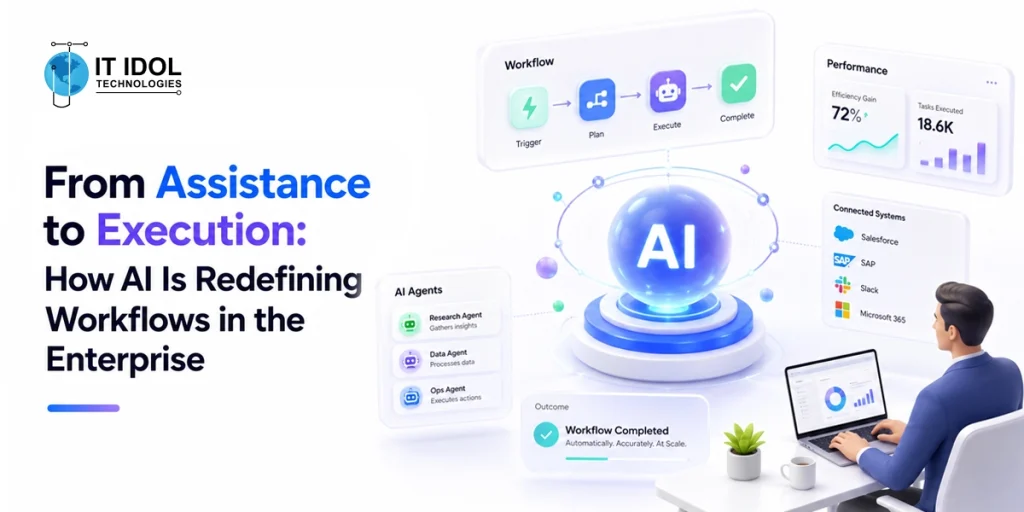
The defining shift in enterprise AI is not improved productivity; it is the transfer of execution. What began as assistive tooling has evolved into systems that can initiate, sequence, and complete work across functions.
This changes the role of humans from operators of tasks to validators of outcomes, and it forces a re-architecture of workflows, accountability, and control systems. Organizations that treat AI as “faster software” will underperform; those that treat it as an execution layer will redesign how work actually gets done.
What Does It Mean for AI to Move from Assistance to Execution?
AI becomes an execution layer when it no longer waits for step-by-step human input but instead orchestrates multi-step tasks end-to-end within defined constraints. This includes drafting documents, generating code, synthesizing research, triggering workflows, and integrating across enterprise systems without continuous human intervention.
In practice, this means that work is no longer decomposed into micro-tasks assigned to individuals. Instead, work is defined as an outcome, and AI systems determine the sequence of actions required to achieve it.
For example, a product team requesting a market analysis no longer briefs an analyst, waits for iterations, and consolidates insights manually. An AI system can gather data, synthesize insights, structure outputs, and present a near-final deliverable requiring human input only for validation, contextual judgment, and strategic framing.
This transition introduces a critical distinction: assistance reduces effort; execution reduces ownership of the process. Enterprises must decide where they are comfortable relinquishing control over the “how” of work while retaining control over the “what” and “why.”
Takeaway: AI shifts value creation from task execution to outcome validation, forcing organizations to redefine ownership, accountability, and control boundaries.
How Do Workflows Change When AI Becomes the Primary Executor?
Traditional workflows are linear, role-based, and dependency-heavy. AI-driven workflows are parallelized, outcome-oriented, and system-coordinated. The change is structural, not incremental.
In a conventional enterprise workflow, each stage, research, analysis, drafting, and review, is owned by different roles with handoffs between them. This creates latency, coordination overhead, and variability in output quality. When AI executes workflows, these stages collapse into a continuous process managed by a system that can iterate instantly and maintain internal consistency.
For example, in software development, AI can simultaneously generate code, write tests, document functionality, and identify potential vulnerabilities. The workflow is no longer sequential; it is synchronized. Human involvement shifts to reviewing architectural decisions, validating edge cases, and ensuring alignment with business objectives.
However, this introduces a new dependency: the quality of the workflow is now determined by how well the system configures its prompts, constraints, integrations, and feedback loops. Poorly designed AI workflows can scale errors faster than traditional processes.
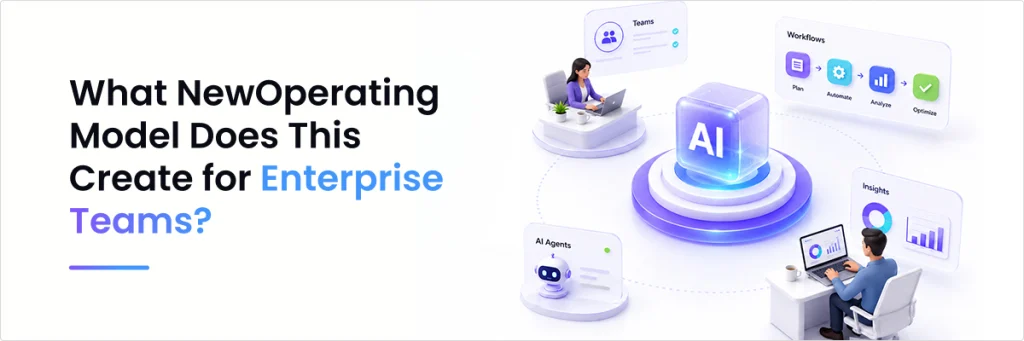
What New Operating Model Does This Create for Enterprise Teams?
As AI takes over execution, teams transition from “doers” to “orchestrators.” This requires a new operating model built around three distinct roles: instruction, supervision, and assurance.
Instruction involves defining the objective, constraints, and success criteria in a way that AI systems can interpret. This is not traditional requirement gathering; it is a new discipline of translating business intent into executable system logic.
Supervision involves monitoring AI outputs in real time, identifying deviations, and refining system behaviour. Unlike traditional management, supervision is continuous and data-driven rather than episodic.
Assurance involves validating outcomes against business, regulatory, and quality standards. This is where human judgment remains critical, particularly in high-stakes environments.
In practice, this model reduces the need for large execution teams but increases the demand for high-leverage roles that can design, guide, and validate AI-driven processes. It also blurs the boundaries between functions, product, engineering, operations, and analytics, which become more tightly integrated because the execution layer spans all of them.
Organizations that fail to redefine roles will encounter friction, with teams either underutilizing AI or duplicating work unnecessarily.
Takeaway: The enterprise operating model shifts from role-based execution to system-based orchestration, requiring new capabilities in instruction, supervision, and assurance.
How Should Enterprises Decide What Work to Hand Over to AI?
Not all workflows are equally suited for AI execution. The decision to delegate work should be based on three criteria: determinism, tolerance for error, and reversibility.
Determinism refers to how clearly the task can be defined in terms of inputs and expected outputs. Tasks with well-defined parameters, such as report generation, code scaffolding, or data transformation, are strong candidates for AI execution.
Tolerance for error reflects the acceptable level of risk. High-stakes decisions with low error tolerance, such as financial approvals or regulatory compliance, require more human oversight, even if AI is involved.
Reversibility considers how easily errors can be corrected. Tasks where mistakes can be quickly identified and fixed, such as drafting internal documents, are more suitable for full AI execution than tasks with irreversible consequences.
For example, a marketing team might fully automate content generation for internal use but retain human control over external messaging. A finance team might use AI for data analysis, but require human approval for final decisions.
The key is not to ask “Can AI do this?” but “Should AI own this end-to-end?” This distinction determines where value is created and where risk is introduced.
Takeaway: Effective AI adoption depends on selectively delegating work based on determinism, risk tolerance, and reversibility, not on technological capability alone.
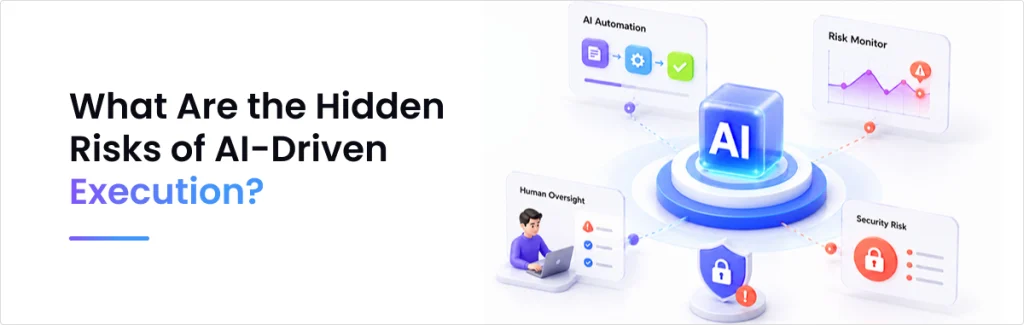
What Are the Hidden Risks of AI-Driven Execution?
The most significant risk is not inaccuracy; it is misaligned execution at scale. AI systems can produce outputs that are internally consistent but strategically incorrect, and they can do so rapidly across multiple workflows.
One common failure mode is over-automation, where organizations delegate too much too quickly without establishing robust validation mechanisms. This leads to a loss of situational awareness, where teams no longer fully understand how outcomes are being produced.
Another risk is the erosion of institutional knowledge. As AI systems take over execution, human expertise may atrophy, reducing the organization’s ability to intervene effectively when systems fail or behave unexpectedly.
There is also the challenge of accountability. When outcomes are generated by AI systems, it becomes less clear who is responsible for errors: the individual who configured the system, the team that validated the output, or the organization that deployed the technology.
In regulated industries, these risks are amplified by compliance requirements, which often demand explainability and auditability that AI systems may not inherently provide.
Mitigating these risks requires designing workflows with explicit checkpoints, maintaining human-in-the-loop mechanisms for critical decisions, and ensuring that system behavior is transparent and traceable.
Takeaway: The primary risk of AI execution is not isolated errors but systemic misalignment, which must be managed through governance, transparency, and human oversight.
How Do You Implement AI Execution Without Disrupting the Organization?
Successful implementation is less about deploying tools and more about redesigning workflows incrementally. Organizations that attempt large-scale transformation often encounter resistance, confusion, and operational disruption.
A more effective approach is to identify high-impact, low-risk workflows and transition them to AI execution in controlled environments. This allows teams to build confidence, refine processes, and establish best practices before scaling.
For example, an enterprise might start by automating internal reporting processes, where the impact of errors is limited and easily corrected. Over time, the scope can expand to more complex workflows, such as customer support or product development.
Crucially, implementation should include feedback loops that capture how AI systems perform in real-world conditions. This data is essential for improving system accuracy, refining workflows, and identifying new opportunities for automation.
Leadership plays a critical role in setting expectations and aligning incentives. If teams are evaluated based on traditional metrics such as hours worked or tasks completed, they will resist adopting AI-driven workflows. Metrics must shift to outcomes, efficiency, and quality.
Takeaway: AI execution should be implemented through incremental workflow redesign, supported by feedback loops and aligned incentives, rather than large-scale, top-down transformation.
What Does Success Actually Look Like in Practice?
Success in AI-driven workflows is not measured by how much work is automated but by how effectively outcomes are delivered with minimal friction and maximum reliability.
In high-performing organizations, AI systems operate as an invisible layer that continuously executes tasks, while humans focus on strategic decisions, exception handling, and innovation. Workflows are faster, more consistent, and less dependent on individual performance.
However, success also requires maintaining a balance between automation and control. Organizations that over-optimize for efficiency may sacrifice flexibility and resilience, while those that retain too much manual intervention may fail to capture the full benefits of AI.
A practical indicator of success is the reduction in coordination overhead, fewer meetings, fewer handoffs, and fewer delays, combined with improved output quality and faster time-to-decision.
Another indicator is the organization’s ability to adapt workflows quickly in response to changing conditions. AI-driven systems should not only execute tasks but also enable rapid reconfiguration of processes.
Takeaway: True success is achieved when AI-driven execution reduces friction, improves consistency, and enhances organizational agility without compromising control or accountability.
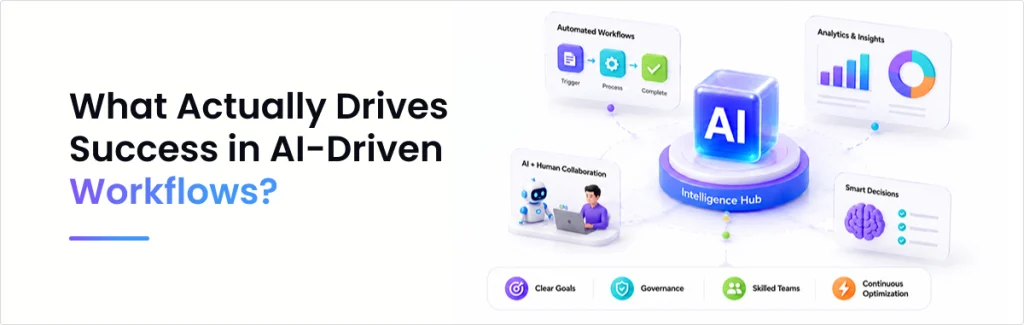
What Actually Drives Success in AI-Driven Workflows?
The transition from assistance to execution is not a technological upgrade; it is an operational transformation. The organizations that succeed are those that redesign workflows, redefine roles, and establish clear decision frameworks for delegating work to AI.
Three factors ultimately determine success. First, clarity of intent, defining outcomes, constraints, and success criteria in a way that AI systems can execute reliably. Second, the strength of governance ensures that execution is aligned with business objectives and risks are managed effectively. Third, adaptability continuously refines workflows based on real-world performance and changing conditions.
Enterprises that approach AI as an execution layer will unlock fundamentally new levels of efficiency and scalability. Those who treat it as a productivity tool will achieve incremental gains but miss the larger opportunity.
The question is no longer whether AI can assist work. It is whether organizations are prepared to let it execute and whether they have the systems, structures, and discipline to manage that shift effectively.
AI is no longer limited to supporting employees with recommendations or content generation. Modern AI systems are increasingly capable of executing multi-step operational tasks such as workflow orchestration, data processing, reporting, customer interactions, testing, and decision support with minimal human intervention.
Traditional enterprise workflows were designed around manual coordination, approvals, and repetitive operational tasks. AI is redefining these workflows by automating execution layers, reducing dependency on manual intervention, accelerating process completion, and enabling real-time operational responsiveness across departments.
Organizations are moving toward AI execution systems because productivity improvements alone are no longer sufficient for competitive advantage. Enterprises now require AI systems that can actively manage operational workflows, reduce execution delays, improve scalability, and increase overall business efficiency.
AI-driven execution improves productivity by automating repetitive tasks, reducing operational bottlenecks, accelerating decision-making, and enabling teams to focus on higher-value strategic work. This allows enterprises to increase output without proportionally increasing operational complexity or workforce overhead.
AI is transforming functions such as software development, customer support, finance operations, HR workflows, IT operations, supply chain management, marketing automation, and enterprise analytics. Many organizations are using AI to streamline cross-functional processes that previously required extensive manual coordination.
Common challenges include fragmented systems, unclear process ownership, poor data quality, governance gaps, employee resistance, and integration complexity across legacy infrastructure. Enterprises often discover that inefficient workflows become more visible when AI is introduced into operational environments.
AI reduces the need for manual execution in repetitive and process-heavy workflows, but human oversight remains essential for governance, strategic decisions, exception handling, and business-critical validations. The role of employees is increasingly shifting from performing tasks to supervising, validating, and optimizing AI-driven systems.
AI-powered workflows allow organizations to scale operations more efficiently without linearly increasing staffing requirements. By automating execution processes across departments, enterprises can handle larger operational volumes, faster delivery cycles, and more complex workflows with improved consistency and lower operational friction.
AI systems amplify the strengths and weaknesses of existing operational structures. Enterprises that redesign workflows before implementing AI execution systems are better positioned to eliminate inefficiencies, simplify dependencies, and achieve measurable operational improvements at scale.
AI-driven execution is reshaping enterprise operating models by creating more autonomous, data-driven, and continuously optimized workflows. Over time, organizations are expected to transition from human-centric execution models toward hybrid operating environments where AI systems handle execution while humans focus on strategy, governance, and innovation.
Deval Rathod
Founder & CEO
|
Deval Rathod is the Founder and CEO of IT IDOL Technologies, a custom software development company. With over a decade of experience in software engineering, solution architecture, and technology leadership, she has worked across custom software development, enterprise applications, AI & ML, and digital transformation. Her expertise includes guiding technology teams, designing scalable software solutions, and helping businesses evaluate and implement emerging technologies. She contributes insights on software engineering, artificial intelligence, enterprise technology, and digital transformation.