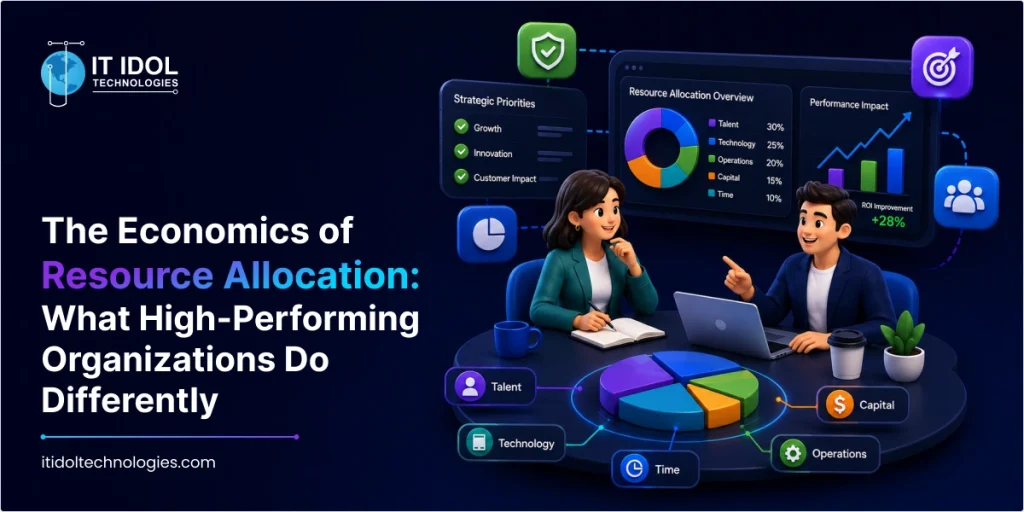
Resource allocation is one of the most consequential decisions a leadership team makes and one of the most poorly executed. It sounds operational. It is, in fact, deeply strategic. Where an organization directs its capital, talent, and technological capacity in any given year determines not just its efficiency but also its competitive trajectory over the next three to five years. The gap between organizations that allocate resources dynamically and those that don’t is marginal; it is structural.
According to McKinsey research, 83% of senior executives identify resource reallocation as the single most important management lever for spurring growth more impactful than operational excellence or M&A. And yet, a third of the companies in the same study reallocated just 1% of their capital year to year, with the average sitting at a modest 8%. The strategic intent exists. The execution does not keep pace. That disconnection is exactly where value is lost.
Why Most Resource Allocation Frameworks Fail Before They Start
The most common failure in resource allocation isn’t a lack of data or ambition; it’s a structural bias toward continuity. Most organizations run budgeting processes that are, at their core, inheritance mechanisms. Last year’s allocation becomes this year’s baseline. Business unit leaders negotiate incremental changes. The result is a portfolio frozen in time, funded by yesterday’s strategic logic.
McKinsey’s analysis found that only about 30% of executives say their current budgets across capital expenditures, product development, and sales and marketing are actually similar or very similar to their companies’ most recent strategic plans. That means roughly 70% of organizations are executing a budget that has already diverged from the strategy it was meant to fund. Strategy and spend have decoupled, and the organization is essentially funding the past while planning for the future.
The fix is not a better spreadsheet. It is a fundamentally different governance model: one where resource allocation decisions are made in explicit, visible relationship to strategic priorities reviewed not once annually but dynamically throughout the year as conditions evolve.
The Compounding Return of Dynamic Reallocation
When organizations move from static to dynamic resource allocation, the return differential is not linear; it compounds. McKinsey research tracking shareholder returns across more than 1,600 companies found that active reallocators delivered average annual returns of 10% to shareholders, compared to just 6% for sluggish reallocators a four-percentage-point gap that, over a decade, transforms into a dramatically different competitive position.
The mechanism behind this is not complexity. It is opportunity cost visibility. When capital and talent are embedded in legacy functions or underperforming units, the organization is implicitly making a choice: it is choosing those functions over the alternatives. Active reallocators make that trade-off explicit. They ask, at every planning cycle, whether the resources currently deployed in a given area would generate more value deployed elsewhere. This question is simple in principle, politically difficult in practice, and separates value-creating organizations from value-preserving ones.
The takeaway for decision-makers is precise: the return on improving your resource allocation process exceeds most operational improvements, and it does not require additional investment, only a redeployment of what already exists.
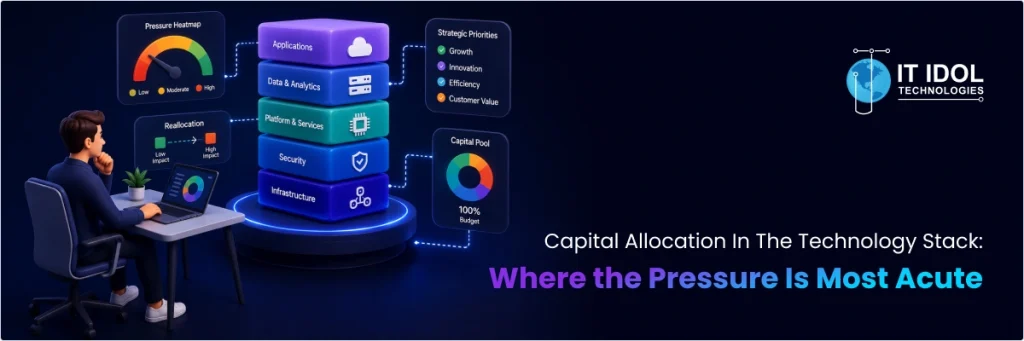
Capital Allocation in the Technology Stack: Where the Pressure Is Most Acute
For technology organizations specifically, the economics of resource allocation have been reshaped by the shift from capital expenditure to operational expenditure models. According to Gartner’s 2025 CIO Agenda, as cited by McKinsey, 79% of IT spend now flows to operating expenditures, driven by cloud adoption and as-a-service models. This shift creates a materially different allocation problem: instead of managing a multi-year capital decision (a data center, a server contract, a license), leaders are managing ongoing consumption patterns that are granular, variable, and visible.
The organizations that are winning this transition are those treating technology spend as a strategic portfolio, not an infrastructure cost. McKinsey’s own analysis found that enterprises with high-performing IT organizations achieve up to 35% higher revenue growth and 10% higher profit margins than their peers. Those outcomes do not emerge from cost-cutting; they emerge from precise investment in the highest-return technology capabilities, funded by disciplined reallocation away from low-value legacy spending.
The rise of FinOps as an operational discipline is a direct consequence of this shift. Organizations are building dedicated functions to manage technology spend at the unit cost level cost per prompt, cost per API call, cost per compute hour because the granularity of cloud and AI consumption makes this level of visibility both possible and necessary. For CIOs and CFOs, the collaboration imperative has never been clearer.
Talent as the Invisible Allocation Problem
Capital allocation gets the most boardroom attention, but talent allocation may carry the higher cost when mismanaged. Deploying the wrong people on the wrong priorities is not just inefficient; it is competitively self-defeating. High-capability individuals assigned to low-leverage work generate a fraction of the value they could, and they exit organizations that keep doing it.
Deloitte’s 2024 Global Human Capital Trends research, drawing on responses from over 14,000 business and HR leaders across 95 countries, found that 73% of respondents believe it is important to ensure human capabilities keep pace with technological innovation, but just 9% say they are actually making progress toward that balance. The gap between organizational aspiration and talent deployment reality is not a skills shortage problem. It is an allocation problem.
Effective talent allocation requires treating your workforce as a portfolio, not as a hierarchy. The question is not “who reports to whom?” but “what are the highest-value problems in the organization right now, and who has the capability regardless of current role to work on them?” This is skills-based organization design in practice. It demands visibility into actual competencies, agile deployment mechanisms, and leadership tolerance for short-term disruption in exchange for long-term capability advantage.
The organizations that embed talent reallocation into their quarterly business rhythms, not just annual performance cycles, consistently outperform peers across both retention and productivity metrics. The management overhead is real. The return is larger.
The AI Investment Allocation Trap: Pilots Without Pathways
Among all the resource allocation decisions facing enterprise leadership today, AI investment is the most prone to structural failure, not because the technology underperforms, but because the allocation decisions around it are made without a deployment framework.
IDC research found that 88% of AI proofs-of-concept never reach production. The average enterprise loses between $500,000 and $3 million on failed AI pilots when factoring in technology costs, consulting fees, and opportunity cost. These are not isolated anecdotes; they represent a systemic misallocation of AI investment: resources directed at demonstration, not deployment.
The distinction matters economically. A proof-of-concept that never scales consumes capital, consumes engineering talent, and consumes executive attention, all of which have alternative uses. The organizations capturing real AI value are not running more pilots. They are making harder allocation decisions: selecting fewer use cases, funding them to production readiness, and building the data and integration infrastructure required to sustain them.
Google Cloud’s 2025 research across 3,466 senior leaders in 24 countries found that 74% of organizations achieving ROI from AI did so within the first year of deployment, suggesting the bottleneck is not time-to-value but the decision to commit enough resources to reach production. McKinsey’s analysis reinforces this divide: only 6% of organizations qualify as AI high performers, those achieving 5% or more EBIT impact, while 39% report any enterprise-level financial impact at all. The gap between these two groups is not a function of model selection or technology vendor. It is a function of organizational resource commitment to seeing AI through from pilot to operating reality.
For CXOs, the actionable implication is this: stop allocating AI investment across ten initiatives and start allocating it deeply into three. Resource concentration creates deployment momentum. Resource dispersion creates pilot portfolios that never generate returns.
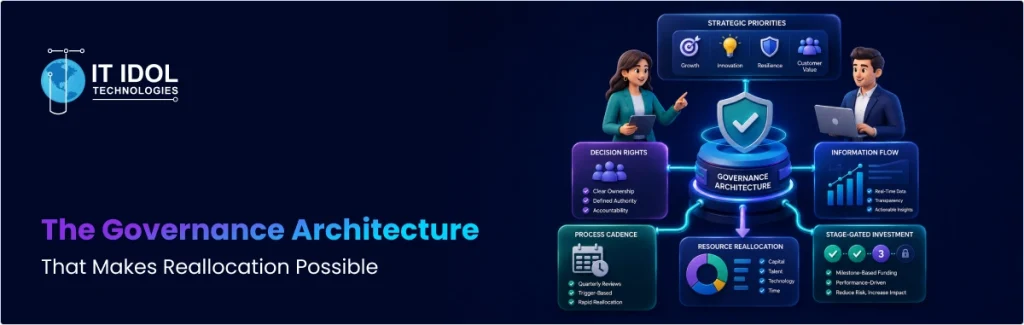
The Governance Architecture That Makes Reallocation Possible
Dynamic resource allocation does not happen by intention alone. It requires a governance architecture with the decision rights, process cadences, and information flows that make real-time reallocation operationally possible. Without this, even well-intentioned leadership teams revert to inertia when pressured.
McKinsey recommends maintaining a portfolio of ten to thirty essential strategic initiatives at the enterprise level, enough to create meaningful coverage of strategic priorities, compact enough to maintain genuine focus and accountability. More than thirty initiatives is not a portfolio; it is a list of intentions that diffuses attention and becomes impractical to manage.
Effective governance includes three structural elements that most organizations lack. First, a separation between baseline budget (what is needed to keep the business running) and strategic investment budget (what is directed at growth priorities) because combining them structurally biases toward continuity. Second, a defined mechanism for in-year reallocation: a quarterly or trigger-based investment committee with actual authority to move resources between initiatives, not merely to advise on them. Third, stage-gating: the practice of releasing resources in tranches contingent on performance milestones, which both protects against over-commitment to underperforming initiatives and creates a forcing function for honest progress assessment.
McKinsey’s research is unambiguous on one governance requirement: CEO engagement is non-negotiable. Resource allocation decisions that are delegated to CFOs and business unit heads without direct CEO involvement drift toward political compromise rather than strategic optimization. The CEO’s role is not to manage every line item; it is to set and defend the portfolio logic, ensuring that the organization’s resource choices actually express its strategic priorities rather than just reflecting its existing organizational structure.
What Actually Drives Success: A Synthesis for Decision-Makers
Every insight in this piece points to a common root: the organizations that outperform on resource allocation treat it as a strategic discipline, not a financial process. The companies destroying value and there are many treat allocation as budgeting with a strategy narrative attached. The companies creating durable competitive advantage treat it as the primary mechanism through which strategy becomes real.
Three operating principles separate the leaders from the laggards. The first is ruthlessness about portfolio concentration: high-performing allocators make large, committed bets on fewer priorities rather than modest, hedged investments across many. This requires leadership confidence and political courage that institutional processes tend to dilute. The second is cadence discipline: dynamic allocation requires regular, structured decision-making forums, not annual planning events, but quarterly reviews with real authority and real data. The third is execution honesty: the willingness to call underperforming investments what they are, and move resources without waiting for a natural budget cycle to provide cover.
The economics of resource allocation are ultimately the economics of strategic discipline. In an environment where AI investment, talent scarcity, and technology complexity are all competing for finite organizational capacity simultaneously, the organizations that can concentrate, commit, and course-correct with speed and clarity will compound advantages that less disciplined competitors cannot close through operational execution alone.
The question is not whether your organization has enough resources. It is whether the resources you have are working on the right things and whether your leadership architecture gives you the authority and visibility to change that when they are not.
FAQs
1. What is resource allocation in business?
Resource allocation is the process of assigning people, budgets, technology, and time to initiatives that deliver the highest strategic value and business impact.
2. Why is resource allocation important for organizational performance?
Effective resource allocation helps organizations maximize productivity, reduce waste, improve decision-making, and achieve strategic objectives more efficiently.
3. How do high-performing organizations allocate resources differently?
They prioritize investments based on data, business outcomes, and long-term goals rather than departmental politics, historical spending patterns, or assumptions.
4. What are the biggest resource allocation mistakes companies make?
Common mistakes include spreading resources too thin, funding low-value projects, ignoring performance data, and failing to adapt to changing business priorities.
5. How can businesses improve resource allocation efficiency?
Organizations can improve efficiency by using data-driven planning, regularly reviewing priorities, tracking outcomes, and reallocating resources based on performance.
6. What role does data play in resource allocation decisions?
Data provides visibility into resource utilization, project performance, costs, and opportunities, enabling more informed and objective allocation decisions.
7. How does strategic resource allocation impact profitability?
By directing resources toward high-return initiatives, organizations can improve operational efficiency, accelerate growth, and increase overall profitability.
8. What frameworks help organizations prioritize resources effectively?
Frameworks such as OKRs, portfolio management, value-based prioritization, and strategic planning models help align resources with business objectives.
9. How can leaders identify underutilized resources within their organization?
Regular audits, utilization reports, performance metrics, and workflow analysis can reveal unused capabilities, redundant tools, and inefficiencies.
10. What metrics should organizations track to measure resource allocation success?
Key metrics include resource utilization rates, project ROI, productivity levels, budget efficiency, time-to-value, and achievement of strategic goals.