There is a meaningful difference between an industry that uses artificial intelligence and one that is being fundamentally restructured by it. For most of the previous decade, BFSI institutions occupied the former category, deploying machine learning models in targeted applications, piloting automation in back-office workflows, and integrating AI capabilities into specific product lines without altering the foundational architecture of how financial organizations think, decide, and operate.
That equilibrium has broken. What enterprise leaders across banking, financial services, and insurance are now confronting is a category shift: from AI as a functional tool to AI as an institutional operating layer, one that is beginning to reshape credit infrastructure, customer engagement models, regulatory compliance architecture, and risk intelligence in ways that are simultaneously strategic and irreversible.
This article examines the substantive dimensions of that shift. Not the speculative possibilities of AI, but the operational realities that BFSI decision-makers are managing today: the architectural demands, the organizational tensions, the governance imperatives, and the competitive dynamics that are separating institutions that are genuinely transforming from those that are applying innovation cosmetics to legacy operating models.
Why This Moment Is Structurally Different From Earlier AI Cycles
BFSI has engaged with computational intelligence in various forms for decades. Actuarial modeling, quantitative risk frameworks, algorithmic trading systems, and early expert systems all introduced machine-driven decision support into financial operations long before “artificial intelligence” became a mainstream topic of conversation in enterprise. Understanding why the current moment represents a qualitative departure, rather than simply a more powerful iteration of familiar technology, is essential to grounding strategy in reality rather than in cycle-driven enthusiasm.
Three converging conditions distinguish the present enterprise AI era in financial services from its predecessors.
The first is the shift from narrow, domain-specific models to foundation models capable of broad contextual reasoning. Earlier AI deployments in BFSI were purpose-built for specific tasks a fraud detection algorithm trained on transaction patterns, an underwriting model calibrated to a specific product class. These systems performed their defined function well but could not transfer learning across domains, interpret ambiguous inputs, or generate reasoned explanations for their outputs. Large language models and multimodal foundation models fundamentally alter this constraint, enabling AI systems to operate across documents, data streams, conversational interfaces, and structured records in ways that begin to approximate cross-domain analytical capability.
The second condition is the maturation of cloud-native financial infrastructure. The migration of core banking, insurance administration, and capital markets operations toward cloud-native architectures has created the data accessibility and computational elasticity required to deploy AI at enterprise scale. AI transformation and cloud transformation are not sequential; they are architecturally interdependent, and institutions that deferred meaningful cloud migration are now encountering that deferral as a structural impediment to AI capability development.
The third condition is regulatory and competitive pressure converging simultaneously. Regulatory bodies across major economies are signaling that AI governance requirements will escalate, which is accelerating the need for institutions to build responsible AI frameworks now rather than reactively. Simultaneously, non-traditional competitors technology-native financial platforms, embedded finance providers, and AI-first neobanks are demonstrating that institutions built with AI as a native operating principle can deliver customer experiences and operational economics that legacy incumbents struggle to replicate through retrofit. These dual pressures are compressing the strategic timeline for serious transformation.
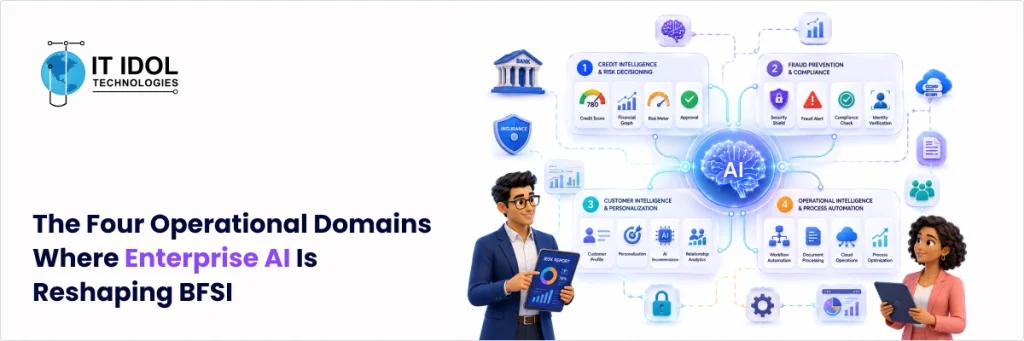
The Four Operational Domains Where Enterprise AI Is Reshaping BFSI
Understanding enterprise AI in financial services requires examining where it is generating substantive operational change not in theory, but in the actual workflows, decision processes, and institutional capabilities that define competitive advantage in the sector.
1. Credit Intelligence and Risk Decisioning
Credit risk assessment has historically been constrained by two structural limitations: the quality and coverage of available data, and the interpretive capacity of the models applied to that data. Traditional credit scoring frameworks were built on a narrow set of financial variables payment history, utilization rates, and credit tenure that systematically underrepresented the creditworthiness of segments whose financial behavior did not conform to those indicators. This created both a commercial limitation (institutions unable to serve addressable market segments) and an equity concern (systematic exclusion of populations whose risk profiles were misread by inadequate models).
Enterprise AI is beginning to alter both constraints. Machine learning models that incorporate broader data sets, including behavioral signals, cash flow patterns, and alternative financial history, are enabling more granular and accurate risk segmentation across borrower populations. More significantly, AI-driven credit infrastructure is enabling dynamic risk assessment: the capacity to continuously update credit evaluations based on evolving borrower behavior rather than relying on periodic static snapshots.
The organizational implication is significant. Credit functions that adapt to enterprise AI must evolve from being model-governance teams overseeing periodic scorecards to becoming continuous intelligence operations monitoring model performance in real time, managing distribution shift as economic conditions change, and maintaining the explainability frameworks that regulators and customers both require.
2. Fraud Prevention and Financial Crime Compliance
Financial crime detection represents perhaps the most commercially validated application of AI in BFSI, and it remains an area of active and consequential development. The adversarial nature of fraud, where perpetrators continuously evolve their methods in response to detection countermeasures, creates a domain where static rule-based systems are inherently limited. An enterprise AI approach to fraud prevention treats detection not as a fixed ruleset but as an adaptive system that learns from emerging patterns, adjusts its sensitivity thresholds dynamically, and coordinates signals across transaction channels, identity verification systems, and behavioral analytics simultaneously.
What is less frequently discussed is the organizational complexity this introduces. Adaptive fraud systems generate more nuanced alert profiles than binary rule-based flags, which means the human analysts and investigators who act on those alerts must develop the interpretive capacity to work meaningfully with probabilistic outputs rather than deterministic triggers. This is a workforce capability challenge as much as a technology architecture challenge, and institutions that invest only in the AI layer without investing in the human-AI collaboration design are likely to find that false positive rates remain elevated, and analyst productivity gains fail to materialize.
Anti-money laundering and sanctions compliance represent an adjacent domain where AI is delivering genuine operational value, primarily through the reduction of false positive alerts, which consume substantial investigator time in conventional transaction monitoring systems, and through the integration of network-level analysis that can identify structuring and layering behaviors that individual transaction rules would miss. Financial institutions exploring AI-enhanced financial crime compliance should note that regulatory expectations around model explainability are particularly demanding in this domain; the ability to provide a coherent, auditable rationale for any suspicious activity report generated with AI assistance is not optional.
3. Customer Intelligence and Hyper-Personalization
The concept of personalization in retail financial services has been present for years, but its practical expression has frequently been limited to segment-based targeting, adjusting messaging and offers based on demographic clusters and transactional cohorts rather than genuine individual intelligence. Enterprise AI creates the technical conditions for a substantively different model of customer intelligence: one grounded in real-time behavioral understanding, predictive need anticipation, and contextually adaptive engagement across channels.
The strategic value of this capability is not primarily in marketing efficiency, though that is a measurable benefit. It lies in the institution’s ability to deliver proactive financial guidance anticipating a customer’s liquidity need before it becomes a crisis, identifying a moment of financial transition that signals an opportunity to provide relevant advisory support, or calibrating risk communication to match an individual’s demonstrated financial literacy and decision-making patterns. When delivered with appropriate timing and genuine relevance, this type of engagement deepens the institutional relationship in ways that transactional interaction alone cannot.
The capability requirements for achieving genuine contextual personalization at scale are demanding. Unified customer data infrastructure integrating behavioral signals across digital channels, product usage data, service interaction history, and market context is foundational. Without this data integration, AI models for personalization are working with partial pictures, and the recommendations they generate risk being irrelevant, poorly timed, or inconsistent with the customer’s actual financial situation. For many established financial institutions, this integration challenge is the primary implementation constraint, not the sophistication of the AI models themselves.
4. Operational Intelligence and Process Automation
Beyond customer-facing and risk-oriented applications, enterprise AI is creating significant operational value in the internal workflows of financial institutions: processing, reconciliation, regulatory reporting, document management, and operational monitoring. Intelligent document processing, which applies AI to extract, classify, and validate information from unstructured documents at scale, is delivering meaningful efficiency gains in mortgage origination, insurance claims handling, trade finance, and KYC operations. These are high-volume, document-intensive processes where manual processing has historically been both expensive and error-prone.
The distinction worth emphasizing for enterprise leaders is between operational automation and operational intelligence. Automation, replacing a manual step with a programmatic one, delivers cost reduction. Operational intelligence, equipping workflow systems with the capacity to detect anomalies, identify process degradation, and surface optimization opportunities in real time, delivers adaptive operational resilience. BFSI institutions building toward the latter will find that the infrastructure investments required are substantively greater, but the competitive differentiation they enable is commensurately more durable.
The Governance Imperative: Why Responsible AI Is Not a Compliance Exercise
Financial services institutions considering enterprise AI transformation face a governance landscape that is both more complex and more consequential than the governance environment that surrounded earlier digital transformation programs. The stakes are higher because AI-influenced decisions in financial services on creditworthiness, claims assessment, fraud flagging, and investment recommendations carry direct and significant consequences for individuals, and because the systemic interconnectedness of financial institutions means that AI failures can propagate in ways that amplify rather than contain their impact.
The emerging regulatory direction across key markets is toward more structured accountability for AI in financial decision-making. The EU AI Act, which classifies certain financial AI applications as high-risk and imposes corresponding conformity requirements, represents the most comprehensive regulatory framework to date, though equivalent scrutiny is developing through other channels in multiple jurisdictions. Financial institutions operating globally must navigate a regulatory landscape that is neither uniform nor fully settled, which makes building flexible and documented governance frameworks a more valuable investment than optimizing for any single jurisdiction’s current requirements.
Several practical dimensions of AI governance merit particular attention from BFSI enterprise leaders.
Model lifecycle management the set of processes governing model development, validation, deployment, monitoring, and retirement requires both technical infrastructure and organizational discipline. Many institutions have mature model risk management frameworks for traditional quantitative models; extending those frameworks to encompass foundation models, which present distinct challenges around training data documentation, behavioral boundaries, and output variability, requires deliberate framework evolution rather than simple extension.
Explainability and auditability are requirements in financial services that create a genuine technical tension with certain classes of AI models. The most capable models for some tasks are also, by their architecture, the least inherently interpretable. Institutions must navigate the tradeoff between model performance and interpretability on a use-case-by-use-case basis, with explicit documentation of the tradeoffs made and the oversight mechanisms that compensate for reduced interpretability where complex models are deployed.
Bias monitoring and fairness assessment require ongoing operational attention, not only at the point of model deployment. The distribution of outcomes produced by AI models in credit, insurance, and other financial decision domains must be continuously monitored for disparate impact across protected characteristics, not because regulatory compliance demands it (though it does), but because systematic unfairness in AI-driven decisions represents both an ethical failure and a long-term institutional risk.
The Architecture of Enterprise AI Readiness in Financial Services
For CIOs and enterprise architects leading BFSI transformation programs, enterprise AI readiness is not a binary state but a multi-dimensional capability profile. Institutions should expect to assess their readiness across at least four architectural dimensions.
Data architecture and quality are the most foundational dimension and the one where the gap between aspiration and reality is most consistently underestimated. AI models in production are only as valuable as the data they operate on is accurate, complete, and accessible. Financial institutions that have accumulated years of data fragmentation, product-siloed systems, inconsistent customer identifiers, and unstructured records across legacy platforms face a substantive data remediation challenge before AI systems can reach their potential. This is not a problem that AI itself can solve; it requires deliberate data governance investment that precedes model deployment.
Integration infrastructure determines whether AI capabilities function as isolated intelligence or as connected components within an intelligent enterprise architecture. API-driven integration layers, event-streaming infrastructure capable of real-time data transmission, and orchestration platforms that coordinate AI-driven decisions across workflows are the integration components that separate enterprise AI from departmental AI experiments.
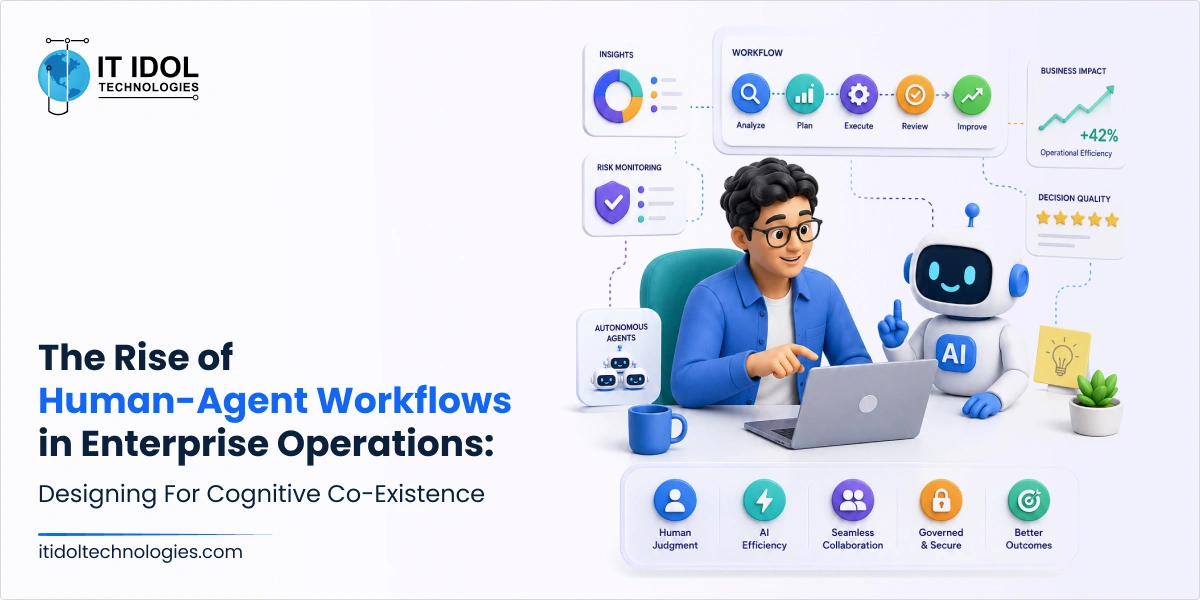
Human-AI collaboration design is an architectural dimension that is frequently underweighted relative to the technical dimensions. The interfaces through which practitioners engage with AI outputs the design of dashboards, recommendation surfaces, alert systems, and decision-support tools determine whether AI capabilities translate into improved human decision-making or whether they create new forms of friction, cognitive overload, or misplaced trust. Enterprise architects should apply the same rigor to interaction design that they apply to system integration design.
Security and resilience take on heightened significance in AI-enabled financial systems, where the attack surface includes not only conventional cyber vulnerabilities but also adversarial inputs designed to manipulate model behavior, training data integrity risks, and the operational dependencies created when critical decision processes rely on AI systems that may fail in non-obvious ways. Security architecture for enterprise AI requires deliberate extension of existing frameworks rather than assumption of coverage.
Competitive Implications: What Separates Leaders From Followers in BFSI AI Adoption
The competitive landscape in enterprise AI adoption across BFSI is stratifying. A relatively small cohort of institutions primarily large global banks, leading insurance groups, and technology-forward financial platforms has made the sustained investment in data infrastructure, talent, and organizational capability required to deploy enterprise AI at scale. A larger middle tier is making genuine progress on specific use cases while managing the complexity of transformation alongside legacy operational demands. A third group remains in an experimental phase, accumulating proof-of-concept experience without the foundational investment that would enable production-scale deployment.
The distance between the leading cohort and the experimental cohort is widening in ways that compound over time. AI-enabled institutions are generating richer proprietary data assets through their AI deployments, improving model performance iteratively in ways that are difficult to replicate through later entry. They are developing organizational capabilities, AI governance expertise, human-AI collaboration practices, and data engineering capacity that represent durable institutional advantages. And they are reshaping customer expectations in ways that create rising bars for the entire sector.
For institutions in the middle or experimental tier, the strategic imperative is to move from use-case accumulation to enterprise AI architecture development. The organizations that will close the competitive gap most effectively are not those that pursue the most impressive individual AI applications, but those that invest in the foundational architecture that allows AI capabilities to scale, integrate, and compound across the institution’s operating model.
Looking Ahead: The Next Phase of Enterprise AI in Financial Services
Several developments are likely to define the next phase of enterprise AI evolution in BFSI, and strategic leaders should be monitoring them with some precision rather than treating them as general horizon concerns.
Agentic AI systems AI architectures in which models can plan, initiate multi-step processes, and interact with external systems autonomously represent a capability frontier with substantial potential application in financial services. The prospect of AI agents that can conduct research, prepare documentation, execute workflows, and coordinate across systems without step-by-step human direction introduces significant efficiency potential in areas like commercial lending, complex claims handling, and regulatory reporting. It also introduces a new tier of governance requirements, given that agentic systems operating with greater autonomy create greater potential for consequential errors at speed. Institutions exploring agentic AI should invest in evaluation and oversight frameworks that match the autonomy level of the systems they are deploying.
Synthetic data is becoming an increasingly relevant capability for financial institutions seeking to train and validate AI models while managing data privacy and sensitivity constraints. The ability to generate realistic financial data that preserves the statistical properties required for model training, without exposing actual customer information, addresses a genuine tension in AI development within privacy-regulated industries. This is an area where both the technical capabilities and the regulatory guidance are evolving, and institutions should verify current best practices against their applicable regulatory frameworks.
Embedded intelligence across the financial ecosystem, where AI capabilities are delivered not only within institutional channels but through partner platforms, open banking interfaces, and embedded finance contexts, will increasingly require institutions to think about AI governance as an ecosystem responsibility rather than a purely internal concern. As financial intelligence travels through API layers into third-party environments, the accountability frameworks governing its behavior must travel with it.
Strategic Takeaway: Building Institutions That Learn
The most accurate way to characterize the enterprise AI era in BFSI is not as a technology transition but as a capability transition from institutions defined by their processes to institutions defined by their capacity to learn, adapt, and improve continuously at institutional scale. This framing matters for strategy because it clarifies what the investment objective actually is.
The BFSI organizations that will define the next decade of competitive advantage in financial services are those building the foundational conditions: data architecture, governance frameworks, human-AI collaboration design, organizational learning culture under which enterprise AI can function not as a project but as a permanent operating property. That is a more demanding ambition than deploying impressive models. It is also, for institutions willing to commit to it seriously, the ambition most likely to generate advantage that compounds rather than erodes.
For enterprise leaders navigating this transformation, the discipline required is less about identifying which AI capabilities to pursue and more about building the institutional conditions under which AI can be deployed, governed, and continuously improved in ways that are trustworthy, scalable, and aligned with the long-term interests of the institution, its customers, and the financial system it serves.
Enterprise AI in BFSI refers to the large-scale adoption of artificial intelligence technologies across banking, financial services, and insurance organizations to improve decision-making, automate processes, enhance customer experiences, and strengthen risk management capabilities.
Decision intelligence combines artificial intelligence, analytics, business rules, and data science to help BFSI organizations make faster, more accurate, and context-aware decisions across areas such as lending, fraud detection, underwriting, and customer service.
Banks use Enterprise AI to analyze vast amounts of structured and unstructured data in real time. Common applications include credit scoring, fraud prevention, customer segmentation, personalized product recommendations, and operational forecasting.
Traditional decision systems often operate in silos and rely heavily on static rules. BFSI organizations are redesigning decision intelligence frameworks to leverage real-time data, adaptive AI models, and continuous learning to improve agility, accuracy, and regulatory responsiveness.
Common challenges include data quality issues, legacy infrastructure constraints, regulatory compliance requirements, model explainability, cybersecurity concerns, talent shortages, and resistance to organizational change.
AI-powered fraud detection systems continuously monitor transactions, identify unusual behavioral patterns, detect anomalies in real time, and adapt to emerging fraud techniques, helping financial institutions minimize losses and improve security.
Enterprise AI can support regulatory compliance when implemented with strong governance frameworks, explainable models, transparent audit trails, data privacy controls, and ongoing monitoring aligned with industry regulations and standards.
Decision intelligence platforms in BFSI often integrate machine learning, predictive analytics, natural language processing, knowledge graphs, real-time data pipelines, cloud computing, and automation technologies to deliver intelligent business outcomes.
The future of Enterprise AI in BFSI will focus on human-AI collaboration, real-time decision orchestration, explainable AI, hyper-personalized customer experiences, autonomous financial operations, and responsible AI governance that balances innovation with trust.
Deval Rathod
Founder & CEO
|
Deval Rathod is the Founder and CEO of IT IDOL Technologies, a custom software development company. With over a decade of experience in software engineering, solution architecture, and technology leadership, she has worked across custom software development, enterprise applications, AI & ML, and digital transformation. Her expertise includes guiding technology teams, designing scalable software solutions, and helping businesses evaluate and implement emerging technologies. She contributes insights on software engineering, artificial intelligence, enterprise technology, and digital transformation.