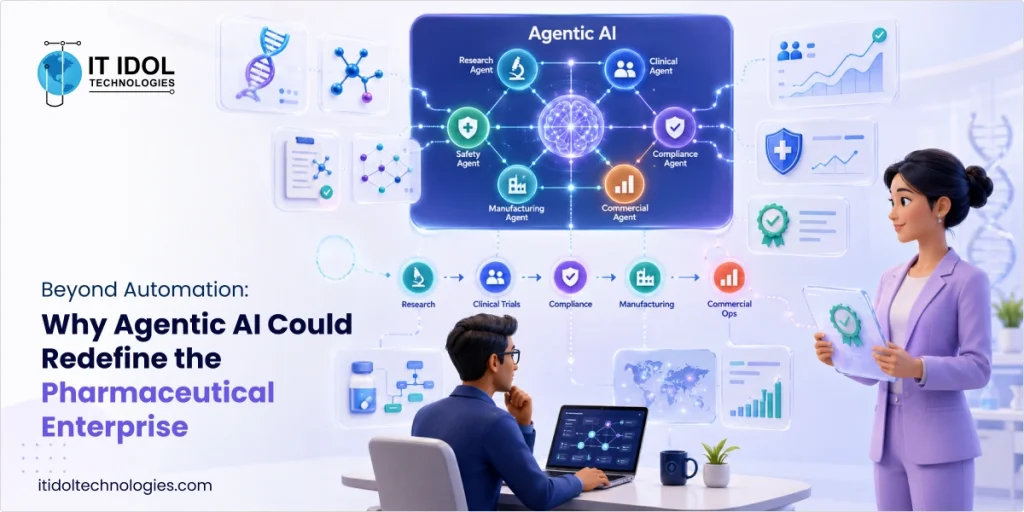
Agentic AI represents a shift from isolated automation toward coordinated enterprise intelligence.
Pharmaceutical AI transformation depends as much on governance and infrastructure as on model capability.
Human-guided autonomy will likely dominate the adoption of healthcare AI rather than unrestricted automation.
Data readiness remains one of the largest barriers to scalable enterprise AI deployment.
Multi-agent systems could reshape research, clinical operations, pharmacovigilance, and commercialization.
Governance-by-design is becoming essential for regulated AI environments.
The most valuable pharmaceutical AI systems will optimize operational decision-making rather than simply generate content.
Artificial intelligence is no longer experimental inside the pharmaceutical industry. AI models already assist with molecular discovery, imaging analysis, pharmacovigilance workflows, supply-chain forecasting, and commercial intelligence. What is changing now is not simply the sophistication of models, but the role AI plays inside enterprise operations. The industry is beginning to move beyond task automation toward autonomous coordination.
This transition is what makes agentic AI strategically important.
Unlike conventional automation systems that execute predefined instructions, agentic systems are designed to pursue objectives, orchestrate workflows, retrieve contextual information, invoke tools, reason across tasks, and adapt dynamically to changing operational environments.
In pharmaceutical enterprises, it introduces a very different operational model, one where AI increasingly becomes part of the decision architecture itself.
The timing is not accidental.
Pharmaceutical organizations are simultaneously facing rising R&D costs, regulatory complexity, fragmented data ecosystems, mounting pressure for faster drug development, and growing demands for personalized care models.
According to Deloitte’s life sciences AI analysis, AI and generative AI initiatives could unlock between $5 billion and $7 billion in value across pharmaceutical operations by improving research, manufacturing, and commercial workflows.
Yet despite the growing excitement around agentic AI, much of the current discourse remains fragmented. Vendor narratives often emphasize autonomous productivity while minimizing governance and infrastructure realities.
Academic research frequently focuses on model performance without fully addressing enterprise deployment constraints. Engineering discussions concentrate on orchestration and scalability while overlooking healthcare regulation and operational adoption.
The real transformation will not come from AI models alone.
It will come from whether pharmaceutical enterprises can operationalize trustworthy autonomous systems inside highly regulated, data-intensive, and risk-sensitive environments.
Why Pharma Needs Agentic AI Beyond Traditional Automation
Pharmaceutical operations are fundamentally interconnected systems.
Most enterprise AI deployments today still operate in isolated silos. A clinical prediction model may never interact with pharmacovigilance systems. Regulatory documentation tools often remain disconnected from real-world evidence pipelines. Commercial analytics rarely integrate dynamically with manufacturing intelligence.
Traditional automation improves individual processes. It does not solve systemic fragmentation.
Agentic AI introduces the possibility of coordinated enterprise intelligence.
A clinical trial agent, for example, could continuously monitor enrollment patterns, retrieve protocol deviations, identify geographic bottlenecks, escalate recruitment risks, and coordinate recommendations across operational teams. A pharmacovigilance agent could monitor adverse event streams in real time while cross-referencing regulatory thresholds and historical safety signals.
This shift matters because pharmaceutical inefficiency is rarely caused by a lack of software. More often, it emerges from disconnected systems, fragmented data, delayed decisions, and operational latency between functions.
The next competitive advantage in pharma may therefore come less from isolated AI tools and more from orchestration intelligence across the enterprise.
Generative AI Versus True Agentic Systems
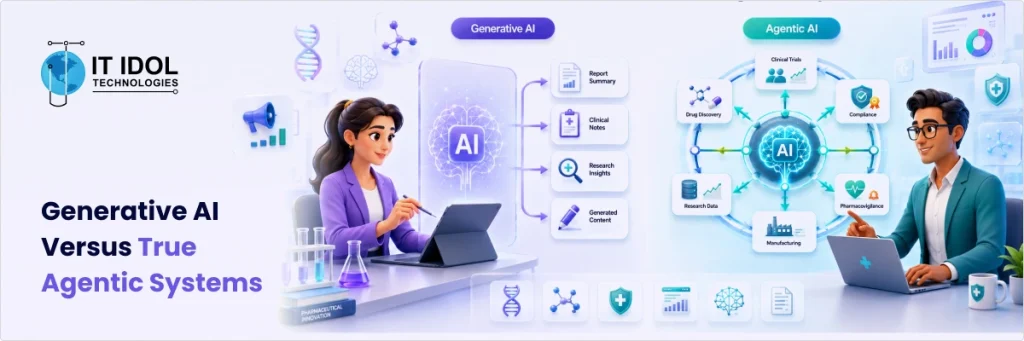
Many organizations currently use the terms “generative AI” and “agentic AI” interchangeably. The distinction is important.
Generative AI systems primarily create outputs:
text
summaries
recommendations
synthetic content
or conversational responses
Agentic systems operate differently. They are designed to pursue goals.
An agentic architecture may:
retrieve information
reason through dependencies
invoke external systems
coordinate workflows
maintain memory
apply rules
and escalate decisions when confidence thresholds are exceeded
For example, a generative AI tool might summarize a clinical trial report. An autonomous pharmaceutical agent could retrieve multiple trial records, compare findings against historical adverse event databases, validate inconsistencies against compliance requirements, generate regulatory-ready summaries, and route unresolved anomalies to human reviewers.
The difference is operational agency.
This distinction becomes increasingly important as pharmaceutical enterprises move toward compound AI architectures that combine:
large language models
biomedical foundation models
retrieval systems
vector databases
orchestration frameworks
knowledge graphs
and governance layers
The future pharmaceutical AI stack is unlikely to rely on a single model. It will resemble a distributed ecosystem of specialized agents operating across research, compliance, clinical operations, and commercialization workflows.
Anatomy of an Agentic Pharma Architecture
Building enterprise-grade agentic systems in healthcare requires far more than deploying a foundation model behind a chatbot interface.
Most production-scale pharmaceutical AI systems require several interconnected architectural layers.
Data Foundation Layer
Pharmaceutical organizations manage some of the world’s most complex data environments:
clinical trial records
genomics datasets
imaging repositories
EHR systems
scientific literature
manufacturing systems
regulatory documentation
and pharmacovigilance databases
The problem is not simply scale. It is interoperability.
Many enterprises still operate across fragmented ontologies, legacy systems, inconsistent metadata standards, and region-specific compliance constraints. AI systems amplify these inconsistencies if data governance remains immature.
This is one reason why many AI initiatives fail to scale beyond pilot environments.
Retrieval and Knowledge Layer
Healthcare AI systems require grounded outputs.
Large language models alone are insufficient for regulated pharmaceutical operations because hallucinated clinical or compliance information introduces unacceptable risk.
Modern architectures increasingly depend on:
retrieval-augmented generation (RAG)
vector databases
biomedical embeddings
semantic search systems
and enterprise knowledge graphs
These systems allow AI agents to retrieve validated organizational knowledge rather than relying purely on probabilistic generation.
Orchestration Layer
Agentic systems become operationally useful only when multiple tools and agents can coordinate effectively.
A mature orchestration layer may coordinate:
scientific research agents
compliance validation agents
workflow automation systems
document generation tools
and human escalation pathways
This is where many organizations underestimate complexity.
Multi-Agent Systems Across the Pharma Value Chain
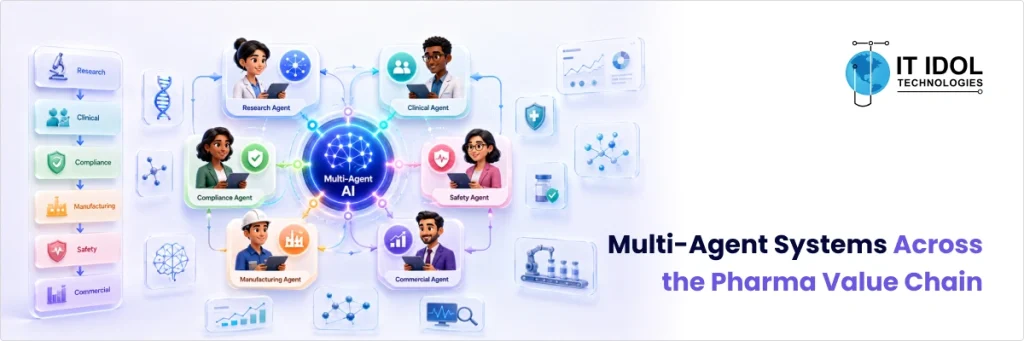
The long-term evolution of pharmaceutical AI is likely to involve interconnected multi-agent ecosystems.
Research organizations may deploy scientific agents capable of continuously monitoring published literature, identifying molecular patterns, synthesizing emerging findings, and proposing experimental hypotheses.
Clinical operations may rely on recruitment agents, patient engagement agents, protocol monitoring systems, and trial optimization workflows operating simultaneously across global sites.
Regulatory affairs may use specialized agents for:
submission validation
labeling consistency
multilingual harmonization
and jurisdiction-specific compliance analysis
Commercial operations could increasingly depend on intelligent systems analyzing physician engagement patterns, reimbursement dynamics, market access conditions, and real-time demand forecasting. Pharmacovigilance may ultimately become one of the most agentically intensive areas within pharma because of the scale and speed required for adverse event analysis.
The industry is gradually shifting from isolated AI tools toward coordinated intelligence systems spanning the entire pharmaceutical lifecycle.
Clinical Intelligence Still Requires Human Judgment
One of the most misunderstood assumptions in enterprise AI discussions is the belief that autonomy automatically eliminates human involvement. Healthcare reality suggests the opposite. Clinical environments involve ambiguity, incomplete information, ethical accountability, and contextual reasoning that cannot be fully reduced to probabilistic outputs.
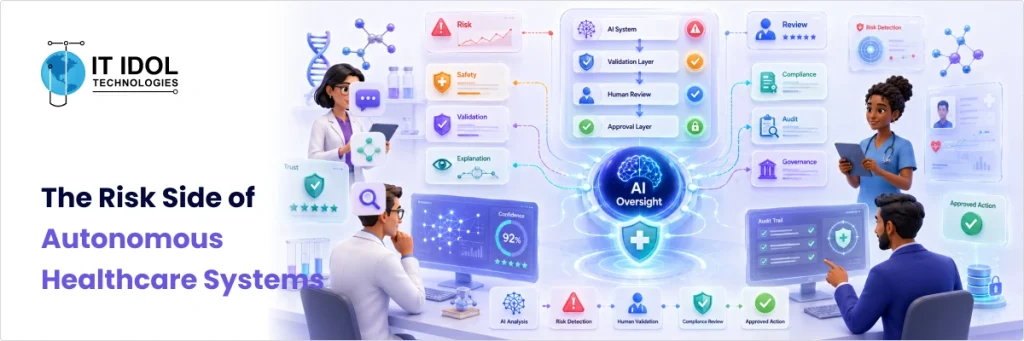
This is why most mature healthcare AI strategies increasingly focus on human-guided autonomy rather than unrestricted automation.
In practice, that means:
Clinicians remain the final decision authorities
Escalation systems intervene during uncertainty
High-risk outputs require validation
and confidence thresholds determine operational boundaries
The FDA has repeatedly emphasized lifecycle oversight, safety evaluation, transparency, and risk management for AI-enabled medical technologies.
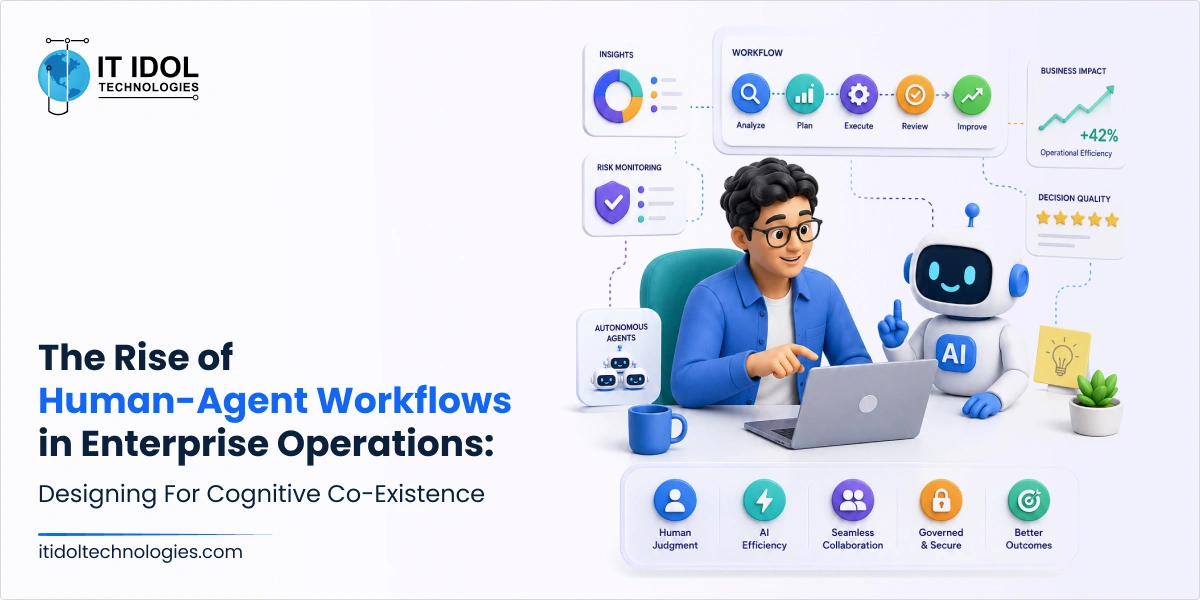
The future of pharmaceutical AI is therefore unlikely to remove human expertise. More realistically, it will redistribute human attention toward supervision, interpretation, exception management, and strategic decision-making.
Governance Is Becoming Part of the Architecture
Governance can no longer be treated as a post-deployment compliance exercise. In regulated industries, governance increasingly becomes an architectural requirement.
Healthcare regulators globally are placing growing emphasis on:
explainability
model transparency
data provenance
post-market monitoring
algorithmic accountability
and continuous validation
Research published on AI-enabled medical device oversight has highlighted significant gaps in safety reporting, demographic transparency, and clinical validation standards. The challenge becomes even more complicated with adaptive AI systems capable of evolving over time.
According to research analyzing FDA-approved AI medical device updates, model retraining can improve performance in one environment while degrading reliability in another.
This creates substantial implications for pharmaceutical AI governance.
Organizations increasingly require:
auditability
runtime monitoring
confidence scoring
policy enforcement layers
model lineage tracking
and explainable decision systems
Governance maturity may ultimately become one of the defining competitive differentiators in enterprise healthcare AI.
Infrastructure Realities Are Often Ignored
Many enterprise AI conversations remain disconnected from infrastructure reality.
Agentic systems are computationally expensive because they involve:
parallel model calls
retrieval pipelines
orchestration engines
persistent memory systems
and multi-step reasoning chains
As organizations scale autonomous systems across business functions, infrastructure bottlenecks become operational constraints.
Pharmaceutical enterprises also face additional complexity involving:
data localization requirements
cybersecurity obligations
regulated cloud environments
latency sensitivity
and cross-border compliance controls
The industry is beginning to realize that successful AI adoption depends as much on infrastructure maturity as model capability. This is one reason why many organizations remain trapped in proof-of-concept cycles rather than achieving enterprise-wide deployment.
Data Readiness Remains the Hidden Barrier
The pharmaceutical sector has enormous data volumes but inconsistent data usability.
Many organizations still struggle with:
fragmented research repositories
incompatible clinical systems
inconsistent metadata structures
unstructured scientific documents
and disconnected operational platforms
AI systems do not automatically resolve these issues. In many cases, they expose them more aggressively.
This is particularly important for agentic systems because autonomous workflows amplify both operational strengths and operational weaknesses at scale. Without reliable data governance, even highly sophisticated AI systems can generate unreliable outputs.
Deloitte’s life sciences analysis emphasizes that data interoperability and enterprise integration remain foundational requirements for scalable AI transformation.
The Risk Side of Autonomous Healthcare Systems
The conversation around AI in pharma often emphasizes capability while underestimating failure modes.
Potential risks include:
hallucinated recommendations
unsafe automation
protocol inconsistencies
regulatory noncompliance
model drift
biased clinical outputs
adversarial manipulation
and overreliance on probabilistic systems
Recent concerns surrounding AI-enabled medical devices demonstrate why healthcare organizations remain cautious. Reuters reported growing scrutiny around AI-assisted medical technologies following device malfunctions and safety concerns tied to clinical deployment environments.
The challenge is not that AI systems are inherently unsafe. The challenge is that healthcare environments have extremely low tolerance for uncertainty.
This is why mature organizations increasingly focus on:
bounded autonomy
layered validation
continuous monitoring
explainable outputs
and human escalation systems
Trustworthy AI requires operational discipline, not just model sophistication.
Economic Impact Will Come From Acceleration, Not Just Cost Reduction
The economic promise of agentic AI in pharma is substantial, but it is often oversimplified. The most important impact may not be labor elimination. It may be organizational acceleration. Faster clinical trial adaptation, improved knowledge synthesis, earlier anomaly detection, streamlined regulatory workflows, and improved operational coordination can all compress pharmaceutical timelines significantly.
Research from enterprise AI transformation studies suggests organizations increasingly realize measurable returns when AI initiatives remain strategically focused rather than broadly distributed.
The pharmaceutical organizations that benefit most from agentic AI will likely be those that combine:
governance maturity
infrastructure readiness
data interoperability
and operational integration
The Future of the Autonomous Pharmaceutical Enterprise
The pharmaceutical enterprise of the future is unlikely to be fully autonomous. It is more likely to become autonomously coordinated. The distinction matters because healthcare still requires accountability, ethics, contextual interpretation, and scientific judgment.
What agentic AI can provide is operational continuity across fragmented systems:
continuously adaptive clinical workflows
intelligent regulatory monitoring
predictive pharmacovigilance
autonomous research assistance
and dynamic commercial intelligence
The defining advantage will not necessarily belong to organizations with the largest models.
It will belong to enterprises capable of building trustworthy systems that combine:
AI capability
regulatory intelligence
operational resilience
and human oversight
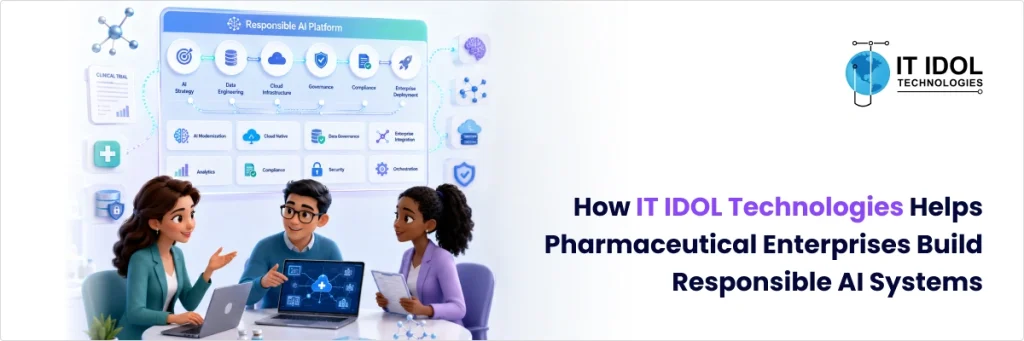
How IT IDOL Technologies Helps Pharmaceutical Enterprises Build Responsible AI Systems
IT IDOL Technologies works with enterprises to design scalable AI, cloud, data engineering, and digital transformation solutions aligned with operational and regulatory realities.
For pharmaceutical and healthcare organizations exploring agentic AI, the challenge is rarely limited to model selection. The larger challenge involves integrating intelligent systems into existing enterprise architectures while maintaining governance, interoperability, compliance visibility, and operational resilience.
IT IDOL Technologies supports organizations through:
AI and data modernization strategies
cloud-native infrastructure engineering
enterprise integration and orchestration
intelligent automation solutions
data governance and interoperability frameworks
scalable analytics ecosystems
and digital transformation consulting for regulated industries
As healthcare AI evolves from experimentation to enterprise-scale orchestration, organizations will increasingly require technology partners capable of balancing innovation with operational reliability.
FAQs
1. What is agentic AI in the pharmaceutical industry?
Agentic AI refers to autonomous or semi-autonomous AI systems capable of pursuing goals, coordinating workflows, retrieving contextual information, and making operational decisions across pharmaceutical processes.
2. How is agentic AI different from generative AI?
Generative AI creates outputs such as text or summaries, while agentic AI performs coordinated actions, reasoning, workflow orchestration, and adaptive decision-making.
3. Where can agentic AI be used in pharma?
Common areas include:
drug discovery
clinical trial optimization
pharmacovigilance
regulatory documentation
manufacturing intelligence
and commercial operations
4. Why is governance important in pharmaceutical AI?
Healthcare AI systems operate in regulated environments where explainability, validation, transparency, and accountability are critical for patient safety and compliance.
5. What are the risks of autonomous AI in healthcare?
Potential risks include hallucinated outputs, biased recommendations, unsafe automation, model drift, compliance failures, and unreliable clinical predictions.
6. What is a multi-agent AI system?
A multi-agent system involves multiple specialized AI agents collaborating across workflows such as research, compliance, clinical monitoring, and operational coordination.
7. Why do many pharmaceutical AI projects fail to scale?
Common reasons include poor data quality, fragmented infrastructure, governance gaps, interoperability limitations, and weak operational integration.
8. Does agentic AI replace healthcare professionals?
Current healthcare AI models are more likely to augment human expertise rather than replace clinicians, regulators, or scientific teams.
9. What infrastructure is required for enterprise agentic AI?
Organizations typically require:
cloud-native architectures
orchestration systems
vector databases
retrieval pipelines
governance frameworks
observability systems
and secure data environments
10. What will define successful pharmaceutical AI adoption over the next decade?
Long-term success will likely depend on combining AI capability with governance maturity, infrastructure readiness, data interoperability, and responsible human oversight.