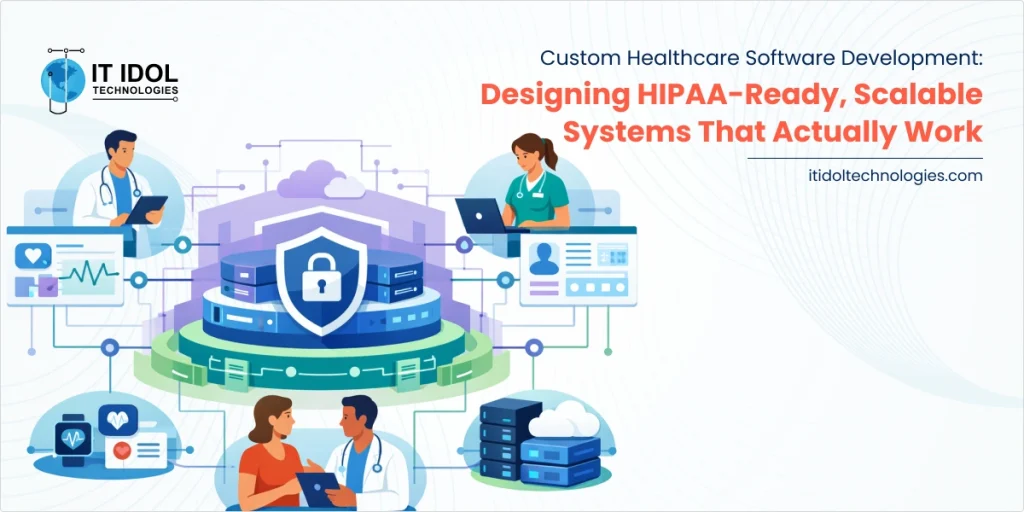
Custom healthcare software is becoming essential, but long-term compliance, not just initial Health Insurance Portability and Accountability Act adherence, is the real challenge.
Scalability in healthcare is about managing growing complexity without delays or inefficiencies, not just handling higher volumes.
Fragmented systems lead to inconsistent data and broken workflows; true efficiency requires architectural alignment, not just integrations.
Custom development matters when systems need to mirror real healthcare workflows instead of forcing workarounds.
The industry is shifting from basic digitization to aligning technology with care delivery for sustainable growth and better outcomes.
Most healthcare systems don’t fail because of missing features. They fail because the system doesn’t reflect how healthcare actually operates.
On paper, everything looks compliant and connected. There’s an electronic health record system in place, integrations with labs and billing, patient portals for access, and dashboards for reporting. From a technical standpoint, the system appears complete. But when you move closer to day-to-day operations, the gaps become harder to ignore.
Clinicians switch between screens to find patient data. Administrative teams manually reconcile information across systems. Patients repeat the same details at different touchpoints. The system exists, but it doesn’t behave as one.
For CIOs and CTOs in health tech, this is not a new problem. What has changed is the scale at which it is now being felt.
Healthcare systems today are under pressure from multiple directions at once. There is growing demand for digital-first patient experiences, increasing regulatory scrutiny around data privacy, and a need to scale operations without compromising care quality.
At the same time, the underlying technology landscape is becoming more fragmented, with legacy systems, third-party tools, and new digital platforms all trying to coexist.
This is where the conversation around custom healthcare software development begins, not as a preference, but as a necessity.
The Compliance Trap: When HIPAA Becomes a Checkbox
Compliance is often the starting point for healthcare technology decisions. And rightly so. Regulations like the Health Insurance Portability and Accountability Act set the baseline for how patient data must be handled, stored, and shared.
But one of the most common issues in healthcare systems is how compliance is approached.
In many cases, HIPAA is treated as a checklist. Encryption is implemented. Access controls are defined. Audit logs are enabled. Once these elements are in place, the system is considered compliant.
Technically, that may be true.
Operationally, it is often incomplete.
Compliance in healthcare is not just about securing data. It is about ensuring that data flows safely and consistently across the entire system.
When systems are fragmented, maintaining that consistency becomes difficult. Data may be secure within individual systems, but when it moves between them, gaps can appear. These gaps are where risks emerge.
The U.S. Department of Health and Human Services has repeatedly emphasized that HIPAA compliance extends beyond individual applications to the way information is accessed, transmitted, and managed across systems.
This distinction matters. A system can be technically compliant and still introduce operational risks if it is not designed as a cohesive whole.
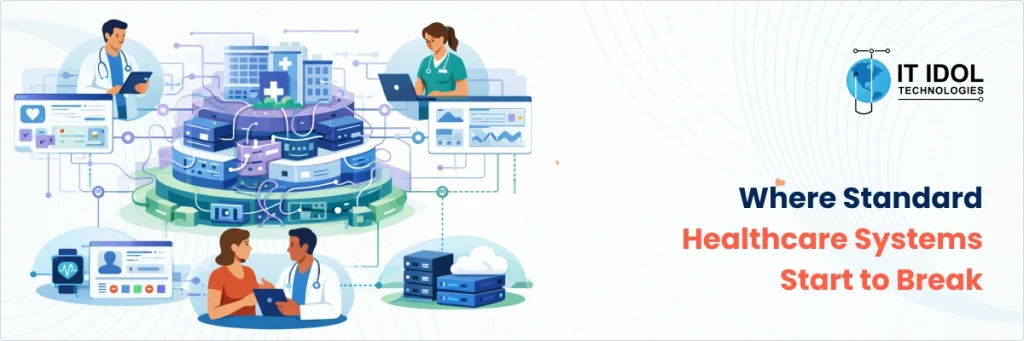
Where Standard Healthcare Systems Start to Break
Most healthcare organizations rely on a combination of systems rather than a single unified platform. Electronic health records, practice management tools, billing systems, telehealth platforms, and analytics tools are often sourced from different vendors.
Each of these systems performs its function well.
The problem lies in how they interact.
As patient journeys become more complex, the need for seamless data flow increases. A single patient interaction can involve multiple systems registration, consultation, diagnostics, billing, and follow-up. If these systems are not tightly integrated, information gets fragmented.
This fragmentation manifests in subtle yet critical ways. A clinician may not have access to the complete patient history at the point of care. A billing system may not reflect real-time updates from clinical records. A patient portal may display outdated information. Individually, these issues seem manageable. Collectively, they impact both efficiency and care quality.
Gartner has highlighted that integration challenges remain a major barrier to digital transformation in healthcare, particularly when organizations rely on multiple disconnected systems. What these points point to is not a lack of technology, but a lack of alignment.
The Scalability Problem No One Sees Early
In the early stages, most healthcare systems are built to handle current demand. Performance is optimized for existing workflows, and infrastructure is sized accordingly. The challenge emerges when the organization begins to scale. Scaling in healthcare is not just about handling more users or transactions. It involves managing increased complexity.
More patients, more data, more interactions, and more regulatory requirements. Systems that were designed for stability at a smaller scale often struggle to maintain performance and consistency as complexity increases.
This is where many organizations experience what can be described as “silent system stress.” The system continues to function, but inefficiencies grow. Response times increase, data synchronization delays become more frequent, and manual interventions start to fill the gaps.
By the time these issues become visible, they are often deeply embedded in the system.
Custom Development: Moving From Tools to Systems
Custom healthcare software development is often viewed as an alternative to off-the-shelf solutions. In reality, it is a shift in how systems are designed.
Instead of assembling a stack of tools, custom development focuses on creating a unified system that reflects how healthcare operations actually work. This begins with understanding workflows at a granular level.
How does patient data move from intake to diagnosis to treatment to billing? Where are decisions made? Where do delays occur? How do different roles interact with the system?
These questions define the architecture.
A well-designed custom system does not eliminate the need for integrations, but it ensures that integrations operate within a consistent framework. Data is not just transferred between systems; it is aligned. Timing is synchronized. Logic is consistent. This reduces the need for manual intervention and improves overall system reliability.
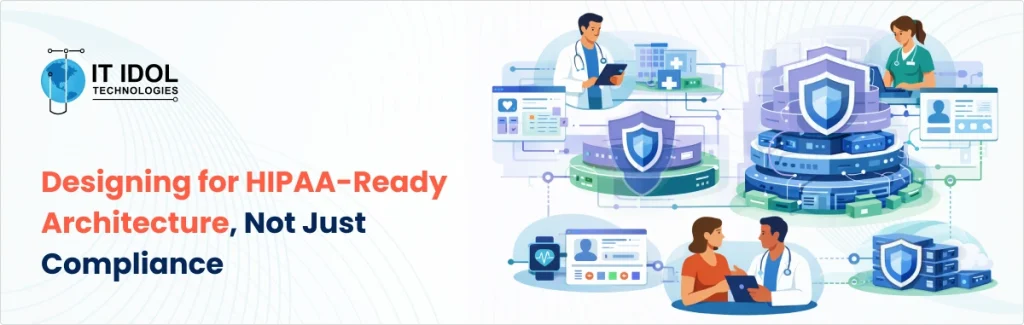
Designing for HIPAA-Ready Architecture, Not Just Compliance
One of the key advantages of custom development is the ability to design compliance into the architecture itself.
Instead of adding security features as an afterthought, the system is built with privacy and security as foundational elements. Data access is controlled at a granular level. Encryption is applied consistently across storage and transmission. Audit trails are integrated into system workflows rather than added externally.
This approach aligns with guidance from the National Institute of Standards and Technology, which emphasizes that security should be embedded into system design rather than layered on top. When compliance is part of the architecture, it becomes easier to maintain as the system evolves.
The Role of Interoperability in Modern Healthcare Systems
Interoperability is often discussed as a technical requirement, but its impact is operational. Healthcare systems need to communicate not just internally, but with external entities, such as labs, pharmacies, insurance providers, and other healthcare organizations.
Standards like FHIR have been developed to support this exchange. But implementing interoperability is not just about adopting a standard. It requires aligning data structures, workflows, and system logic. Without that alignment, interoperability remains partial.
Custom systems provide the flexibility to design interoperability in a way that reflects actual use cases. Instead of forcing external systems to adapt, the architecture can accommodate different data sources and formats while maintaining consistency.
Why Many Custom Healthcare Projects Still Fall Short
Despite the advantages, not all custom healthcare systems succeed.
A common reason is that they replicate existing structures instead of rethinking them. Organizations rebuild legacy workflows in a new system without addressing the underlying inefficiencies.
The result is a modern interface on top of an outdated model. Another challenge is underestimating the complexity of healthcare operations.
Designing a system that supports real-world workflows requires a deep understanding of both technology and clinical processes.
Without that, the system may be technically sound but operationally misaligned.
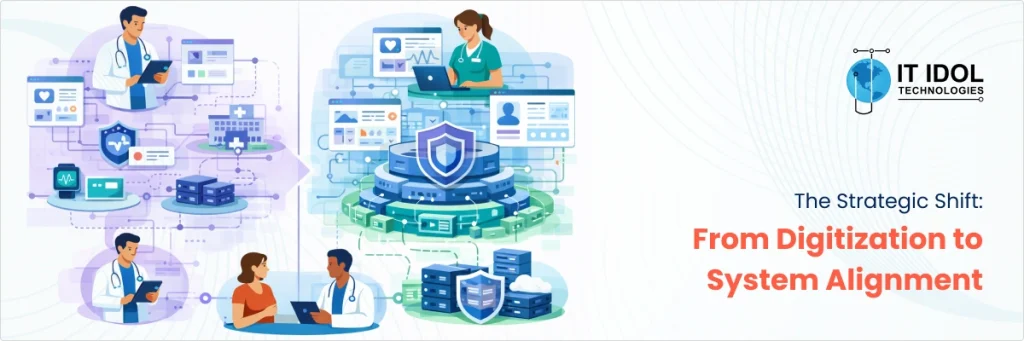
The Strategic Shift: From Digitization to System Alignment
Healthcare technology is moving beyond digitization.
The focus is shifting from converting processes into digital formats to aligning systems with how care is delivered.
This shift is being driven by several factors. The rise of value-based care models, the increasing importance of patient experience, and the need for data-driven decision-making are all pushing organizations toward more integrated systems.
According to McKinsey & Company, healthcare organizations that invest in integrated digital systems are better positioned to improve both operational efficiency and patient outcomes. This is not about adopting more technology. It is about using technology more effectively.
Where This Leaves CIOs and CTOs
For technology leaders in healthcare, the challenge is not choosing between custom and off-the-shelf solutions. It is understanding when the existing approach no longer supports the organization’s needs.
The signs are usually clear. Systems require constant workarounds. Data inconsistencies affect decision-making. Scaling introduces more friction instead of efficiency. Compliance becomes harder to manage as complexity increases.
At this point, incremental improvements are no longer enough. A more fundamental shift is required, one that focuses on system design rather than tool selection.
Final Thought
Healthcare systems operate in one of the most complex environments of any industry. The stakes are high, and the margin for error is low. Technology plays a critical role, but only when it is aligned with how care is delivered.
Custom healthcare software development is not about building something new for the sake of it. It is about creating systems that can handle complexity without breaking, scale without losing consistency, and maintain compliance without slowing down operations.
That balance is difficult to achieve with fragmented systems. It requires a different approach to how systems are designed from the start.
Closing Perspective
For organizations that are beginning to feel the limits of their current systems, the next step is not just to upgrade technology, but to rethink how that technology supports the entire healthcare ecosystem.
This is where teams like IT IDOL Technologies work closely with healthcare organizations, designing HIPAA-ready, scalable systems that align with real-world workflows rather than forcing workflows to adapt to technology.
Because in healthcare, the effectiveness of a system is not measured by how many features it has, but by how well it supports the people who rely on it every day.
FAQ’s
1. What is custom healthcare software development?
Custom healthcare software development involves designing and building systems tailored to specific healthcare workflows, rather than relying on generic platforms. It focuses on aligning technology with how care is actually delivered, ensuring better efficiency and scalability.
2. Why is HIPAA compliance critical in healthcare software?
Health Insurance Portability and Accountability Act sets the standard for protecting sensitive patient data. Non-compliance can lead to legal penalties, data breaches, and loss of patient trust, making it essential for any healthcare system handling patient information.
3. Can off-the-shelf healthcare solutions meet compliance needs?
They can meet basic compliance requirements, but often struggle with maintaining consistency across complex workflows and integrations. As systems scale, gaps may appear in how data is managed and secured across different platforms.
4. When should an organization consider custom healthcare software?
The need typically arises when existing systems require constant workarounds, data inconsistencies affect operations, or scaling introduces inefficiencies. At that stage, redesigning the system becomes more effective than adding new tools.
5. How does custom software improve scalability?
Custom systems are designed around specific workflows and data flows, allowing them to handle increasing complexity more efficiently. This reduces bottlenecks and ensures performance remains stable as the organization grows.
6. What role does interoperability play in healthcare systems?
Interoperability ensures that different systems can exchange and use data effectively. Standards like FHIR enable this, but true interoperability requires aligning system logic and workflows, not just data formats.
7. Is custom healthcare software more expensive than ready-made solutions?
Initial costs are typically higher, but over time, custom systems can reduce operational inefficiencies, manual work, and integration challenges, leading to better long-term value.
8. How can organizations ensure data security beyond compliance?
Security should be built into the system architecture, not added later. This includes controlled access, encryption, audit trails, and continuous monitoring to ensure data remains protected across all workflows.
9. What are the risks of fragmented healthcare systems?
Fragmentation leads to inconsistent data, delayed processes, and increased chances of errors. It also makes compliance harder to manage and reduces overall system reliability.
10. How do organizations get started with custom healthcare software development?
The first step is evaluating current workflows, identifying gaps, and understanding where systems fail to align with operations. From there, the focus should shift to designing a system architecture that supports both compliance and scalability.