Artificial intelligence has crossed an important threshold in the enterprise. The question is no longer whether companies are experimenting with AI. Most are. The more useful question is: How deeply has AI actually changed the way enterprises operate?
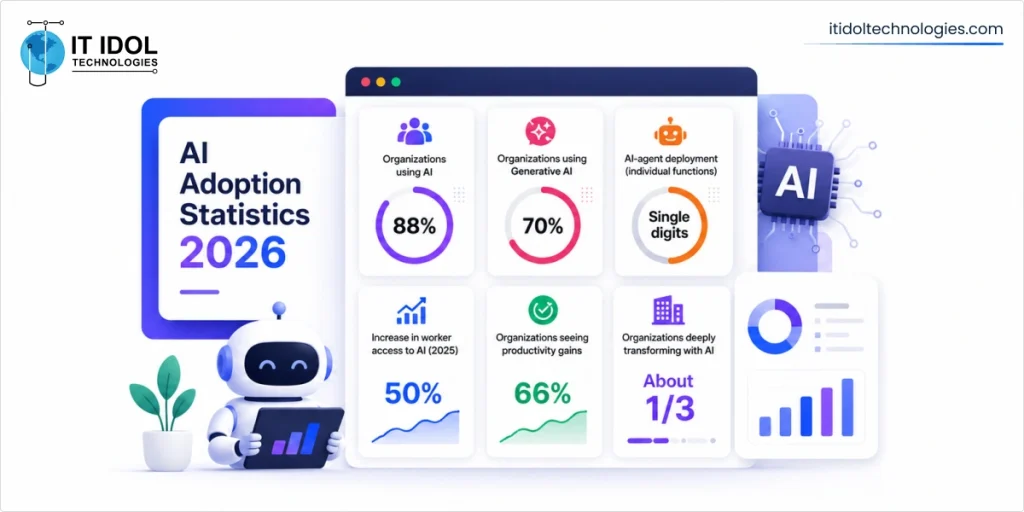
The numbers reveal a more nuanced picture than the usual adoption headlines suggest. According to the Stanford AI Index 2026, 88% of surveyed organizations reported using AI in at least one business function in 2025, while 70% reported using generative AI in at least one function. Yet AI-agent deployment remained in the single digits across nearly all individual business functions.
Deloitte’s 2026 enterprise research exposes a similar gap between adoption and transformation. Worker access to AI increased substantially during 2025, and productivity benefits are becoming more common, but only about one-third of surveyed organizations are using AI to deeply transform products, processes, or business models.
That distinction defines enterprise AI adoption in 2026. AI is increasingly easy to access. It is becoming normal to use. But turning it into a governed, integrated, measurable production capability remains much harder. For business and technology leaders, the competitive question is shifting from “Do we use AI?” to “Where does AI create measurable value, and can we scale that capability repeatedly?”
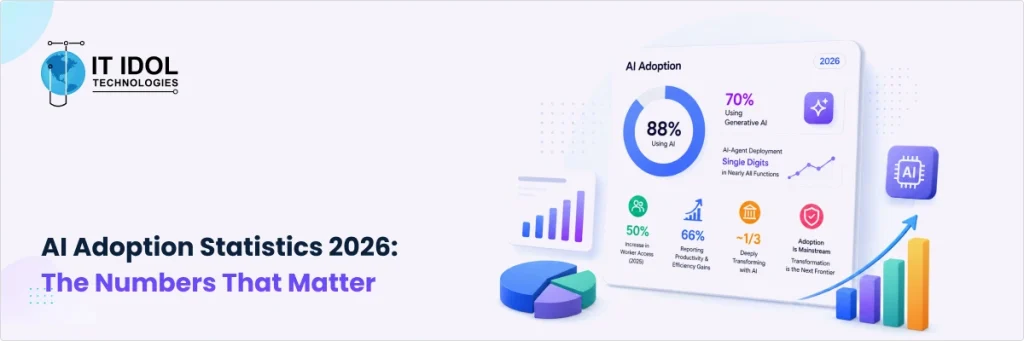
AI Adoption Statistics 2026: The Numbers That Matter
A handful of statistics capture the current state of enterprise AI better than a long list of disconnected market forecasts.
Enterprise AI indicator
Latest finding
What it means
Organizations using AI in at least one business function
88%
AI adoption is now widespread across surveyed organizations
Organizations using generative AI in at least one business function
70%
GenAI has moved well beyond early experimentation
AI-agent deployment by individual business function
Single digits in nearly all functions
Agentic AI attention is far ahead of scaled deployment
Increase in worker access to AI during 2025
50%
Enterprise AI availability is expanding rapidly
Organizations reporting productivity and efficiency gains
66%
Operational efficiency is currently the clearest realized value
Organizations deeply transforming with AI
About one-third
Broad adoption has not yet translated into equally broad transformation
The first three findings come from Stanford’s 2026 AI Index, while the latter findings are reported in Deloitte’s 2026 State of AI in the Enterprise research. Taken together, these statistics tell a more important story than any single percentage can. Enterprise AI adoption is mainstream. Enterprise AI maturity is not. That difference matters because the word adoption now covers activities with radically different levels of technical complexity, organizational change, risk, and economic impact.
What Does “AI Adoption” Actually Mean in 2026?
An organization can truthfully say it has “adopted AI” if employees use an approved generative AI assistant. Another company might make the same claim because it has machine-learning models embedded in production systems. A third may have redesigned customer service, software engineering, procurement, or financial operations around AI-enabled workflows. These organizations are not at the same level of maturity. Yet they can appear side by side in an adoption statistic. That is why executives should interpret AI adoption through four distinct layers:
1. Access
Employees have access to approved AI tools. This might include enterprise chatbots, copilots, generative AI assistants, coding tools, or AI features embedded in existing SaaS platforms. Access is important because employees cannot build AI-enabled work habits without tools they are permitted to use. But access alone says little about whether those tools are producing meaningful business outcomes.
2. Usage
Employees actively incorporate AI into everyday work. AI may help draft documents, summarize meetings, analyze information, generate code, search internal knowledge, or support decisions.
At this stage, organizations should move beyond license counts and ask more useful questions:
How frequently are employees using AI?
Which workflows are changing?
Are users returning to the tools after initial experimentation?
Is AI saving meaningful time?
3. Production
AI becomes part of operational systems and repeatable workflows. This is where adoption becomes technically demanding. Production AI may require integrations with CRM, ERP, data platforms, identity systems, internal APIs, knowledge repositories, or transaction systems. Organizations also need monitoring, evaluation, security controls, permissions, fallback mechanisms, and ownership.
A successful prototype proves that AI can perform a task. A production system must prove that it can perform that task reliably, economically, securely, and repeatedly.
4. Transformation
The organization redesigns its processes, products, or business models around capabilities enabled by AI. Instead of asking how AI can make an existing step faster, leaders ask whether the workflow should still exist in its current form. This is the hardest level of adoption and potentially the most consequential. A useful way to think about enterprise AI maturity is therefore:
Access → Usage → Production → Transformation
The farther an organization moves along that path, the less AI adoption becomes a technology-purchasing problem and the more it becomes an architecture, operating model, governance, and organizational change problem.
Enterprise AI Has Crossed the Adoption Threshold
Enterprise AI adoption has accelerated rapidly over a short period. Stanford’s AI Index reported organizational AI usage at 55% in 2023 and 78% in 2024. Its 2026 report puts adoption among surveyed organizations at 88% in 2025. The strategic implication is significant.
For many large organizations, deciding whether AI deserves attention is no longer the primary issue. The harder decisions now concern allocation.
Which workflows deserve investment?
Which AI capabilities should be purchased, configured, integrated, or custom-built?
Where does AI create enough economic value to justify production engineering?
Which experiments should be stopped?
And which capabilities could become strategically differentiating?
This changes the role of enterprise AI strategy.
During the early generative AI boom, experimentation itself created learning. Organizations needed hands-on exposure to understand model capabilities and limitations. By 2026, experimentation without prioritization can become expensive noise. Enterprises may accumulate dozens or hundreds of proofs of concept while still struggling to demonstrate enterprise-level impact.
The next phase requires portfolio discipline: fewer disconnected experiments, clearer business cases, stronger technical foundations, and explicit decisions about what deserves to scale.
Generative AI Is Mainstream, but Production Scale Is Uneven
Generative AI has spread extraordinarily quickly because the barrier to initial use is low. A user can open an AI assistant and immediately draft, summarize, search, classify, brainstorm, translate, analyze, or generate code. Enterprise production systems are different. They require AI to operate within real business constraints.
GenAI adoption has expanded rapidly
Stanford reports that 70% of surveyed organizations used generative AI in at least one business function in 2025. That level of adoption suggests GenAI is no longer confined to innovation teams or isolated experiments. It is increasingly becoming part of the enterprise technology environment.
But “using GenAI” remains a broad category.
A company where employees use a general-purpose assistant and a company operating an AI-powered claims-processing workflow may both count as adopters, even though their technical and operational maturity differs dramatically.
Pilots still outnumber truly scaled deployments
The pilot-to-production gap has been visible throughout the generative AI adoption cycle. The underlying problem is rarely that enterprises cannot build an impressive demonstration. Modern foundation models make prototypes remarkably fast to create. The challenge begins when a prototype meets enterprise reality.
A production application may need to retrieve information from multiple internal systems, respect role-based permissions, protect sensitive data, provide traceability, meet latency requirements, control inference costs, handle failures, and integrate into an existing workflow without creating new operational friction. Those requirements turn an AI demo into a software-engineering and organizational-design problem.
Why AI pilots get stuck
Several recurring barriers explain why promising AI experiments fail to scale.
Data is fragmented. The model may be capable, but the information it needs is scattered across databases, documents, SaaS platforms, legacy systems, and departmental silos.
Integration is underestimated. An AI system becomes far more valuable when it can interact safely with enterprise systems, but every integration introduces permissions, reliability, security, and maintenance requirements.
Evaluation is weak. Teams often test whether an AI system appears impressive rather than defining measurable criteria for accuracy, quality, cost, risk, and business impact.
Governance arrives too late. Security, compliance, privacy, and model-risk teams may become involved only after a prototype has already been designed.
The workflow never changes. Adding AI to an inefficient process can simply automate fragments of inefficiency.
Ownership is unclear. AI initiatives often cross technology, data, legal, security, and business teams. Without clear accountability, pilots can remain permanently experimental.
The lesson is simple: model capability is only one component of enterprise AI readiness.
What Enterprises Are Actually Using AI For
The most useful way to understand enterprise AI adoption is not to compile dozens of isolated use cases. It is to look at the patterns of work where AI is becoming operationally useful.
Knowledge and productivity
Knowledge work remains one of the easiest entry points. Enterprises are applying AI to activities such as document summarization, enterprise search, research assistance, meeting support, content drafting, knowledge retrieval, and document classification.
These applications spread quickly because they often augment employees rather than replace entire operational systems. They also offer relatively straightforward value metrics: time saved, search time reduced, response speed, throughput, and employee adoption.
The limitation is that productivity gains at the individual level do not automatically translate into equivalent enterprise-level financial gains. Saving an employee 20 minutes does not necessarily save the organization 20 minutes of cost. Value appears when saved capacity changes something measurable: output increases, cycle times shrink, staffing needs change, customer response improves, or employees redirect time toward higher-value work.
Software engineering
Software development has become another major AI adoption area. AI coding assistants can support code generation, debugging, documentation, test creation, refactoring, code explanation, and modernization. The strongest enterprise implementations treat these tools as part of an engineering system rather than as autocomplete.
That means measuring outcomes such as development cycle time, defect rates, review quality, test coverage, maintainability, developer experience, and delivery throughput. AI can accelerate code production, but faster code generation is not automatically better software. Without architecture discipline and review practices, organizations can simply create technical debt faster.
Customer and commercial workflows
Customer service, sales, and marketing offer large volumes of language-heavy work that fit generative AI particularly well. Common applications include customer-service assistance, automated response drafting, conversation summarization, knowledge retrieval, sales research, proposal support, marketing content, and personalization.
The important shift is from standalone chatbots toward AI embedded inside the employee or customer workflow. A support assistant becomes more valuable when it understands the customer context, retrieves approved knowledge, accesses relevant account information, recommends an action, and records the outcome. That requires integration, not merely a capable language model.
Operations and decision support
Enterprises are also applying AI across document-heavy and data-intensive operations. Examples include invoice and contract processing, forecasting, anomaly detection, supply-chain analysis, quality monitoring, fraud detection, risk analysis, and operational decision support. Many of these areas combine traditional machine learning, automation, analytics, and generative AI rather than relying on a single model type. That hybrid architecture is important. Enterprise AI is not synonymous with large language models. The most effective system may combine deterministic software, business rules, machine learning, retrieval, generative models, and human review.
AI ROI Is Appearing but Mostly Where the Problem Is Narrow and Measurable
The debate about AI ROI often becomes unnecessarily binary. Either AI is portrayed as producing extraordinary returns, or organizations are described as failing to generate value.
The reality is more layered.
Deloitte’s 2026 enterprise research reports that 66% of surveyed organizations are seeing productivity and efficiency improvements, making these the most commonly realized benefits from enterprise AI adoption. Yet only about one-third are using AI to deeply transform the business.
This gap makes sense.
Efficiency is usually easier to achieve than transformation. An organization can automate document classification or accelerate software testing without redesigning its business model. Transformational value requires many more dependencies to align.
It helps to separate AI value into three categories.
Efficiency
AI reduces the resources required to perform existing work. Examples include lower handling time, faster document processing, reduced manual effort, or shorter development cycles. These projects are often easiest to justify because the baseline is measurable.
Effectiveness
AI improves the outcome rather than merely reducing effort. Examples might include better customer resolution, more accurate forecasting, higher-quality software, faster decisions, or improved conversion. Effectiveness can produce more strategic value, but measurement becomes more difficult because many variables influence the result.
Transformation
AI changes what the organization can offer or how work is fundamentally structured. This might involve redesigning an end-to-end process, creating an AI-native product, changing how customers interact with the company, or restructuring work around human-AI collaboration. Transformation potentially creates the greatest strategic impact, but it also requires the most organizational change.
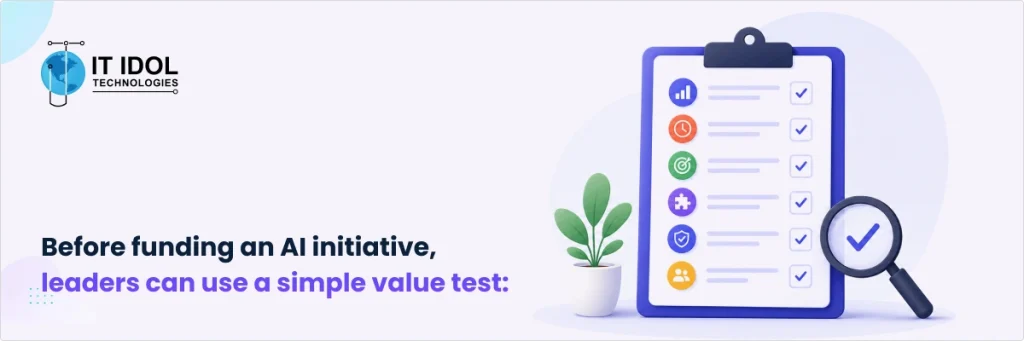
Before funding an AI initiative, leaders can use a simple value test:
Dimension
Question to ask
Volume
Does this workflow happen frequently enough to matter?
Friction
Does it consume significant time, cost, or expertise today?
Measurability
Can we establish a credible baseline before deploying AI?
Integration
Can AI access the systems and information required to perform useful work?
Risk
What happens when the system produces an incorrect result or action?
Adoption
Will employees or customers actually use the redesigned workflow?
This framework helps explain why narrow AI applications can outperform ambitious “transform the enterprise with AI” programs. A bounded problem with high volume, measurable friction, reliable data, and clear ownership may generate more value than a technically impressive initiative with no operational baseline.
Agentic AI Is the Next Adoption Wave but the Statistics Need Context
Few enterprise technology concepts have attracted as much attention as AI agents. The adoption numbers, however, require perspective. Stanford’s 2026 AI Index reports that AI-agent deployment remains in the single digits across nearly all individual business functions. That does not mean agentic AI lacks enterprise potential. It means attention is ahead of scaled deployment.
Why agents are harder than copilots
A copilot primarily assists a human.
An agent may do considerably more.
Depending on its design, an agent can interpret a goal, create a plan, retrieve information, call tools, interact with software systems, make intermediate decisions, and trigger actions.
Every additional degree of autonomy changes the risk profile. If a chatbot generates a poor draft, a person can discard it. If an agent updates a customer record, approves a workflow step, changes a system configuration, initiates a transaction, or sends information to another system, an incorrect action can propagate.
This is why enterprise agent development is not simply “adding an LLM to automation.” The real engineering challenge is determining what the agent is allowed to know, decide, and do and what happens when confidence is low, or something goes wrong.
Where enterprise agents are likely to scale first
The strongest early candidates are not necessarily workflows requiring maximum autonomy. They are workflows that are: bounded, repetitive, tool-driven, measurable, and easy to escalate. Consider an internal IT agent. A poorly scoped goal would be: “Resolve all employee technology problems autonomously.” A more realistic production scope might be: classify requests, retrieve approved troubleshooting guidance, collect diagnostic information, perform a limited set of authorized actions, and escalate exceptions with a structured summary. The second workflow is easier to evaluate, govern, and improve. Enterprise agent adoption is therefore likely to progress through controlled autonomy, not a sudden jump to unrestricted autonomous operations.
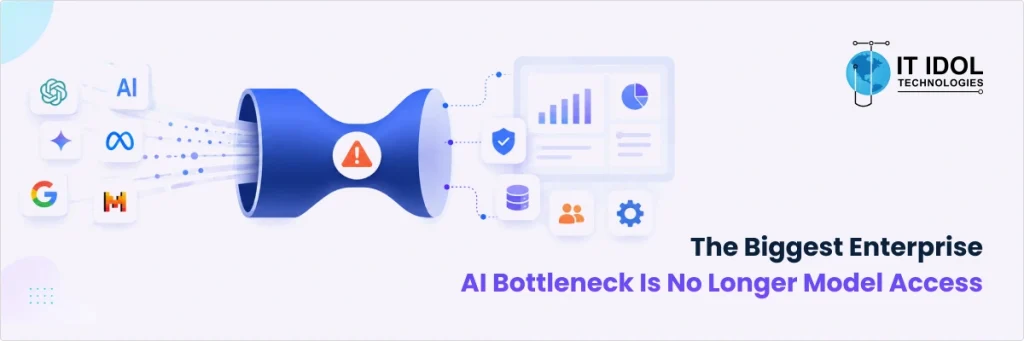
The Biggest Enterprise AI Bottleneck Is No Longer Model Access
Organizations can access highly capable AI models through APIs, cloud platforms, enterprise software, open-source ecosystems, and commercial AI products.
Model access is rarely the hardest constraint anymore.
The bottleneck has moved into the enterprise itself.
Data
AI systems are only as useful as the context they can reliably access. Enterprise data is often fragmented across structured databases, documents, SaaS applications, emails, legacy platforms, data warehouses, APIs, and departmental systems. Giving an AI model access to “company knowledge” therefore becomes a data-architecture problem.
Teams must determine which sources are authoritative, who is permitted to access them, how information stays current, how retrieval is evaluated, and how sensitive information is protected.
Integration
Standalone AI tools can improve individual productivity.
Integrated AI can change workflows.
That distinction explains why integration is becoming central to enterprise adoption.
An AI assistant that drafts a customer response is useful.
An AI system that understands the customer’s history, retrieves approved knowledge, checks order status, recommends the correct action, prepares the response, updates the CRM, and routes exceptions appropriately can change the economics of the workflow.
But every system connection introduces engineering complexity. Enterprise AI therefore increasingly resembles a distributed systems problem involving APIs, events, data pipelines, identity, observability, security, and software architecture.
Governance
As AI moves from generating content to influencing decisions and taking actions, governance becomes part of system design. McKinsey’s 2026 research on AI trust highlights the growing governance challenge as organizations move toward more autonomous AI systems. The consequences of failure increase when AI can trigger actions and interact with other systems rather than merely provide recommendations.
The strongest governance models are not simply approval committees positioned at the end of development.
Governance should influence architecture from the beginning.
A low-risk internal summarization tool and an agent capable of modifying financial records should not have identical controls.
Risk should determine autonomy, permissions, evaluation requirements, human oversight, logging, and escalation.
Operating model
AI programs also fail for organizational reasons.
Who owns the outcome?
Who funds shared AI infrastructure?
Who maintains models and prompts?
Who approves production deployment?
Who monitors performance?
Who decides when a model or workflow should be retired?
These questions become increasingly important as AI moves from innovation labs into core operations. The most mature organizations will treat AI less as a collection of isolated projects and more as an enterprise capability with reusable architecture, governance, evaluation, and delivery practices.
Build, Buy, or Integrate? AI Adoption Is Becoming an Architecture Decision
As AI capabilities become embedded across enterprise software, leaders face a growing portfolio question:
Where should we buy AI, where should we integrate it, and where should we build proprietary capability?
There is no universal answer.
Buy when the capability is becoming a commodity
General productivity assistants, meeting summarization, basic content generation, and common SaaS AI features may offer little strategic advantage when custom-built. If a mature vendor can deliver the capability securely and economically, building from scratch can create unnecessary maintenance.
Integrate when context creates the value
Many enterprise AI opportunities sit in the middle. The underlying model is not proprietary, but the value comes from connecting AI to enterprise data, business rules, workflows, permissions, and software systems.
This is where architecture matters most. The competitive advantage may not come from owning the foundation model. It may come from how effectively the organization integrates intelligence into its operating environment.
Build when the capability differentiates the business
Custom development becomes more defensible when AI supports proprietary workflows, unique data, specialized decision logic, customer-facing products, or strategically important intellectual property.
The right question is not:
“Should we build our own AI?”
It is:
“Where does owning this AI capability create enough differentiation, control, or economic advantage to justify the engineering responsibility?”
That distinction prevents organizations from overbuilding commodity capabilities while underinvesting in AI that could genuinely differentiate the business.
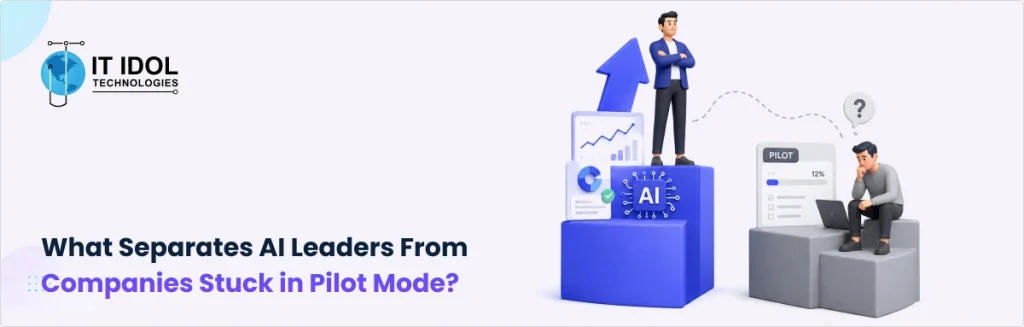
What Separates AI Leaders From Companies Stuck in Pilot Mode?
AI leaders are not necessarily the companies with the largest number of experiments. They are the organizations that can repeatedly convert promising use cases into measurable production capabilities. Several practices distinguish that approach.
They prioritize workflows rather than features. Instead of asking where to add a chatbot, they identify high-friction processes where AI can materially change cost, speed, quality, or customer outcomes.
They establish a baseline before building. Without knowing the current cost, cycle time, quality, or performance of a workflow, proving AI ROI becomes difficult.
They redesign processes rather than layering AI onto inefficiency. Automating one step inside a broken process may create only marginal value.
They invest in data and integration foundations. AI becomes more useful when it can operate with reliable enterprise context and interact safely with operational systems.
They treat governance as architecture. Security, permissions, evaluation, human oversight, and auditability are designed into the system rather than added immediately before launch.
They match autonomy to risk. Not every workflow needs a fully autonomous agent. In many cases, AI recommendations plus human approval create a better balance between speed and control.
They measure what happens after launch. Deployment is not the finish line. Organizations need to monitor usage, accuracy, cost, failure patterns, business outcomes, and user behavior continuously.
McKinsey’s enterprise AI research has repeatedly highlighted the importance of workflow redesign, governance, leadership involvement, and structured scaling practices in capturing value from AI. Its 2025 survey found that most organizations were still early in implementing many of these practices at scale.
The broader lesson is that AI leadership is becoming an organizational capability. A company that successfully deploys one AI application has built one solution. A company that can repeatedly identify, evaluate, engineer, govern, integrate, measure, and improve AI systems has built something more valuable: a repeatable AI operating capability.
How Enterprises Should Benchmark AI Adoption in 2026
The percentage of employees “using AI” is becoming an increasingly weak standalone KPI. It measures activity, not necessarily maturity. An organization could achieve near-universal AI usage because employees use writing assistants while producing little measurable business impact.
Another enterprise might have fewer AI users but operate several highly valuable AI systems inside critical workflows.
Leaders therefore need a more complete benchmark.
Ask:
Access: What percentage of employees have approved access to relevant AI capabilities?
Active usage: How many employees use those capabilities meaningfully and repeatedly?
Production: How many AI initiatives have moved beyond pilots into operational systems?
Workflow coverage: Which high-value business processes are materially AI-enabled?
Integration: How many deployments connect safely with enterprise data and systems of record?
Economics: Which initiatives have measurable cost, revenue, productivity, quality, or cycle-time outcomes?
Governance: What percentage of production systems have defined evaluation, monitoring, permissions, accountability, and escalation?
Transformation: Where has AI changed the design of the workflow rather than merely accelerating an existing task?
These measures produce a much more useful picture than a single adoption percentage.
An enterprise with high access but low production has an execution problem.
An enterprise with many production deployments but weak measurement has a value-realization problem.
An enterprise with strong use cases but poor integration may have an architecture problem.
An enterprise with widespread AI usage but inconsistent controls may have a governance problem.
The benchmark should identify the bottleneck.
What the 2026 AI Adoption Statistics Really Tell Us
Three conclusions stand out from the current evidence.
First, AI adoption is now broad enough that simply having access to AI is no longer a meaningful competitive differentiator.
With Stanford reporting AI use in at least one business function among 88% of surveyed organizations, the differentiator is increasingly what companies do after access becomes commonplace.
Second, production maturity remains far less widespread than headline adoption numbers imply.
Generative AI may be common, but integrating it into operational systems requires data engineering, software architecture, security, evaluation, governance, change management, and clear economics.
Agentic AI makes those requirements even more important because systems are beginning to move from generating outputs toward taking actions.
Third, the enterprise AI divide is shifting from adoption to execution.
The strongest organizations will not necessarily be those with the most AI tools, pilots, or model licenses.
They will be the ones that can answer four questions consistently:
Where can AI create meaningful value?
How should that capability be engineered into the workflow?
How can it be governed according to its actual risk?
And how will the organization know whether it worked?
That is the real state of enterprise AI adoption in 2026.
The technology is increasingly available to everyone. The harder and more strategically important capability is turning it into reliable business infrastructure.
For enterprises moving from AI experimentation toward production, that often means solving architecture, integration, data, governance, and software-engineering challenges together rather than treating AI as a standalone tool. ITIDOL Technologies can support that transition by helping organizations translate viable AI use cases into engineered digital solutions aligned with existing systems and business workflows.
AI adoption continues to accelerate in 2026, with enterprises expanding AI initiatives beyond pilot projects into core business operations. Organizations are increasingly deploying AI for customer service, software development, cybersecurity, predictive analytics, and business process automation to improve efficiency and decision-making.
Technology, healthcare, financial services, retail, manufacturing, and logistics remain among the leading industries adopting AI. These sectors are using AI to automate operations, enhance customer experiences, optimize supply chains, improve fraud detection, and enable data-driven decision-making.
While chatbots remain a common application, enterprises are increasingly using AI for predictive maintenance, intelligent document processing, software development assistance, demand forecasting, cybersecurity threat detection, personalized customer experiences, and AI-powered business intelligence.
The biggest drivers include growing data volumes, increased demand for operational efficiency, advances in generative AI, improved cloud infrastructure, competitive pressure, and the need for faster, data-driven decision-making across business functions.
Common challenges include poor data quality, integrating AI with legacy systems, data privacy and regulatory compliance, talent shortages, governance concerns, implementation costs, and demonstrating measurable business value from AI investments.
Organizations typically measure AI success through productivity improvements, cost savings, faster decision-making, revenue growth, customer satisfaction, operational efficiency, reduced manual effort, and improved business outcomes rather than focusing solely on technology adoption.
Generative AI adoption has grown significantly, with many enterprises moving from experimentation to production deployments. Businesses are integrating generative AI into customer support, content creation, software development, knowledge management, and employee productivity workflows.
Enterprise AI adoption is supported by cloud computing, data lakehouses, machine learning platforms, large language models (LLMs), vector databases, MLOps platforms, AI copilots, edge AI, and modern data engineering frameworks that ensure scalable and reliable AI deployment.
Successful AI implementation starts with clear business objectives, high-quality data, strong governance, scalable infrastructure, cross-functional collaboration, continuous monitoring, employee training, and responsible AI practices that address security, privacy, and regulatory requirements.
Deval Rathod
Founder & CEO
|
Deval Rathod is the Founder and CEO of IT IDOL Technologies, a custom software development company. With over a decade of experience in software engineering, solution architecture, and technology leadership, she has worked across custom software development, enterprise applications, AI & ML, and digital transformation. Her expertise includes guiding technology teams, designing scalable software solutions, and helping businesses evaluate and implement emerging technologies. She contributes insights on software engineering, artificial intelligence, enterprise technology, and digital transformation.