


Agile vs Waterfall: Which Software Development Life Cycle Fits Your Business?
A practical framework for choosing between Agile, Waterfall, and hybrid delivery based on how your requirements, stakeholders, and risk actually behave, not on which methodology is trending.
Most businesses don’t fail at software delivery because they picked “the wrong methodology” in some abstract sense. They fail because they chose a methodology that didn’t align with how their requirements actually behave. Waterfall gets blamed for being rigid. Agile gets blamed for scope creep that never seems to end. In reality, both are simply different ways of sequencing decisions under uncertainty, and the software development life cycle you choose determines when you find out you were wrong: early, in small increments, or late, in one expensive surprise.
This guide skips the textbook definitions you’ve likely already read. Instead, it gives you a working framework for deciding which model Agile, Waterfall, or a hybrid of the two actually fits your business, your team, and your risk appetite, along with a checklist you can run through before your next project kickoff.
What Agile and Waterfall Actually Decide?
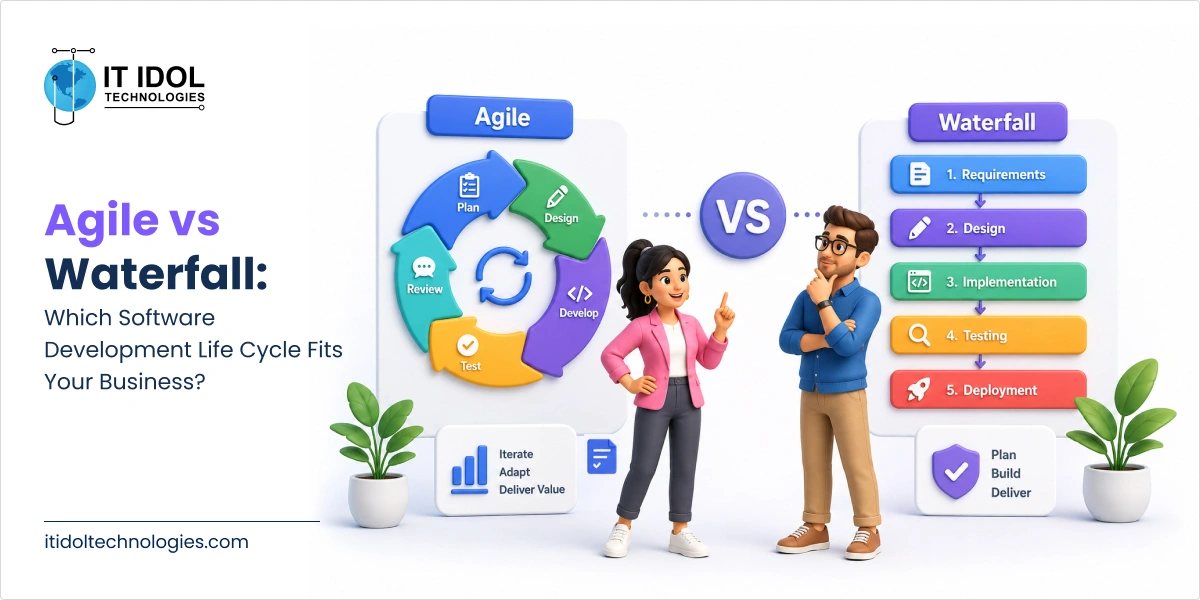
Strip away the ceremonies, the sprint boards, and the Gantt charts, and Agile and Waterfall are answering one underlying question differently: when do you want to find out that a requirement was wrong?
• Waterfall front-loads the decision. You define requirements, design, and architecture in full before a single line of production code is written. If a requirement turns out to be wrong, you typically discover it at user acceptance testing or, worse, after launch.
• Agile defers the decision in small pieces. You build in short cycles (usually 1–4-week sprints), release working increments, and continuously gather feedback. Mistakes surface early and cost less to fix, but you trade away a fixed, locked-in scope for one that keeps evolving.
This reframing matters because it turns “Agile vs Waterfall” from a culture or personality preference into a risk-timing decision. Once you see it that way, the right choice for your specific project becomes far easier to argue for in a board meeting.
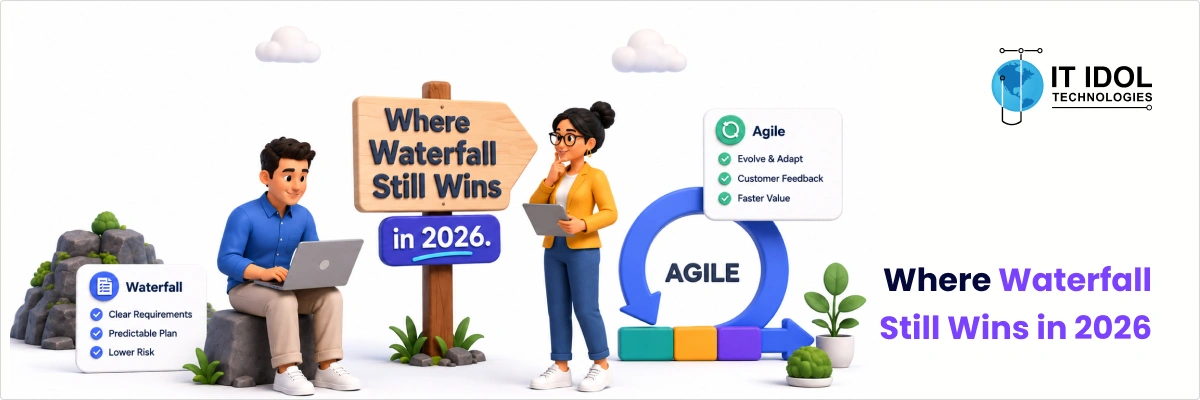
Where Waterfall Still Wins in 2026?
Fixed-Price Contracts and Compliance-Bound Projects
Government tenders, fixed-price enterprise contracts, and regulated domains such as medical device software or financial reporting systems typically require a full, auditable documentation trail before a certification body, procurement office, or compliance officer will sign off. Waterfall’s sequential, document-heavy structure maps directly onto that kind of audit requirement; every phase produces an artifact that becomes part of the compliance record.
Hardware-Dependent or One-Shot Releases
Embedded firmware, industrial control systems, and any software tied to a physical rollout (kiosks, medical hardware, manufacturing lines) can’t always be patched the way a cloud app can. When the cost of a late-stage change is high because it requires reflashing devices or re-certifying hardware, Waterfall’s upfront design discipline reduces the kind of rework that’s expensive, slow, or sometimes physically impossible after deployment.
Where Agile Creates Better ROI?
Products With Evolving Market Requirements
Consumer apps, e-commerce platforms, and CRM or SaaS products the kind of systems IT IDOL Technologies builds for enterprise clients through platforms like iSales CRM benefit from short feedback loops. When usage data and customer behavior should shape the next release, Agile shortens the distance between “what we built” and “what customers actually do with it.”
Startups and Teams Still Validating Product-Market Fit
When you don’t yet know the complete set of requirements, Waterfall forces you to guess it all up front an expensive guess to get wrong. Agile lets you spend engineering budget only on features that have already been validated with real users, cutting the cost of building things nobody ends up wanting.
Agile vs Waterfall: Side-by-Side Comparison
| Factor | Waterfall | Agile |
| Requirements | Locked before development starts | Refined continuously across sprints |
| Client visibility into progress | Mostly at milestone reviews | Every sprint (typically 1–4 weeks) |
| Change requests | Expensive; usually require formal change control | Expected and absorbed into backlog |
| Documentation | Extensive, produced upfront | Lightweight, evolves with the product |
| Budget predictability | High, if scope doesn’t change | Moderate; cost is fixed per sprint, scope flexes |
| Best-fit industries | Healthcare devices, aerospace, government, fixed-bid contracts | SaaS, e-commerce, CRM, consumer apps, startups |
| Time to first usable release | Long — usually at project end | Short — a working increment within weeks |
The Methodology Fit Score: A Framework for Deciding
Instead of asking “Agile or Waterfall?” as a single yes-or-no question, score your actual project against six business variables. Each variable is worth 0, 1, or 2 points, based on which description fits your project most closely.
| Business Variable | 0 points | 1 point | 2 points |
| Requirements | Fixed by regulation or contract | Broadly known, minor shifts expected | Market-driven, likely to evolve |
| Stakeholder availability | Only available at sign-off gates | Available every few weeks | Embedded product owner, available daily |
| Release expectation | Single go-live date | A few planned milestone releases | Continuous or frequent releases |
| Compliance documentation load | Heavy (audit trail, certification body) | Moderate internal governance | Light, mostly internal |
| Cost of a late-stage change | Very high (hardware, firmware, physical rollout) | Moderate (integrated systems) | Low (pure software, cloud-deployed) |
| Team structure | Multiple fixed-scope vendor contracts | Mixed in-house and vendor teams | Single in-house cross-functional team |
How to read your total score (0–12 points)
0–4 points: Waterfall is likely your better fit. Your requirements, compliance load, or hardware dependency don’t leave much room for iterative discovery.
5–8 points: A hybrid model fits best: plan and contract in a Waterfall-style structure, then build in Agile sprints inside that plan.
9–12 points: Agile is likely your better fit. Your requirements are still evolving, and your team can absorb continuous change without added risk.
Why Most Real Projects Land in the Middle: The Hybrid SDLC?
In practice, very few enterprise projects run as pure Agile or pure Waterfall. Forrester analyst Dave West coined the term “Water-Scrum-Fall” in 2011 to describe what he found across most organizations adopting Agile: development teams run sprints internally, while the surrounding business contracting, budgeting, release management, and compliance sign-off still operates on a Waterfall timeline. (Forrester, 2011) This pattern still describes how most large organizations operate today, more than a decade later.
For a business choosing a methodology, this is genuinely useful context: you don’t have to pick a single ideology and force every part of the organization into it. A common and effective structure looks like this:
1. Water: define the business case, budget, high-level requirements, and any compliance gates upfront, before development begins.
2. Scrum: build the product in sprints, with a product owner who can make day-to-day scope decisions inside the agreed budget and timeline.
3. Fall: release in planned, tested batches rather than continuous deployment, when your operations or compliance process requires a controlled rollout.
One caveat worth being direct about: findings on how much more successful Agile projects are compared to Waterfall vary significantly across the industry surveys that get cited (some report roughly 2–3x higher success rates, others report narrower gaps). The methodology and definitions behind these figures differ from study to study, so any specific percentage should be verified against the source, such as the Standish Group’s CHAOS research, before it’s used in a client-facing proposal or board presentation.
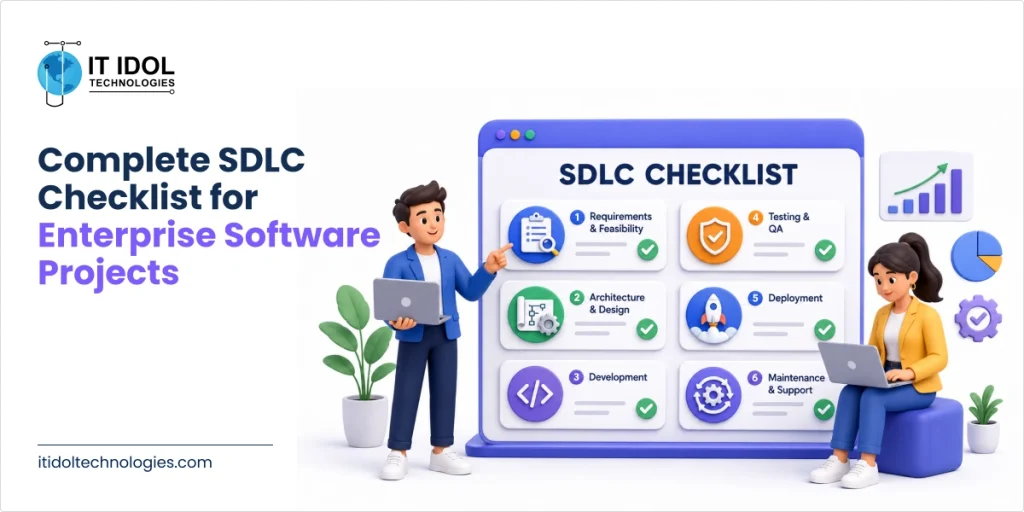
Software Development Life Cycle Checklist Before You Choose
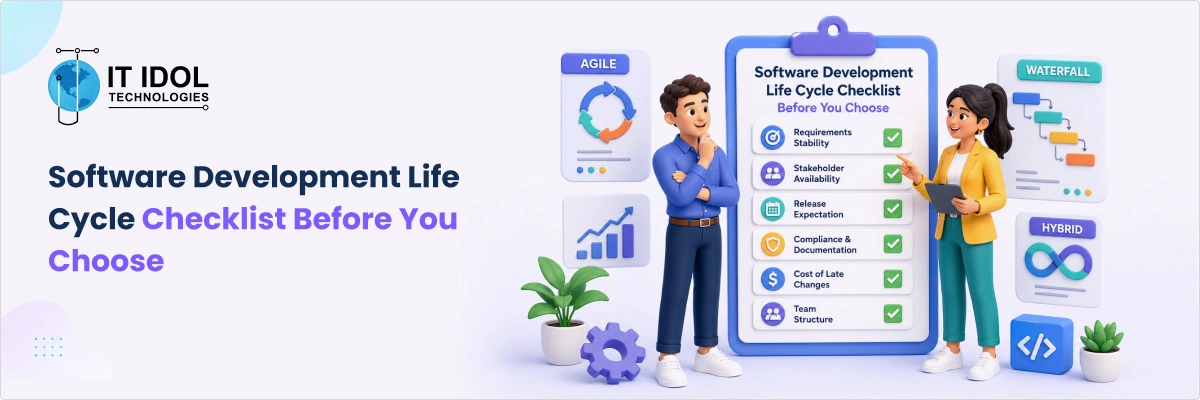
Run through this checklist with your project stakeholders before signing a statement of work. It takes ten minutes and prevents the most expensive mismatches.
• Have we written down what would count as a “change in requirements” for this project, and who has to approve it?
• Is there a regulatory body, auditor, or certification process that requires phase-based documentation?
• Can our stakeholders realistically commit to reviewing work every 1–2 weeks, or only at set milestones?
• What does it cost us if we discover a design flaw after the product has already shipped?
• Is any part of this project tied to physical hardware, firmware, or a fixed go-live event?
• Do we have an in-house product owner empowered to make scope trade-offs, or only an external vendor contract?
• Have we scored the project against the six variables in the Methodology Fit Score above?
• Does our contract structure (fixed-price vs. time-and-materials) match the methodology we’re about to choose?
Common Mistakes Businesses Make When Choosing a Methodology
• Calling a Waterfall project “Agile” without changing anything else. Running sprint ceremonies on top of a fixed, pre-approved scope doesn’t create agility; it just adds meetings.
• Choosing Agile because it sounds modern, not because requirements are actually uncertain. If your compliance obligations are fixed, Agile’s flexibility works against you by making the scope harder to lock down for auditors.
• Choosing Waterfall to make budgeting easier, then absorbing constant change requests anyway. This produces the worst of both: a rigid process paired with an unstable scope, which is where most cost overruns originate.
• Never revisiting the choice mid-project. A methodology decision made at kickoff should be revisited once real requirement volatility becomes apparent, typically after the first month of work.
Choosing the Right Delivery Model for Your Next Project
The right methodology isn’t the one your last vendor used or the one trending in industry articles; it’s the one that matches how stable your requirements are, how available your stakeholders are, and how much a late-stage change would actually cost you.
If you’re scoping a new software project and want a second opinion on whether Agile, Waterfall, or a hybrid delivery model fits your specific constraints, IT IDOL Technologies works with enterprise teams to plan software development life cycles around real business risk rather than a one-size-fits-all process. A conversation before the contract is signed is usually the cheapest step in the entire project.
Also Read: Complete SDLC Checklist for Enterprise Software Projects