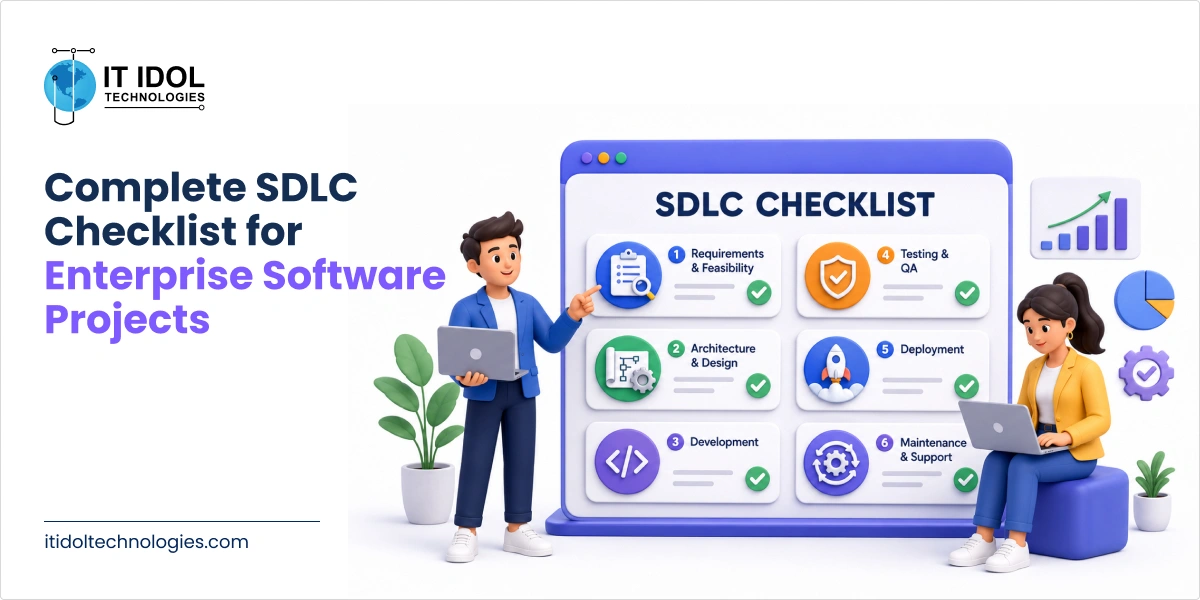
Most SaaS cost estimates fall apart within the first two months of a project. Not because the vendor lied, but because the estimate was built around a feature list instead of a software development life cycle. Features tell you what you’re building. The SDLC tells you what it takes to build it safely: discovery, architecture, development, testing, deployment, and the ongoing cost of keeping the product alive after launch.
If you’re budgeting for a SaaS product right now, the number you actually need isn’t “how much does an app cost.” It’s “how much does each phase of the software development life cycle cost, and where do businesses consistently under-budget?” This guide walks through that, phase by phase, using a cost framework you can apply directly to your own project plus a checklist you can hand to a vendor or internal team before a single line of code gets written.
Why Do Feature-Based Estimates Keep Failing?
A feature list answers “what.” It says nothing about “how much rework,” “how much testing,” or “how much it costs to run this at 10x the users.” Those three questions are where SaaS budgets actually break, and all three live inside the SDLC, not the feature backlog.
Here’s the pattern that shows up again and again: a business gets a quote based on screens and features, signs off, and then discovers three months in that security review, load testing, and DevOps setup were never priced in because they weren’t “features.” They were life cycle stages that got skipped in the estimate.
This is why serious vendors price against the life cycle, not the wish list. It’s also why you, as the buyer, should ask to see a phase-by-phase breakdown before signing anything.
The SDLC Cost Layering Framework
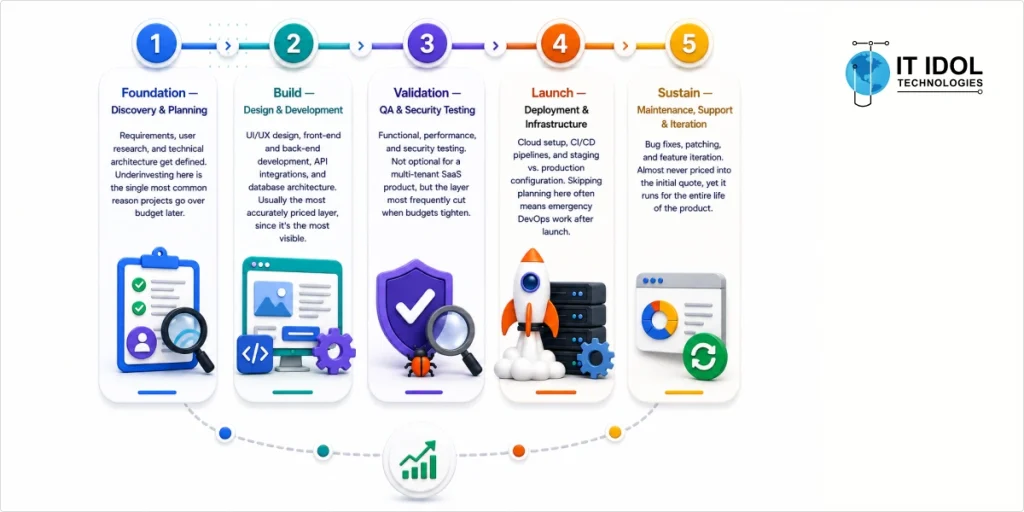
To make this concrete, it helps to think about SaaS development cost in five layers instead of six or seven textbook SDLC stages. Each layer answers a different budgeting question.
The point of this framework isn’t the specific percentages any vendor might quote you; those vary by project complexity, region, and team structure, and any number here would need to be verified against your specific scope. The point is that if a quote you receive is missing one of these five layers entirely, you should ask why before you sign it.
What Drives Cost Within Each Layer?
Requirements Clarity (Foundation Layer)
The clearer your requirements going in, the less you pay in change requests later. A discovery phase that produces a real technical specification, not just a mood board, is what separates a project that stays on budget from one that doesn’t.
Team Structure and Location (Build Layer)
Development cost is heavily influenced by team composition: whether you’re working with an in-house team, an offshore team, a nearshore team, or a hybrid model, and whether the team includes dedicated roles (like a solutions architect or QA lead) or generalists wearing multiple hats. There’s no universally “correct” model; the right choice depends on your timeline, budget, and how much oversight you can provide.
Compliance and Data Sensitivity (Validation Layer)
A SaaS product handling healthcare, financial, or personal data carries testing and compliance obligations that a simple internal tool doesn’t. This is one of the most common places businesses under-scope testing costs, because compliance requirements are often decided after development has already started rather than during planning.
Scalability Requirements (Launch Layer)
A product built to serve 500 users and a product built to serve 500,000 users are architected differently from day one. If you know you’re building for scale, that decision needs to shape the infrastructure conversation early; retrofitting scalability after launch is consistently more expensive than designing for it upfront.
Post-Launch Support Model (Sustain Layer)
Will you need a dedicated support team, a shared support pool, or an SLA-backed managed service? This decision affects ongoing cost more than almost any single development decision, because it runs for the life of the product rather than a fixed project window.
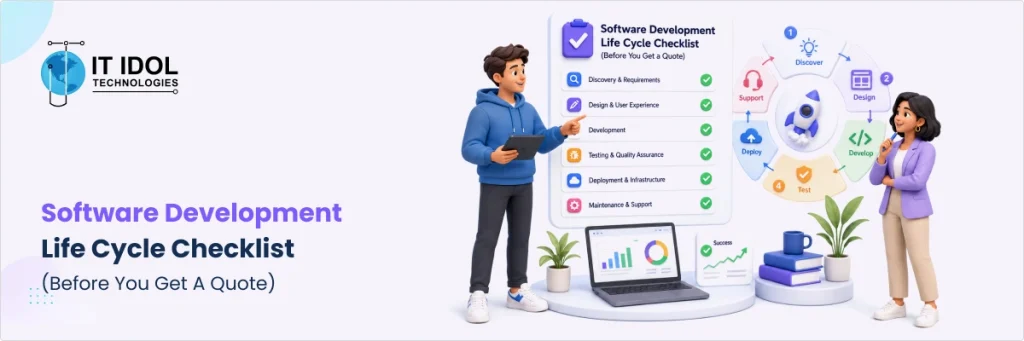
Software Development Life Cycle Checklist (Before You Get a Quote)
Use this checklist as a pre-quote conversation guide with any vendor or internal team:
☐ Is there a documented discovery/requirements phase, or does the project go straight to design?
☐ Does the quote separate design cost from development cost?
☐ Is QA/testing itemized, or bundled vaguely into “development”?
☐ Is security testing explicitly scoped, especially if the product handles customer data?
☐ Is there a named DevOps/infrastructure setup phase, including CI/CD?
☐ Does the quote specify staging vs. production environments?
☐ Is there a defined post-launch support period, and what happens after it ends?
☐ Are ongoing infrastructure/hosting costs separated from one-time development costs?
☐ Is there a change-request process defined, with pricing, for scope changes mid-project?
☐ Does the vendor provide a phase-by-phase timeline, not just a total delivery date?
If a vendor can’t answer most of these clearly, that’s a signal to ask more questions before committing budget.
Common Mistakes That Inflate SaaS Development Cost
• Treating discovery as optional. Skipping or rushing discovery to “save time” is the most common reason projects blow past their original budget.
• Pricing only the MVP, not the roadmap. An MVP quote that doesn’t account for what happens after launch often looks artificially cheap compared to a quote that includes a realistic 12-month iteration plan.
• Ignoring compliance until it’s urgent. Compliance requirements discovered mid-development are dramatically more expensive to retrofit than requirements planned for from the start.
• Underestimating integration complexity. Connecting to third-party systems (payment processors, CRMs, identity providers) is routinely underestimated because it looks simple from the outside and often isn’t.
• No plan for post-launch iteration. A SaaS product isn’t “done” at launch; it’s a live system that needs ongoing investment. Budgets that stop at launch are, by definition, incomplete.
A Simple Way to Sanity-Check Any Quote
Ask the vendor to map their quote back to the five layers above: Foundation, Build, Validation, Launch, Sustain. If any layer is missing or vaguely worded, that’s where your budget risk is hiding. This single exercise resolves more scope disputes than any amount of back-and-forth negotiation on the total number.
Key Takeaways
SaaS development cost isn’t one number; it’s the sum of five distinct life cycle layers, and vendors who skip pricing a layer are shifting that cost to you later, not eliminating it. Discovery and validation are the two most commonly under-budgeted phases, despite being where the most expensive mistakes originate.
Post-launch maintenance and iteration should be part of the initial budget conversation, not an afterthought. Any specific percentage, dollar figure, or benchmark you hear from a vendor should be verified against your own project’s scope and region cost figures, which vary too widely to generalize responsibly.
Where This Leaves You
A software development life cycle isn’t a formality; it’s the actual cost structure of your project, whether or not a vendor’s quote reflects it. Businesses that ask for a phase-by-phase breakdown before committing budget consistently end up with fewer surprises than those who negotiate only on the total number.
If you’re currently evaluating vendors or scoping an internal build, IT IDOL Technologies works with businesses to structure SDLC-based project plans before development begins so the budget conversation happens with full visibility into every phase, not just the parts that are easiest to quote
It’s the structured sequence a software product moves through from requirements and design to development, testing, deployment, and maintenance, used to manage cost, quality, and risk at each stage rather than treating development as one undivided task.
It varies significantly based on scope, team location, compliance requirements, and complexity. Any specific figure quoted online should be treated as a rough reference point and verified against your actual project scope, not treated as a fixed benchmark.
Discovery/planning and QA/security testing are the two phases most frequently under-scoped in initial quotes, often because they’re less visible than design and development work.
Yes, in a lighter form. Even a small MVP benefits from a defined (if compressed) discovery, build, and testing phase; skipping structure entirely tends to cost more in rework than it saves in time.
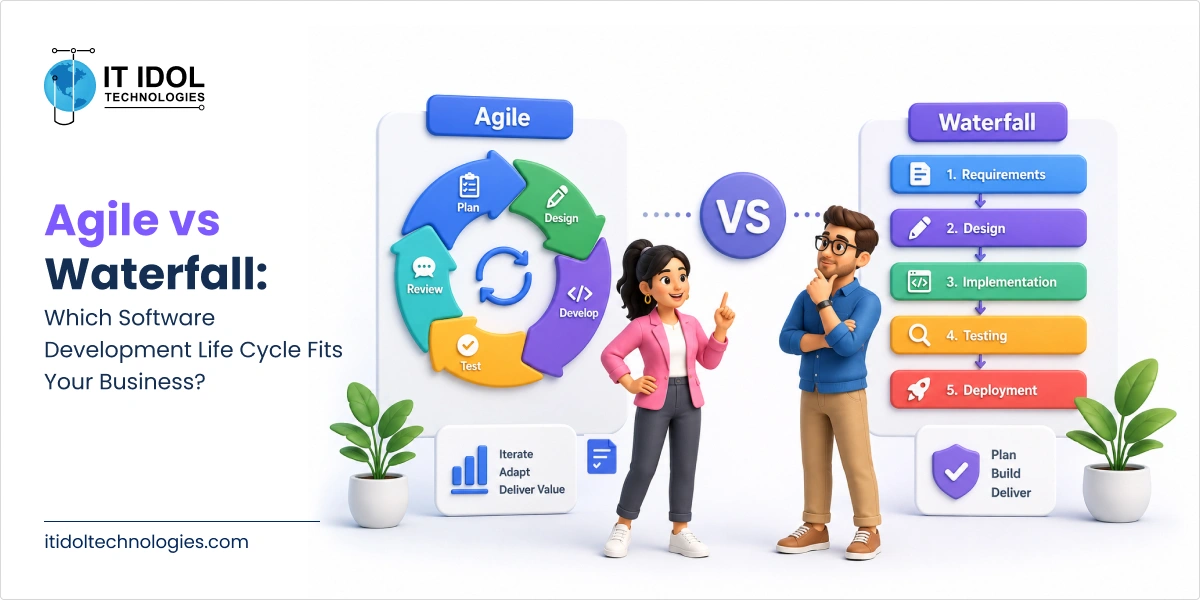
Waterfall front-loads planning and locks scope early, which can make costs more predictable but less flexible. Agile allows scope to evolve, which can control cost on uncertain projects but requires more disciplined budget tracking since scope isn’t fixed upfront.
Yes. Maintenance, patching, and iteration are ongoing costs for the life of the product, and budgeting for them from the start avoids the common trap of treating launch as the finish line.
Handling regulated data (healthcare, financial, or personal information) typically adds testing, documentation, and architectural requirements that should be scoped during planning; retrofitting compliance after development starts is consistently more expensive.
Integration complexity with third-party systems is one of the most frequently underestimated costs, because it looks straightforward until the actual data mapping and edge cases surface.
Ask each vendor to break their quote down by SDLC phase (discovery, design, development, testing, deployment, support) rather than comparing total numbers; this reveals which quotes are missing entire cost categories.
Ask about the discovery process, how testing is scoped, whether security review is included, what infrastructure setup involves, and what the post-launch support model looks like. The checklist earlier in this guide covers this in full.
Deval Rathod
Founder & CEO
|
Deval Rathod is the Founder and CEO of IT IDOL Technologies, a custom software development company. With over a decade of experience in software engineering, solution architecture, and technology leadership, she has worked across custom software development, enterprise applications, AI & ML, and digital transformation. Her expertise includes guiding technology teams, designing scalable software solutions, and helping businesses evaluate and implement emerging technologies. She contributes insights on software engineering, artificial intelligence, enterprise technology, and digital transformation.