Why Data Lakehouses Are Becoming the Foundation of Modern Data Engineering
Enterprise data is growing at a pace that traditional architectures were never designed to handle. Every customer interaction, IoT device, SaaS application, financial transaction, and AI-powered workflow generates data that businesses can use to improve operations and make better decisions. However, storing more data does not automatically create more value.
Many organizations still rely on separate data lakes for raw storage and data warehouses for reporting. While this approach worked for years, it often leads to duplicated datasets, inconsistent governance, higher storage costs, and delayed analytics. Data engineers spend valuable time moving and preparing data instead of building solutions that support the business.
This challenge has pushed data lakehouses into the spotlight. In 2026, they are becoming the preferred architecture for organizations that need a single platform capable of supporting analytics, artificial intelligence, machine learning, and real-time reporting.
Companies modernizing legacy analytics environments often begin by improving their existing data infrastructure. How to Use Azure Databricks for Data Warehouse Modernization explains how many enterprises are evolving beyond traditional warehouse architectures before adopting a complete lakehouse strategy.
Rather than maintaining multiple copies of the same information across disconnected systems, a data lakehouse creates a unified environment where engineering, analytics, and AI teams work from trusted data. This approach reduces operational complexity while improving collaboration across departments.
As businesses continue investing in intelligent applications, the quality of enterprise data has become just as important as the quality of AI models themselves.
What Is a Data Lakehouse?
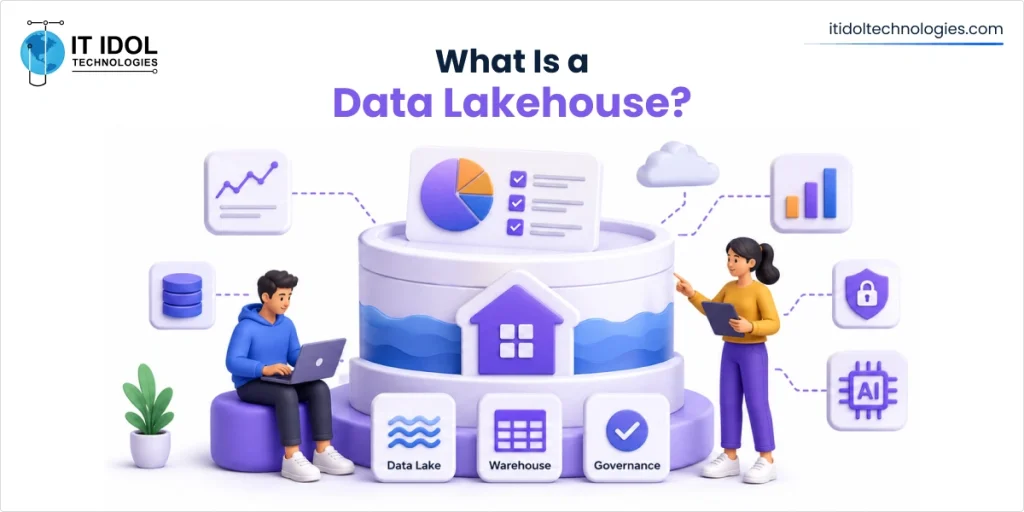
A data lakehouse is a modern data architecture that combines the scalability and flexibility of a data lake with the governance, performance, and reliability of a data warehouse.
Unlike traditional warehouses that primarily manage structured information, a lakehouse stores structured, semi-structured, and unstructured data in one centralized platform. Business intelligence tools, data scientists, AI models, and operational applications can all access the same trusted datasets without maintaining separate storage environments.
This unified approach supports a wide range of enterprise workloads, including:
Business intelligence and reporting
Real-time analytics
Machine learning model training
Generative AI applications
Predictive analytics
Data science experimentation
Enterprise dashboards
Instead of moving data between multiple systems, organizations manage a single source of truth that supports every stage of the data lifecycle.
How a Data Lakehouse Combines the Best of Both Worlds
Traditional data lakes offer inexpensive storage and virtually unlimited scalability. However, they often lack strong governance, transactional consistency, and high-performance analytics.
Data warehouses solve many of these challenges by providing structured storage, optimized SQL queries, and enterprise-grade governance. Their limitation is flexibility. Managing large volumes of unstructured or rapidly changing data can become expensive and difficult.
A data lakehouse combines the strengths of both approaches.
Organizations can continue storing diverse datasets in low-cost cloud storage while adding capabilities such as:
ACID transactions
Schema enforcement
Version control
Fine-grained access management
High-performance SQL analytics
Native AI and machine learning support
As enterprises increase their investment in AI, many long-held assumptions about enterprise data are changing. Several of these misconceptions are explored in Data Engineering Myths That AI Is Breaking, highlighting why modern AI initiatives require stronger data foundations rather than simply larger datasets.
By reducing duplicate storage and improving governance, lakehouses help organizations spend less time managing infrastructure and more time delivering business value.
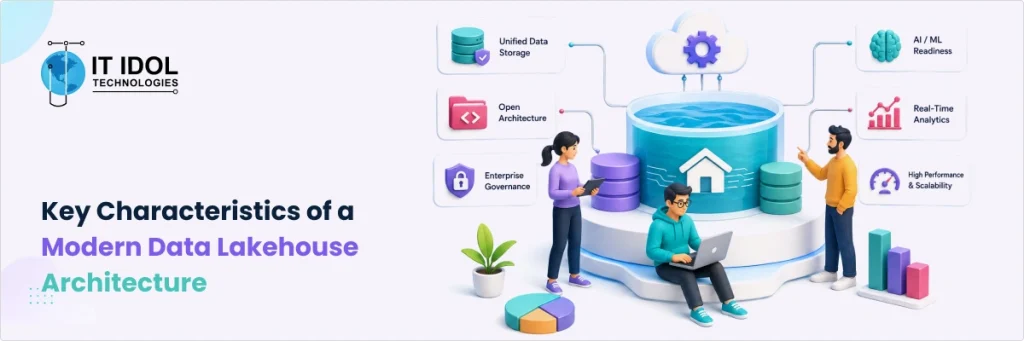
Key Characteristics of a Modern Data Lakehouse Architecture
Although technology vendors implement lakehouses differently, the core principles remain the same. A modern lakehouse provides the flexibility to manage growing data volumes while maintaining the governance and performance enterprises expect from production systems.
Unified Data Storage
A lakehouse stores structured, semi-structured, and unstructured data in a centralized repository. Instead of creating separate environments for reporting, analytics, and AI, every team works from the same trusted datasets.
This approach reduces duplicate storage, improves consistency across departments, and makes it easier to govern enterprise data.
Open Architecture
One of the biggest shifts in data engineering is the adoption of open table formats such as Apache Iceberg, Delta Lake, and Apache Hudi. These technologies reduce vendor lock-in while allowing organizations to use multiple analytics engines without migrating data between platforms.
Governance has become a business requirement rather than a technical feature.
Modern lakehouses centralize:
Role-based access control
Data lineage
Metadata management
Audit logging
Data quality monitoring
Regulatory compliance
This is especially valuable for organizations operating in healthcare, financial services, retail, and other highly regulated industries.
AI and Machine Learning Readiness
Artificial intelligence depends on reliable enterprise data. A lakehouse allows machine learning engineers, data scientists, analysts, and business users to access the same governed datasets instead of maintaining isolated copies.
This improves model consistency while reducing operational overhead.
Organizations building autonomous business systems also require data platforms capable of supporting continuous AI decision-making. What Is Agentic AI? A Practical Definition for Business Leaders explains why trusted enterprise data is becoming one of the most important requirements for next-generation AI applications.
Modern businesses rarely have the luxury of waiting for overnight reports.
Retailers adjust inventory throughout the day. Manufacturers monitor equipment continuously. Financial institutions detect suspicious transactions within seconds. Logistics companies optimize delivery routes in real time.
A lakehouse supports both historical analysis and streaming data, allowing organizations to respond as business conditions change.
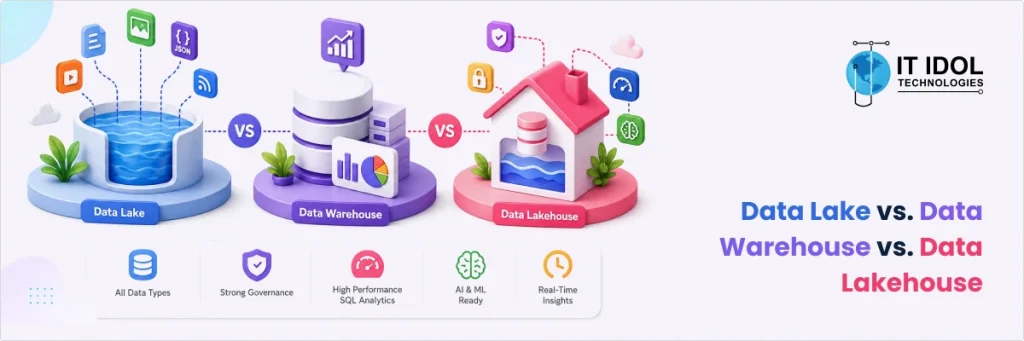
Data Lake vs. Data Warehouse vs. Data Lakehouse
Although these technologies are closely related, they serve different purposes.
Feature
Data Lake
Data Warehouse
Data Lakehouse
Data Types
Structured, semi-structured, unstructured
Primarily structured
All data types
Storage Cost
Low
Higher
Optimized
Governance
Basic
Strong
Strong
SQL Analytics
Limited
Excellent
Excellent
Machine Learning
Excellent
Moderate
Excellent
Real-Time Analytics
Moderate
Good
Excellent
Scalability
High
Moderate
High
Data Duplication
Common
Common
Significantly reduced
For organizations investing in AI, advanced analytics, and intelligent automation, maintaining separate environments often creates unnecessary complexity. A lakehouse helps consolidate these workloads into a single governed platform.
How a Data Lakehouse Works
A lakehouse combines cloud-native storage with modern data management technologies that improve reliability, scalability, and performance.
Instead of storing data inside proprietary warehouse systems, information is typically stored in cloud object storage while compute resources operate independently. This separation allows organizations to scale storage and processing based on demand instead of purchasing infrastructure for peak workloads.
Several technologies make this architecture possible.
Cloud Object Storage
Cloud storage provides virtually unlimited scalability while keeping storage costs predictable. Organizations can retain historical data without constantly expanding expensive warehouse infrastructure.
Open Table Formats
Technologies such as Apache Iceberg, Delta Lake, and Apache Hudi introduce enterprise capabilities directly into cloud storage.
These include:
ACID transactions
Schema evolution
Snapshot management
Version control
Concurrent read and write operations
These capabilities make cloud storage practical for enterprise production workloads.
Metadata Layer
Metadata serves as the intelligence layer of the lakehouse.
It records:
Table definitions
Schema history
Data ownership
Lineage
Access permissions
Quality metrics
Without strong metadata management, organizations struggle to scale analytics and AI initiatives across departments.
Transactional consistency ensures multiple users and applications can safely update data without creating conflicts.
This capability is essential for enterprise reporting, financial analytics, and AI model training.
Schema Evolution and Time Travel
Business data changes continuously.
Lakehouses allow schemas to evolve without breaking existing applications while maintaining historical versions of datasets. Teams can compare previous snapshots, recover earlier versions, and simplify compliance audits.
As organizations modernize their data architecture, they often discover that the greatest challenge is not storage but connecting business systems efficiently. Enterprise Application Integration (EAI): The Key to Seamless Business Operations explores how integrated enterprise systems improve data availability across the organization.
Understanding the Medallion Architecture
A lakehouse is more than a centralized storage platform. To keep data reliable and easy to manage, most organizations organize it into logical layers. The most widely adopted approach is the Medallion Architecture, which gradually improves data quality as information moves through the platform.
Rather than cleaning every dataset before storage, this model allows you to preserve raw data while creating trusted, business-ready datasets for analytics and AI.
Bronze Layer: Raw Data
The Bronze layer captures data exactly as it enters the platform.
Common sources include:
ERP systems
CRM platforms
IoT devices
Application logs
Website clickstream data
API integrations
Transaction records
Very little processing occurs at this stage. Keeping original data intact allows engineers to rebuild pipelines, troubleshoot issues, and support future business requirements without losing historical information.
Silver Layer: Validated and Refined Data
The Silver layer improves data quality before it reaches business users.
Typical processes include:
Removing duplicate records
Standardizing formats
Validating business rules
Handling missing values
Combining related datasets
Applying reference data
This layer creates consistent datasets that analysts, AI models, and operational systems can trust.
The Gold layer contains curated datasets built specifically for reporting and decision-making.
Examples include:
Executive dashboards
Sales performance reports
Customer lifetime value metrics
Financial KPIs
Predictive AI features
Supply chain analytics
Instead of rebuilding the same calculations repeatedly, business users access trusted datasets that are already optimized for analytics.
Core Components of a Modern Data Lakehouse
A successful lakehouse depends on more than centralized storage. Several technologies work together to create a scalable, enterprise-ready platform.
Data Ingestion Pipelines
Enterprise data comes from hundreds of systems.
Modern ingestion pipelines continuously collect information from applications, databases, cloud services, APIs, and connected devices while maintaining consistent processing standards.
Batch and Streaming Processing
Organizations need both historical reporting and live operational insights.
Batch processing remains valuable for financial reporting, forecasting, and long-term trend analysis.
Streaming pipelines support use cases such as:
Fraud detection
Inventory updates
Equipment monitoring
Personalized recommendations
Shipment tracking
Supporting both processing models within one platform allows businesses to respond faster without maintaining separate architectures.
Metadata Management
Metadata provides context for enterprise data.
It answers questions such as:
Where did the data originate?
Who owns it?
When was it updated?
Can it be trusted?
Which reports depend on it?
Without strong metadata management, data becomes increasingly difficult to discover and govern.
Data Governance and Security
Governance protects enterprise data throughout its lifecycle.
Modern lakehouses centralize:
Access management
Compliance policies
Data lineage
Audit trails
Classification
Encryption
Organizations operating in regulated industries benefit from consistent governance across analytics and AI workloads.
Analytics and Query Engines
Business users expect answers within seconds.
Modern query engines allow analysts to work directly with large datasets without first moving them into specialized warehouse environments.
AI and Machine Learning Integration
Perhaps the biggest advantage of a lakehouse is that engineering, analytics, and AI teams all work from the same trusted datasets.
This reduces duplicated pipelines while improving consistency across predictive models, dashboards, and intelligent applications.
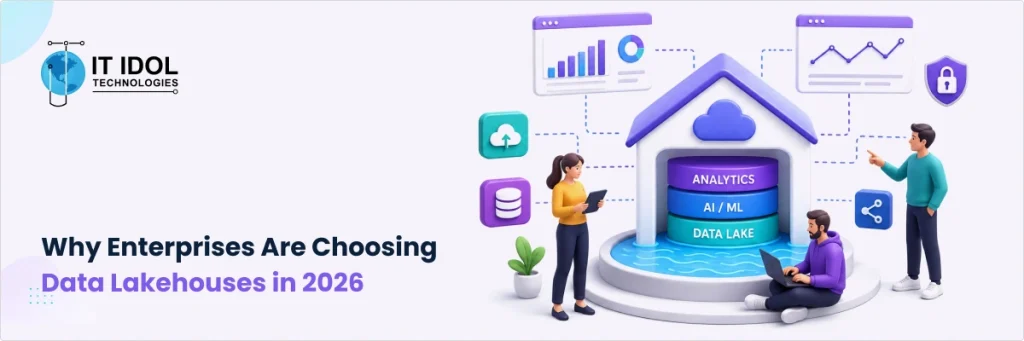
Why Enterprises Are Choosing Data Lakehouses in 2026
The conversation around enterprise data has shifted significantly over the past few years. Organizations are no longer asking how to store more information. Instead, they want to know how quickly they can turn trusted data into measurable business outcomes.
A lakehouse supports that goal in several ways.
Lower Infrastructure Costs
Maintaining separate data lakes, warehouses, ETL pipelines, and analytics platforms increases both storage costs and operational complexity.
A lakehouse reduces unnecessary duplication while allowing storage and compute resources to scale independently.
Better AI Readiness
Artificial intelligence performs best when it has access to accurate, governed, and continuously updated data.
A lakehouse creates a reliable foundation for:
Predictive analytics
Recommendation engines
Large language models
AI copilots
Intelligent automation
AI agents
Faster Business Decisions
Business leaders increasingly expect real-time visibility into operations.
Whether monitoring patient outcomes, managing retail inventory, optimizing delivery routes, or identifying fraudulent transactions, organizations benefit from immediate access to reliable data.
Simplified Enterprise Architecture
Replacing disconnected data platforms with a unified architecture simplifies governance, improves collaboration, and reduces maintenance overhead.
Technology continues to evolve rapidly, but several trends are clearly influencing enterprise data strategies.
AI-Native Data Platforms
Modern platforms are increasingly designed for AI from the beginning rather than adding AI capabilities later.
This improves feature engineering, metadata generation, pipeline automation, and AI application development.
Open Table Formats Continue to Grow
Apache Iceberg, Delta Lake, and Apache Hudi have become preferred standards because they improve interoperability while reducing vendor dependency.
Real-Time Data Is Becoming the Default
Streaming analytics is expanding beyond financial services and telecommunications.
Retail, manufacturing, healthcare, logistics, SaaS, and education organizations increasingly rely on continuous data processing instead of scheduled reporting.
AI-Powered Data Observability
Artificial intelligence is beginning to monitor data pipelines automatically.
Instead of waiting for failures, AI systems identify anomalies, detect quality issues, recommend fixes, and predict operational risks before business users notice problems.
Stronger Governance for AI
As AI adoption grows, governance becomes increasingly important.
Organizations need clear policies around data ownership, model training, compliance, lineage, and access control.
A data lakehouse delivers value across industries because it creates a single, trusted foundation for analytics and AI while reducing the complexity of managing multiple data platforms.
Healthcare: Improve patient analytics, streamline clinical reporting, and support AI-driven diagnostics while maintaining stronger governance.
Retail and E-commerce: Build personalized shopping experiences, improve inventory forecasting, and respond to customer behavior in real time.
FinTech: Strengthen fraud detection, risk modeling, compliance reporting, and customer insights using governed, real-time data.
Manufacturing: Monitor production lines, predict equipment failures, and improve supply chain visibility through connected operational data.
SaaS: Analyze product usage, customer engagement, and platform performance from a single data platform.
Logistics: Combine fleet, warehouse, and shipment data to optimize routes, improve delivery accuracy, and reduce operational costs.
Education: Support personalized learning, student performance analysis, and institutional reporting with centralized data.
Startups: Build scalable analytics and AI capabilities without continuously redesigning the underlying data architecture.
Best Practices for Building a Future-Ready Data Lakehouse
Implementing a lakehouse successfully requires more than choosing the right technology. A clear strategy helps organizations maximize long-term value.
Define business objectives before selecting tools.
Adopt open standards to maintain flexibility and reduce vendor lock-in.
Build governance, security, and metadata management into the platform from day one.
Design for both batch and real-time processing.
Continuously monitor data quality and pipeline performance.
Prepare your data platform for future AI initiatives instead of treating AI as a separate project.
Data engineering is moving beyond simply storing and processing information. Over the next several years, organizations will focus on creating intelligent data platforms that continuously improve governance, automate data management, and support AI-driven decision-making.
Data lakehouses will play a central role in this shift because they provide a unified foundation for analytics, machine learning, and operational systems. As AI applications become more autonomous, the quality, accessibility, and governance of enterprise data will become even more important.
Organizations that invest in modern data architectures today will be better positioned to adopt emerging AI technologies, respond faster to market changes, and scale innovation without repeatedly rebuilding their data infrastructure.
Conclusion
A data lakehouse is more than the next step in data storage. It represents a practical approach to managing enterprise data in an environment where analytics, AI, and real-time decision-making are becoming everyday business requirements.
By combining the flexibility of data lakes with the governance and performance of data warehouses, organizations can reduce complexity, improve collaboration, and create a reliable foundation for future innovation.
Whether you operate in healthcare, retail, manufacturing, FinTech, logistics, SaaS, or another data-driven industry, choosing the right architecture today will influence how effectively your business can use AI and analytics tomorrow.
At IT IDOL Technologies, we help organizations build scalable data platforms, AI-powered applications, and enterprise software solutions that support long-term business growth. Whether you’re modernizing legacy systems or planning your next data initiative, investing in the right architecture today can help you deliver measurable value for years to come.
A data lakehouse is a unified data architecture that combines the scalability of a data lake with the governance, performance, and reliability of a data warehouse.
A traditional data warehouse primarily manages structured data for reporting, while a data lakehouse supports structured, semi-structured, and unstructured data for analytics, AI, and machine learning within the same platform.
Organizations are adopting lakehouses to reduce data duplication, improve governance, support AI initiatives, enable real-time analytics, and simplify enterprise data management.
Healthcare, retail, FinTech, manufacturing, SaaS, logistics, education, and startups benefit significantly because they manage large volumes of diverse data and increasingly rely on AI-driven insights.
Yes. A lakehouse provides governed, high-quality datasets that data scientists, machine learning engineers, and AI applications can access from a single platform, improving consistency and reducing duplicate data pipelines.
Deval Rathod
Founder & CEO
|
Deval Rathod is the Founder and CEO of IT IDOL Technologies, a custom software development company. With over a decade of experience in software engineering, solution architecture, and technology leadership, she has worked across custom software development, enterprise applications, AI & ML, and digital transformation. Her expertise includes guiding technology teams, designing scalable software solutions, and helping businesses evaluate and implement emerging technologies. She contributes insights on software engineering, artificial intelligence, enterprise technology, and digital transformation.