For nearly two decades, SEO teams worked within a relatively stable framework. Rankings determined visibility, clicks reflected discoverability, and analytics platforms translated user behavior into measurable performance indicators. The relationship between search engines and websites was imperfect but understandable.
That model is beginning to fragment.
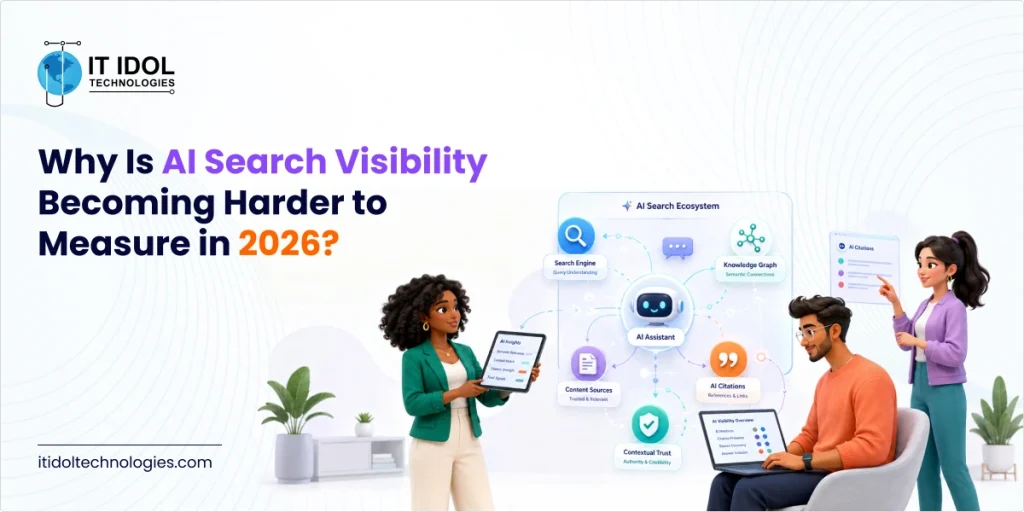
The rise of AI-generated search experiences is changing how information is surfaced, consumed, and attributed across the web. Instead of directing users toward lists of links, AI systems increasingly synthesize information directly into conversational answers. In many cases, the user journey ends before a click ever happens.
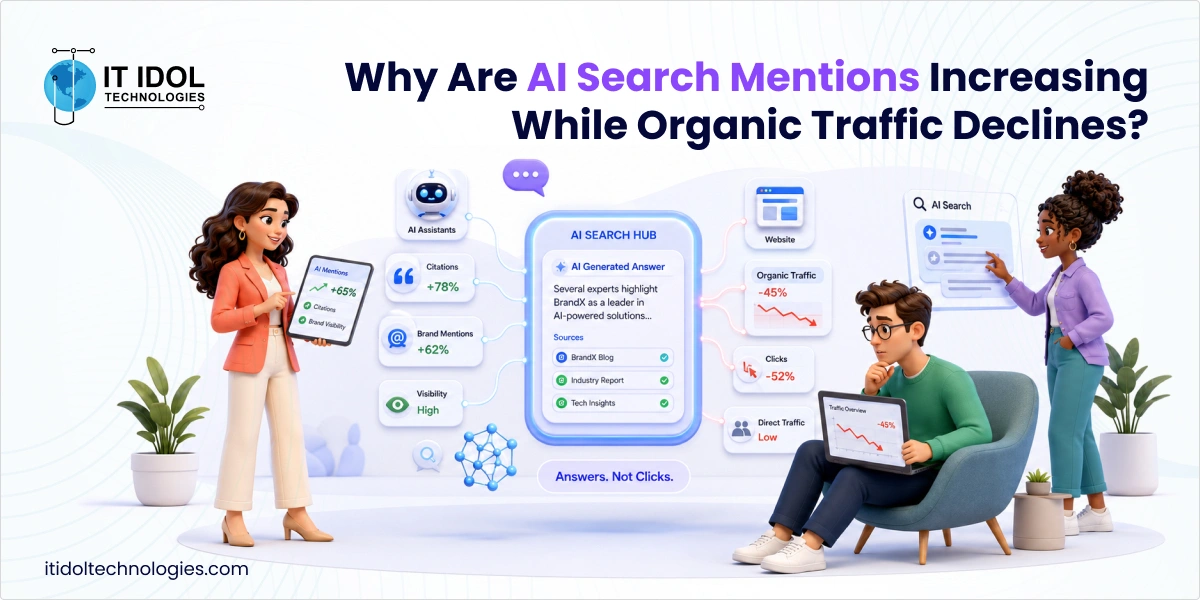
This is creating a measurable gap between visibility and traffic.
A brand may influence an AI-generated response without receiving a measurable website visit. A research article might shape a synthesized answer without ranking first in organic search. Enterprise content may become part of retrieval systems used by AI assistants even when traditional keyword tracking tools show limited movement.
The challenge for businesses is no longer limited to ranking pages. It is understanding how discoverability works when search becomes distributed across AI systems.
Search Is Moving From Navigation to Interpretation
Traditional search engines primarily acted as navigational systems. A user entered a query, the engine retrieved indexed pages, and rankings determined exposure. AI search environments operate differently. Platforms such as Google AI Overviews, OpenAI ChatGPT Search, Microsoft Copilot, Perplexity AI, and Anthropic Claude increasingly function as interpretation systems rather than simple retrieval engines. They aggregate, summarize, contextualize, and synthesize information from multiple sources before presenting a response.
Google itself acknowledged this directional shift during the rollout of AI Overviews, explaining that generative search experiences are designed to help users ask more complex questions and explore topics conversationally. According to Google’s official announcement on AI Overviews, users are increasingly interacting with search in ways that go beyond traditional keyword behavior.
This fundamentally changes how visibility should be understood.
A page does not necessarily need to “rank” in the traditional sense to influence AI-generated answers. Instead, content must become retrievable, interpretable, and contextually trustworthy across multiple AI systems.
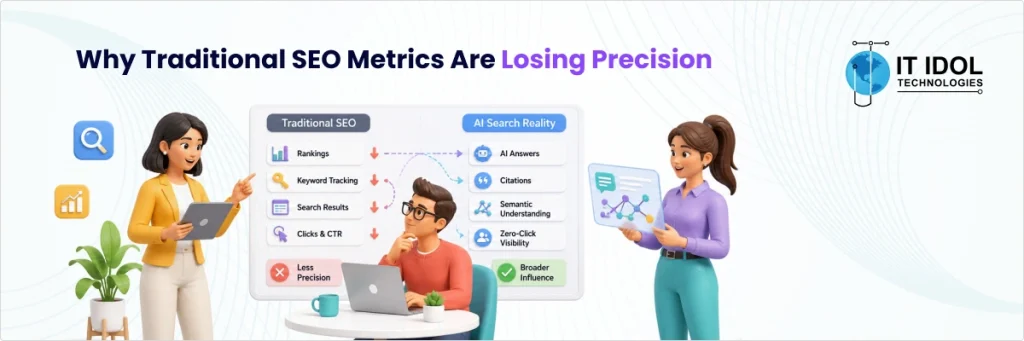
Why Traditional SEO Metrics Are Losing Precision
One of the biggest changes happening in search analytics is the decline of precision-level measurement.
Historically, SEO performance could be tracked through:
exact keyword rankings
page-level impressions
click-through rates
and organic traffic attribution
AI-generated responses disrupt this model because visibility can occur without direct interaction.
A user may receive:
a synthesized product comparison
a summarized industry explanation
or a contextual recommendation without visiting the source
This creates a new reality where influence is expanding while measurable attribution becomes less precise.
Google has also stated that AI-powered search experiences may generate broader exploratory behavior. In its documentation about Search Generative Experience and AI Overviews, the company notes that users often engage with a wider range of queries during conversational exploration rather than following linear search patterns.
For marketers and publishers, this means older reporting models may no longer capture the full picture of discoverability.
The Real Shift Is Semantic, Not Technical
Many businesses still approach AI visibility as if it were simply a new SEO feature.
It is not.
The larger transition is semantic. Traditional SEO often rewarded exact-match optimization and isolated keyword targeting. AI retrieval systems operate with broader contextual interpretation. They attempt to understand relationships between concepts, expertise, entities, and subject depth rather than relying exclusively on direct keyword repetition. This is one reason why shallow content is becoming increasingly ineffective.
Pages written primarily for ranking formulas often struggle in AI-driven environments because they lack:
informational depth
conceptual continuity
contextual completeness
and expertise signals
Conversational AI systems tend to favour content that demonstrates topical coherence across a wider subject ecosystem. In practice, this means a well-structured article discussing AI governance, infrastructure readiness, compliance risks, and operational implications may become more retrievable than several narrowly optimized pages targeting isolated keyword variants.
AI Visibility Is Becoming an Ecosystem Problem
One of the most overlooked aspects of AI search is that discoverability no longer happens on a single platform.
Brands are now surfaced across interconnected AI ecosystems:
search engines
conversational assistants
enterprise copilots
retrieval systems
browser-integrated AI tools
and multimodal assistants
A company’s visibility may appear inside:
AI summaries
product comparisons
synthesized research outputs
conversational responses
or knowledge retrieval systems
This means businesses can no longer evaluate visibility exclusively through website analytics.
Instead, organizations increasingly need to assess:
topical authority
citation frequency
entity association
semantic relevance
and cross-platform retrievability
The companies gaining visibility in AI environments are often those building interconnected knowledge ecosystems rather than isolated SEO pages.
Why Authority Signals Matter More in AI Systems
AI systems evaluate content differently from traditional ranking algorithms. While Google Search has long emphasized expertise and trustworthiness through its E-E-A-T framework, AI retrieval environments intensify the importance of authoritative context. Google’s Search Quality Evaluator Guidelines repeatedly emphasize the importance of demonstrating experience, expertise, authoritativeness, and trustworthiness for content that influences user decisions.
Content that merely repeats popular terms without contributing meaningful interpretation becomes easier for AI systems to deprioritize.
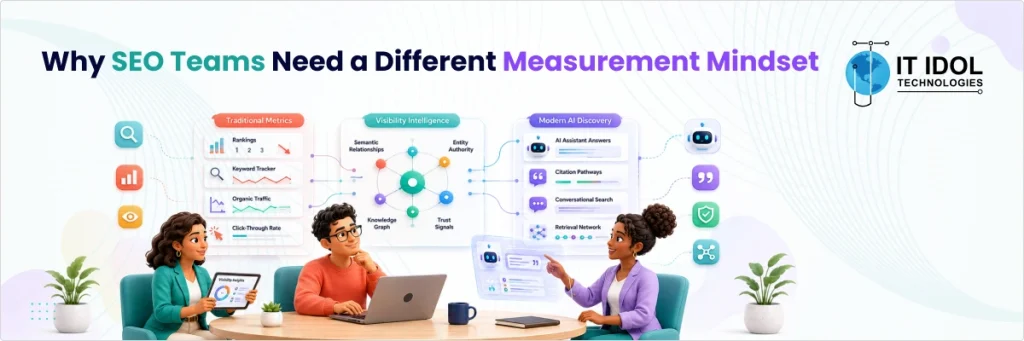
Why SEO Teams Need a Different Measurement Mindset
The future of AI visibility may depend less on precision tracking and more on directional intelligence.
That requires a different mindset.
Instead of asking:
“Where does this page rank?”
Organizations may increasingly ask:
Is our expertise retrievable?
Are we being referenced contextually?
Does our brand appear in AI-generated research flows?
Are we becoming part of industry knowledge ecosystems?
Is our content shaping conversations even when direct clicks decline?
This does not mean traditional SEO disappears. Organic search still matters enormously. Google Search continues to drive large-scale discovery behavior across industries. However, the mechanics of discoverability are expanding beyond ranking alone.
Search visibility is gradually becoming a combination of:
retrieval relevance
semantic authority
contextual trust
and cross-platform knowledge presence
What Businesses Should Focus on Now
The organizations adapting most effectively to AI-driven discovery are not chasing algorithm shortcuts. They are strengthening informational quality.
That includes:
publishing original analysis
improving technical accuracy
building topic depth
connecting related subject areas
maintaining structured content architecture
and creating information ecosystems rather than disconnected articles
AI systems increasingly reward clarity, completeness, and contextual usefulness over isolated optimization tactics. As AI search environments mature, businesses that focus only on traffic metrics may miss broader visibility shifts happening across conversational interfaces and retrieval systems. The companies that succeed long-term will likely be those that understand a larger reality.
In AI-driven search environments, discoverability is no longer just about ranking pages.
It is about becoming part of the information layer AI systems trust enough to retrieve, interpret, and surface repeatedly.
How IT IDOL Technologies Helps Businesses Adapt to AI-Driven Search Ecosystems
As search evolves toward AI-driven discovery and conversational retrieval, businesses need more than traditional SEO tactics. They require scalable digital ecosystems capable of supporting semantic discoverability, structured content intelligence, AI-ready architecture, and data-driven visibility strategies.
IT IDOL Technologies helps enterprises build future-ready digital platforms through AI engineering, cloud-native development, enterprise modernization, data solutions, and intelligent content ecosystems designed for evolving search and AI environments.
From scalable web architecture to AI-integrated digital transformation strategies, the company supports organizations looking to strengthen visibility, operational intelligence, and long-term digital discoverability in increasingly AI-driven markets.
FAQ’s
1. What is AI search visibility?
AI search visibility refers to how often and how prominently a brand, website, or content appears within AI-generated search responses, conversational engines, and answer-based discovery platforms.
2. Why is AI search visibility harder to track in 2026?
AI-driven search engines increasingly provide direct answers instead of clickable links, making traditional metrics like rankings, impressions, and organic traffic less reliable for measuring visibility.
3. How are AI search engines changing SEO measurement?
AI search systems prioritize contextual relevance, entity recognition, semantic understanding, and user intent over conventional keyword-based ranking models, changing how visibility is evaluated.
4. Which platforms are influencing AI search visibility?
Platforms such as AI-powered search assistants, generative search engines, conversational AI systems, and answer engines are reshaping how users discover information online.
5. Are traditional SEO tools enough for AI search tracking?
Most traditional SEO tools are not fully equipped to measure AI-generated search exposure, citation frequency, conversational inclusion, or entity-based visibility across AI ecosystems.
6. What metrics matter most for AI search optimization in 2026?
Key metrics include brand mentions, AI citations, entity authority, topical relevance, engagement quality, semantic coverage, and conversational search presence.
7. How does zero-click search affect visibility measurement?
Zero-click search reduces website visits because users receive answers directly within AI interfaces, making traffic-based attribution more difficult for marketers and SEO teams.
8. Why are attribution models becoming less accurate?
AI-generated responses often aggregate information from multiple sources without clear referral paths, limiting visibility into which content influenced user decisions.
9. How can businesses improve AI search visibility?
Businesses can strengthen visibility by publishing authoritative content, improving structured data, building topical depth, optimizing for entities, and maintaining high content credibility.
10. What is the future of AI search analytics?
AI search analytics is expected to evolve toward entity tracking, conversational visibility monitoring, semantic performance analysis, and AI citation intelligence rather than traditional keyword rankings.
Parth Inamdar is a Content Writer at IT IDOL Technologies, specializing in AI, ML, data engineering, and digital product development. With 5+ years in tech content, he turns complex systems into clear, actionable insights. At IT IDOL, he also contributes to content strategy—aligning narratives with business goals and emerging trends. Off the clock, he enjoys exploring prompt engineering and systems design.