For years, digital visibility followed a relatively straightforward equation.
If your content ranked well, traffic increased. If impressions improved, discoverability expanded. SEO teams optimized pages, monitored rankings, tracked clicks, and connected search performance directly to business growth.
That relationship is becoming less predictable.
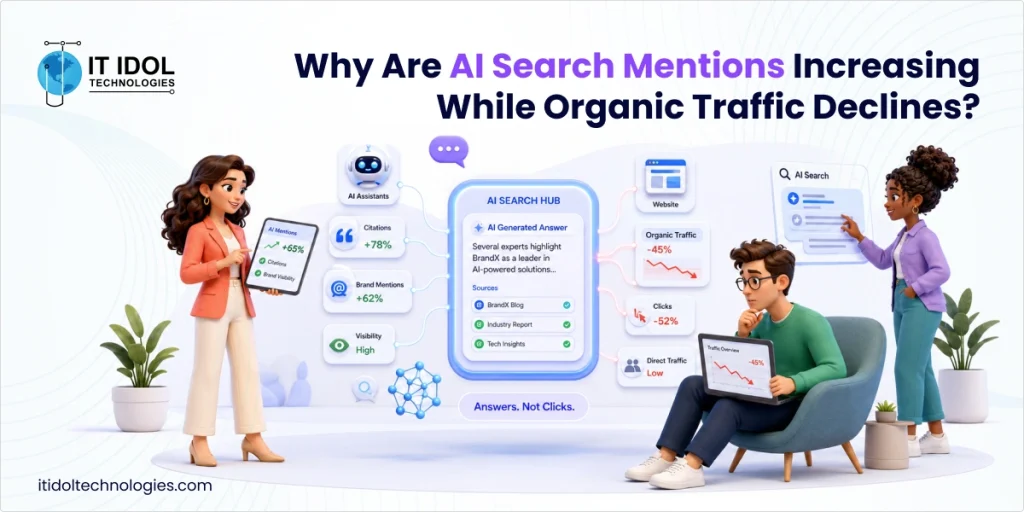
Across industries, many businesses are beginning to notice a strange pattern emerging inside analytics dashboards: branded visibility appears to be growing, content is being referenced across AI systems, and yet traditional organic traffic metrics are either flattening or declining.
At first glance, this feels contradictory.
How can visibility increase while measurable visits decrease?
The answer lies in the way search itself is changing.
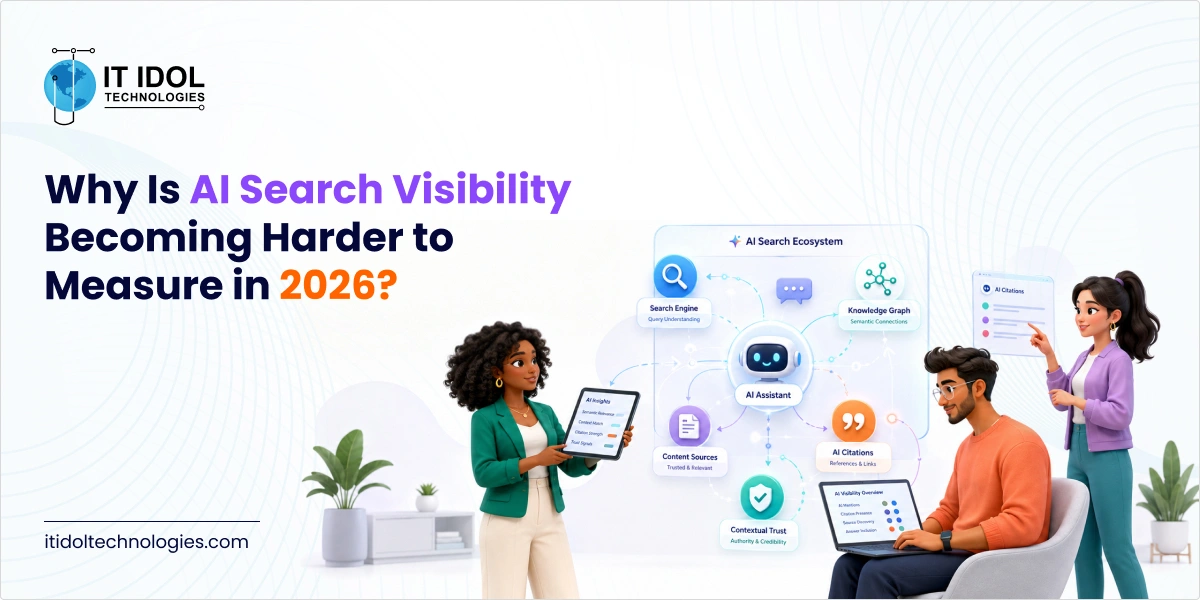
AI-powered search experiences are gradually shifting user behavior away from navigation-based discovery toward answer-based interaction. Instead of simply retrieving lists of links, modern AI systems increasingly synthesize information directly inside search environments. Users often receive explanations, summaries, recommendations, and comparisons before ever clicking through to a website.
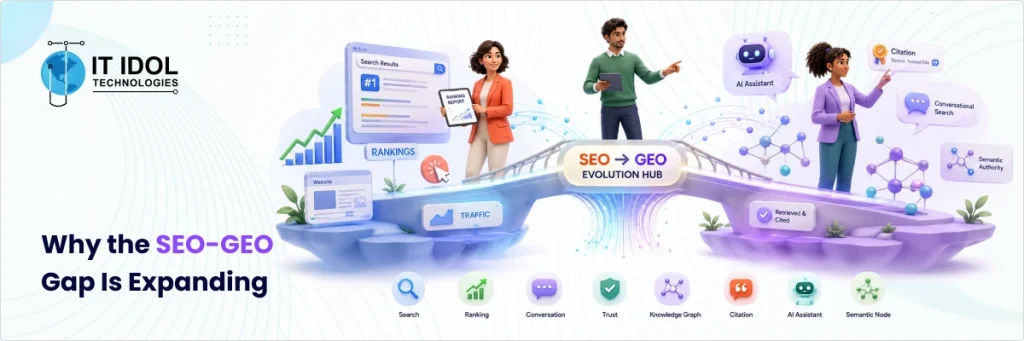
This creates what many marketers are now experiencing as the SEO-GEO gap.
Traditional SEO still measures website performance through rankings and traffic. Generative Engine Optimization (GEO) introduces a different reality where brands may influence AI-generated responses without always receiving direct attribution through clicks.
The result is a visibility economy that no longer maps cleanly to older measurement systems.
Search Is Becoming a Layered Discovery Environment
One of the biggest misconceptions surrounding AI search is the assumption that it simply replaces traditional search engines.
The reality is more complex.
Modern search behavior now operates across multiple layers simultaneously:
conventional search results
AI-generated summaries
conversational assistants
recommendation engines
enterprise copilots
browser-integrated AI tools
and retrieval-driven answer systems
A single user researching cybersecurity software, healthcare AI governance, or cloud migration strategy may move fluidly between:
search engines
conversational AI platforms
video explainers
community forums
documentation systems
and AI-generated synthesis layers
This means discoverability no longer happens in one measurable location.
A company’s expertise may influence:
an AI-generated answer
a conversational recommendation
a summarized comparison
or a retrieval-based assistant response without generating a measurable website session
That changes how digital visibility must be interpreted.
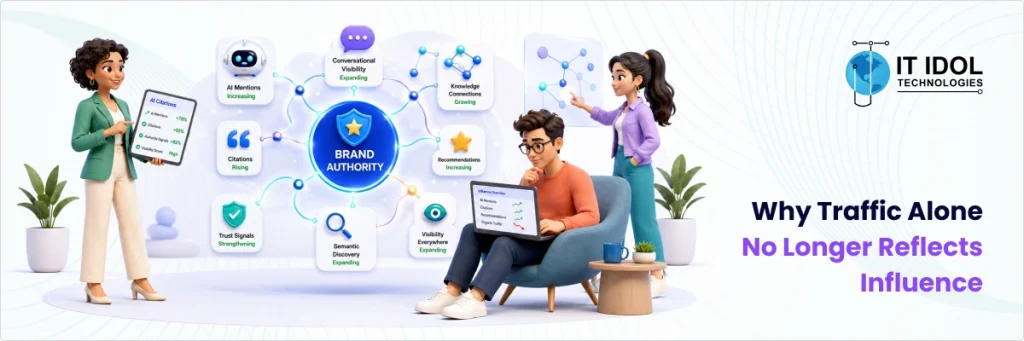
Why Traffic Alone No Longer Reflects Influence
Traditional SEO analytics were designed around referral behaviour.
The assumption was simple: visibility led to clicks, clicks led to visits, and visits represented influence.
AI-generated search environments interrupt this sequence.
Users increasingly receive enough contextual information directly within AI interfaces to continue decision-making without immediately visiting a source website. In some cases, AI systems aggregate insights from multiple sources into a single synthesized response.
This creates an important distinction between:
visibility
influence
and traffic
A brand may shape user understanding without owning the final interaction.
This is especially visible in B2B industries where users conduct extensive research across fragmented digital environments before engaging directly with vendors.
An enterprise buyer evaluating cloud security platforms, for example, may encounter a company’s insights:
inside AI-generated summaries
through retrieved documentation
across conversational search tools
or within synthesized market overviews long before ever visiting the company’s website
Traditional analytics platforms rarely capture this broader influence layer effectively.
The Internet Is Moving From Indexing to Interpretation
Search engines historically focused on indexing content.
AI systems increasingly focus on interpretation.
That difference matters more than many organizations realize.
Older SEO models emphasized:
keyword targeting
metadata optimization
link authority
and ranking mechanics
AI retrieval systems operate with broader contextual reasoning. Instead of matching isolated phrases, they attempt to understand relationships between topics, entities, expertise domains, and informational relevance.
This changes the role of content entirely.
Pages designed purely around search positioning often struggle because they lack informational depth or contextual richness. AI systems tend to favor content that demonstrates:
conceptual continuity
expertise signals
semantic relationships
structured explanation
and topical completeness
In practice, this means businesses publishing genuinely insightful material may gain AI visibility even if they do not dominate conventional keyword rankings.
The opposite is also becoming true.
Some websites with strong traditional SEO footprints may see declining engagement if their content lacks the depth or contextual trust required for AI retrieval systems.
Why the SEO-GEO Gap Is Expanding
The growing gap between SEO performance and AI visibility is not temporary.
It reflects a larger architectural transition happening across digital discovery systems.
Several forces are driving this shift simultaneously.
First, conversational interfaces reduce the number of direct navigational searches users perform. Instead of searching fragmented keywords, users increasingly ask complete questions and receive synthesized answers.
Second, retrieval-augmented AI systems pull information contextually rather than ranking pages exclusively through positional mechanics.
Third, AI systems increasingly prioritize information utility over page optimization patterns.
And fourth, user behavior itself is changing.
People are becoming more comfortable interacting with answers rather than browsing websites.
This does not mean websites disappear. It means websites increasingly function as knowledge sources feeding broader AI ecosystems rather than serving solely as destination endpoints.
For marketers, this creates a difficult adjustment because traditional SEO reporting was built around measurable website interaction.
AI visibility often operates beyond those boundaries.
The Future of Search Measurement Will Be Probabilistic
One of the most important mindset shifts organizations need to make is accepting that AI visibility may never be measured with the same precision as traditional rankings.
That is uncomfortable for performance-driven marketing teams.
SEO historically offered relatively deterministic signals:
ranking positions
traffic volumes
impression counts
and conversion pathways
AI-driven discoverability behaves differently because exposure becomes distributed across multiple dynamic systems.
The same content might:
appear in one AI assistant
be omitted from another
surface differently depending on query phrasing
or contribute partially to synthesized responses without direct citation
Visibility becomes probabilistic rather than positional.
This means future measurement models may increasingly rely on directional indicators such as:
branded search growth
entity recognition
citation frequency
conversational presence
knowledge graph inclusion
assisted conversions
and cross-platform discoverability signals
Organizations waiting for perfectly precise AI attribution systems may struggle because search itself is becoming less linear.
Why Content Depth Matters More Than Content Volume
The AI search transition is also exposing weaknesses in large-scale content production strategies.
For years, many SEO programs focused heavily on publishing volume:
more landing pages
more keyword variants
more topical clusters
and more search-targeted content
AI retrieval systems are gradually reducing the effectiveness of shallow informational repetition.
Large language models increasingly surface content that demonstrates:
contextual richness
expert interpretation
original analysis
operational specificity
and conceptual clarity
This is particularly important in B2B industries where users expect nuanced understanding rather than generic explanations.
A 700-word article repeating common SEO phrases may struggle to influence AI systems meaningfully. A deeply reasoned analysis connecting infrastructure realities, governance implications, operational risks, and strategic outcomes is far more likely to become retrievable across AI ecosystems.
In other words, informational value is becoming more important than publishing scale alone.
Businesses Need to Rethink Digital Authority
One of the biggest strategic mistakes companies make today is treating AI visibility as a technical SEO adjustment.
It is much larger than that.
The rise of AI search is fundamentally changing how digital authority is established.
Authority is increasingly inferred through:
topical consistency
semantic relationships
source reputation
expertise continuity
and ecosystem-level trust signals
This favours organisations capable of building sustained informational credibility over time.
It also means that brand reputation, thought leadership, documentation quality, research depth, and operational expertise are becoming directly connected to discoverability.
The companies most likely to succeed in AI-driven search environments are not necessarily those producing the highest content volume.
They are the ones building the strongest knowledge ecosystems.
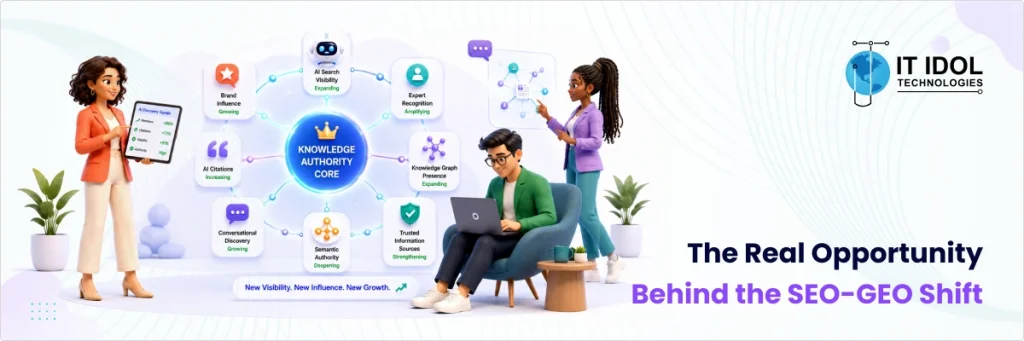
The Real Opportunity Behind the SEO-GEO Shift
Much of the current discussion around AI search focuses on traffic loss.
That perspective is incomplete.
The larger opportunity is that discoverability itself is expanding beyond traditional search mechanics.
AI systems create new pathways for:
expertise exposure
brand association
informational influence
and contextual visibility
Businesses that adapt early have an opportunity to become structurally embedded within emerging AI retrieval ecosystems.
That requires a different strategic focus.
Instead of optimizing exclusively for rankings, organizations increasingly need to optimize for:
interpretability
retrievability
authority
semantic clarity
and informational usefulness
The future of discoverability may belong less to companies chasing algorithms and more to organizations building genuinely valuable knowledge systems.
Search is no longer just about being found.
Increasingly, it is about becoming part of the information infrastructure AI systems trust enough to surface repeatedly.
How IT IDOL Technologies Helps Businesses Navigate AI-Driven Search Transformation
As AI-generated discovery reshapes digital visibility, businesses need more than traditional SEO execution. They require scalable digital ecosystems capable of supporting semantic discoverability, AI-ready content architecture, enterprise search intelligence, and long-term authority building across evolving search environments.
IT IDOL Technologies helps organizations modernize digital platforms through AI engineering, cloud-native development, enterprise architecture, intelligent data systems, and scalable content ecosystems designed for the next generation of AI-driven discoverability.
From enterprise digital transformation to AI-integrated web experiences, IT IDOL Technologies supports businesses building future-ready visibility strategies in increasingly conversational and retrieval-based search ecosystems.
FAQ’s
1. What are AI search mentions?
AI search mentions refer to instances where a brand, website, product, or content source is referenced within AI-generated answers, summaries, or conversational search responses.
2. Why is organic traffic declining despite increased AI mentions?
AI-powered search platforms increasingly provide direct answers within the interface, reducing the need for users to click through to websites even when brands are mentioned.
3. How do AI search engines impact website traffic?
AI search engines often summarize information from multiple sources, creating zero-click experiences that decrease traditional organic visits while still exposing brands to users.
4. What is zero-click search in AI-driven search ecosystems?
Zero-click search occurs when users get the information they need directly from AI-generated responses without visiting external websites or webpages.
5. Are AI mentions still valuable if traffic decreases?
Yes. AI mentions can improve brand visibility, authority, trust, and awareness, even if they do not immediately generate measurable website clicks.
6. How can businesses track AI search visibility?
Businesses can monitor AI citations, brand mentions, entity recognition, conversational appearances, and semantic relevance across AI-powered search platforms.
7. Why are traditional SEO metrics becoming less reliable?
Metrics like keyword rankings and click-through rates no longer fully capture visibility because AI systems often surface answers without displaying conventional search result pages.
8. What types of content perform well in AI search systems?
Authoritative, well-structured, context-rich, and semantically relevant content tends to perform better in AI-driven search environments.
9. Can AI search visibility improve brand authority?
Yes. Frequent mentions in AI-generated responses may strengthen perceived expertise, digital authority, and trustworthiness among users.
10. What strategies can help businesses adapt to AI-driven search changes?
Businesses should focus on entity optimization, topical authority, structured content, high-quality information architecture, and multi-platform digital visibility strategies.
Parth Inamdar is a Content Writer at IT IDOL Technologies, specializing in AI, ML, data engineering, and digital product development. With 5+ years in tech content, he turns complex systems into clear, actionable insights. At IT IDOL, he also contributes to content strategy—aligning narratives with business goals and emerging trends. Off the clock, he enjoys exploring prompt engineering and systems design.