Artificial intelligence has moved beyond answering questions and generating content. Today, businesses are beginning to deploy AI systems that can analyze information, make decisions, and complete multi-step tasks with minimal human input. This new approach is known as Agentic AI, and it is quickly becoming one of the most important conversations in enterprise technology.
Unlike traditional AI tools that wait for instructions, Agentic AI is designed to pursue goals. It can plan, reason, use external tools, and adapt its actions based on changing conditions. That shift has significant implications for every industry, from healthcare and manufacturing to finance, retail, logistics, and SaaS.
For business leaders, the question is no longer whether AI can improve productivity. The real question is whether your organization is ready to manage AI systems that actively participate in business operations.
In this guide, you’ll learn what Agentic AI is, how it differs from generative AI and AI agents, why it matters in 2026, and how organizations can prepare for this new phase of enterprise AI.
Why Agentic AI Is the Biggest Enterprise AI Shift of 2026
Over the past few years, generative AI has changed how people write emails, summarize documents, create code, and answer questions. While these capabilities have delivered measurable productivity gains, they still require humans to guide every step of the process.
Businesses are now looking for something more.
Instead of asking AI to generate a report, organizations want AI to gather data, analyze trends, create the report, send it for approval, and notify stakeholders once the task is complete. That difference marks the transition from AI as an assistant to AI as an active participant in business operations.
Several industry trends are accelerating this shift in 2026:
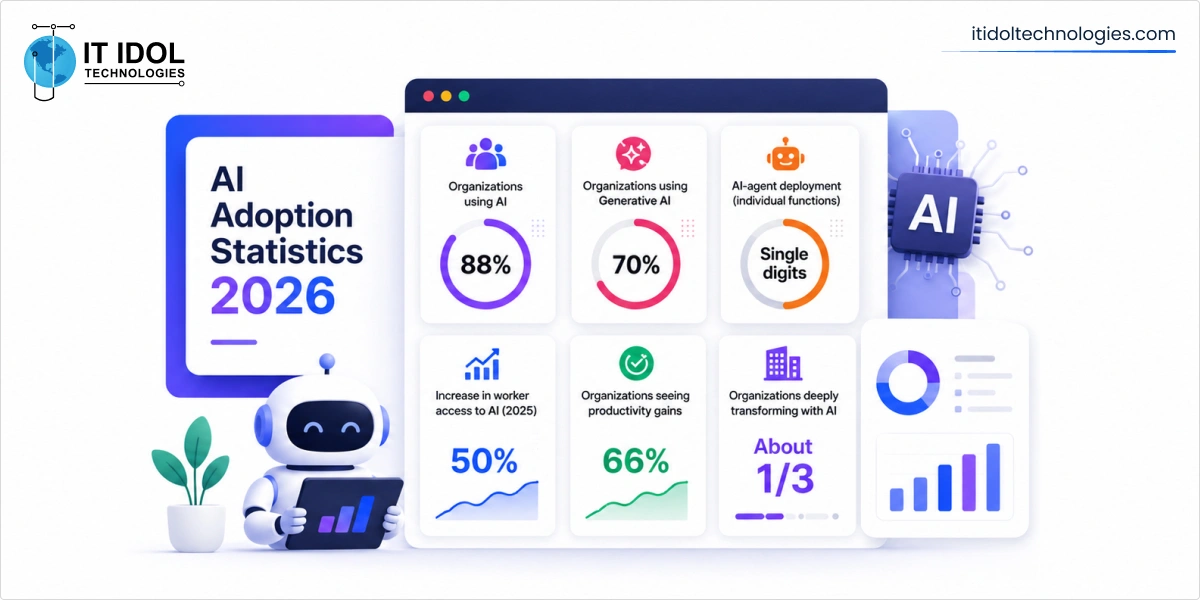
Enterprise AI adoption has moved beyond pilot projects into production environments.
Large language models have become more reliable at planning and reasoning across multiple steps.
AI agents can now interact with enterprise software through APIs and business tools.
Companies are investing in AI governance to safely deploy autonomous systems.
Businesses face increasing pressure to improve productivity without significantly expanding their workforce.
As a result, organizations are beginning to view AI as a digital coworker rather than a productivity feature. This change affects far more than IT departments. It influences customer service, finance, operations, software development, supply chain management, and executive decision-making. Business leaders who understand this shift today will be better prepared to evaluate future investments in AI.
What Is Agentic AI? A Practical Definition
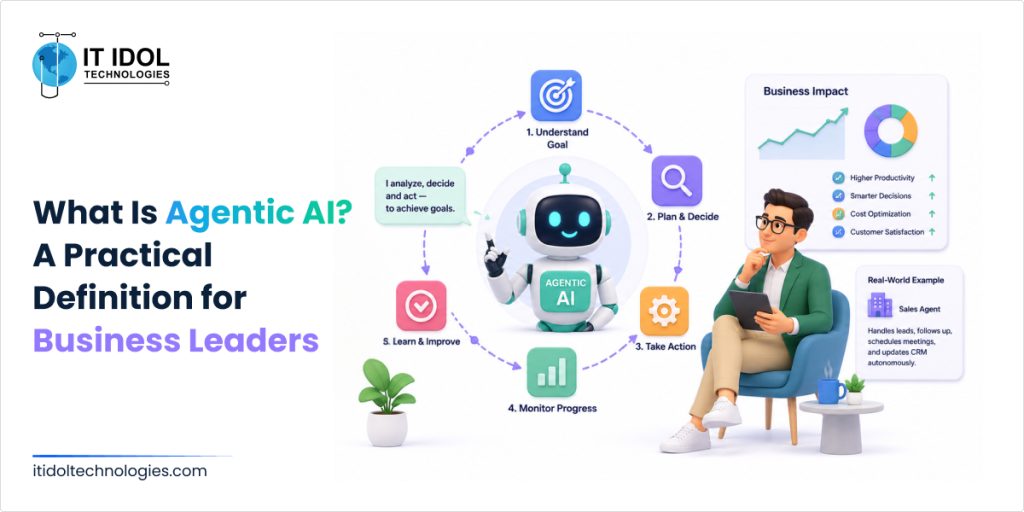
In simple terms, Agentic AI is an artificial intelligence system that can understand a goal, create a plan, make decisions, and complete tasks with limited human intervention. Instead of responding to a single prompt, Agentic AI works toward achieving an outcome.
For example, imagine you ask an AI system to prepare your monthly sales report.
A traditional chatbot might generate a template or explain how to build the report.
An Agentic AI system could:
Collect sales data from multiple systems.
Verify data quality.
Compare current performance with previous months.
Generate visual dashboards.
Identify unusual trends.
Draft executive insights.
Share the report with managers.
Schedule follow-up actions if revenue falls below target.
The difference is significant. Rather than completing one task, Agentic AI manages an entire workflow. That ability allows organizations to automate business processes that previously required coordination between multiple employees and software applications.
The Five Characteristics of Agentic AI
While definitions may vary, most Agentic AI systems share five essential capabilities.
Goal-Oriented Execution
Agentic AI begins with a business objective instead of a single prompt. It focuses on achieving results rather than generating isolated outputs.
Planning
Instead of solving one problem at a time, it breaks larger objectives into smaller steps and determines the most efficient sequence of actions.
Reasoning
Modern AI systems evaluate available information before making decisions. They can compare options, identify dependencies, and adjust their approach when conditions change.
As new information becomes available, the system updates its decisions without requiring users to restart the entire workflow.
These capabilities make Agentic AI suitable for business operations that involve multiple systems, changing data, and ongoing decision-making.
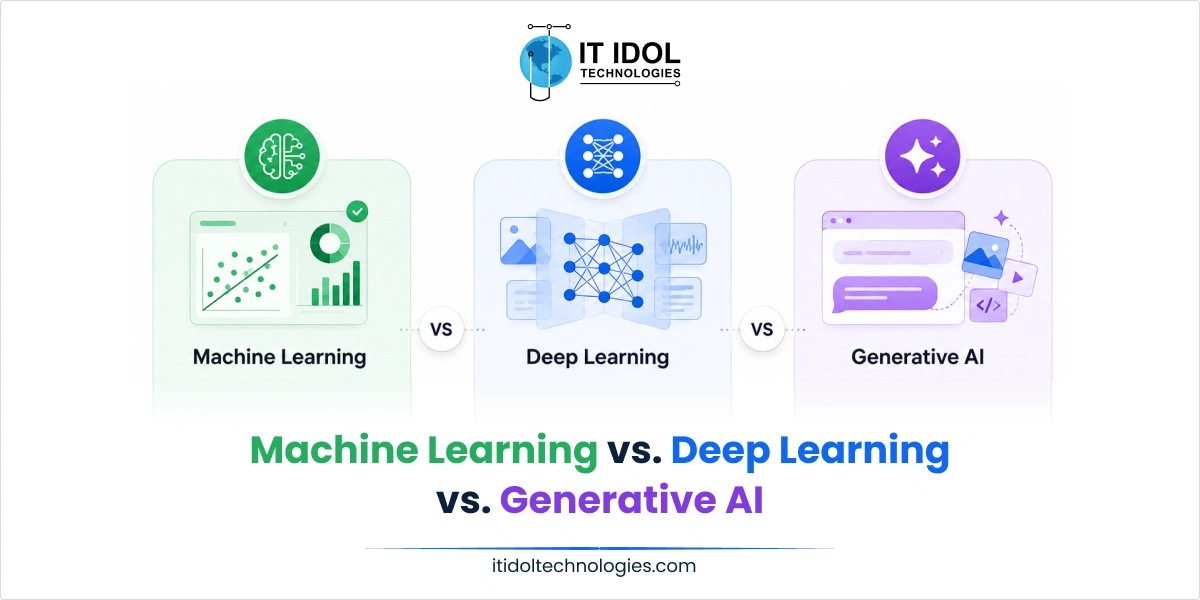
Agentic AI vs. Generative AI vs. AI Agents: What’s the Difference?
Many business leaders use these terms interchangeably, but they describe different technologies. Understanding the distinction helps organizations choose the right solution for their needs.
Capability
Generative AI
AI Agent
Agentic AI
Primary purpose
Creates content
Performs specific tasks
Achieves business goals
User interaction
Prompt-based
Task-based
Goal-based
Decision making
Limited
Moderate
Advanced
Planning
No
Basic
Multi-step planning
Tool integration
Limited
Yes
Extensive
Workflow execution
No
Partial
End-to-end
Generative AI focuses on creating text, images, code, or summaries. An AI agent performs predefined tasks such as booking meetings or retrieving information. Agentic AI goes a step further. It coordinates multiple actions, evaluates outcomes, and adjusts its strategy while working toward a defined objective.
Think of it this way.
Generative AI writes an email.
An AI agent sends the email.
Agentic AI determines who should receive the email, gathers the required information, drafts the message, schedules delivery, monitors responses, and recommends the next action based on the recipient’s behavior. That level of autonomy explains why many analysts view Agentic AI as the next stage of enterprise AI. It also explains why organizations are beginning to rethink how work gets done.
Businesses are no longer asking, “How can AI help employees complete tasks?”
Instead, they’re asking, “Which business processes can AI manage from start to finish while keeping people in control of critical decisions?”
That question will shape enterprise AI strategies for years to come.
How Agentic AI Actually Works?
To understand why Agentic AI is gaining attention, you first need to understand how it approaches work. Traditional AI systems respond to a request and stop. Agentic AI follows an objective until it reaches a result or requires human approval.
Think about how an operations manager works. They don’t complete a single task and wait for instructions. They evaluate the situation, create a plan, coordinate resources, solve problems, and adapt when priorities change.
Agentic AI follows a similar process.
Goal-Based Planning Instead of Prompt-Based Responses
Most AI chatbots depend on prompts. If you want another action, you provide another prompt.
Agentic AI starts with a business goal.
For example, instead of asking:
“Summarize customer feedback.”
You might say:
“Identify the top five customer complaints from the past 90 days, prioritize issues affecting revenue, create improvement recommendations, and assign follow-up tasks to the appropriate teams.”
The AI plans each step, retrieves the necessary information, executes the workflow, and reports the outcome.
This reduces manual coordination and allows employees to focus on decisions that require human judgment.
Memory, Context, and Reasoning
Enterprise work rarely happens in isolation. A customer support request may require information from your CRM, billing platform, knowledge base, product documentation, and previous conversations. Agentic AI can maintain context across these systems.
Instead of treating every interaction as a new conversation, it understands the broader objective and uses previous information to make better decisions. This ability makes AI significantly more useful for complex business operations than traditional chatbots.
Autonomous Decision-Making Within Business Rules
Agentic AI is autonomous, but it should never operate without boundaries. Organizations define policies that determine what an AI system can and cannot do.
For example, an AI agent may:
Approve refunds under $100.
Escalate larger refunds to a manager.
Flag suspicious transactions for review.
Notify compliance teams when policy violations occur.
Human oversight remains essential, especially in regulated industries such as healthcare and financial services. The goal is responsible automation, not unrestricted automation.
Human-in-the-Loop vs. Fully Autonomous Execution
One of the biggest misconceptions about Agentic AI is that humans are removed from the process. In reality, most enterprise deployments use a human-in-the-loop model.
AI completes repetitive work, while people approve high-impact decisions.
For example:
AI prepares contract summaries.
Legal teams approve the final version.
AI identifies cybersecurity incidents.
Security analysts decide how to respond.
AI recommends inventory purchases.
Supply chain managers approve procurement.
This approach increases efficiency while maintaining accountability.
Why Multi-Agent Systems Are Becoming the Next Enterprise Architecture
Together, these agents complete an entire workflow without requiring constant human coordination. This collaborative model is expected to become a common enterprise architecture as organizations scale AI adoption.
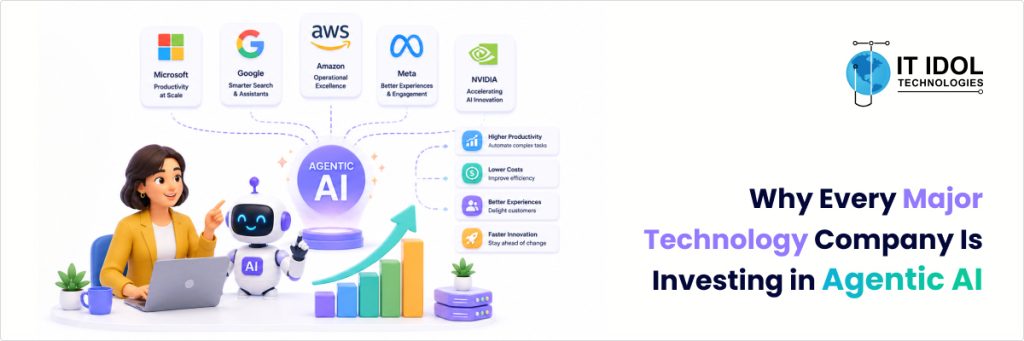
Why Every Major Technology Company Is Investing in Agentic AI
The technology industry has shifted its focus. The conversation is no longer about who has the best chatbot. It is about who can build the most capable AI workforce. Leading technology companies are investing heavily in autonomous AI because businesses want systems that create measurable business outcomes rather than simply generating content.
Across the industry, AI platforms are evolving to support:
Autonomous task execution
Multi-agent collaboration
Enterprise workflow orchestration
AI governance
Long-term memory
Secure enterprise integration
The direction is clear. Enterprise software is becoming AI-native. Instead of opening multiple applications to complete a process, employees increasingly describe an objective while AI coordinates the underlying systems. This changes how organizations think about productivity.
Rather than measuring how quickly employees complete tasks, businesses will increasingly measure how effectively humans and AI collaborate to achieve business goals. For executives, this shift represents more than another software upgrade. It introduces a new operating model where digital workers become part of everyday business operations.
How Agentic AI Is Changing Business Operations
Many organizations initially adopted AI to improve individual productivity. Agentic AI expands that value across entire business processes. Instead of helping one employee work faster, it helps entire teams operate more efficiently.
Faster Decision-Making
Business leaders often spend days gathering information before making decisions. Agentic AI shortens that timeline. It can collect information from multiple systems, analyze trends, identify risks, and present recommendations within minutes. Decision-making becomes faster because information is already organized and prioritized.
Automating Business Processes Instead of Individual Tasks
Traditional automation focused on repetitive actions. Agentic AI focuses on outcomes. For example, instead of automating invoice generation, an AI system can manage the complete accounts payable workflow by validating invoices, detecting exceptions, routing approvals, updating financial systems, and notifying stakeholders. This creates greater operational efficiency than isolated task automation.
Organizations exploring broader automation strategies may also benefit from understanding how enterprise automation strategies are evolving alongside AI.
Better Customer Experiences
Customers expect immediate responses and personalized interactions. Agentic AI enables businesses to provide both.
AI systems can:
Resolve common support issues.
Recommend products.
Schedule appointments.
Escalate complex cases.
Follow up after service interactions.
Because the AI understands context across multiple systems, customer experiences become more consistent.
Scaling Organizational Knowledge
Many businesses depend heavily on experienced employees. When those employees leave, valuable knowledge often leaves with them. Agentic AI helps capture institutional knowledge by connecting documentation, historical decisions, and enterprise data into searchable business intelligence. Employees spend less time searching for information and more time applying it.
Organizations building intelligent business applications often combine these capabilities with AI and machine learning development services to create systems that fit their operational requirements.
Improving Productivity Without Linear Hiring
One of the most important benefits of Agentic AI is its ability to support growth without increasing headcount at the same pace. Rather than replacing employees, AI reduces repetitive administrative work. Your teams spend more time solving business problems, improving customer relationships, and driving innovation. This is especially valuable for startups and mid-sized organizations that need to grow efficiently.
How Different Industries Are Using Agentic AI
Every industry approaches AI differently, but the underlying objective remains the same: reduce manual work, improve decision-making, and increase operational efficiency.
Healthcare
Healthcare organizations use Agentic AI to coordinate patient scheduling, assist with clinical documentation, automate prior authorization workflows, and improve administrative efficiency. AI helps reduce paperwork while allowing healthcare professionals to focus on patient care.
Retail and E-Commerce
Retailers are using Agentic AI to manage inventory, forecast demand, personalize shopping experiences, and optimize pricing strategies. For online businesses, AI also improves customer service by handling post-purchase support and order management.
Businesses interested in digital retail innovation can also explore current digital commerce trends shaping customer expectations.
FinTech
Financial organizations are applying Agentic AI to fraud detection, compliance monitoring, customer onboarding, and risk assessment. AI continuously evaluates transactions while identifying patterns that may require human investigation.
Manufacturers are using AI to monitor equipment performance, predict maintenance needs, optimize production schedules, and improve quality control. Combined with IoT data, Agentic AI helps reduce downtime and improve operational efficiency.
Logistics
Logistics companies are deploying AI to optimize delivery routes, manage warehouse operations, forecast shipping demand, and improve fleet utilization. These capabilities help reduce costs while improving delivery performance.
SaaS and Technology Companies
Software companies are using Agentic AI to improve customer onboarding, monitor application health, automate DevOps workflows, and assist customer success teams.
Development teams are also integrating AI into software engineering processes. As discussed in our article on AI coding assistants and human developers, the most successful organizations treat AI as a collaborative partner rather than a replacement.
Common Myths About Agentic AI
As interest in Agentic AI grows, so do misconceptions. Separating fact from fiction helps you make better investment decisions and set realistic expectations.
Myth #1: Agentic AI Is Just an Advanced Chatbot
Chatbots respond to questions. Agentic AI pursues business objectives. For example, a chatbot can explain your refund policy. An Agentic AI system can verify an order, process the refund based on company rules, update your ERP, notify the customer, and create an audit record. The difference lies in execution, not conversation.
Myth #2: Agentic AI Will Replace Employees
Businesses are not adopting Agentic AI to eliminate people. They are adopting it to reduce repetitive work. Tasks such as gathering data, updating systems, preparing reports, and coordinating workflows consume valuable employee time. AI can handle many of these activities, allowing your teams to focus on customer relationships, strategic planning, product innovation, and problem-solving. The strongest results come from human expertise working alongside AI, not from replacing it.
Myth #3: AI Can Operate Without Oversight
Autonomous does not mean unsupervised. Every enterprise AI system should operate within clearly defined policies. Human approval should remain part of high-impact decisions involving finance, healthcare, legal matters, compliance, or customer commitments. Responsible AI always includes governance.
Myth #4: Agentic AI Is Only for Large Enterprises
Large organizations may have started the conversation, but startups and mid-sized businesses often move faster. Cloud-based AI platforms, APIs, and managed services have lowered the barrier to entry. Organizations can begin with one high-value workflow and expand as they gain confidence.
As discussed in our article on Why Mid-Sized Enterprises Are Moving Faster on AI Than Large Enterprises, smaller businesses often have fewer legacy systems and can adopt new AI capabilities more quickly.
The Business Challenges Leaders Should Prepare For
Agentic AI offers significant opportunities, but successful adoption depends on addressing several business challenges.
AI Governance and Accountability
Every AI-driven action should be transparent.
Business leaders need clear answers to questions such as:
Who approved this AI workflow?
Why did the AI make this decision?
Can the decision be audited?
Who is responsible if something goes wrong?
Without governance, organizations expose themselves to operational and regulatory risk.
Security and Identity
As AI systems gain access to enterprise applications, identity management becomes increasingly important. Every AI agent should have clearly defined permissions, limited access to sensitive information, and continuous monitoring. Security should focus on what an AI system can do, not just where it runs.
Data Quality
AI performs only as well as the information it receives. Disconnected systems, duplicate records, and outdated data reduce accuracy and increase operational risk. Before expanding AI initiatives, organizations should assess whether their data foundation is ready.
If your business is evaluating intelligent enterprise systems, our guide on Enterprise Data Mesh vs. Data Fabric explains how modern data architectures support scalable AI initiatives.
Change Management
Technology adoption is often easier than organizational adoption. Employees need to understand how AI supports their work, what responsibilities remain with humans, and how success will be measured. Organizations that invest in communication and training generally achieve stronger adoption and better long-term results.
Questions Every CEO and CTO Should Ask Before Investing in Agentic AI
Before launching an Agentic AI initiative, ask these questions:
Which business processes create the greatest operational bottlenecks?
Where will AI create measurable business value within the next 12 months?
Which decisions should always require human approval?
Is our data accurate, secure, and accessible?
Can our ERP, CRM, and business applications integrate with AI systems?
How will we measure success beyond productivity gains?
Do we have governance policies for AI usage, security, and compliance?
The answers will help you prioritize projects that deliver meaningful business outcomes instead of isolated technical wins.
The Future of Agentic AI: What Business Leaders Should Expect
Agentic AI is still in its early stages, but its direction is becoming clear. Over the next few years, organizations are likely to deploy specialized AI agents across finance, customer service, HR, operations, software development, and supply chain management.
These systems will collaborate with employees, share information across business applications, and complete increasingly sophisticated workflows. This does not mean every decision will become automated. Instead, AI will take responsibility for repetitive operational work while people continue to provide judgment, creativity, and strategic direction. The organizations that gain the greatest advantage will not necessarily deploy the most AI.
They will build the strongest governance, integrate AI into high-value business processes, and create clear collaboration between people and intelligent systems. Agentic AI should be viewed as a long-term business capability rather than a short-term technology trend.
Why the Right AI Development Partner Matters
Building an Agentic AI solution involves more than selecting a language model. Businesses need secure integrations, reliable data pipelines, governance frameworks, user-friendly experiences, and measurable business outcomes. That requires expertise across software engineering, enterprise integration, artificial intelligence, and cloud technologies.
Whether you are exploring AI-powered workflows, intelligent enterprise applications, or custom AI agents, working with an experienced technology partner can reduce implementation risk and accelerate results.
At IT IDOL Technologies, we help organizations evaluate opportunities, design practical AI strategies, and build secure, scalable solutions that align with business objectives. Our AI Agent Development Services focus on creating intelligent systems that integrate with existing enterprise applications while keeping governance, security, and business value at the center of every project.
Generative AI creates content such as text, images, or code. Agentic AI goes further by executing workflows, interacting with business systems, and working toward a defined objective.
Healthcare, retail, FinTech, manufacturing, logistics, SaaS, education, and e-commerce are among the industries seeing strong adoption because they rely on data-driven processes and repetitive operational workflows.
Yes. Modern Agentic AI platforms are designed to connect with enterprise applications through APIs, allowing businesses to automate workflows without replacing their existing systems.
Yes, provided it includes governance, identity management, access controls, audit logging, and human oversight. These capabilities are essential for industries such as healthcare and financial services.
No. Its primary purpose is to automate repetitive work, support decision-making, and improve productivity while allowing employees to focus on higher-value responsibilities.
Start with a single business process where AI can deliver measurable value. Define clear success metrics, involve business stakeholders early, establish governance policies, and expand gradually as confidence grows.
Deval Rathod
Founder & CEO
|
Deval Rathod is the Founder and CEO of IT IDOL Technologies, a custom software development company. With over a decade of experience in software engineering, solution architecture, and technology leadership, she has worked across custom software development, enterprise applications, AI & ML, and digital transformation. Her expertise includes guiding technology teams, designing scalable software solutions, and helping businesses evaluate and implement emerging technologies. She contributes insights on software engineering, artificial intelligence, enterprise technology, and digital transformation.