A note on accuracy before we begin: The AI model landscape is evolving at a pace that makes any point-in-time comparison inherently provisional. As of my knowledge cutoff (August 2025), I’m not fully certain “GPT-5.5” exists as a distinct, publicly released model under that exact designation. OpenAI’s versioning has shifted frequently, and a model by that name may have launched or been renamed after my cutoff.
The current date is June 2026, which means readers should verify current model availability, pricing, and capability benchmarks directly with OpenAI, Anthropic, and Google before making procurement decisions. The frameworks and comparisons in this article are built to remain useful regardless of exact version names.
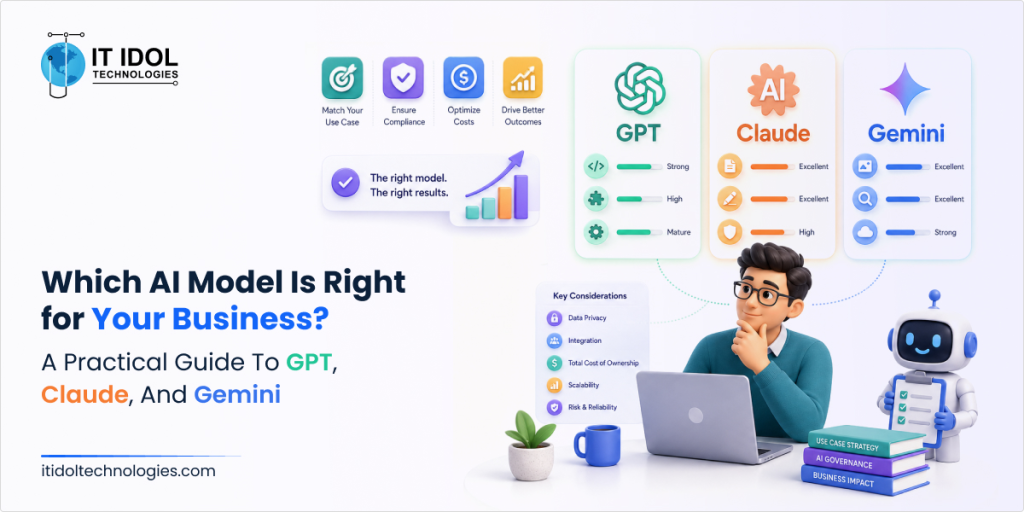
The Real Question Isn’t “Which Model Is Best?” It’s “Best for What?”
Every week, another enterprise IT leader or digital transformation team walks into a vendor conversation asking the same question: which AI model should we be building on? The honest answer the one that actually helps, isn’t a single name. It’s a framework.
The three dominant model families in the enterprise AI space right now are OpenAI’s GPT series, Anthropic’s Claude, and Google’s Gemini. Each has evolved significantly over the past two years. Each serves different organizational contexts, risk profiles, and workload types with meaningfully different strengths. And each comes with tradeoffs that will materially affect your implementation, your costs, and your outcomes.
This is not a benchmark article. Benchmarks matter, but they rarely tell you whether a model will perform well inside your specific workflow, with your data, against your compliance requirements, and within your team’s technical capacity. This article is a decision guide built for business leaders and technical teams who need to think clearly before they commit.
Understanding What You’re Actually Choosing Between
Before comparing models, it’s worth establishing what “choosing a model” actually means in an enterprise context.
You are not simply selecting a chatbot. You are choosing:
A reasoning engine that will power workflows, agents, or user-facing products
A provider relationship with associated data handling agreements, rate limits, and API terms
A capability profile that fits (or doesn’t fit) your primary use cases
A cost structure that scales with your usage in ways that vary significantly between providers
An alignment philosophy how the model handles ambiguous, sensitive, or high-stakes prompts
These are architectural decisions, not software purchases. Getting them right matters more than finding the “smartest” model on a leaderboard.
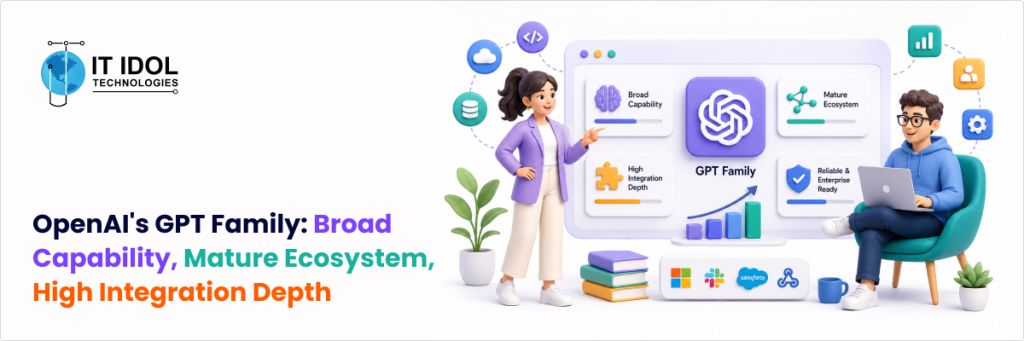
OpenAI’s GPT Family: Broad Capability, Mature Ecosystem, High Integration Depth
OpenAI’s models across the GPT-4o, GPT-4.5, GPT-5, and any subsequent iterations in that lineage have built the deepest third-party integration ecosystem of the three. Microsoft’s Azure OpenAI Service, Copilot across Office 365, and a vast library of LangChain, LlamaIndex, and custom integrations mean that for most enterprise environments already invested in the Microsoft stack, OpenAI models carry the lowest integration friction.
Where GPT-family Models Tend to Excel
Code generation and developer tooling. GitHub Copilot’s underlying architecture, Azure AI Studio’s default model positioning, and the sheer volume of developer community tooling built around OpenAI APIs mean these models perform reliably in software development assistance, code review, and documentation generation.
Structured reasoning and function calling. For applications that require reliable JSON output, tool use, and multi-step function chaining, think CRM automation, ticketing systems, or ERP integrations the OpenAI API’s structured output capabilities are mature and well-documented.
Broad horizontal deployment. Organizations looking to deploy a single model across many departments HR, legal, marketing, engineering, benefit from GPT’s generality. It’s a reasonable “safe default” for organizations that can’t yet articulate specialized use cases.
Where to Be Cautious
OpenAI’s cost structure at scale can surprise organizations. Token pricing, context window costs, and the difference between standard and reasoning-optimized models add up quickly in high-volume enterprise deployments. Teams should model usage economics carefully before committing.
Data privacy arrangements also warrant scrutiny. API usage terms, zero-data-retention options, and compliance with regional data regulations (GDPR, India’s DPDP Act, HIPAA for healthcare contexts) should be reviewed contractually, not assumed.
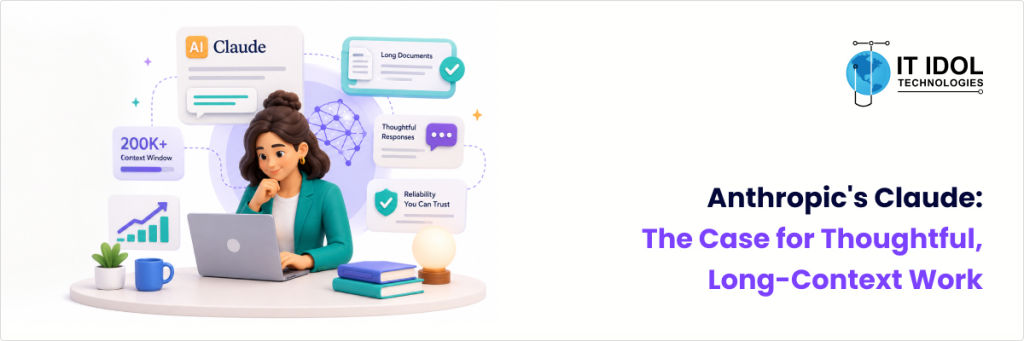
Anthropic’s Claude: The Case for Thoughtful, Long-Context Work
Anthropic was founded by former OpenAI researchers with a specific focus on AI safety and interpretability. That philosophical orientation has produced something practically distinctive: a model family that handles nuance, ambiguity, and extended reasoning with less tendency toward confident fabrication.
Claude’s architecture, particularly from the Claude 3 and Claude 4 families onward, introduced some of the largest commercially available context windows in the industry. This matters enormously for specific enterprise workloads.
Where Claude Tends to Excel
Long-document analysis. Contract review, policy analysis, regulatory document comparison, research synthesis any task that requires maintaining coherent reasoning across tens or hundreds of pages benefits from Claude’s context handling. Law firms, compliance teams, and financial analysts have found this particularly valuable.
Nuanced writing and editorial work. Claude produces prose that reads closer to how a thoughtful human writer actually constructs arguments. For thought leadership content, executive communications, internal documentation, and customer-facing writing that needs to feel considered rather than generated, this distinction is noticeable.
Sensitive or high-stakes prompts. In domains where a model saying the wrong thing carries real consequences healthcare information, legal guidance, HR contexts, financial advice Claude’s trained conservatism is often an asset rather than a limitation. The model is more likely to appropriately hedge, flag uncertainty, and decline to speculate than to produce a confident wrong answer.
Instruction-following fidelity. For complex prompt structures with multiple constraints, format requirements, persona specifications, and output rules, Claude tends to hold instructions more consistently across long conversations.
Where to Be Cautious
Claude can be more conservative than business teams expect, particularly in early prompt development. Teams accustomed to other models may need to recalibrate their prompting approach. Anthropic’s API ecosystem, while growing, does not yet match OpenAI’s breadth of third-party integrations. For organizations already deeply inside Microsoft or Salesforce tooling, this may create additional implementation work.
Google’s Gemini: Multimodal Depth and the Power of the Google Ecosystem
Google’s Gemini family represents perhaps the most ambitious architectural bet of the three. Built natively as a multimodal model trained simultaneously on text, images, audio, video, and code rather than retrofitted, Gemini’s design reflects a different theory of where enterprise AI is heading.
The strategic advantage of Gemini is not just the model itself. It’s the surrounding infrastructure: Google Workspace integration, BigQuery, Vertex AI, Google Search grounding, and the breadth of Google Cloud’s enterprise relationships. For organizations already running on Google Cloud, Gemini isn’t just a model, it’s an AI layer that sits across the stack.
Where Gemini Tends to Excel
Multimodal business applications. Document intelligence that spans text, images, charts, and tables. Customer support workflows that include image attachments. Product catalogue management with visual and descriptive attributes. Any application where data arrives in multiple formats benefits from Gemini’s native multimodal reasoning rather than a text-model bolt-on.
Google Workspace-embedded AI. For organizations relying on Gmail, Google Docs, Sheets, and Meet, Gemini’s native integration reduces the build burden substantially. Drafting, summarization, meeting intelligence, and data analysis within familiar tools lowers adoption friction.
Large-scale data and analytics contexts. Gemini’s integration with BigQuery and Google Cloud’s data infrastructure makes it a strong candidate for organizations building AI-augmented analytics, business intelligence, and data querying workflows.
Grounding in real-time information. Google’s ability to connect Gemini to its Search infrastructure for grounded, citation-backed responses gives it an edge in research-intensive use cases where knowledge cutoff is a real concern.
Where to Be Cautious
Gemini’s enterprise maturity in terms of fine-tuning support, API consistency, and deployment tooling outside the Google ecosystem has been developing quickly but may still lag in specific areas compared to OpenAI’s longer-standing enterprise programs.
Organizations outside the Google Cloud ecosystem may find the integration story less compelling. Pricing models across Gemini tiers also require careful evaluation for production-scale deployments.
A Practical Use Case Mapping
Rather than declaring a winner, here’s how a decision-maker might think about primary fit by use case category:
Legal and compliance document analysis → Claude’s long context and careful hedging behaviour make it a strong default. Gemini’s multimodal handling is valuable if documents include charts and images.
Developer productivity and code generation → OpenAI’s GPT family has the deepest tooling ecosystem. For teams already on GitHub Copilot or Azure, this is often the path of least resistance.
Customer service and support automation → All three are viable. The decision turns on integration requirements (existing CRM, ticketing), volume economics, and whether multilingual capability is needed. Gemini’s grounding in current information is an advantage for products with rapidly changing content.
Internal knowledge management and enterprise search → Claude’s instruction-following and long-context retrieval is strong. Gemini’s Workspace integration is compelling for Google-first organizations.
Marketing and content operations → Claude’s writing quality and nuance is frequently preferred by editorial teams. GPT’s broader integrations serve organizations needing connection to many downstream tools.
Multimodal and visual AI applications → Gemini’s native multimodal architecture is the clearest differentiator here.
Finance and risk analysis → All three require careful evaluation against data handling requirements. Claude’s conservatism on uncertain claims aligns well with the stakes involved.
The Questions Your Team Should Be Answering Before Choosing
Selecting a model without answering these questions leads to expensive pivots six months later:
What is our primary workload profile? A model built for code generation will behave differently on long-form document analysis. Specificity here prevents regret.
What does our data residency situation require? Regional compliance obligations, industry regulations, and client contractual commitments may eliminate options before any capability comparison begins.
What is our integration starting point? Microsoft-first organizations and Google-first organizations often have a clearer path to one provider’s enterprise offering than a capability comparison alone would suggest.
What is our volume and cost tolerance at scale? A model that performs well in a pilot can become uneconomical in production. Token costs, context window pricing, and tier structures should be modeled against realistic usage projections.
What are our stakes around model confidence and accuracy? In low-stakes content generation, occasional hallucinations are manageable. In legal, medical, or financial contexts, they are not. Model behavior under uncertainty should be tested explicitly.
The Multi-Model Reality Most Enterprises Are Moving Toward
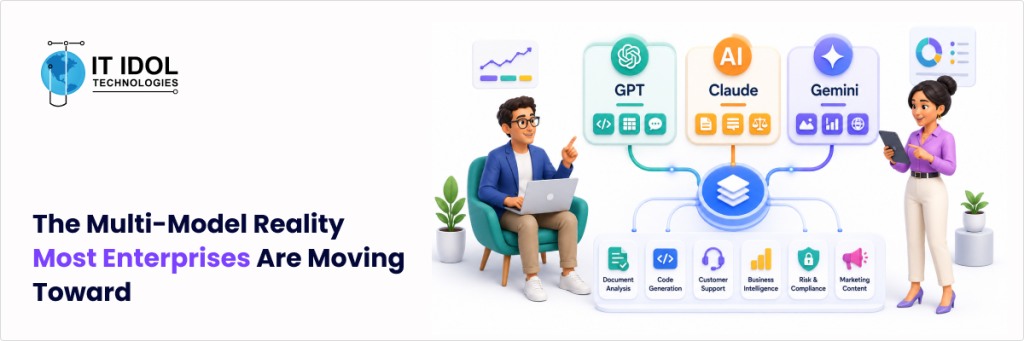
One of the more mature observations from organizations that have deployed AI at scale: few are betting their entire operation on a single model. The pattern that’s emerging is model routing using the model best suited to each task type within a broader orchestration layer.
A well-architected enterprise AI system might route nuanced writing tasks to Claude, code generation to OpenAI, real-time grounded research to Gemini, and cost-sensitive high-volume tasks to smaller, faster, cheaper models from any provider. This requires more initial architecture investment but reduces lock-in and optimizes cost-performance across workloads.
This is where the conversation shifts from “which model” to “what infrastructure allows you to work with the right model for each job,” and that’s increasingly the more important strategic question.
Conclusion
The excitement around model releases GPT-5, Claude 4, Gemini Ultra is understandable. These are genuinely impressive systems. But enterprise AI success is determined less by which model you select and more by how clearly you’ve defined your use cases, how rigorously you’ve evaluated fit against your specific constraints, and how thoughtfully you’ve designed the workflows and guardrails around the model.
The organizations seeing real business outcomes from AI are not necessarily those with the most advanced model. They’re the ones with the clearest problem definition, the most disciplined implementation, and the willingness to treat AI as a system that requires ongoing governance, not a feature you turn on.
Choose the model that fits your use case. Invest as heavily in the strategy around it.
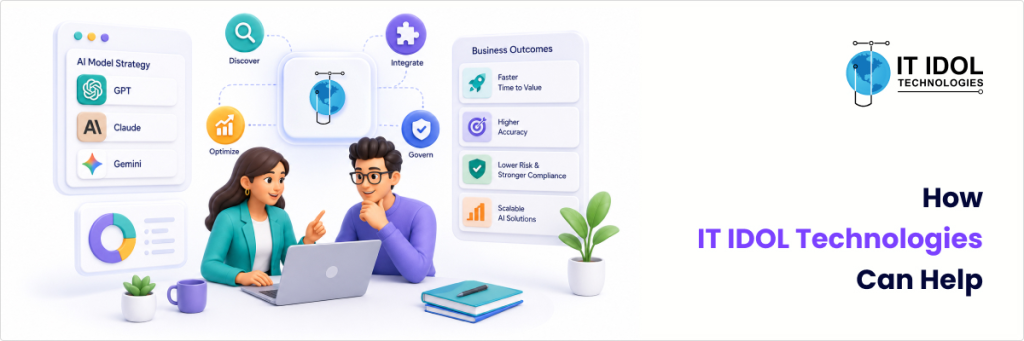
How IT IDOL Technologies Can Help
Selecting, integrating, and governing enterprise AI models requires more than a technical evaluation; it requires aligning model capabilities with your specific business processes, compliance environment, and organizational readiness.
IT IDOL Technologies works with enterprises at every stage of this journey: from use case discovery and model evaluation to integration architecture, prompt engineering, and responsible AI governance.
If your organization is navigating the model selection decision or looking to scale AI across functions, the IT IDOL Technologies team brings the technical depth and strategic experience to help you move from evaluation to outcome.
FAQ’s
1. What is the most important factor when choosing between GPT, Claude, and Gemini for enterprise use?
The most important factor is use case fit, not general benchmark performance. Each model has meaningful differences in how it handles long documents, multimodal inputs, structured output, creative writing, and sensitive content. Define your primary workload before evaluating models.
2. Is GPT-5.5 (or the current OpenAI flagship model) always the most capable option?
Not necessarily. “Most capable” depends entirely on the task. OpenAI’s models lead in certain coding and integration contexts, but Claude and Gemini outperform on specific workloads like long-context document analysis and multimodal data, respectively. Capability should be assessed per task type.
3. Which AI model is best for legal and compliance document review?
Claude is frequently preferred for legal and compliance contexts because of its large context window, careful hedging of uncertain claims, and consistent instruction-following. However, your specific compliance requirements, particularly around data handling, may affect which provider is viable.
4. How should enterprises think about data privacy when using cloud-based AI models?
Data privacy requires direct contractual review with each provider. Key considerations include whether training on your data can be opted out of, data residency options for regional compliance (GDPR, HIPAA, DPDP Act, etc.), and whether enterprise-tier agreements offer zero-data-retention guarantees.
5. Can a business use multiple AI models simultaneously?
Yes, and this is increasingly common among mature enterprise AI implementations. Model routing directing different task types to the model best suited to each allows organisations to optimize cost, performance, and risk across workloads without full vendor lock-in.
6. What does “context window” mean, and why does it matter for business applications?
A context window is the amount of text (or other input) a model can process in a single interaction. Larger context windows allow models to reason across entire contracts, research reports, or conversation histories without losing information. For document-intensive workflows, context window size is a critical selection criterion.
7. Which model is best for customer-facing AI applications?
All three are viable depending on integration requirements and use case. Key variables include your existing CRM or support platform, whether real-time information grounding is needed (a Gemini strength), required languages, and the sensitivity of the content being handled.
8. How do AI model costs scale in enterprise deployments, and what should finance teams know?
AI model costs are typically usage-based, measured in tokens (units of text processed). Costs scale with volume, context window size, and the model tier used. Enterprise teams should model usage economics at projected production volumes, not just pilot volumes, to avoid budget surprises. Pricing structures vary significantly between providers and tiers.
9. What role does AI governance play in model selection?
Governance covering output auditing, hallucination management, bias monitoring, and human review workflows should be designed in parallel with model selection, not after. Different models have different risk profiles for confident errors, and your governance framework should reflect the stakes of your specific use case.
10. How often should enterprises re-evaluate their AI model choices?
Given the pace of model development, a structured review every 6–12 months is reasonable for most organizations. Major capability releases, pricing changes, new compliance requirements, or shifts in your core use cases are all triggers for re-evaluation. Building on an orchestration layer that abstracts the underlying model reduces the cost of switching when re-evaluation recommends a change.
Parth Inamdar is a Content Writer at IT IDOL Technologies, specializing in AI, ML, data engineering, and digital product development. With 5+ years in tech content, he turns complex systems into clear, actionable insights. At IT IDOL, he also contributes to content strategy—aligning narratives with business goals and emerging trends. Off the clock, he enjoys exploring prompt engineering and systems design.