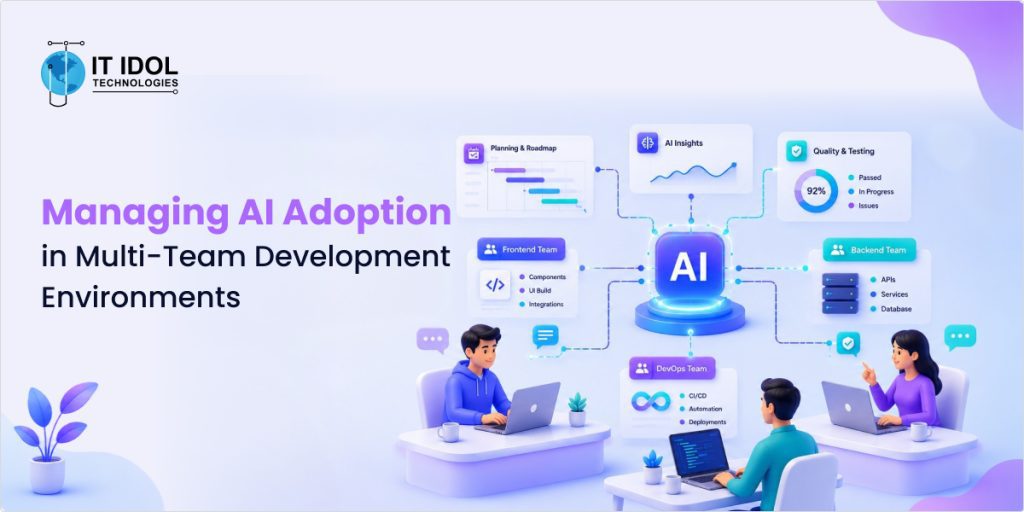
AI adoption fails less because of technology limitations and more because organizations underestimate the coordination cost across teams. In multi-team environments, AI is not a tool rollout; it is a systems-level change that reshapes how decisions are made, how work is validated, and how accountability flows. Leaders who treat it as a localized productivity upgrade create fragmentation. Those who treat it as an operating model shift unlock compounding value.
What follows is not a theoretical view of AI adoption, but a grounded perspective on how it actually plays out across engineering, product, data, and operations teams and what separates controlled acceleration from organizational chaos.
Why AI Adoption Becomes a Coordination Problem Before it Becomes a Technology Problem
AI adoption introduces asymmetry: some teams move faster, others lag, and dependencies become unstable. The moment one team integrates AI into development workflows, whether through code generation, testing automation, or decision support, the assumptions of adjacent teams break.
A backend team using AI-assisted development may ship faster iterations, but if QA, DevOps, or product teams are not aligned with that increased velocity, the system bottlenecks elsewhere. The result is not acceleration but uneven throughput.
In practice, this manifests as:
Increased rework because outputs are not validated consistently
Mismatched expectations of delivery timelines
Dependency failures across teams that operate at different “AI maturity levels.”
The mistake is assuming adoption can be decentralized without consequences. In reality, decentralized experimentation must be paired with centralized coordination mechanisms.
A useful mental model here is “velocity synchronization.” AI increases local velocity, but unless system-wide velocity is harmonized, the organization experiences friction rather than gain.
Takeaway: AI adoption becomes a coordination challenge the moment multiple teams are involved; without synchronization, speed gains in one area create instability in others.
How Should Leaders Structure Ownership of AI Across Multiple Teams?
One of the most common failure points is unclear ownership. When AI sits “everywhere,” it is effectively owned by no one.
Organizations typically fall into one of three flawed patterns:
Fully centralized AI teams that become bottlenecks
A central AI function defines standards, tooling, governance, and evaluation frameworks
Individual teams’ own implementation within their domain, aligned to those standards
This mirrors how high-performing organizations manage DevOps or platform engineering. The central team is not building everything; it is enabling consistency and reducing duplication.
In execution, this means:
Shared model selection criteria and evaluation benchmarks
Clear guidelines on where AI decisions can be autonomous vs. human-reviewed
Without this structure, teams reinvent solutions, create incompatible systems, and introduce hidden risks.
Takeaway: AI ownership must be federated and centralized for standards, decentralized for execution, otherwise scale turns into fragmentation.
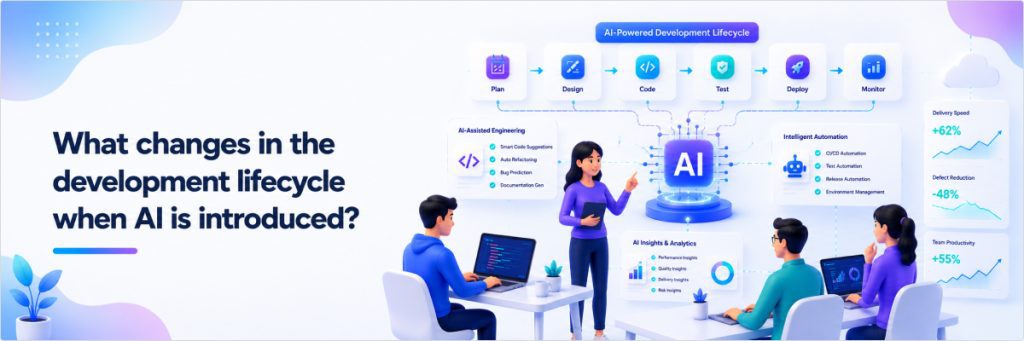
What Changes in the Development Lifecycle when AI is Introduced?
AI does not just accelerate development; it changes what “development” actually means. The shift is subtle but critical: teams move from creating outputs to supervising outputs.
Traditionally, engineering workflows were deterministic. With AI, they become probabilistic. This affects every stage of the lifecycle:
Design: Requirements must account for variability, not just correctness
Development: Code is partially generated, not fully authored
Testing: Validation expands from functional correctness to behavioural reliability
Deployment: Monitoring includes model performance, not just system health
The biggest operational shift is in the responsibility for validation. AI-generated outputs can appear correct while introducing edge-case failures that are hard to detect through traditional testing.
Teams that succeed redefine roles:
Engineers become validators and integrators, not just builders
QA evolves into continuous evaluation systems
Product teams take ownership of defining acceptable output boundaries
A common failure is assuming existing QA processes are sufficient. They are not designed for probabilistic systems.
Takeaway: AI transforms development from deterministic execution to probabilistic supervision, requiring a redefinition of validation across the lifecycle.
How Do You Prevent Fragmentation of Tools, Models, and Workflows?
In multi-team environments, uncontrolled experimentation leads to tool sprawl. Different teams adopt different models, frameworks, and vendors, creating integration complexity and cost inefficiency.
The issue is not experimentation itself; it is the absence of convergence.
A practical approach is to separate exploration from standardization:
Allow teams to experiment within defined boundaries
Establish periodic convergence points where decisions are standardized
This can be operationalized through:
Approved model registries
Standard integration layers
Shared observability frameworks
The goal is not to restrict innovation but to prevent divergence from becoming permanent.
A useful decision lens is “replaceability vs. dependency.” Any AI component introduced should be replaceable without system-wide disruption. If switching costs become too high, the organization has created hidden technical debt.
Takeaway: Fragmentation is prevented not by limiting experimentation, but by enforcing convergence through shared standards and replaceable architectures.
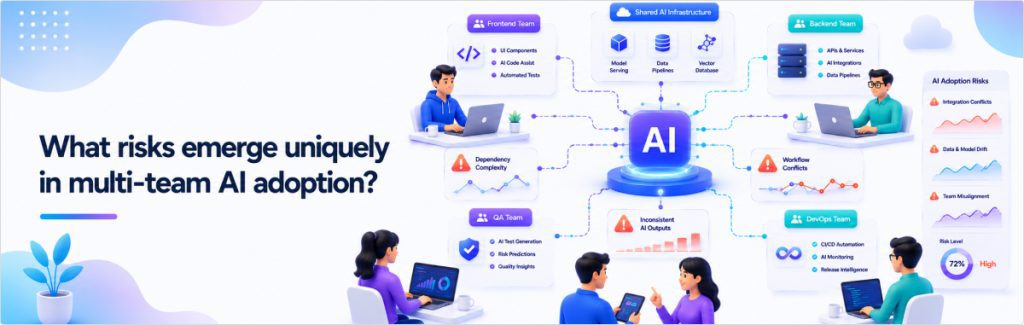
What Risks Emerge Uniquely in Multi-team AI Adoption?
AI introduces risks that are amplified in multi-team setups because accountability becomes diffused.
AI outputs can be incorrect without obvious signals. When multiple teams depend on these outputs, errors propagate silently across systems.
2. Misaligned Evaluation Criteria
Different teams may define “acceptable performance” differently, leading to inconsistent quality across the product.
3. Over-Automation of Decisions
Teams may automate decisions prematurely without understanding edge cases, leading to systemic errors.
4. Dependency Opacity
Teams may rely on AI-generated outputs without visibility into how they are produced, creating black-box dependencies.
Mitigating these risks requires explicit mechanisms:
Shared evaluation benchmarks across teams
Clear escalation paths for AI-related failures
Transparent logging and traceability of AI decisions
One of the most effective practices is implementing “decision checkpoints.” These are predefined points where human validation is mandatory before outputs propagate downstream.
Takeaway: The primary risk in multi-team AI adoption is not failure; it is undetected failure spreading across interconnected systems.
How Do You Measure ROI and Success Beyond Productivity Gains?
Most organizations default to measuring AI success through productivity metrics, faster coding, reduced manual effort, and quicker releases. These are necessary but insufficient.
In multi-team environments, the more meaningful metrics are system-level:
Throughput consistency: Are all teams moving faster, or just a few?
Rework rate: Has AI reduced or increased downstream corrections?
Decision latency: Are decisions being made faster and with better quality?
Cross-team dependency stability: Are integrations becoming smoother or more fragile?
A critical but often overlooked metric is “validation cost.” If AI reduces development time but significantly increases validation effort, the net gain may be minimal or negative. Another important lens is “quality of outcomes, not quantity of outputs.” AI can increase output volume, but if decision quality declines, the business impact deteriorates. Leaders should think in terms of system efficiency, not local efficiency.
Takeaway: AI ROI in multi-team environments is measured by system stability and decision quality, not just speed or output volume.
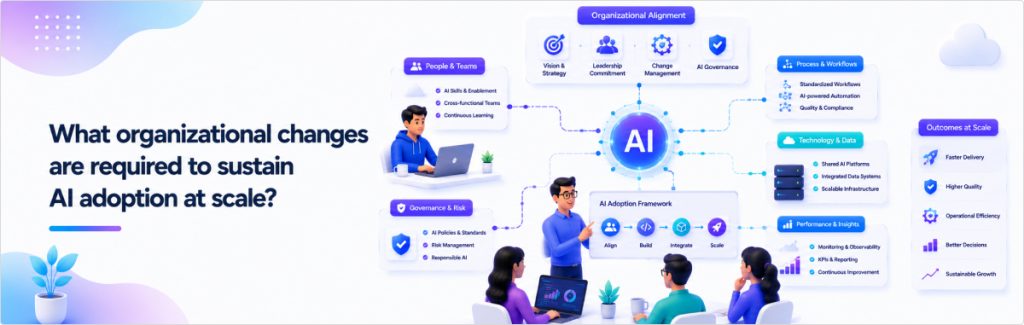
What Organizational Changes are Required to Sustain AI Adoption at Scale?
Three changes are consistently observed in successful organizations:
1. From Execution Ownership to Outcome Ownership
Teams are no longer evaluated on what they produce, but on the quality and impact of outcomes, regardless of how much AI contributes.
2. From Static Roles to Dynamic Capabilities
Roles become fluid. Engineers, product managers, and analysts all interact with AI systems, blurring traditional boundaries.
3. From Process Compliance to Judgment Quality
Strict processes become less effective when outputs are probabilistic. Organizations must invest in improving decision-making judgment rather than enforcing rigid workflows.
This often requires:
Upskilling teams in AI literacy, not just tool usage
Redefining performance metrics to reflect new realities
Encouraging critical thinking over blind automation
Organizations that fail to make these shifts end up with superficial adoption tools that are used, but the impact remains limited.
Takeaway: Sustainable AI adoption is an organizational transformation, not a tooling upgrade. It changes how work is evaluated, executed, and improved.
How Should Leaders Sequence AI Adoption Across Teams?
A common question is whether to roll out AI broadly or start with specific teams. The answer depends on dependency structures.
The most effective sequencing strategy is dependency-first adoption:
Start with teams that have the highest downstream impact
Expand to dependent teams once stability is established
For example:
If platform or backend teams adopt AI first, their improvements cascade across the system
If isolated teams adopt first, gains remain localized and harder to scale
Another effective approach is identifying “high-friction workflows” areas where delays, rework, or inefficiencies are most visible. AI adoption in these areas tends to deliver clearer ROI.
The key is to avoid random adoption. Sequencing should be deliberate, based on system impact.
Takeaway: AI adoption should follow system dependencies and friction points, not organizational convenience.
What Actually Drives Success in Multi-Team AI Adoption
Managing AI adoption across multiple teams is fundamentally about system design, not tool selection. The organizations that succeed do not move the fastest; they move the most coherently.
A combination of drives success:
Coordinated velocity across teams
Redefined validation processes for probabilistic systems
Controlled experimentation with enforced convergence
System-level metrics that reflect real impact
Organizational shifts toward outcome-driven work
AI introduces speed, but without structure, that speed creates instability. The real advantage comes from aligning that speed across the system, turning isolated gains into compounding outcomes.
In practice, AI adoption is not about doing more work faster. It is about building systems that make better decisions, more consistently, across every team involved.
Managing AI adoption becomes difficult when different teams use separate workflows, coding standards, delivery pipelines, and collaboration models. Without centralized governance, AI implementation can create inconsistencies in software quality, security practices, and operational execution across the organization.
Enterprises can scale AI adoption effectively by creating standardized governance frameworks, approved tooling policies, security controls, and shared engineering practices. A phased rollout approach, combined with internal training and workflow alignment, helps reduce friction and improve consistency in adoption across teams.
Governance provides operational control over how AI tools are used across engineering environments. It helps organizations reduce risks related to security vulnerabilities, compliance violations, inaccurate AI-generated outputs, and inconsistent software development practices.
AI improves collaboration by automating repetitive coordination tasks, accelerating testing and documentation, and improving visibility across development workflows. In multi-team environments, this helps engineering, QA, DevOps, and product teams work more efficiently with faster decision-making and reduced operational bottlenecks.
Unmanaged AI adoption can introduce security risks, inconsistent code quality, fragmented workflows, and compliance challenges across teams. Organizations may also face issues such as shadow AI usage, reduced maintainability, duplicated efforts, and overreliance on unverified AI-generated outputs.
Organizations should evaluate AI adoption based on measurable business and operational outcomes rather than on usage metrics alone. Key indicators include reduced deployment time, improved engineering productivity, lower defect rates, faster release cycles, and better cross-team operational efficiency.
AI can automate repetitive development activities and accelerate software delivery, but it cannot replace engineering leadership, architectural thinking, or business decision-making. Human expertise remains essential for governance, product strategy, system design, security oversight, and validating AI-generated outputs.
The most effective strategy is to begin with targeted pilot initiatives focused on high-impact workflows and measurable outcomes. Organizations that gradually expand AI adoption while refining governance, training, and operational processes are more likely to achieve sustainable long-term success.
AI can improve software quality by supporting automated testing, code generation, debugging, and documentation processes. However, organizations still require strong review mechanisms and engineering oversight to ensure AI-generated code aligns with architectural standards, security requirements, and maintainability goals.
AI systems amplify the efficiency of existing workflows, but they also expose inefficiencies, fragmented processes, and operational gaps. Organizations that optimize workflows before scaling AI adoption typically achieve better productivity gains, stronger collaboration, and more scalable technology operations.
Deval Rathod
Founder & CEO
|
Deval Rathod is the Founder and CEO of IT IDOL Technologies, a custom software development company. With over a decade of experience in software engineering, solution architecture, and technology leadership, she has worked across custom software development, enterprise applications, AI & ML, and digital transformation. Her expertise includes guiding technology teams, designing scalable software solutions, and helping businesses evaluate and implement emerging technologies. She contributes insights on software engineering, artificial intelligence, enterprise technology, and digital transformation.