Security incidents involving modern cloud platforms rarely fit into the traditional categories of “breach” or “exploit.” The April 2026 incident involving Vercel is a clear example. It is best understood not as a failure of infrastructure, but as a supply chain and identity-layer compromise that reflects how today’s systems are actually interconnected.
Before concluding, it is important to anchor the discussion in what has been explicitly confirmed and, equally, to acknowledge where details remain under investigation. The analysis below reflects publicly available disclosures and established technical patterns, without extending into speculation.
What Vercel has officially confirmed
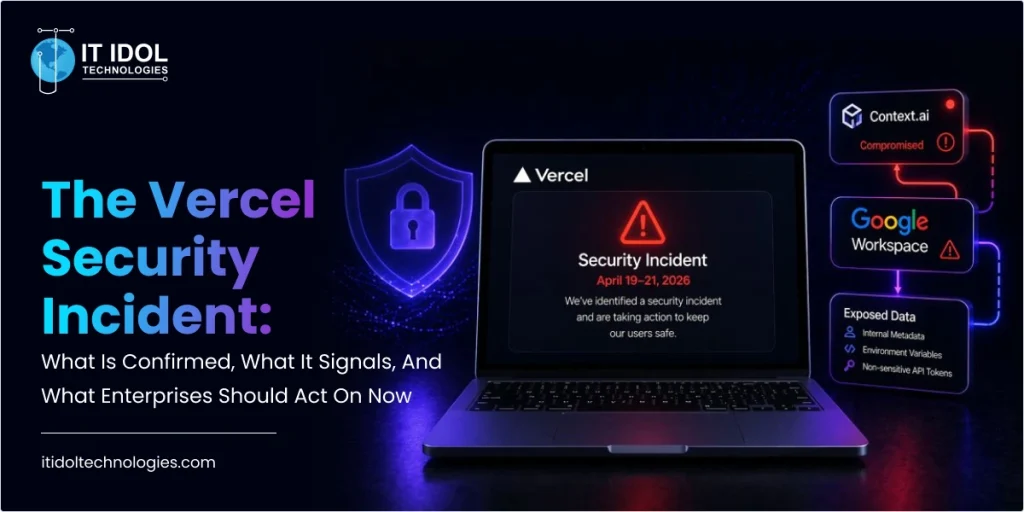
According to the security bulletin published by Vercel, the company identified unauthorized access to certain internal systems and initiated a coordinated response that included external incident response experts and law enforcement engagement.
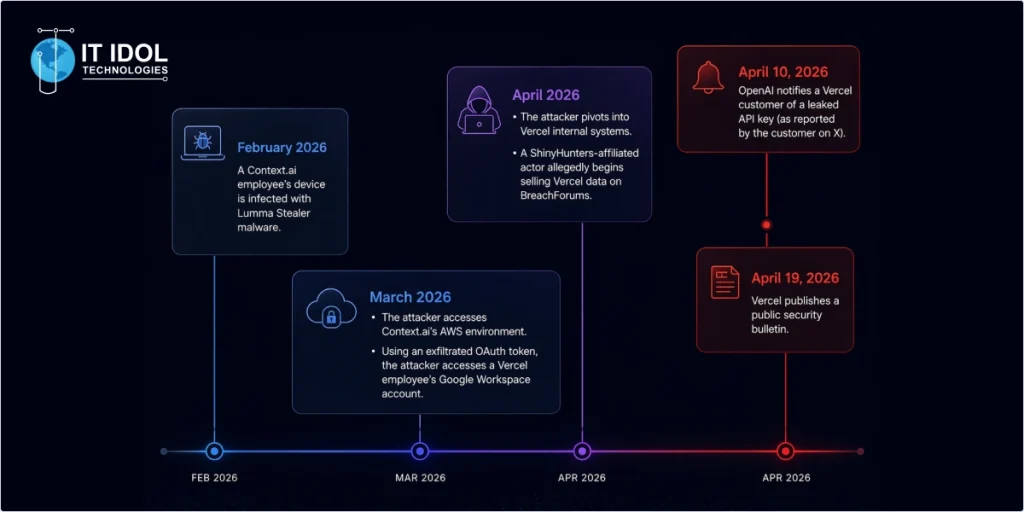
The confirmed entry point was not a direct compromise of Vercel’s infrastructure. Instead, the incident originated from a third-party integration involving Context.ai, which had access to internal workflows. Through that compromise, an attacker was able to gain access to a Vercel employee’s Google Workspace account.
From there, the attacker accessed internal systems and retrieved a subset of environment variables.
Vercel made several technically important clarifications:
Environment variables explicitly marked as sensitive are encrypted, and there is no evidence that these encrypted values were accessed
The accessed data was limited to variables not designated as sensitive
The company has not identified evidence of broader system compromise or unauthorized access to encrypted secrets
Affected customers were directly notified with guidance to rotate credentials and review activity
These points define the verified scope of the incident and provide a clear boundary between confirmed impact and unverified claims.
What The Attack Chain Shows Without Speculation
Independent technical analysis, including research from Trend Micro, helps contextualize the mechanics of the incident while remaining aligned with confirmed disclosures.
The attack followed a pattern consistent with OAuth-based supply chain compromises:
The initial compromise occurred within the third-party ecosystem. From there, attackers leveraged OAuth permissions or access tokens to authenticate into connected systems. Because these permissions were already granted through legitimate workflows, the attacker did not need to exploit vulnerabilities or bypass authentication controls in the traditional sense.
This allowed access to persist and expand through trusted identity pathways.
In practical terms, the attacker’s movement relied on:
Existing authorization rather than forced entry
Integration-level access rather than infrastructure-level compromise
Identity federation across platforms rather than an isolated system targeting
This is a structurally different attack model from conventional breaches, and it is increasingly relevant in environments where SaaS and AI tools are deeply embedded into operations.
Where the Current Understanding has Limits
It is equally important to acknowledge what is not fully established at this stage.
The complete scope of downstream impact across all potentially affected systems has not been publicly detailed. Attribution beyond the technical mechanism of compromise remains under investigation. The full extent to which accessed environment variables could be leveraged in follow-on activity is also not definitively known.
Rather than filling these gaps with assumptions, the more responsible approach is to treat them as active areas of investigation.
This is consistent with how modern incident response unfolds. Initial disclosures establish the verified baseline, while deeper insights emerge over time as forensic analysis progresses.
Why The Incident Matters Beyond Its Immediate Scope
Even within its confirmed boundaries, the incident highlights a structural shift in how enterprise risk manifests.
The compromise did not begin within Vercel. It began in a connected system that had been granted access. That distinction is critical because it reflects how modern architectures operate.
Organizations today rely on a network of integrations:
AI tools embedded into development and operations
SaaS platforms connected through APIs and identity systems
Shared authentication frameworks that span multiple environments
Each integration introduces a trust relationship, and those relationships collectively define the operational surface of the system.
In this context, risk is no longer confined to what an organization directly controls. It extends to everything that has been allowed to interact with its environment.
The Role of OAuth and Identity In This Incident
One of the most relevant technical aspects of this case is the role of OAuth-based access. OAuth is designed to enable secure, delegated access between systems. It is foundational to how modern applications integrate.
However, as highlighted in the analysis from Trend Micro, OAuth can also create conditions where access is:
Persistent rather than session-bound
Broad in scope, depending on granted permissions
Less visible to traditional monitoring systems
In the Vercel incident, the attacker leveraged these characteristics to move across systems using legitimate access pathways.
This does not indicate a flaw in OAuth itself. It reflects how powerful these mechanisms are and how important it is to govern them carefully in enterprise environments.
Interpreting The Environment Variable Exposure Correctly
A key point in Vercel’s disclosure is the distinction between sensitive and non-sensitive environment variables.
Sensitive variables are encrypted and protected in a way that prevents direct exposure. This control functioned as intended. The accessed variables were those not classified under that protection model.
From a system design perspective, this demonstrates that segmented data protection controls can limit the impact of an incident, even when access is obtained.
At the same time, the incident reinforces the need to evaluate how non-sensitive data is used. In complex environments, configuration-level data can still provide context that may support further analysis or targeting.
This is not a contradiction. It is a reminder that data sensitivity is contextual and evolves with system complexity.
A Practical Perspective for Enterprise Environments
For organizations designing and operating cloud-native and AI-enabled systems, including implementation teams at IT IDOL Technologies, this incident aligns with a broader pattern that is already visible in enterprise environments.
The challenge is not a lack of security controls. It is the distribution of access across interconnected systems.
Modern architectures are built for speed and integration. Tools are connected to accelerate workflows, automate processes, and enable real-time collaboration. But each connection introduces an access layer that must be understood and managed.
This requires a shift in focus from isolated system security to holistic access governance.
It means understanding not just who has access, but how that access is granted, how long it persists, and how it can be monitored across systems.
Acting on What is Known Today
Even without a complete picture of the incident, the confirmed attack chain provides enough clarity for organizations to take meaningful action.
The priority is not to wait for additional disclosures, but to address the structural conditions that enabled this type of compromise.
This includes gaining visibility into OAuth-based integrations, reviewing the scope of permissions granted to third-party tools, and ensuring that identity-based access is continuously monitored rather than assumed to be secure by default.
It also involves revisiting how environment-level data is classified and protected, particularly in systems where configuration data can influence broader access patterns.
These are not reactive measures tied to a single incident. They are foundational steps for operating securely in interconnected environments.
Closing Perspective
The Vercel incident is still under active investigation, and additional details may refine the understanding of its scope and impact. What is already clear, however, is the nature of the attack path.
A third-party compromise led to identity-based access, which enabled interaction with internal systems, while core protections around sensitive data remained intact.
That combination reflects both the strengths and the evolving challenges of modern cloud architectures.
For enterprises, the takeaway is not to reduce integration or slow down adoption of AI and SaaS tools. It is to ensure that these systems are supported by clear, enforceable, and observable access controls.
Because in today’s environment, security is not defined only by what is protected. It is defined by how effectively access is granted, monitored, and constrained across the entire ecosystem.
Deval Rathod is the Founder and CEO of IT IDOL Technologies, a custom software development company. With over a decade of experience in software engineering, solution architecture, and technology leadership, she has worked across custom software development, enterprise applications, AI & ML, and digital transformation. Her expertise includes guiding technology teams, designing scalable software solutions, and helping businesses evaluate and implement emerging technologies. She contributes insights on software engineering, artificial intelligence, enterprise technology, and digital transformation.