AI accelerates development, but also compresses the timeline for technical debt accumulation
Generated code often hides deeper architectural and maintainability issues
Visibility gaps emerge when code creation outpaces understanding
AI amplifies both strong and weak engineering practices
Documentation and context-sharing are critical in AI-assisted workflows
Over-reliance on AI can reduce critical thinking and system ownership
Governance and measurement frameworks are essential for long-term sustainability
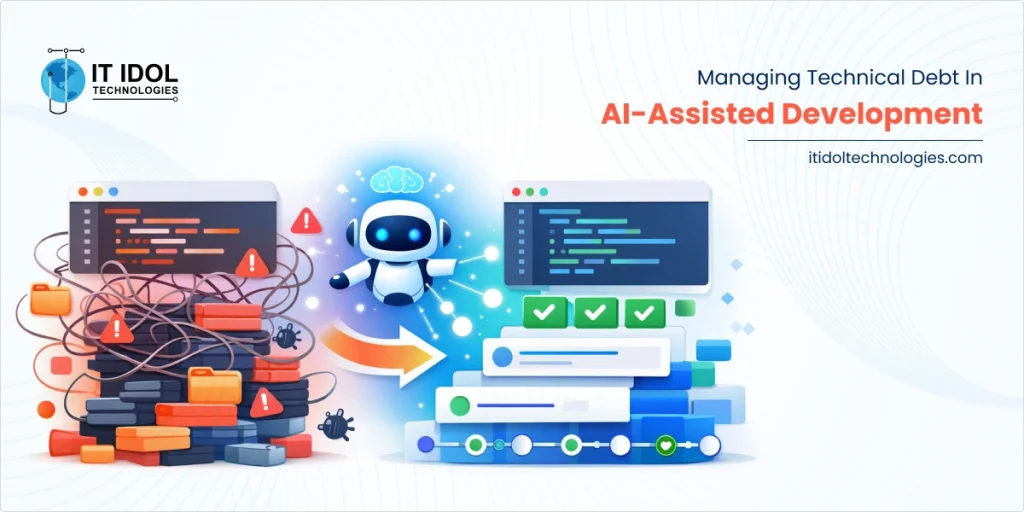
The promise of AI-assisted development is hard to ignore. Teams are shipping faster, prototyping more freely, and reducing repetitive engineering work in ways that felt unrealistic just a few years ago. Tools powered by large language models can generate code, suggest refactors, and even debug issues in real time. But beneath this acceleration lies a quieter, more complex challenge: technical debt is not disappearing, it’s evolving.
In many organizations, engineering leaders are discovering that AI doesn’t eliminate technical debt; it compresses the timeline in which it forms. Code is produced faster than it can be deeply understood, architectural shortcuts are easier to justify, and patterns, good or bad, spread across systems with unprecedented speed. Managing technical debt in this environment requires more than discipline; it requires a recalibration of how teams think about quality, ownership, and long-term sustainability.
The New Shape of Technical Debt in AI-Driven Workflows
Technical debt has always been a calculated trade-off. What’s different in AI-assisted development is how easily that trade-off scales. When a developer introduces a flawed abstraction, the impact is often contained. When an AI tool generates that same abstraction, and it gets reused across services, the debt compounds almost instantly.
AI-generated code typically looks clean. It compiles, aligns with syntax expectations, and often passes initial tests. But beneath that surface, it may introduce inefficiencies, outdated patterns, or inconsistencies with existing architecture. Because the code “works,” teams are less likely to challenge it in the moment.
A 2023 McKinsey report highlights that generative AI can significantly boost developer productivity, while also stressing the need for governance and quality controls to mitigate downstream risks.
This tension between accelerated output and deferred scrutiny is where modern technical debt begins to accumulate.
Velocity Without Visibility: The Core Risk
One of the most consequential shifts AI introduces is the imbalance between creation and comprehension. Developers can now generate large volumes of code in minutes, but understanding that code still requires time, context, and critical thinking.
This creates a visibility gap. Systems evolve quickly, but shared understanding lags. Over time, this leads to codebases that function correctly yet are increasingly difficult to reason about.
Where AI Introduces Hidden Debt
Development Activity
Traditional Risk Profile
AI-Assisted Risk Shift
Long-Term Impact
Code generation
Slower, more deliberate
Rapid, high-volume generation
Reduced code comprehension across teams
Pattern reuse
Intentional reuse
Unchecked replication of generated patterns
System-wide inconsistencies
Debugging
Root-cause focused
Patch-based fixes suggested by AI
Layered, unresolved issues
Refactoring
Planned and scoped
Often deferred due to speed pressure
Compounding structural complexity
This shift is subtle but significant. The issue is not that teams are writing worse code; it’s that they are scaling decisions faster than they can validate them.
AI as a Force Multiplier for Good and Bad
AI doesn’t inherently degrade code quality. In well-structured environments, it can reinforce best practices, accelerate refactoring, and improve consistency. The challenge is that it amplifies whatever context it operates within. If a codebase is clean, modular, and well-documented, AI tends to produce aligned outputs. If it’s fragmented or inconsistent, those issues propagate just as efficiently.
A Deloitte analysis on AI in software engineering notes that while AI enhances productivity, organizations must invest in governance frameworks to manage quality, security, and maintainability risks. This amplification effect shows up most clearly in areas like duplicated logic, inconsistent abstractions, and security oversights issues that are easy to miss in isolated code reviews but costly at scale.
Rethinking Code Review in an AI-Assisted World
Code review has traditionally been about verifying correctness and catching errors. In AI-assisted workflows, it becomes a mechanism for restoring context. Reviewers are no longer just asking, “Does this work?” They are asking, “Why does this work this way?” and “Does the developer understand what was generated?” This requires a more deliberate approach.
Teams that adapt successfully tend to treat AI-generated code as a starting point rather than a finished product. Developers are expected to interpret, refine, and, when necessary, rewrite generated logic.
The goal is not to slow down development, but to ensure that speed does not erode system clarity.
Documentation as a First-Class Discipline
AI-assisted development often leads to an unintended side effect: documentation debt. When code is generated quickly, documentation struggles to keep pace.
But in systems where code is less “authored” and more “assembled,” documentation becomes essential. It explains intent, captures trade-offs, and provides the context that generated code lacks. Effective teams are responding by embedding documentation into the development process itself, treating it as part of delivery rather than an afterthought.
Practical Signals of Documentation Debt
Signal
What It Indicates
Business Consequence
Frequent onboarding delays
Lack of system clarity
Slower team scaling
Repeated developer questions
Missing contextual documentation
Reduced productivity
Inconsistent feature behavior
Misaligned assumptions
Customer experience issues
High dependency on senior engineers
Knowledge silos
Increased operational risk
These signals often surface gradually, but by the time they become visible, the cost of correction is already high.
The Hidden Cost of Over-Reliance on AI
A more subtle risk is behavioural. As AI tools become more reliable, developers may begin to trust outputs without fully interrogating them.
This shift affects how decisions are made. Instead of exploring multiple approaches, teams may default to the first viable solution generated by AI. Over time, this can erode critical thinking and reduce the depth of system understanding. When that balance tilts too far toward automation, technical debt becomes harder to detect, not because it isn’t there, but because fewer people are actively looking for it.
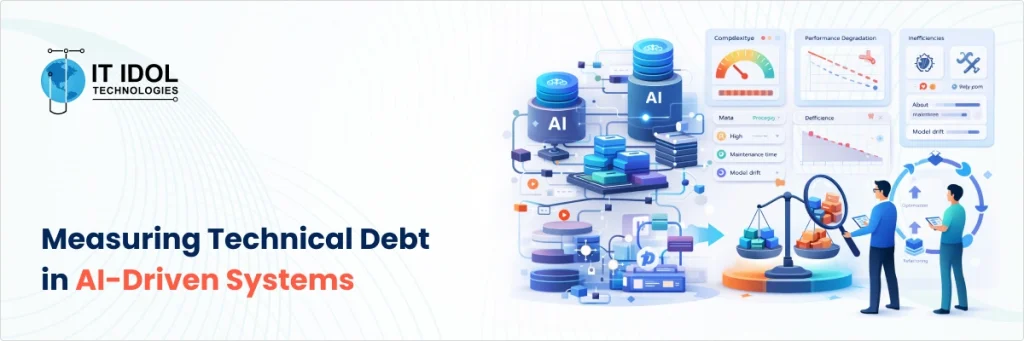
Measuring Technical Debt in AI-Driven Systems
Traditional metrics, code complexity, defect rates, and test coverage still matter. But they don’t fully capture the dynamics introduced by AI.
Organizations are beginning to look at additional indicators that reflect how AI is shaping their codebases:
How much of the code is AI-generated?
How often are generated patterns reused without modification?
How frequently is generated code refactored or replaced?
These metrics provide insight into whether AI is reinforcing good practices or accelerating hidden risks. Gartner has cautioned that without governance around AI-generated code, organizations risk increased maintenance costs and reduced system reliability over time. The objective is not to restrict AI usage, but to understand its impact with the same rigour applied to other engineering decisions.
Balancing Speed and Sustainability
The core tension remains unchanged: speed versus sustainability. What AI changes is the scale and speed at which this tension plays out.
Teams can now deliver features at an unprecedented pace, but without guardrails, that velocity can lead to long-term friction. Systems become harder to maintain, innovation slows, and engineering effort shifts from building new capabilities to managing complexity.
Organizations that navigate this well tend to embed a few principles into their culture. Speed is valued, but not at the expense of clarity. Shortcuts are allowed, but they are made visible and revisited. AI is embraced, but human accountability remains central.
These are not technical adjustments; they are cultural ones.
The Organizational Dimension of Technical Debt
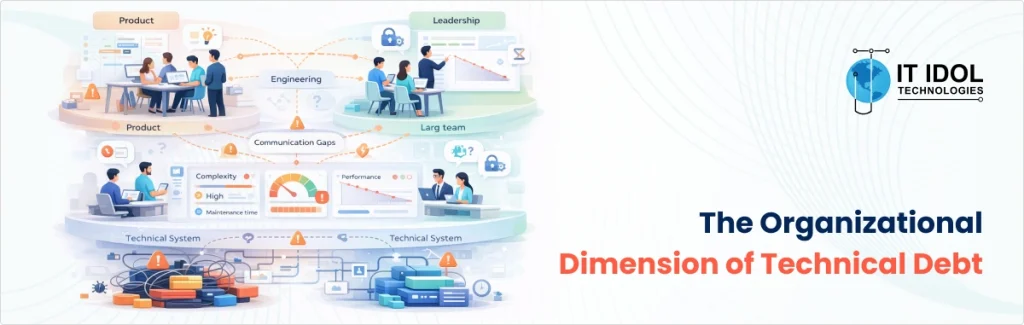
In AI-assisted environments, technical debt increasingly reflects organizational decisions rather than individual ones.
How teams adopt AI tools, how they define quality, and how they enforce standards all influence how debt accumulates. Without alignment, different teams may develop inconsistent practices, leading to fragmented systems and duplicated effort.
This is particularly relevant at scale. Enterprises rolling out AI across multiple teams often see divergence in how tools are used, which creates hidden integration challenges over time. Organizations that address this proactively tend to standardize AI usage guidelines, invest in shared tooling, and align incentives around long-term system health rather than short-term output. Technical debt, in this context, becomes a signal of organizational maturity.
The organizations that succeed will not be those that avoid debt entirely, but those that manage it intentionally. They will invest in visibility, governance, and developer education. They will treat AI as an accelerator but not a substitute for engineering judgment. The goal is not perfection. It is control.
Conclusion
AI-assisted development is reshaping how software is built, but it is not changing the fundamentals of good engineering. Technical debt still exists it simply accumulates faster, spreads wider, and becomes harder to detect. The path forward lies in balance.
Organizations must combine the speed of AI with the discipline of experienced engineering practices. They must ensure that generated code is understood, that systems remain coherent, and that long-term maintainability is never an afterthought.
For teams navigating this shift, the challenge is as much strategic as it is technical. Establishing the right governance models, development workflows, and quality benchmarks will define how effectively AI can be scaled without compromising system health.
As businesses move in this direction, partners like IT IDOL Technologies can help structure AI adoption in a way that aligns speed with sustainability, ensuring that innovation today does not become technical debt tomorrow.
No, when managed intentionally, it can enable faster innovation while maintaining control.
Deval Rathod
Founder & CEO
|
Deval Rathod is the Founder and CEO of IT IDOL Technologies, a custom software development company. With over a decade of experience in software engineering, solution architecture, and technology leadership, she has worked across custom software development, enterprise applications, AI & ML, and digital transformation. Her expertise includes guiding technology teams, designing scalable software solutions, and helping businesses evaluate and implement emerging technologies. She contributes insights on software engineering, artificial intelligence, enterprise technology, and digital transformation.