Funnel Optimization for Lead Generation Websites: Why Most B2B Funnels Lose Revenue Before Sales Conversations Even Begin
Last Update on 08 June, 2026
|Share on:
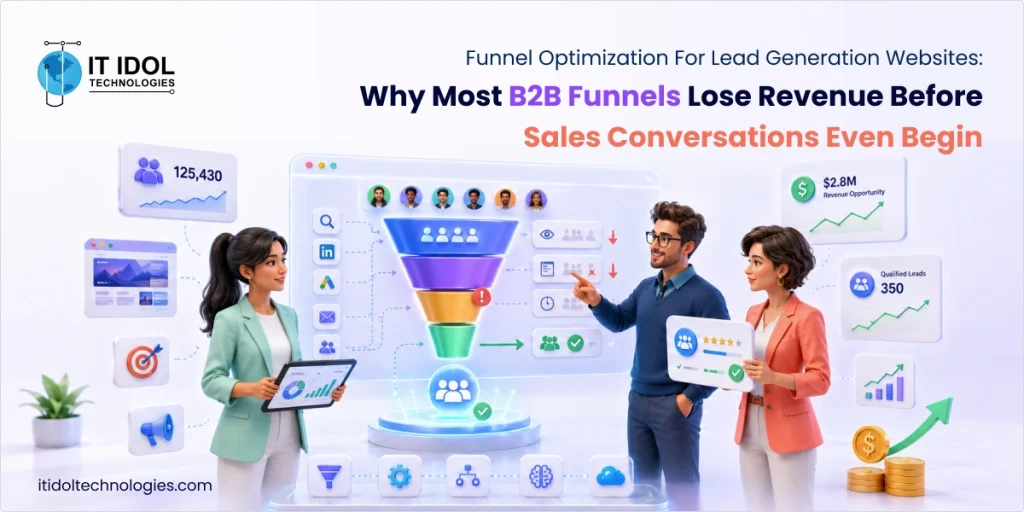
Most businesses think they have a lead generation problem.
In reality, many have a funnel efficiency problem.
Traffic may be increasing. Campaigns may be generating form submissions. Marketing dashboards may show rising engagement metrics. Yet despite higher acquisition activity, conversion quality often declines, sales cycles become longer, and pipeline efficiency weakens over time.
This happens because lead generation is rarely determined by traffic alone.
What ultimately drives pipeline growth is how effectively a website guides decision-making across the entire buyer journey.
That is where funnel optimization becomes critical.
For B2B organizations especially, a lead generation website is no longer just a digital brochure or campaign destination. It functions as an operational conversion system responsible for:
- building trust
- reducing friction
- validating expertise
- qualifying intent
- guiding user behavior
- and supporting purchase readiness across multiple stages of evaluation
When funnel architecture is weak, even high-performing marketing campaigns struggle to generate meaningful business outcomes.
Why Traditional Conversion Optimization Is No Longer Enough
For years, website optimization largely focused on isolated conversion elements:
- CTA buttons
- landing page forms
- page speed
- A/B testing
- and visual engagement patterns
While these factors still matter, buyer behavior has become significantly more complex.
Modern B2B buyers rarely convert after a single interaction. According to Google’s research on complex B2B buying journeys, enterprise purchasing decisions involve extensive independent research, multiple stakeholders, and non-linear decision paths.
This means funnel optimization can no longer focus only on isolated conversion events.
Organizations increasingly need to optimize:
- information architecture
- content sequencing
- trust validation
- intent progression
- behavioral flow
- and decision confidence across the full digital experience
In many cases, conversion loss happens long before a user reaches a contact form.
Most Lead Generation Funnels Break at the Trust Layer
One of the most overlooked problems in lead generation websites is the assumption that users convert primarily because they understand a product or service.
In reality, B2B buyers convert when uncertainty decreases.
A website may explain offerings clearly while still failing to generate qualified leads because it does not establish sufficient trust, operational credibility, or decision confidence.
This becomes especially important in industries involving:
- enterprise software
- AI solutions
- healthcare technology
- cloud infrastructure
- cybersecurity
- fintech
- or digital transformation services
In these sectors, buyers are evaluating risk as much as capability.
A visitor arriving from search or paid acquisition often asks implicit questions such as:
- Can this company solve complex problems?
- Do they understand enterprise operations?
- Are they technically credible?
- Can they scale?
- Have they solved similar challenges before?
- Will implementation risk be manageable?
Funnels that fail to answer these questions early experience higher abandonment rates regardless of traffic quality.
Funnel Optimization Is Increasingly About Information Flow
Many organizations still structure websites around internal business categories rather than buyer decision logic.
This creates friction.
Users do not naturally navigate websites according to organizational departments. They navigate according to uncertainty reduction.
Effective lead generation funnels increasingly guide users through progressive informational stages:
- awareness
- validation
- contextual understanding
- operational confidence
- and conversion readiness
This requires more than good design.
It requires structured information flow.
For example, a visitor exploring enterprise AI implementation services may initially search for strategic understanding rather than vendor selection. If the website immediately pushes aggressive conversion CTAs without establishing expertise or operational context, the user often disengages.
On the other hand, websites that progressively build informational confidence through:
- educational insights
- implementation realities
- technical clarity
- governance understanding
- and business impact analysis tends to create stronger downstream conversion quality
The best funnels do not pressure users into conversion.
They reduce enough uncertainty that conversion becomes logical.
Why Traffic Quality Alone Does Not Solve Funnel Problems
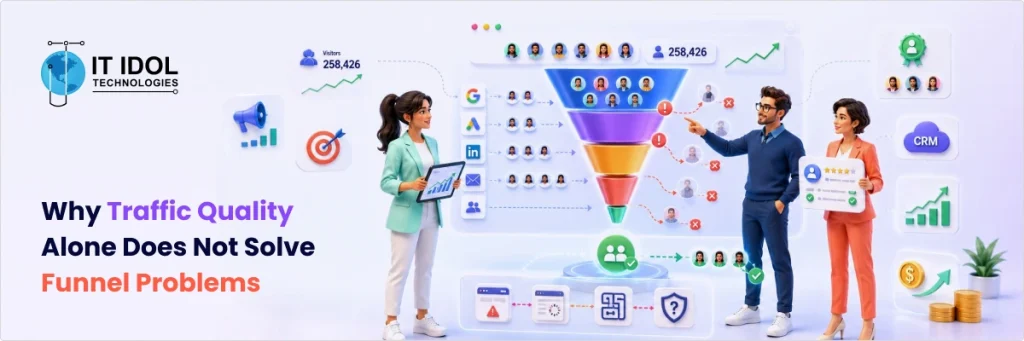
One of the most common mistakes businesses make is assuming poor lead generation performance is caused primarily by insufficient traffic.
This often leads organizations to increase:
- ad spend
- SEO activity
- social campaigns
- or outbound acquisition efforts
But scaling traffic into a weak funnel usually amplifies inefficiency rather than solving it.
A poorly structured conversion journey causes:
- Higher bounce rates
- lower intent progression
- weak lead qualification
- inconsistent sales alignment
- and rising acquisition costs
This is particularly visible in paid acquisition environments where businesses drive high-intent visitors toward pages lacking:
- contextual depth
- strategic messaging
- operational clarity
- or trust-building architecture
Funnel optimization therefore, becomes directly connected to revenue efficiency.
In many cases, improving conversion flow creates greater business impact than increasing traffic volume.
The Role of Content in Modern Lead Generation Funnels
Content is no longer just a traffic acquisition asset.
Increasingly, it functions as a conversion infrastructure layer.
Modern B2B buyers expect websites to help them:
- evaluate complexity
- compare operational approaches
- understand implementation risks
- and validate strategic fit
This is why high-performing lead generation websites increasingly integrate:
- thought leadership
- technical explainers
- implementation frameworks
- operational insights
- and educational resources directly into funnel architecture
According to HubSpot’s State of Marketing research, buyers increasingly engage with educational content throughout the purchase journey before initiating direct sales interaction.
This changes how websites should be designed.
Content should not exist separately from the conversion strategy. It should actively support intent progression.
The strongest lead generation websites create informational continuity between:
- discovery
- education
- validation
- and conversion
Why Mobile Funnel Behavior Requires Different Thinking
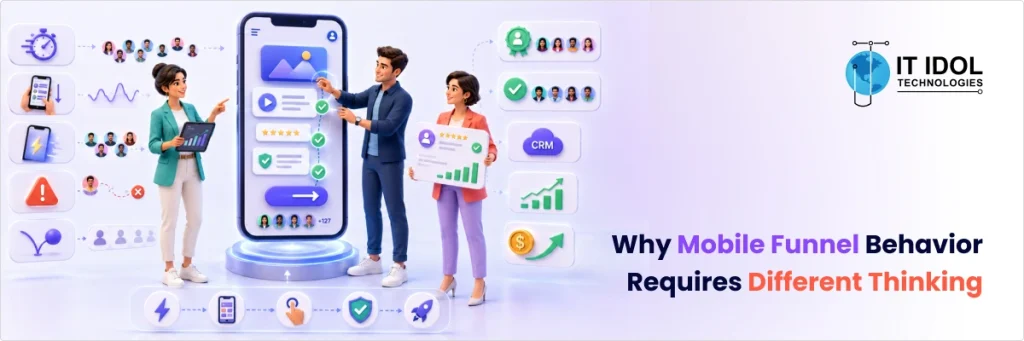
Mobile optimization is often treated as a technical responsiveness issue.
The larger issue is behavioral context.
Mobile users frequently interact with websites differently from desktop users:
- shorter attention windows
- fragmented browsing sessions
- rapid informational scanning
- and lower tolerance for friction
Google has repeatedly emphasized the importance of mobile experience and page usability in digital engagement behaviour. Google Search Central mobile usability guidance
But responsive layouts alone are insufficient.
Lead generation funnels increasingly need:
- simplified navigation paths
- faster informational clarity
- compressed trust signals
- and friction-minimized engagement sequences for mobile environments
A complex multi-step conversion process that works on desktop may underperform dramatically on mobile devices.
Data Visibility Is Essential for Funnel Optimization
Many organizations optimize funnels using incomplete visibility.
They track:
- traffic
- form submissions
- and click-through rates, while missing deeper behavioral signals
Modern funnel optimization increasingly depends on understanding:
- Where users hesitate
- Which pages reduce trust
- How intent shifts across sessions
- Where decision friction appears
- And what informational gaps prevent progression
Without behavioral visibility, optimization efforts often become reactive rather than strategic.
The most effective lead generation systems combine:
- analytics
- behavioral intelligence
- CRM integration
- session analysis
- and sales feedback loops to identify where pipeline friction actually occurs
This transforms funnel optimization from isolated marketing experimentation into a broader operational intelligence process.
Why AI Is Changing Funnel Expectations
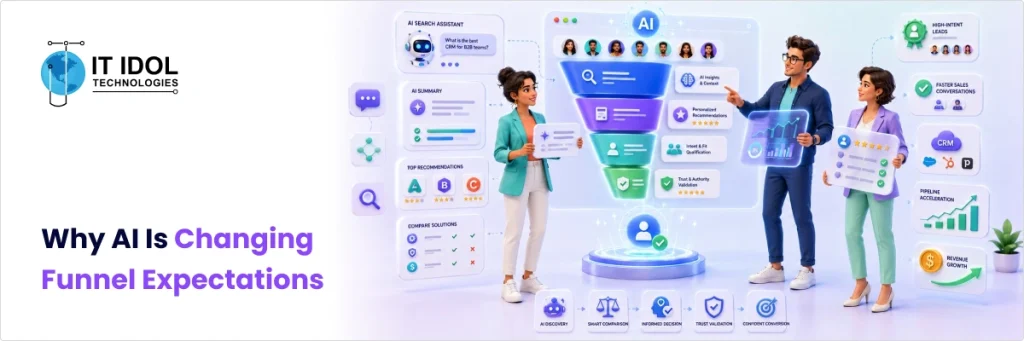
AI-powered search and conversational discovery are also reshaping how users enter conversion funnels.
Visitors increasingly arrive with:
- higher informational awareness
- stronger comparison context
- and more refined expectations
This means websites can no longer rely on generic marketing messaging alone.
Users expect:
- specificity
- operational clarity
- implementation realism
- and contextual expertise quickly
As AI-generated search experiences continue expanding, websites increasingly function less as initial discovery points and more as validation environments where users confirm credibility before engaging directly.
That raises the importance of:
- expertise signaling
- structured authority
- and informational trust inside the funnel design
The Future of Lead Generation Funnels Will Be Experience-Centric
The next generation of lead generation websites will likely be defined less by aggressive conversion tactics and more by intelligent experience architecture.
High-performing funnels increasingly combine:
- strategic content
- behavioral intelligence
- contextual personalization
- trust engineering
- and operational clarity
Businesses that continue treating websites primarily as static marketing assets may struggle as buyer expectations evolve.
The organizations generating stronger pipelines in the coming years will likely be those building:
- decision-support ecosystems
- informational credibility
- and friction-aware digital experiences
Because in modern B2B environments, lead generation is no longer just about capturing attention.
It is about guiding confidence.
How IT IDOL Technologies Helps Businesses Build High-Performance Lead Generation Ecosystems
IT IDOL Technologies helps businesses design scalable, conversion-focused digital ecosystems that align user experience, enterprise technology, AI-driven engagement, and operational growth objectives.
From enterprise web development and AI-powered digital experiences to cloud-native platforms, analytics integration, and conversion-focused architecture, IT IDOL Technologies supports organizations looking to strengthen lead generation performance through intelligent, future-ready digital systems.
As digital buying behavior becomes increasingly complex, businesses need more than visually attractive websites. They need structured conversion ecosystems capable of building trust, guiding decisions, and supporting long-term revenue growth.
FAQ’s
1. What is funnel optimization in B2B lead generation?
Funnel optimization is the process of improving every stage of a lead generation journey to increase conversions, reduce drop-offs, and improve sales-qualified opportunities.
2. Why do most B2B funnels lose revenue early?
Many B2B funnels lose revenue because of poor user experience, unclear messaging, weak targeting, slow response times, and friction before prospects reach the sales team.
3. What are the common bottlenecks in B2B lead generation funnels?
Common bottlenecks include complicated forms, unclear calls-to-action, irrelevant content, low trust signals, poor landing page performance, and disconnected marketing workflows.
4. How does website experience affect lead conversion?
A confusing or slow website experience increases abandonment rates, reduces engagement, and prevents high-intent buyers from progressing through the funnel.
5. Why is lead qualification important in funnel optimization?
Effective lead qualification helps businesses prioritize high-intent prospects, improve sales efficiency, and reduce wasted marketing spend on unqualified leads.
6. What role does content play in B2B funnel performance?
Content helps educate buyers, build trust, address objections, and guide prospects through different stages of the decision-making process.
7. How can businesses identify funnel leakage points?
Businesses can analyze behavioral analytics, conversion rates, bounce rates, form abandonment, engagement patterns, and user journey data to identify weak funnel stages.
8. Why do long forms reduce lead conversions?
Long or complex forms create friction, increase user fatigue, and discourage prospects from completing the conversion process.
9. How does marketing and sales alignment improve funnel efficiency?
Better alignment ensures smoother lead handoffs, consistent messaging, faster follow-ups, and improved conversion from marketing-qualified leads to revenue opportunities.
10. What strategies improve B2B lead generation funnel performance?
Businesses can improve funnel performance through faster page speeds, better UX design, personalized content, stronger CTAs, automation workflows, lead scoring, and conversion-focused landing pages.
Also Read: Why Are AI Search Mentions Increasing While Organic Traffic Declines?

Parth Inamdar
|Parth Inamdar is a Content Writer at IT IDOL Technologies, specializing in AI, ML, data engineering, and digital product development. With 5+ years in tech content, he turns complex systems into clear, actionable insights. At IT IDOL, he also contributes to content strategy—aligning narratives with business goals and emerging trends. Off the clock, he enjoys exploring prompt engineering and systems design.