Every enterprise AI conversation in 2026 eventually arrives at the same uncomfortable question: Where is the money?
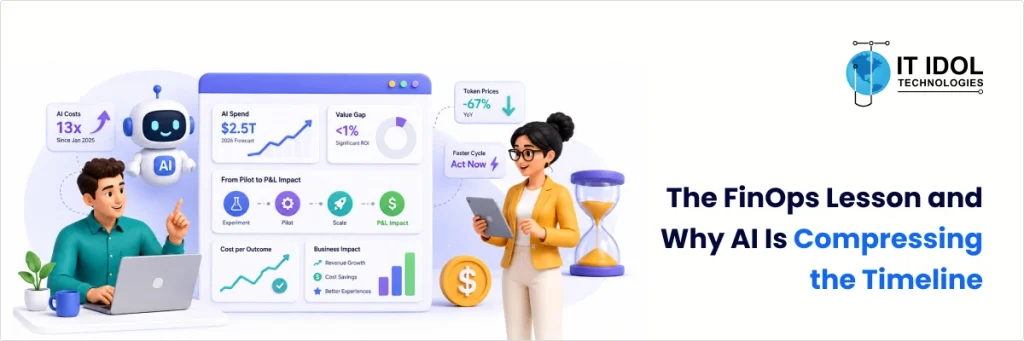
Not where did it go; that part is easy to answer. Global AI spending is forecast to reach $2.5 trillion in 2026, and organizations across industries are committing larger AI budgets with greater conviction than at any prior point. The uncomfortable question is different: What is all of that spending actually returning?
The answer, for most enterprises, is: we don’t fully know.
That gap between what organizations are spending on AI and what they can credibly measure as a return is not a technology problem. It is a leadership problem. And it is increasingly the lens through which boards, CFOs, and shareholders are evaluating whether their CIOs and CTOs understand what they are doing.
The Budget Is Growing. The Proof Is Not.
Let’s establish the baseline. Enterprise AI investment has moved from experimentation into a dedicated operational budget line item. AI and ML workloads now represent 22% of total cloud costs at SaaS and IT companies. Organizations that were once debating whether to invest in AI are now debating how to govern, measure, and justify what they have already deployed.
And yet: fewer than 1% of global executives report a significant ROI from their AI investments, defined as a 20% or greater improvement in profitability or cost savings. Only 3% report a substantial return of 10–20%. More than half (53%) say their returns remain capped at 1–5%.
These are not figures from skeptical outsiders dismissing AI’s potential. They come from the executives running these programs.
The scale of the disconnect is hard to overstate. AI value creation is real, but uneven; CFOs, CIOs, and CTOs are often pulling in different directions, leaving enterprise value stranded in the gaps. That divergence is not accidental. It reflects a structural problem in how most organizations have approached AI: deploy first, measure later, and never quite get to the measuring.
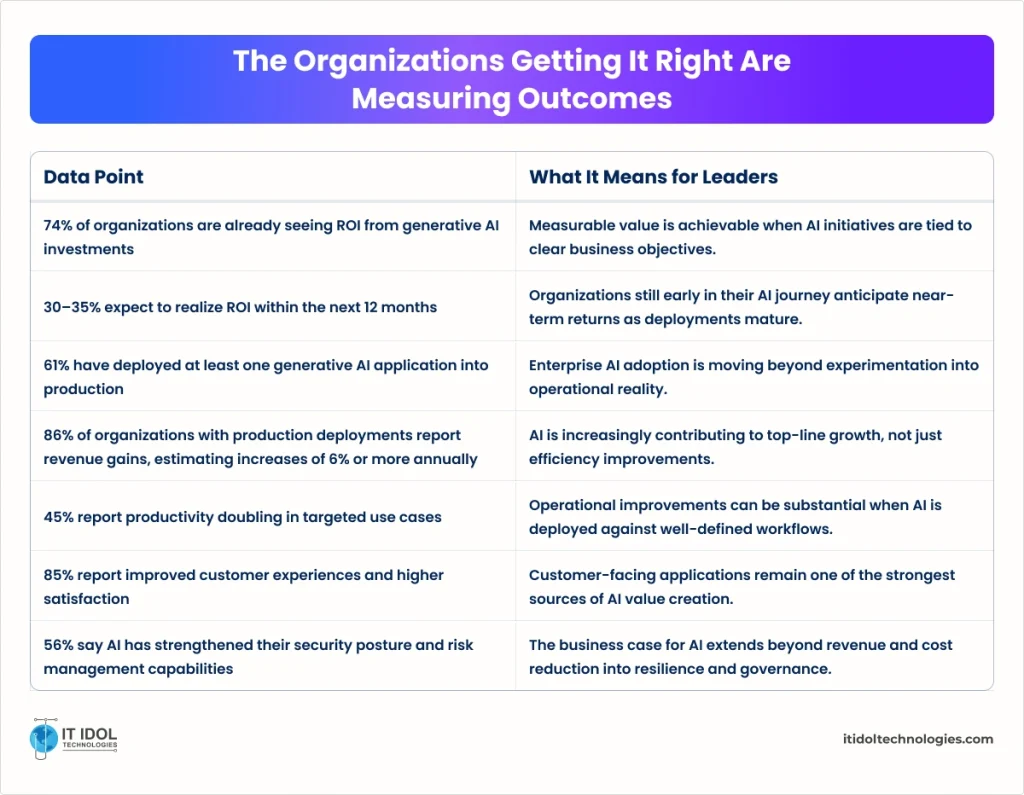
The Organizations Getting It Right Are Measuring Outcomes
While many enterprises struggle to connect AI investments to financial impact, the broader picture is more encouraging than the headlines suggest. Organizations that define success upfront and align AI initiatives with business objectives are already demonstrating measurable value.
Recent Google Cloud research highlights an important distinction: AI does generate returns, but those returns are concentrated among organizations that move beyond technical metrics and focus on business outcomes.
These findings reinforce an important point: the gap is not between organizations that use AI and those that do not. The gap is between organizations that measure outcomes and those that measure activity.
The leaders pulling ahead are not simply deploying more models or consuming more tokens. They establish financial baselines before implementation, define what success looks like in P&L terms, and continuously evaluate whether AI is improving revenue, margins, customer outcomes, or risk exposure.
In other words, the competitive advantage is not access to AI. It is the discipline to prove what AI is worth.
Token Spend is Not a Business Metric
One of the most revealing symptoms of this measurement gap is what technology teams are actually tracking when they track AI spend.
Most enterprises today can tell you how many API calls their AI systems made last month. They can show you token consumption charts, model usage rates, and inference volumes. What very few can tell you is what business outcome was produced by any specific dollar of that spend and whether that outcome was worth the cost.
This is the token spend trap. Token consumption has grown 13x since January 2025, far outpacing budget planning cycles. The pricing per unit has actually fallen; blended AI costs dropped 67% year over year, from $18.40 to $6.07 per million tokens between Q1 2025 and Q1 2026. But total spend is rising explosively because volume is outrunning every forecast model built on traditional software economics.
And the problem compounds with agentic AI. Agentic AI multiplies token consumption geometrically, and autonomous agents consume tokens in the background, making forecasting with traditional methods nearly impossible. A single agentic workflow that would have required ten API calls in a chatbot context can now trigger hundreds of model interactions autonomously, all logged as infrastructure cost, none automatically tied to a revenue outcome.
The Uber case made headlines for exactly this reason: the company gave 5,000 engineers access to an AI coding tool in December 2025 and burned through its entire annual AI budget by April 2026. That is not a story about AI failing. It is a story about measurement and governance failing.
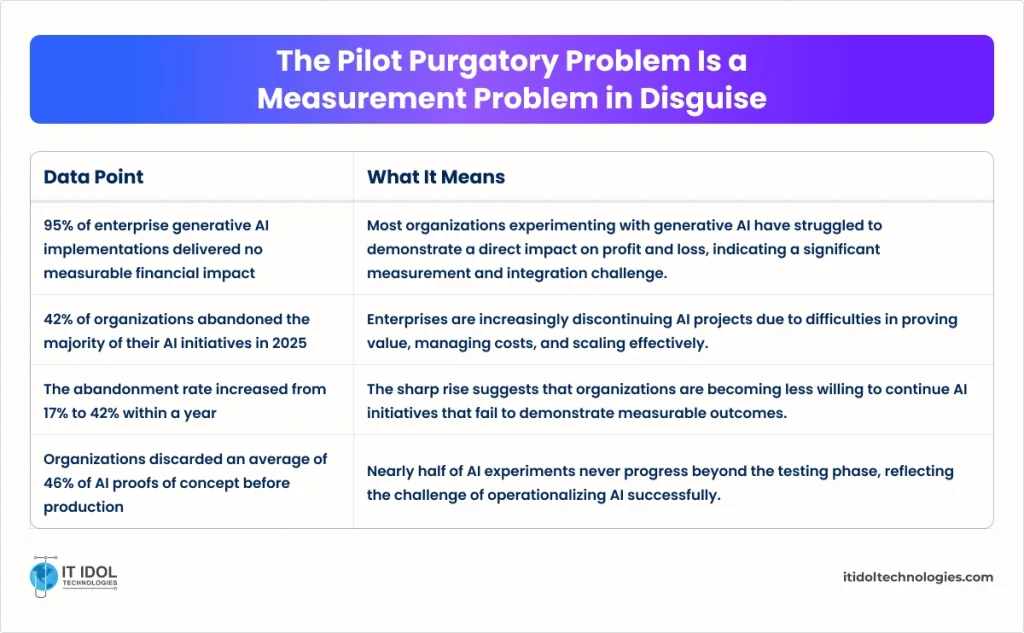
The Pilot Purgatory Problem is a Measurement Problem in Disguise
Key Insight
The evidence from verified sources points to a consistent theme: the biggest barrier to AI success is not necessarily the technology itself, but the inability to establish clear business value and measurable financial outcomes early in the initiative lifecycle. Organizations that fail to define success metrics upfront are more likely to abandon projects before realizing meaningful returns.
So what does it mean to actually measure AI’s P&L impact, rather than its operational proxies?
It starts with a reframe at the design stage. Before any AI initiative goes to build, the sponsoring team needs to answer three financial questions: What specific cost line or revenue driver will this AI touch? By how much, measurably, and within what timeframe? And what is the cost-per-outcome, not per token, per session, or per model run, but per unit of business value created?
That last metric is the one most enterprises are missing. There is no universally accepted method today for attributing AI token spend to business outcomes. This is partly a tooling gap and partly a governance gap. The tooling will improve; a new standards body under the Linux Foundation is formally launching in July 2026 specifically to create open standards and metrics for AI token usage and billing, similar to what FinOps did for cloud spend. But waiting for industry standards is not a leadership strategy.
Organizations taking measurement seriously right now are doing several things differently. They are building cost-per-workflow tracking that ties model consumption to process steps, not just to API invoices. They are setting model routing policies that match model capabilities to task complexity: large frontier models cost 17-25x more per token than small, efficient models, and not every enterprise task requires the most powerful model. They are defining business outcomes, not operational metrics, as the acceptance criteria for production deployment.
AI leaders target core business areas for AI, where 62% of the value is generated, and focus on a few high-impact opportunities rather than scattered pilots. That focus is not conservatism. It is the only way to accumulate enough outcome data actually, to measure whether AI is generating returns.
The FinOps Lesson and Why AI Is Compressing the Timeline
There is a useful historical parallel here. Cloud cost governance followed a predictable arc: organizations spent several years accumulating cloud waste, treating infrastructure spend as an engineering concern rather than a financial one. Then FinOps emerged as a discipline, and the organizations that built cloud financial accountability early ended up with structural cost advantages that compounded over time.
AI economics are compressing that cycle. The cost concentration is higher, the spending rate is faster, and board visibility is already there. Organizations that were responsible for managing AI spend jumped from 31% in 2024 to 63% in 2025, and to 98% by 2026, with AI cost management now the single most sought-after skill set for technology finance teams.
The FinOps Foundation’s 2026 State of FinOps report found that 73% of enterprises reported their AI costs exceeded original projections despite per-unit costs falling. The math failure is the same at every layer: organizations built budget models on seat-based or subscription-based logic, and that logic broke the moment consumption became variable, agentic, and architecturally nonlinear.
CIOs and CTOs who wait for this problem to stabilize before addressing it will find themselves several budget cycles behind peers who built financial accountability into their AI operating model from the start.
Measurement as Leadership, Not Just Finance
It would be a mistake to frame AI measurement purely as a finance function. The organizations getting AI right treat measurement as a strategic and cultural discipline, one that shapes how technology teams set priorities, how engineering leaders communicate with the board, and how AI investments compound over time.
Only 39% of organizations report any EBIT impact from AI deployments despite 88% reporting AI use in at least one business function. That 49-point gap between deployment and financial impact is not a gap in ambition. It is a gap in measurement discipline, and it is the defining condition of enterprise AI right now.
Technology leaders who can close that gap, who can walk into a board conversation with a credible, auditable line from AI spend to margin impact, will not just justify their AI budgets. They will earn the institutional authority to expand them.
The question boards are beginning to ask is not, Are you using AI? The question is: Do you know what it is worth?
The leaders who can answer that question with specificity, not anecdotes, are the ones who will define what AI leadership means over the next five years.
Key Takeaways for CIOs and CTOs
Token spend is not a business metric. Build cost-per-outcome tracking that ties AI consumption to specific revenue or cost drivers, not just API invoices.
Define financial acceptance criteria before pilots begin. If you can’t articulate the P&L case before deployment, you have no measurement baseline when the pilot ends.
Match model to task. Frontier models cost 17–25x more than efficient smaller models per token. Routing policies are governance, not optimization.
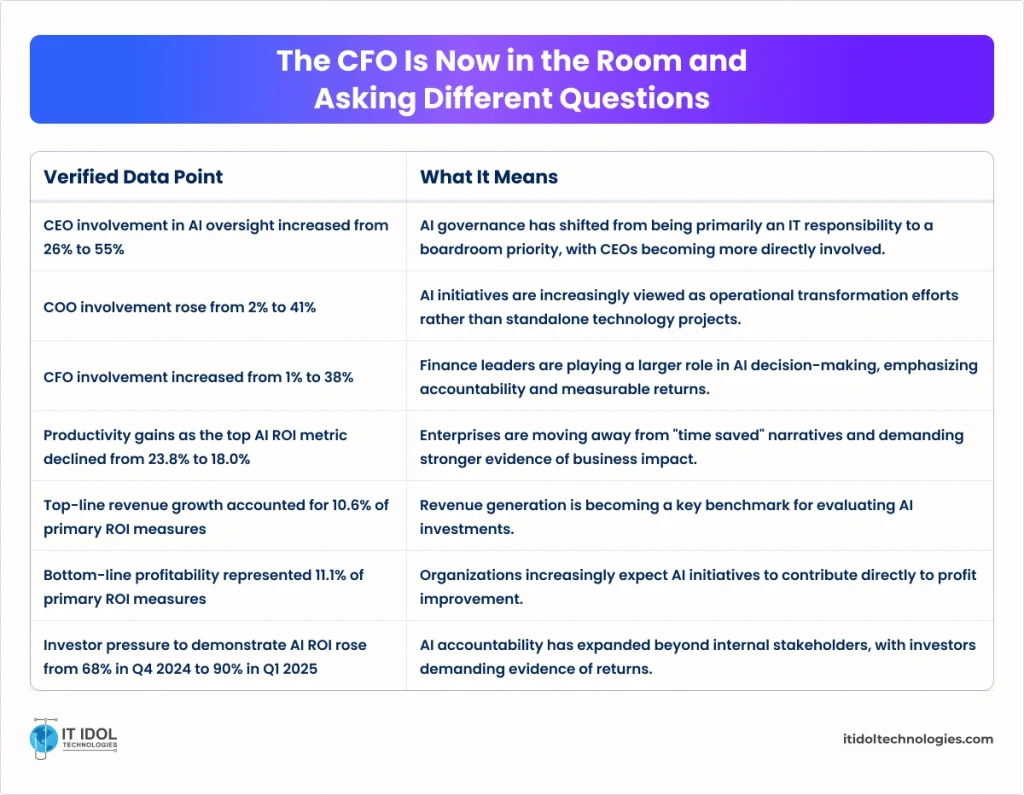
Productivity gains are no longer sufficient justification. CFOs and boards are demanding top-line and bottom-line attribution, not efficiency narratives.
Build AI financial accountability now, not after. The FinOps lesson is that organizations that build governance early earn compounding structural advantages over those who retrofit it.
FAQ’s
1. Why is measuring AI by token spend no longer enough?
Token spend shows how much an organization is consuming AI services, but it does not reveal whether those investments generate business value. Executive teams increasingly evaluate AI through outcomes such as revenue growth, cost reduction, productivity improvements, risk mitigation, and customer impact. Without linking AI initiatives to financial performance, organizations struggle to justify continued investment.
2. What is the difference between AI usage metrics and AI business impact metrics?
Usage metrics track operational activity, including token consumption, prompts processed, active users, or model calls. Business impact metrics measure outcomes such as reduced operating costs, faster cycle times, improved conversion rates, increased revenue, lower churn, or enhanced employee productivity. Effective AI leadership connects both layers to demonstrate how usage translates into enterprise value.
3. How can organizations connect AI investments to P&L outcomes?
Companies can map each AI initiative to a specific business objective and assign measurable KPIs before deployment. These may include labor hours saved, incremental revenue generated, reduced error rates, improved customer retention, or lower processing costs. Tracking these indicators against baseline performance enables leaders to quantify AI’s contribution to the profit and loss statement.
4. Which KPIs should executives use to measure AI success?
The most meaningful AI KPIs vary by use case but commonly include:
Revenue uplift attributable to AI-enabled initiatives
Cost savings from process automation
Productivity gains per employee or team
Customer satisfaction and retention improvements
Time-to-market reductions
Risk and compliance incident reduction
Return on AI investment (ROAI)
Payback period for AI deployments
These indicators provide a clearer picture of business impact than technical metrics alone.
5. What is Return on AI Investment (ROAI), and how is it calculated?
ROAI measures the financial return generated by AI initiatives relative to their total costs. A common formula is:
ROAI = (Financial Benefits − Total AI Costs) ÷ Total AI Costs × 100
Costs should include technology spending, infrastructure, model usage fees, implementation expenses, governance investments, and employee training. The resulting percentage helps organizations compare AI initiatives and prioritize future investments.
6. Why do many AI pilots fail to scale across the enterprise?
A common reason is the absence of predefined success criteria tied to business outcomes. Many pilots demonstrate technical feasibility but lack ownership, governance, change management, or measurable value targets. Without evidence of financial impact, executive sponsorship often weakens, preventing broader deployment.
7. How often should organizations review AI performance metrics?
AI initiatives should be monitored continuously at the operational level and reviewed formally at least quarterly by business and executive stakeholders. Regular reviews help organizations identify underperforming use cases, validate assumptions, optimize investments, and ensure alignment with changing strategic priorities.
8. What role does the CFO play in measuring AI value?
The CFO increasingly acts as a steward of AI accountability by validating assumptions, defining financial measurement frameworks, and ensuring AI investments align with capital allocation priorities. Their involvement helps organizations shift the conversation from experimentation to demonstrable business outcomes and sustainable value creation.
9. How can enterprises avoid overstating AI ROI?
Organizations should establish baseline metrics before implementation, isolate AI’s contribution from other business variables where possible, document assumptions transparently, and track realized outcomes over time rather than relying solely on projected benefits. Independent validation and cross-functional oversight further improve credibility.
10. What does mature AI measurement look like in practice?
Mature organizations move through three stages:
1. Activity Measurement: Tracking usage, adoption, and token consumption.
2. Operational Measurement: Monitoring productivity, quality, and process efficiency improvements.
3.Financial Measurement: Linking AI initiatives directly to P&L outcomes, strategic objectives, and enterprise-wide value creation.
Reaching the third stage enables leaders to make informed investment decisions and build lasting confidence in AI programs.
Parth Inamdar is a Content Writer at IT IDOL Technologies, specializing in AI, ML, data engineering, and digital product development. With 5+ years in tech content, he turns complex systems into clear, actionable insights. At IT IDOL, he also contributes to content strategy—aligning narratives with business goals and emerging trends. Off the clock, he enjoys exploring prompt engineering and systems design.