The confusion between these two categories is not a branding problem. It is a strategy problem, and it is quietly draining automation budgets across industries.
Ask ten enterprise technology leaders to define the difference between workflow automation and AI automation, and you will get ten answers that all sound roughly correct and are all slightly wrong.
Not because these leaders lack intelligence, they clearly don’t, but because the market has spent years deliberately blurring this line. Most organizations are now paying the price of that confusion in the form of automation programs that promise transformation and deliver marginal efficiency gains.
Enterprises are making investment decisions, building business cases, and setting board-level expectations based on a category distinction they have never clearly defined internally. They fund workflow automation projects and expect AI-level adaptability. They invest in AI automation and expect the reliability of a rule-based process.
When neither delivers what was expected, the blame lands on the execution of the implementation partner, the platform vendor, or the team. Rarely does it land where it actually belongs: on the upstream failure to distinguish between two fundamentally different types of automation that solve fundamentally different types of problems.
The Distinction That Most Organizations Never Actually Make
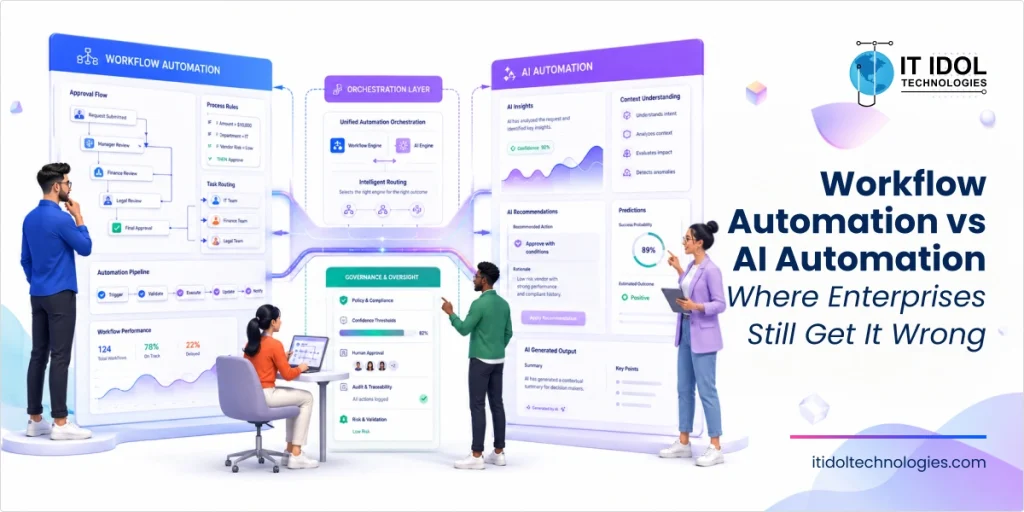
At the architectural level, workflow automation and AI automation are not variations of the same tool. They are built on different assumptions about the world, handle different types of inputs, and fail in different ways when misapplied.
Workflow automation is deterministic. It moves information and tasks through a predefined sequence of steps based on rules and conditions established in advance. If an invoice arrives and matches a vendor in the approved list, route it to accounts payable. If a support ticket is tagged “priority high,” escalate to a senior agent within 15 minutes. If a new employee record is created in HR, trigger onboarding tasks across IT, facilities, and payroll. These are logic-driven, sequenced, and critical; they assume inputs are clean, conditions are predictable, and outcomes are already known.
AI automation is probabilistic. It does not follow a decision tree. It interprets context, handles ambiguous inputs, infers meaning from unstructured data, and generates outputs that are contingent on what is encountered at runtime. When a customer sends a free-form complaint email spanning three products, two invoices, and an emotional tone that suggests churn risk, workflow automation cannot handle that end-to-end. A language model that reads the email, extracts intent, surfaces relevant account history, drafts a personalized response, and flags it for senior review can.
These are not complementary tools competing for the same use case. They are architecturally different systems designed for categorically different problem types.
Side-by-Side: The Core Architectural Difference
Dimension
Workflow Automation
AI Automation
Logic type
Deterministic — rule-based, if/then/else
Probabilistic — context-inferred, judgment-based
Input requirement
Structured, clean, predictable
Unstructured, variable, ambiguous
Output behavior
Predefined, consistent, repeatable
Generated, context-dependent, variable
Failure mode
Breaks on edge cases outside the rule set
Hallucinates, degrades on low-confidence inputs
Auditability
Full — every decision is traceable to a rule
Partial — reasoning can be opaque or non-reproducible
Best suited for
Data routing, approvals, system updates
Language interpretation, classification, content generation
Governance complexity
Moderate — process ownership, SLA monitoring
High — explainability, bias controls, confidence thresholds
McKinsey’s research on generative AI identifies it as a tool for automating decision-making and communication tasks, not routine data handling, fundamentally modifying how automation is designed rather than replacing existing workflow infrastructure. That distinction is load-bearing. Decision-making and communication involve ambiguity by definition. Workflow automation was never built for ambiguity, and no amount of vendor marketing changes that underlying reality.
The strategic error most enterprises commit is treating these as a spectrum rather than as separate design disciplines. They add AI capabilities on top of existing workflow infrastructure and expect the combination to behave intelligently. What they actually get is a workflow that sometimes generates text and occasionally stalls when the AI component returns an output that the workflow logic did not anticipate.
Why the Market Made This Confusion Worse
The vendor landscape deserves a significant share of responsibility for the category confusion enterprises are navigating. Starting around 2023 and accelerating through 2025, nearly every established workflow automation vendor rebranded with AI positioning, adding language model integrations, calling existing chatbot functionality “agents,” and presenting updated conditional routing systems as intelligent automation platforms.
Gartner’s research identified this pattern explicitly, warning that many vendors are engaging in “agent washing,” the rebranding of existing products such as AI assistants, RPA tools, and chatbots without substantial agentic capabilities. Gartner estimates that only approximately 130 of the thousands of vendors claiming agentic AI capabilities represent genuinely agentic systems.
That is a remarkable signal. Organizations evaluating the automation market face a landscape where the overwhelming majority of vendors claiming AI-native capabilities are, in practice, offering enhanced workflow tooling with an AI wrapper.
How “Agent Washing” Manifests in Practice
A rules-based escalation bot is rebranded as an “AI agent” after adding a GPT-generated response layer
Existing RPA scripts are packaged as “intelligent automation” without any model-based decision logic underneath
Vendor demos run in sandbox environments with pre-cleaned inputs, masking the brittleness that appears in production
Feature lists include AI capabilities that require third-party model integrations to function, not native intelligence
Platform documentation conflates “workflow with AI steps” with “AI-native architecture,” leaving buyers to discover the difference post-deployment
The downstream effect is predictable. Procurement teams evaluate platforms on feature lists rather than architectural foundations. Those capabilities encounter entirely different conditions in production environments, where data is inconsistent, edge cases are routine, and workflow logic that looked airtight in the demo reveals its brittleness within weeks.
Gartner noted directly that “many use cases positioned as agentic today don’t require agentic implementations.” Not every workflow that would benefit from optimization requires AI. Applying AI to a problem that workflow automation solves more reliably and cheaply does not make the solution smarter; it makes it more expensive and more fragile.
Where Enterprises Are Getting the Application Wrong
The most consistent misapplication pattern in enterprise automation programs involves applying AI to processes that have not yet been optimized as workflows. This sequencing error is more common than it should be, given how clearly its consequences manifest.
When a process is poorly defined with inconsistent inputs, unclear ownership boundaries, redundant approval steps, and no documented exception-handling logic, adding AI automation does not solve those problems. It inherits them.
An AI agent operating on a chaotic process will generate chaotic outputs at greater speed and scale than the manual process it replaced. The chaos is now automated. The failures arrive faster. The exception queue grows faster. And there is now an AI system in the loop that no one fully understands, making decisions that are difficult to audit and impossible to reverse cleanly.
Process-to-Tool Matching: Getting the Application Right
Process Characteristic
Right Tool
Wrong Tool
Why It Matters
Structured inputs, defined rules
Workflow Automation
AI Automation
AI adds cost and opacity to a problem that rules already solve
Unstructured language, variable context
AI Automation
Workflow Automation
Rules cannot encode meaning; AI can
Compliance-critical, audit-required
Workflow Automation
AI Automation (alone)
Determinism is required for regulatory traceability
High-volume, repeatable transactions
Workflow Automation
AI Automation
AI inference costs at high volume become prohibitive
Exception-heavy, judgment-dependent
AI Automation
Workflow Automation
Rule trees cannot anticipate every exception; models can reason through novel ones
Customer communication, content triage
AI Automation
Workflow Automation
Language interpretation requires probabilistic inference
ERP data updates, system integrations
Workflow Automation
AI Automation
These require precision and consistency, not contextual interpretation
Contract review, proposal analysis
AI Automation
Workflow Automation
Meaning extraction from unstructured documents is AI’s domain
A Forrester analysis noted that generative AI is expected to orchestrate less than one percent of core business processes in the near term, with rules and RPA remaining the primary orchestrators of mission-critical workflows.
This is not a technology limitation; it is an accurate reflection of where AI automation is appropriate at this stage. Core business processes, such as invoice processing, compliance reporting, ERP data management, and HR record updates, operate on defined rules, require auditability, and carry regulatory consequences for errors.
These are exactly the conditions under which workflow automation’s determinism is a feature, not a limitation.
The Governance Gap No One Wants to Acknowledge
There is an uncomfortable organizational truth embedded in most failed automation programs: governance architecture is treated as an implementation concern rather than a design input. By the time governance questions surface, who owns this process, what happens when the automation fails, how do we audit the AI’s decisions, what triggers human review, the architecture is already locked.
As AI takes on higher-stakes workflow ownership, governance, explainability, and compliant design become non-negotiable. Regulators, customers, and auditors will want provenance on why an agent acted, what data it used, and how humans can override it. That requirement does not soften as AI automation scales. It intensifies.
Governance Requirements: Workflow Automation vs AI Automation
Governance Dimension
Workflow Automation
AI Automation
Process ownership
Assigned to a team or role
Requires both process owner and model owner
Audit trail
The rule execution log is the audit trail
Requires separate decision lineage documentation
Failure detection
Rule misfires are visible immediately
AI degradation can accumulate silently over time
Change management
Update the rule; redeploy
Update the model, prompt, and validation logic
Human escalation
Triggered by defined exception conditions
Triggered by confidence thresholds — must be designed in
Model version + prompt version + output threshold version
McKinsey’s research identified workflow redesign as the single biggest driver of EBIT impact from generative AI deployments, and workflow redesign necessarily includes designing the governance model before deployment rather than after.
Organizations that define the human-AI boundary, document when AI outputs are advisory versus binding, and build confidence thresholds into automated decision logic from the start consistently achieve better production outcomes than those that build governance as an afterthought.
The Measurement Problem That Perpetuates the Confusion
One reason enterprises continue to misapply workflow and AI automation is that they measure outcomes in ways that obscure the distinction. Both are evaluated on the same efficiency metrics: time saved, cost reduced, error rate decreased, and headcount redeployed. These metrics capture whether the automation is doing something faster than a human did. They do not capture whether the automation is doing the right thing, handling the right problem type, or generating outcomes that are genuinely accurate and trustworthy.
Metrics That Actually Reveal Performance
For Workflow Automation, measure:
Rule coverage rate: what percentage of real-world inputs the rule set handles without exception
Exception rate trend, whether edge cases are growing over time (a signal that the process is evolving beyond the rules set)
SLA adherence, whether process steps are completed within defined time windows
Change frequency: how often rules need updating (high frequency signals process instability)
For AI Automation, measure:
Output accuracy rate verified against a ground-truth sample, not self-reported
Confidence calibration: whether the model’s stated confidence correlates with actual accuracy
Human intervention rate: how often AI output is overridden or escalated
Hallucination or error rate: how often generated content is factually incorrect or contextually inappropriate
Downstream quality impact on whether processes consuming AI outputs are generating more or fewer downstream exceptions
Companies adopting AI automation report a 40% productivity boost and 20–30% cost savings on average, but these aggregate figures obscure significant variance driven by application fit.
The organizations generating those results applied AI automation to genuinely ambiguous, judgment-heavy processes and workflow automation to structured, rule-defined ones. The ones generating weak results applied the wrong tool and measured the wrong output to evaluate whether it worked.
The Hybrid Architecture That Actually Works
The practical answer to the workflow automation vs AI automation debate is rarely a choice between them. It is a design discipline for combining them appropriately. The organizations generating durable automation returns in 2026 have largely arrived at the same architectural pattern: deterministic workflow automation governing process structure, routing, and compliance logic, with AI automation embedded at the specific points where unstructured data, context interpretation, or judgment-based output is required.
The Three-Layer Hybrid Model
Layer
Type
Responsibility
Technology
Process Layer
Workflow Automation
Document intake, routing, system updates, approval orchestration
Confidence thresholds, human escalation triggers, audit logging, output validation
Monitoring platforms, AI TRiSM controls
In practical terms, this looks like: a workflow automation layer that handles document intake, routing, system updates, and approval orchestration with full determinism and auditability; an AI layer that reads the document content, extracts intent, classifies the request, and generates the initial response or recommendation; and a governance layer that defines confidence thresholds, exception routing, human review triggers, and audit logging for every AI-generated output before it influences a downstream workflow step.
Gartner has described the underlying technology driving this evolution as “generative workflow” systems that dynamically create and orchestrate workflows with runtime context awareness. That evolution does not make the deterministic workflow layer obsolete. It makes it more important because the governance structure that keeps AI outputs trustworthy at enterprise scale requires the reliability and auditability that only rule-based workflow logic can provide.
When to Use Each Layer: A Practical Decision Guide
Use workflow automation when the process inputs are structured, the outcomes are defined, the rules can be written, and auditability is required
Use AI automation when the inputs are unstructured, meaning they must be extracted, variability is high, or judgment is involved
Use both in sequence when a process begins with unstructured input (AI interprets) and ends with structured output (workflow executes)
Add governance controls at every point where AI output feeds into an automated downstream action. Never let AI output flow directly into consequential system updates without a validation gate
What Getting This Right Actually Requires
The organizations that have closed the gap between automation investment and automation return share a set of behaviors that are organizational before they are technical.
The behaviors that distinguish high-performing automation programs:
They have established a clear internal taxonomy for automation types derived from their own process inventory, not from vendor marketing materials
They apply workflow automation as the operational default and justify AI automation only where unstructured data or contextual judgment is demonstrably present in the process
They design governance architecture before selecting platforms, ownership, escalation logic, audit requirements, and explainability standards are defined, and before a vendor is engaged
They measure automation outcomes against business quality metrics, accuracy, exception rate, downstream process quality, not only throughput and cost
They treat the hybrid architecture as a strategic design decision, not as a vendor bundle, ensuring that each layer is selected for architectural fit rather than brand familiarity
McKinsey’s 2025 State of AI survey found that 88% of organizations regularly use AI in at least one business function, but only about one-third have started scaling AI across the enterprise. That gap reflects not a shortage of technology but a shortage of the organizational discipline required to deploy it correctly. Scaling requires clarity about where each automation type belongs, and most enterprises are still operating without that clarity.
Gartner recommends that agentic AI only be pursued where it delivers clear value or ROI, and advises organizations to use AI agents when decisions are needed, automation for routine workflows, and assistants for simple retrieval.
That framework is simple in principle and routinely ignored in practice because vendor sales cycles, pressure to demonstrate AI adoption, and organizational incentives to announce transformation programs all push in the direction of applying AI where workflow automation would have served better and served cheaper.
The enterprises that will generate the strongest automation returns over the next three years are not the ones that deployed the most AI. They are the ones who built the organizational discipline to deploy it correctly, understanding what workflow automation solves, what AI automation solves, where each type belongs in their specific process landscape, and how to govern both in production in ways that produce trustworthy, auditable, business-quality outcomes.
That discipline is not a technology purchase. It is a strategic decision. And it needs to be made before the purchase, not after.
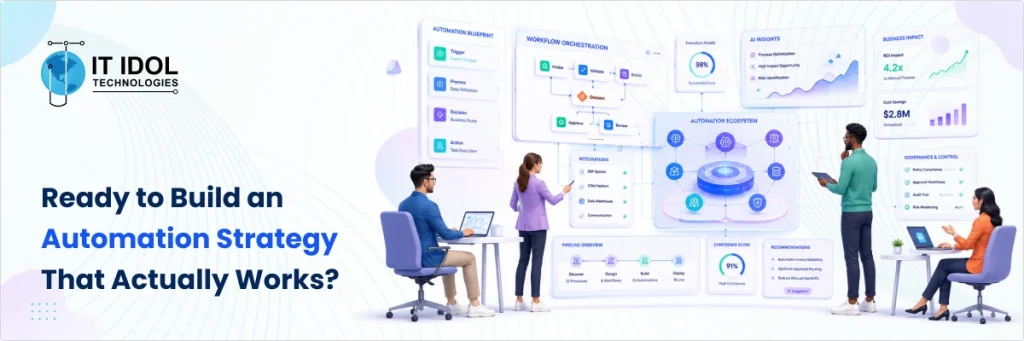
Ready to Build an Automation Strategy That Actually Works?
Most enterprise automation programs stall not because of technology limitations, but because of strategic misalignment between the tools deployed and the problems they were selected to solve. The distinction between workflow automation and AI automation is not a theoretical nuance; it is the decision that determines whether an automation investment delivers measurable business value or becomes another line in the “lessons learned” document.
IT IDOL Technologies works with enterprises to design, implement, and govern automation architectures built on this distinction, not on vendor defaults. Whether your organization is evaluating its first automation investment, restructuring a program that underperformed, or looking to scale AI-augmented workflows across departments, IT IDOL’s advisory and delivery practice begins with the process clarity and governance design that most automation engagements skip.
If your automation program is delivering throughput metrics but not business outcomes or if your teams are struggling to articulate where AI automation ends and workflow automation begins, that is precisely the conversation worth having.
Connect with IT IDOL Technologies to assess your current automation landscape and identify where the strategic gaps are before they become operational costs.
Workflow automation follows predefined rules and structured processes, while AI automation uses machine learning, natural language processing, or predictive intelligence to make decisions, adapt to data, and handle complex or unstructured tasks.
Many organizations label any automated process as “AI” for marketing or innovation positioning. In reality, traditional workflow automation and AI-driven automation solve very different operational problems.
Workflow automation works best for repetitive, rule-based tasks such as approvals, notifications, data transfers, and standardized business processes where outcomes are predictable.
AI automation is commonly used in intelligent chatbots, predictive analytics, fraud detection, document processing, recommendation engines, demand forecasting, and AI-powered customer support systems.
Yes. Many modern enterprises combine both approaches. Workflow automation manages process orchestration, while AI handles intelligent decision-making, classification, prediction, or language understanding within the workflow.
Common mistakes include using AI where simple automation is sufficient, ignoring data quality issues, lacking governance frameworks, overestimating AI capabilities, and deploying AI without clear business objectives.
In most cases, AI automation requires higher investment due to model training, data infrastructure, monitoring, and integration complexity. Workflow automation is generally faster and more cost-effective for structured tasks.
Businesses should evaluate task complexity, data structure, decision variability, scalability requirements, and operational goals. If the process depends on fixed rules, workflow automation may be enough. If it requires learning, prediction, or contextual understanding, AI automation may be more appropriate.
Deval Rathod
Founder & CEO
|
Deval Rathod is the Founder and CEO of IT IDOL Technologies, a custom software development company. With over a decade of experience in software engineering, solution architecture, and technology leadership, she has worked across custom software development, enterprise applications, AI & ML, and digital transformation. Her expertise includes guiding technology teams, designing scalable software solutions, and helping businesses evaluate and implement emerging technologies. She contributes insights on software engineering, artificial intelligence, enterprise technology, and digital transformation.