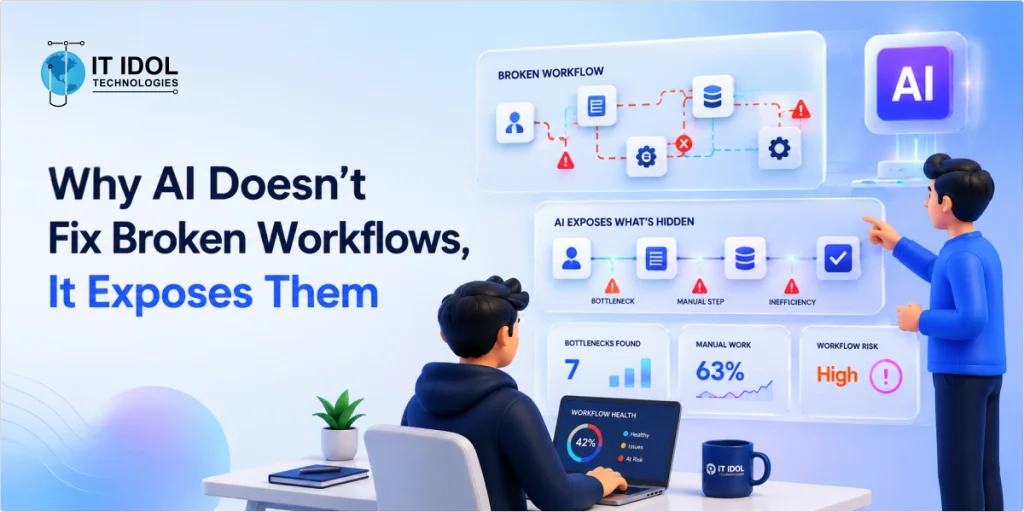
The most consistent pattern across enterprise AI adoption is not transformation, it’s amplification. AI systems do not inherently improve how work gets done; they accelerate whatever already exists. When workflows are well-structured, AI compounds efficiency.
When they are fragmented, ambiguous, or misaligned, AI surfaces those flaws faster and at scale. This is why many AI initiatives stall, not because the technology underperforms, but because it reveals operational weaknesses that were previously tolerable when humans compensated manually.
For decision-makers, the implication is direct: AI is not a shortcut to operational excellence. It is a forcing function that demands it.
Why Does AI Amplify Workflow Quality Instead of Improving It?
AI operates as an execution layer, not a judgment layer. It can complete tasks, generate outputs, and orchestrate sequences, but it depends entirely on the structure, clarity, and logic of the workflow it is embedded in.
In traditional environments, human operators bridge workflow gaps through intuition, context-switching, and informal coordination. A product manager clarifies vague requirements. An engineer compensates for missing documentation. A sales rep navigates inconsistent CRM data. These “invisible fixes” keep systems functional despite structural flaws.
AI removes that buffer. It requires explicit inputs, defined steps, and predictable logic. When those are missing, the system doesn’t adapt, and it produces inconsistent, low-quality, or unusable outputs. In practice, organizations often interpret this as “AI underperformance.” In reality, the AI is faithfully executing a flawed process.
What Types of Workflow Failures Does AI Expose Most Aggressively?
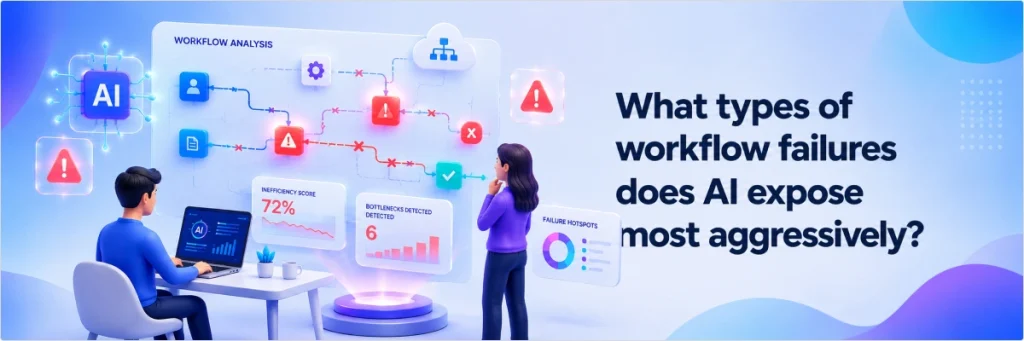
Not all workflow issues surface equally. AI tends to expose four specific categories of failure with high visibility:
Ambiguity in task definition: If a workflow lacks clear inputs, outputs, or success criteria, AI systems produce variable results. For example, “generate a product spec” without a defined structure leads to inconsistent outputs across iterations.
Fragmented tool ecosystems: AI struggles when workflows span disconnected systems with no unified data layer. If critical context lives across emails, documents, and internal tools, AI cannot reliably access or reconcile it.
Hidden dependencies: Many workflows rely on implicit knowledge of who approves what, when decisions happen, or how exceptions are handled. AI cannot infer these unless explicitly modeled.
Inconsistent data quality: AI systems amplify data issues. Duplicate records, outdated information, or missing fields lead to flawed outputs at scale.
A common enterprise scenario illustrates this: introducing AI into a sales pipeline. Instead of improving conversion rates, the AI surfaces inconsistent lead qualification criteria, incomplete CRM data, and unclear handoff processes between marketing and sales.
Why Do AI Implementations Fail Even When The Technology Works?
Most AI failures are not technical; they are operational. The system performs as designed, but the surrounding workflow cannot support it.
There are three recurring failure patterns:
Misaligned expectations: Organizations expect AI to “fix” inefficiencies without redesigning the underlying process. This leads to disappointment when outputs remain inconsistent.
Premature automation: Teams automate workflows that are not yet stable or standardized. Automating a broken process simply accelerates its failure.
Lack of ownership:AI initiatives often sit between functions, product, engineering, and operations without clear accountability for outcomes. This creates gaps in decision-making and iteration.
Consider a content production workflow where AI is introduced to accelerate output. If there is no clear editorial standard, no defined review process, and no ownership of quality, the result is higher volume but lower consistency.
The issue is not the AI, it’s the absence of a coherent system around it. AI fails in environments where workflows are unclear, unstable, or unowned, not where the technology is insufficient.
What Does an “AI-ready” Workflow Actually Look Like?
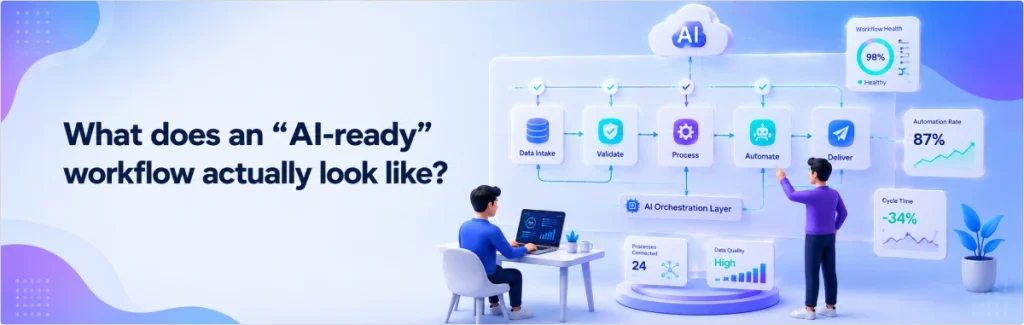
An AI-ready workflow is not defined by tooling; it is defined by structure. It has four characteristics that make it compatible with AI execution:
Explicit inputs and outputs: Every step in the workflow has clearly defined entry and exit criteria. There is no reliance on implicit understanding.
Deterministic logic where possible: While not all work can be fully deterministic, the core flow should be predictable and repeatable. Exceptions are handled through defined pathways, not ad hoc decisions.
Centralized context: Data, documentation, and decision history are accessible in a unified system. AI can only operate on what it can access.
Clear ownership and accountability: Each stage of the workflow has a responsible owner who defines quality standards and resolves edge cases.
In practice, this often requires simplifying workflows before augmenting them. Many organizations discover that their processes have accumulated unnecessary complexity over time, multiple approval layers, redundant steps, or legacy dependencies. AI works best when workflows are not just digitized, but deliberately designed.
How Should Organizations Approach Workflow Redesign Before AI Adoption?
The most effective approach is not to start with AI; it is to start with workflow clarity. This requires a shift from “what can we automate?” to “what actually needs to happen?”
A practical framework for this is “Deconstruct → Stabilize → Augment”:
Deconstruct: Break down the workflow into its fundamental steps. Identify inputs, outputs, dependencies, and decision points. This often reveals unnecessary complexity and hidden assumptions.
Stabilize: Standardize the workflow. Define clear rules, templates, and ownership. Remove variability where it is not valuable.
Augment: Introduce AI only after the workflow is stable. Use it to accelerate well-defined steps, not to compensate for ambiguity.
For example, in a product development cycle, this might involve standardizing how requirements are written, how design decisions are documented, and how handoffs occur between teams before introducing AI to generate or validate outputs.
Organizations that skip the stabilization phase often end up in a cycle of continuous rework, where AI outputs require as much manual correction as the original process.
What Are The Hidden Costs of Ignoring Workflow Quality in AI Adoption?
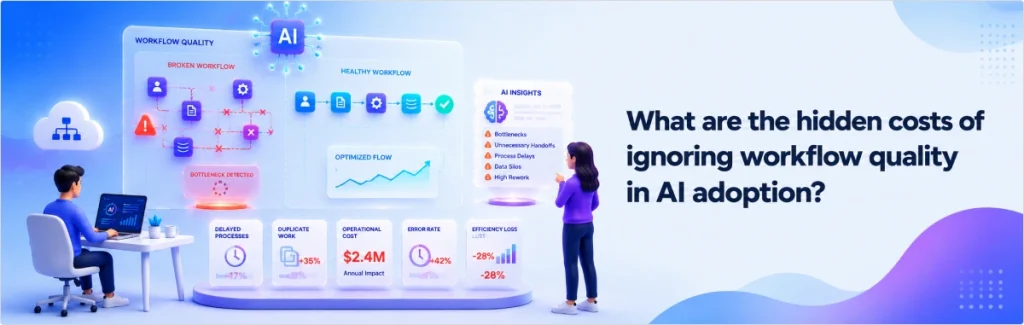
The cost of poor workflows in an AI-enabled environment is not just inefficiency; it is systemic risk.
Compounding errors: AI systems can generate large volumes of output quickly. If the underlying logic is flawed, errors scale proportionally.
Erosion of trust: Inconsistent outputs reduce confidence in AI systems, leading to underutilization or abandonment.
Operational bottlenecks: Instead of eliminating friction, AI can shift it downstream. For example, faster content generation may overwhelm review processes.
Increased coordination overhead: Teams spend more time validating, correcting, and aligning outputs, offsetting any efficiency gains.
One of the most underestimated risks is false confidence. AI-generated outputs often appear coherent, even when they are based on incomplete or incorrect inputs. Without strong workflow controls, this can lead to flawed decisions being executed at scale.
How Should Leaders Measure Whether AI is Improving Workflows?
Traditional productivity metrics speed, volume, and cost. They are insufficient on their own. AI changes the nature of work, so measurement must evolve accordingly.
Three metrics are more indicative of real impact:
Output reliability: How consistent and accurate are the results across iterations? Variability is often a sign of workflow ambiguity.
Intervention rate: How often do humans need to correct or override AI outputs? High intervention indicates unresolved workflow issues.
End-to-end cycle integrity: Does the workflow complete successfully without bottlenecks or breakdowns? AI may optimize individual steps while degrading overall flow.
For example, in a customer support workflow, faster response generation is only valuable if resolution rates improve and escalation rates decrease. Otherwise, the system is optimizing the wrong layer. Leaders should also track time-to-decision, not just time-to-output. AI often accelerates output generation, but if decision-making remains slow or unclear, overall performance does not improve.
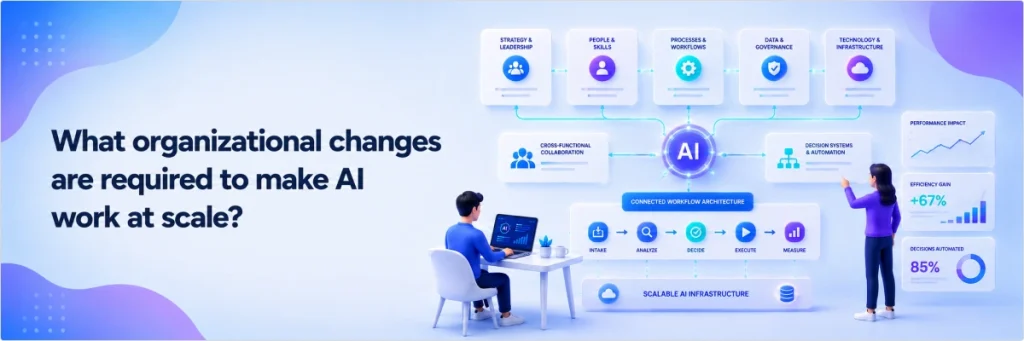
What Organizational Changes are Required to Make AI Work at Scale?
AI adoption is less about deploying models and more about redesigning how work is coordinated. This requires changes at three levels:
Process design: Teams need to think in terms of systems, not tasks. Workflows must be intentionally designed, documented, and continuously improved.
Role definition: As AI takes on execution, human roles shift toward validation, oversight, and exception handling. This requires new skills and accountability structures.
Decision governance: Clear rules must define when AI outputs can be trusted, when human intervention is required, and how edge cases are handled.
A common mistake is treating AI as a tool owned by a single function (e.g., engineering or IT). In reality, it is a cross-functional capability that reshapes how multiple teams interact. Organizations that succeed tend to establish workflow ownership as a formal responsibility, not an implicit one. This ensures that processes evolve in tandem with AI capabilities.
Conclusion
The narrative that AI will “fix” inefficient workflows is not just misleading; it is strategically dangerous. AI is a mirror, not a solution. It reflects the true state of how work gets done, without the distortions introduced by human adaptability.
Organizations that treat AI as a shortcut to efficiency often encounter friction, inconsistency, and stalled initiatives. Those who treat it as a catalyst for operational clarity unlock disproportionate value.
The difference lies in discipline. Clear workflows, defined ownership, structured data, and intentional design are what make AI effective. Without them, even the most advanced systems will underperform. In practice, the question is not whether AI can improve your workflows. It is whether your workflows are ready to be improved.
The organizations that win will not be those that adopt AI the fastest, but those that use it to build systems that actually work.
AI systems are designed to execute and optimize tasks within existing structures, not redesign them. If a workflow has unclear ownership, redundant steps, or poor data flow, AI simply accelerates those inefficiencies rather than resolving them.
By increasing speed and automation, AI removes the buffer that previously masked delays and errors. Bottlenecks, decision gaps, and dependency issues become more visible because work moves faster than the underlying process can support.
Frequent rework, inconsistent outputs, excessive human intervention, unclear approvals, and fragmented data sources are typical indicators. If AI outputs require constant correction, the issue usually lies in the workflow, not the model.
Only marginally. AI can optimize isolated tasks, but without structural changes such as redefining processes, roles, and data flows, any gains are short-lived and often introduce new inefficiencies at scale.
They need to standardize processes, ensure data quality, clarify ownership, and eliminate redundant steps. A well-defined workflow provides the foundation for AI to deliver consistent and scalable outcomes.
Organizations with mature, well-structured workflows see significantly higher returns because AI can operate predictably and at scale. In contrast, immature workflows lead to inconsistent results, limiting the value of AI investments.
AI should be treated as a forcing function for operational clarity. Instead of expecting AI to fix problems, leaders should use it to identify and redesign broken workflows turning inefficiencies into opportunities for transformation.
Deval Rathod
Founder & CEO
|
Deval Rathod is the Founder and CEO of IT IDOL Technologies, a custom software development company. With over a decade of experience in software engineering, solution architecture, and technology leadership, she has worked across custom software development, enterprise applications, AI & ML, and digital transformation. Her expertise includes guiding technology teams, designing scalable software solutions, and helping businesses evaluate and implement emerging technologies. She contributes insights on software engineering, artificial intelligence, enterprise technology, and digital transformation.