Most organizations today are not short of learning platforms. They are short of learning that actually works.
At a glance, everything appears to be in place. Courses are created, users are enrolled, dashboards reflect steady progress, and completion rates give the impression that learning is happening at scale. But when you step away from the reports and look at what’s happening in real work environments, a different picture emerges. People complete training but struggle to apply it. Knowledge doesn’t translate into capability. Learning exists as an activity, not as an outcome.
The Hidden Gap Between Learning Activity and Real Capability
This gap is not caused by poor intent or lack of investment. It is the result of how most Learning Management Systems have been designed.
For years, LMS platforms have followed a structured model. Content is created, organized into modules, assigned to learners, and tracked through completion metrics. This model made sense when learning was formal, scheduled, and separate from everyday work. But the way people learn has changed significantly, and the systems supporting them have not evolved at the same pace.
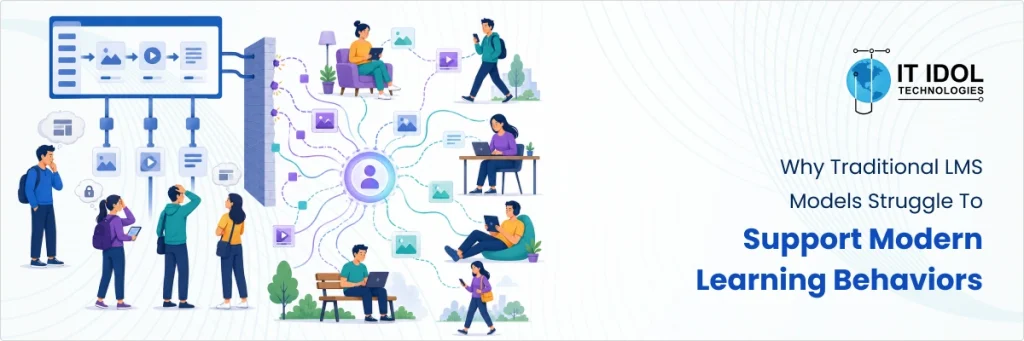
Today, learning is no longer confined to structured sessions. It happens in fragments, often in response to immediate needs. It takes place across devices, within workflows, and in moments where information is required to make decisions. Learners do not follow linear paths anymore. They move between topics, revisit concepts, skip what they already know, and engage only when the content feels relevant to their context.
This shift creates a fundamental mismatch. The system expects order and progression. The learner operates with flexibility and intent. When these two do not align, engagement begins to decline, not because people are unwilling to learn, but because the experience does not fit how they learn.
This is a reality that has been consistently observed across industries. Harvard Business Review has pointed out that learning is most effective when it is embedded within the flow of work, rather than separated from it.
Why Traditional LMS Models Struggle to Support Modern Learning Behaviours
That insight alone challenges the foundation of most traditional LMS platforms. If learning needs to happen alongside work, then systems designed as standalone environments will always feel disconnected. They become destinations that learners visit occasionally, instead of systems that support them continuously.
The challenge becomes more visible as organizations grow. In the early stages, a standard LMS often works well enough. It provides structure, enables quick deployment, and covers essential requirements. But as learning needs expand across roles, departments, and functions, the limitations begin to surface.
The system can deliver content, but it cannot adapt to varied learning behaviours. It can track activity, but it cannot capture meaningful progress. It can support scale in terms of users, but not in terms of outcomes.
At this stage, many organizations try to extend the system rather than rethink it. Additional tools are introduced to improve engagement, analytics, or content delivery. Integrations are added to connect different platforms.
Over time, the LMS becomes part of a larger ecosystem of tools. While this approach solves immediate problems, it also introduces a new kind of complexity. Data becomes fragmented across systems. The user experience becomes inconsistent. Managing the platform requires increasing effort, and the overall system becomes harder to evolve.
This is not a failure of technology. It is a reflection of how the system has been structured.
There is a broader shift happening in the learning landscape that explains why these challenges are becoming more common. Organizations are moving away from viewing learning as a one-time activity and toward seeing it as an ongoing process. Skills are evolving faster than traditional training cycles can keep up with. The expectation is no longer to deliver courses, but to build capabilities continuously.
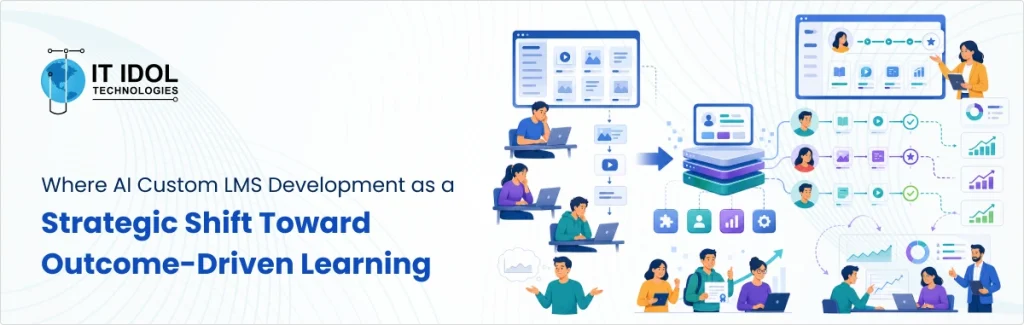
This shift is reshaping how learning systems are being designed. The focus is moving from content delivery to learning experience, from completion metrics to capability development, and from static structures to adaptive systems. Platforms are expected to respond to user behaviour, provide relevant content in context, and generate insights that reflect real-world performance.
Custom LMS Software Development as a Strategic Shift Toward Outcome-Driven Learning
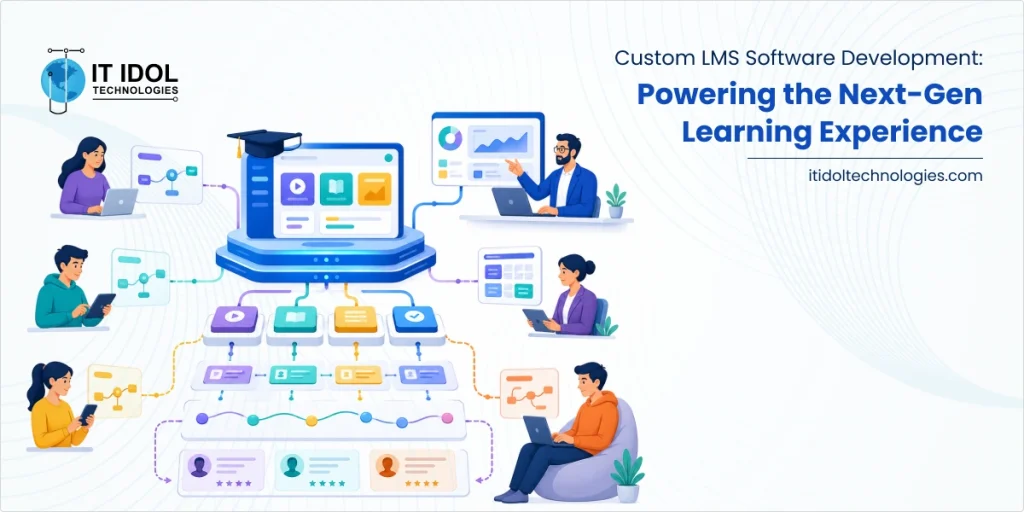
This is where custom LMS software development begins to play a meaningful role. The decision to build a custom LMS is often misunderstood as a preference for control or flexibility. In reality, it is about alignment. It is about designing a system that reflects how learning happens within a specific organization, rather than forcing that organization to adapt to a predefined structure.
Instead of starting with features, custom development starts with questions. How do learners interact with content in real scenarios? Where does learning take place inside a platform, within tools, or during tasks? What kind of feedback is needed to improve outcomes? How should progress be measured in a way that reflects actual capability?
Answering these questions changes how the system is designed.
A well-structured custom LMS does not operate as a separate destination. It becomes part of the workflow. Learning appears when it is needed, not when it is scheduled. Content is organized in a way that supports discovery and application, not just completion. Data is captured in a way that reflects behaviour, not just activity.
This approach requires a different way of thinking about systems. It is not about adding more functionality, but about designing better interactions between different parts of the system. It is about ensuring that learning, work, and performance are connected.
In practice, this means creating systems where learning paths are not fixed but adaptable. Content can be updated without disrupting the entire structure. Feedback loops are built into the experience, allowing continuous improvement. Insights are generated not just from what users do, but from how they engage and where they struggle.
This level of alignment is difficult to achieve with standard platforms because they are designed to serve a broad set of use cases. Custom systems, on the other hand, are designed for specific contexts. They reflect the unique ways in which an organization operates, learns, and evolves.
This is also where the role of technology becomes more strategic. Advances in areas such as artificial intelligence and data analytics are enabling systems to become more responsive and adaptive. But these capabilities only create value when they are integrated into a well-designed architecture. Without that, they remain isolated features that do not significantly improve the learning experience.
The challenge, however, is that not all custom LMS projects deliver the expected results. In many cases, organizations replicate existing structures instead of rethinking them. They build new systems that look and behave like the old ones, just with more control. This approach increases cost without addressing the underlying issues.
The real value of custom development lies in reimagining the system itself. It requires moving away from assumptions that have shaped traditional LMS platforms and designing solutions that align with current learning behaviours.
This is not always an easy shift. It requires a clear understanding of how learning operates within the organization and a willingness to challenge existing models. But for organizations that reach a certain level of complexity, it becomes necessary.
There is usually a point where the existing system starts to feel limiting. Learning needs become more dynamic, but the platform remains static. Updates take longer, integrations become harder to manage, and the gap between learning activity and business outcomes becomes more apparent. At this stage, continuing with incremental improvements often leads to diminishing returns.
This is where a more fundamental change is required.
Organizations that have successfully navigated this shift tend to approach learning systems as part of a broader digital ecosystem. They do not treat the LMS as an isolated tool, but as a component that interacts with other systems, processes, and workflows.
This is the approach followed by teams like IT IDOL Technologies, where LMS development is not seen as a standalone project but as part of a larger system design effort. Their work across education technology, product engineering, and AI-driven solutions reflects this perspective, focusing on building platforms that are adaptable, scalable, and aligned with real-world use cases.
Exploring their work in areas such as education platforms, AI integration, and product development provides a broader view of how modern LMS systems are evolving into integrated learning ecosystems.
This interconnected approach is becoming increasingly important as learning systems continue to evolve. The boundaries between learning, working, and performing are becoming less distinct. Systems need to support this convergence rather than operate separately.
Looking ahead, the direction is clear. Learning platforms will continue to evolve into systems that are more adaptive, more integrated, and more aligned with user behaviour. The emphasis will shift further toward enabling learning in context, providing real-time insights, and supporting continuous development.
The organizations that benefit the most from this shift will not be the ones that adopt the most features. They will be the ones who design systems that reflect how their people actually learn and work.
In the end, the effectiveness of a learning system is not determined by how much content it can deliver or how many users it can support. It is determined by how well it can help people learn, apply knowledge, and improve performance over time.
That is the difference between a platform that exists and a system that works.
For organizations that are beginning to see this gap, the next step is not just to evaluate new tools, but to rethink how learning should be structured and supported. That is where the conversation shifts from choosing a platform to designing a system, and where partners like IT IDOL Technologies help bridge that gap by building learning environments that are aligned with both technology and real-world outcomes.
FAQ’s
1. What is custom LMS software development?
Custom LMS development involves building a tailored learning management system designed to meet specific business, training, or educational needs.
2. How is a custom LMS different from off-the-shelf platforms?
A custom LMS offers full control over features, UI/UX, integrations, and data, unlike pre-built platforms that come with fixed capabilities and limitations.
3. When should a business invest in a custom LMS?
Organizations should consider a custom LMS when they require unique workflows, advanced analytics, branded experiences, or integration with internal systems.
4. What are the key benefits of a custom LMS?
Benefits include scalability, personalized learning paths, enhanced data ownership, seamless integrations, and better alignment with business goals.
5. How long does it take to develop a custom LMS?
Development timelines vary based on complexity but typically range from a few months for basic systems to over a year for enterprise-grade platforms.
6. What technologies are used in custom LMS development?
Common technologies include modern frontend frameworks, cloud-based backends, AI-driven recommendation engines, and APIs for third-party integrations.
7. Is a custom LMS more expensive than a SaaS LMS?
Initial costs are higher, but a custom LMS can offer better long-term ROI by eliminating recurring licensing fees and providing greater flexibility.
Parth Inamdar is a Content Writer at IT IDOL Technologies, specializing in AI, ML, data engineering, and digital product development. With 5+ years in tech content, he turns complex systems into clear, actionable insights. At IT IDOL, he also contributes to content strategy—aligning narratives with business goals and emerging trends. Off the clock, he enjoys exploring prompt engineering and systems design.