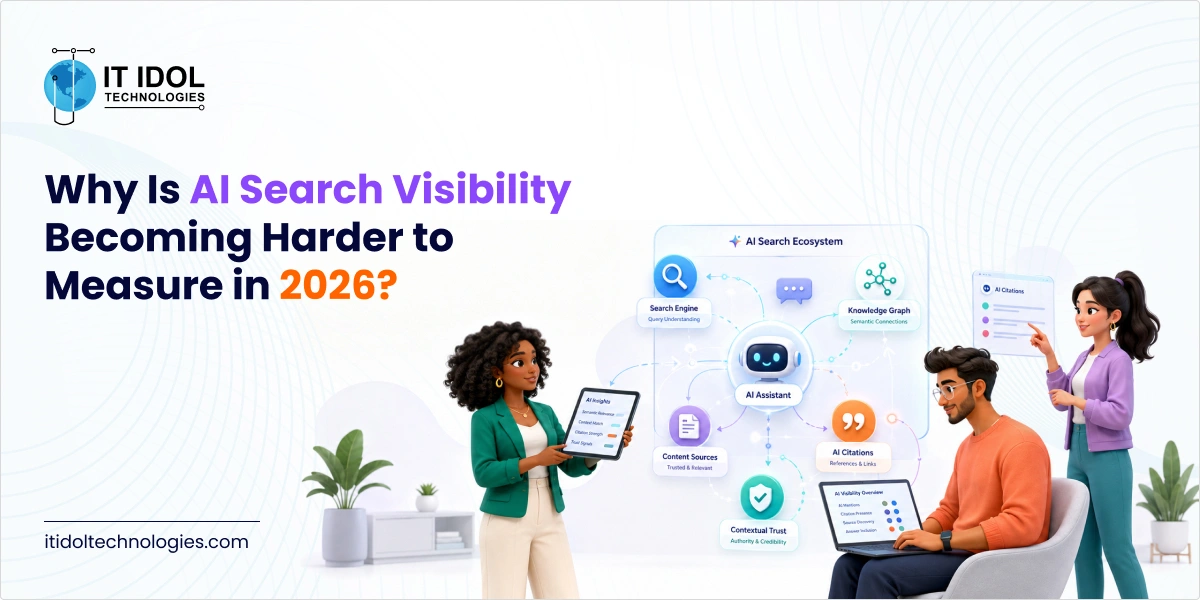
AI usage is growing fast, but measurable traffic impact isn’t keeping up.
Traditional analytics fail to capture AI-driven interactions happening outside websites.
User journeys are shifting from linear search paths to fragmented, AI-assisted discovery.
Traffic volume may drop, but intent and conversion quality often improve.
Attribution models are losing accuracy as AI influence remains largely invisible.
Scaling content with AI doesn’t guarantee visibility without depth and differentiation.
Indirect signals, such as branded search and direct traffic, are becoming more important.
The challenge is that structural analytics systems aren’t built for AI-era behaviour.
Teams are moving from traffic-focused metrics to outcome-driven measurement.
Impact now includes influence and presence, not just clicks and visits.
Over the past year, AI adoption across marketing, content, and product teams has accelerated faster than most organizations can properly measure. Teams are generating more content, answering more queries, automating workflows, and integrating AI into customer touchpoints. On the surface, activity is up across the board.
But when you look at traffic, organic search, referrals, conversions, the impact is often unclear.
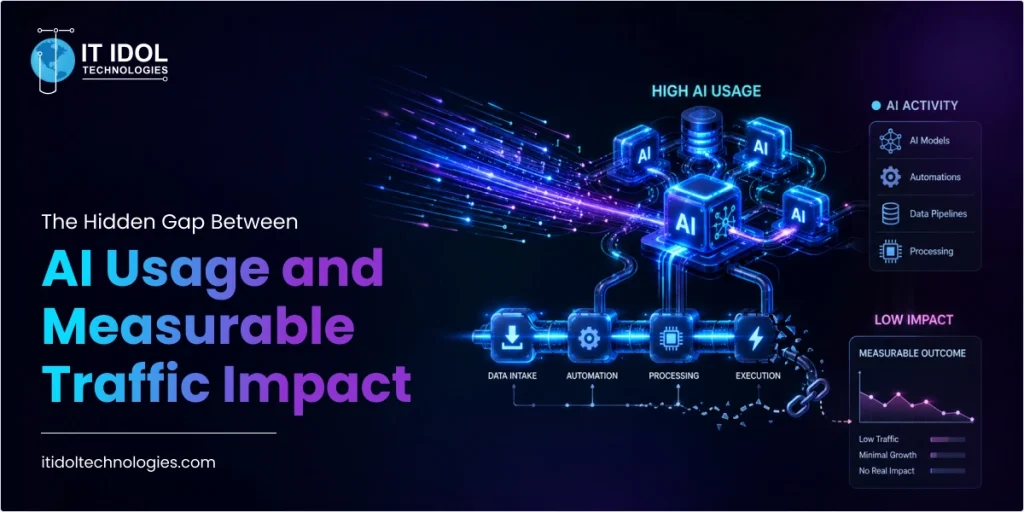
This is the gap most teams don’t anticipate. AI usage increases rapidly, but a measurable traffic impact doesn’t follow at the same pace. In some cases, it doesn’t move at all. In others, it becomes harder to attribute.
The issue isn’t that AI doesn’t work. It’s that the systems used to measure impact were never designed for how AI-driven interactions actually behave.
Where the Expectation Breaks
The expectation is straightforward. More content, faster production, and broader coverage should lead to more traffic. That assumption comes from how traditional SEO and content strategies have worked for years.
In practice, AI changes the shape of the funnel.
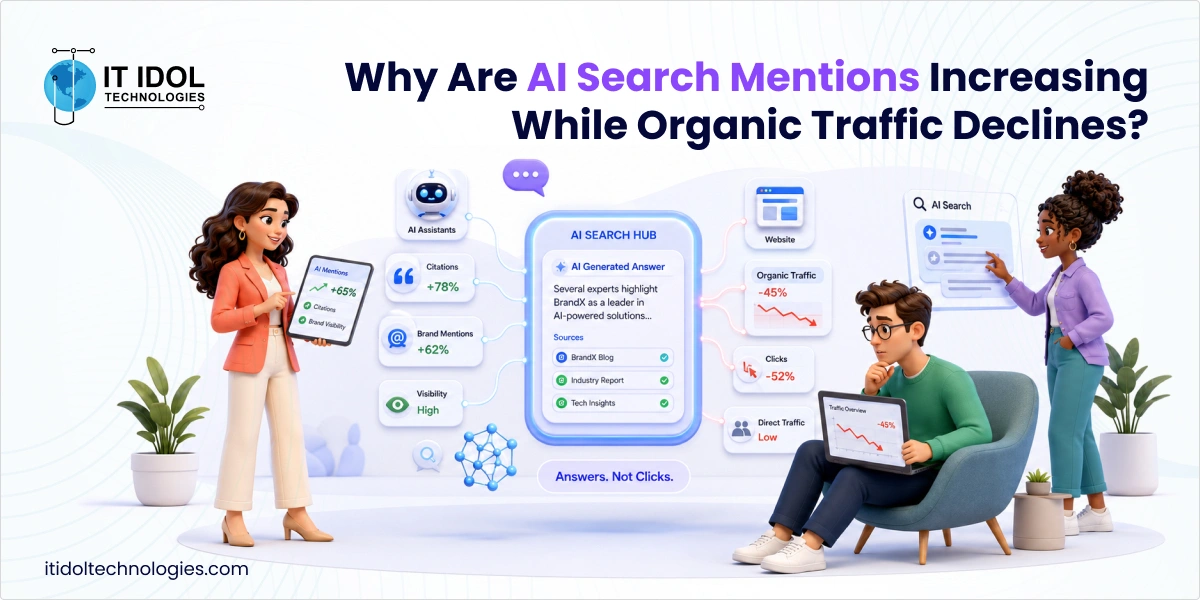
Instead of users discovering content through search and navigating to websites, many interactions now happen within AI interfaces. Answers are generated directly. Queries are resolved without a click. Even when AI is used as a research layer before visiting a site, that interaction is rarely visible in analytics.
This creates a disconnect. Teams see increased usage of AI-generated content and tools, but traffic metrics don’t reflect the same growth. It’s not because the impact isn’t there, it’s because it’s happening outside the boundaries of what traditional analytics capture.
What Actually Happens to User Behaviour
When AI enters the discovery layer, user behaviour shifts in subtle but important ways.
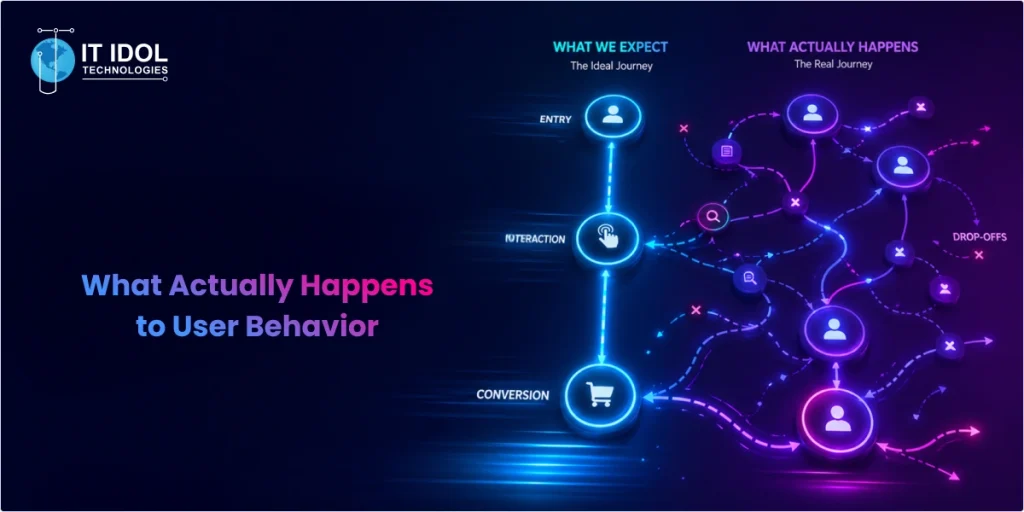
Users no longer follow linear paths from search result to website to conversion. Instead, they move through fragmented journeys. They might start with an AI assistant, refine their query multiple times, and only visit a website when they are already close to a decision.
This reduces the number of top-of-funnel visits while increasing the intent of the traffic that does arrive. From a metrics perspective, this can look like stagnation or even decline in traffic, even though the quality of engagement is improving.
Another shift is the reduction of exploratory clicks. AI systems summarize information, compare options, and provide direct answers. Users don’t need to open multiple tabs to gather context. As a result, fewer impressions convert into visits.
This is where many reporting frameworks fall short. They are optimized to measure volume, not influence.
Why Traditional Attribution Stops Working
Attribution models depend on visible touchpoints. They assume that interactions happen within trackable environments, such as search engines, websites, ads, and known referral sources.
AI introduces interactions that are largely invisible.
If a user reads a summary generated by an AI system that references your content, that interaction may influence their decision. But unless they click through directly, there is no attribution signal. The impact exists, but it is not recorded.
Even when traffic does arrive, attribution can be misleading. A user might discover a brand through an AI-generated response, then later search for it directly. In analytics, this shows up as direct or branded search traffic, not as the source of influence.
This creates a reporting gap. Teams see traffic, but they don’t see the path that led to it.
The Illusion of Increased Output
One of the most common responses to AI adoption is scaling content production. With AI tools, teams can generate significantly more content in less time. The assumption is that more content increases visibility.
In reality, increased output doesn’t guarantee increased traffic.
Search ecosystems are already saturated. Adding more content without differentiation often leads to diminishing returns. AI-generated content, especially when not deeply structured or strategically positioned, tends to compete in the same space as existing material.
There’s also a quality perception layer. Search systems and users alike are becoming more sensitive to content that lacks depth or originality. This doesn’t mean AI-generated content is ineffective, but it does mean that volume alone is not a reliable growth strategy.
Teams often realize this only after publishing at scale and seeing little to no impact on traffic metrics.
Where the Measurement Gap Widens
The gap between AI usage and measurable impact becomes more pronounced in certain scenarios.
In informational queries, where users are looking for quick answers, AI systems often satisfy the need without requiring a visit. This reduces click-through rates even when content is being surfaced.
In product discovery, AI can compress the research phase. Users arrive on websites later in the decision process, which reduces overall traffic but increases conversion likelihood. Traditional metrics interpret this as reduced visibility, even though efficiency has improved.
In B2B contexts, the gap is even harder to track. Decision-making cycles are longer, involve multiple stakeholders, and span multiple channels. AI-driven interactions influence these journeys in ways that are difficult to quantify.
What makes this challenging is that the impact is real, but it’s distributed across touchpoints that are not easily connected.
What Teams Start Noticing in Practice
As systems mature, certain patterns begin to emerge.
Teams notice that traffic growth slows down despite increased activity. At the same time, engagement metrics such as time on site or conversion rates may improve. This creates conflicting signals.
There is also a growing reliance on indirect indicators. Branded search volume, direct traffic, and repeat visits start to carry more weight. These signals suggest that awareness and interest are increasing, even if they can’t be tied directly to specific AI-driven interactions.
Another observation is that content performance becomes more uneven. A smaller subset of content drives meaningful impact, while a larger volume generates little to no traffic. This reflects a shift from broad coverage to selective influence.
These patterns are often confusing at first because they don’t align with traditional growth models.
Why This Is an Architectural Problem, Not Just a Marketing One
The gap between AI usage and measurable traffic impact is not just a measurement issue. It’s also a system design problem.
Most analytics systems are built around pageviews, sessions, and clicks. They are not designed to capture influence that occurs outside of direct interactions. At the same time, AI systems are not designed to provide detailed attribution. They prioritise user experience over traceability. This creates a structural mismatch.
Bridging this gap requires rethinking how systems are connected. It involves integrating signals from multiple sources, redefining what constitutes meaningful engagement, and accepting that not all influence can be directly measured.
This is not a simple adjustment. It requires changes at both the tooling and strategy levels.
How Teams Adapt to the New Reality
In practice, teams start shifting their focus from volume-based metrics to outcome-based metrics.
Instead of asking how much traffic content generates, they look at how it contributes to conversions, retention, and user engagement. This requires combining data from multiple sources and looking at longer time horizons.
Content strategies also evolve. Instead of maximizing output, teams focus on creating assets that are more likely to be referenced, summarized, or surfaced by AI systems. This often means investing in depth, clarity, and structured information.
There is also a growing emphasis on brand presence. When direct attribution is limited, being recognizable becomes more important. Users who encounter a brand multiple times across different contexts are more likely to engage when they do visit.
From a systems perspective, observability becomes more complex. Teams need to track not just what happens on their platforms, but also how their content is being used or referenced externally.
This is not always fully possible, but partial visibility can still provide valuable insights.
The Trade-Off Between Visibility and Attribution
AI introduces a trade-off that many teams are still adjusting to.
On one hand, content can reach users in more places than before. On the other hand, those interactions are harder to track.
This means visibility may increase while measurable traffic does not. The challenge is accepting that not all value can be captured through traditional metrics.
Teams that rely solely on trackable data risk underestimating the impact of their efforts. At the same time, ignoring measurement altogether is not an option. The goal is to develop a more nuanced understanding of performance.
Rethinking What “Impact” Means
The definition of impact is shifting.
It is no longer limited to clicks and visits. It includes influence, recall, and presence across different layers of the user journey.
This doesn’t mean traffic is no longer important. It means it is no longer the only indicator of success.
Organizations that adapt to this shift are better positioned to evaluate their AI investments accurately. They recognize that some of the most valuable interactions happen before a user ever reaches their platform.
Turn AI Usage Into Measurable Business Outcomes
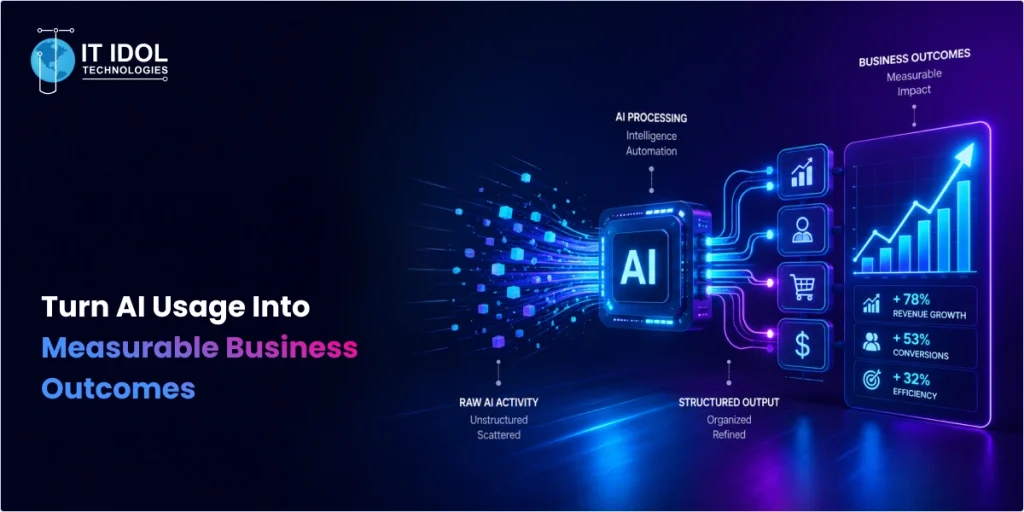
The gap between AI adoption and measurable traffic impact is not a sign that AI isn’t delivering value; it’s a sign that traditional systems aren’t capturing it effectively.
At IT IDOL Technologies, we help organizations bridge this gap by aligning AI-driven initiatives with measurable business outcomes. From building observability into AI workflows to redefining performance metrics and optimizing content strategies, the focus is on making impact visible and actionable.
If your AI efforts are increasing activity but not translating into clear growth signals, it’s time to rethink how your systems measure success.
Parth Inamdar is a Content Writer at IT IDOL Technologies, specializing in AI, ML, data engineering, and digital product development. With 5+ years in tech content, he turns complex systems into clear, actionable insights. At IT IDOL, he also contributes to content strategy—aligning narratives with business goals and emerging trends. Off the clock, he enjoys exploring prompt engineering and systems design.