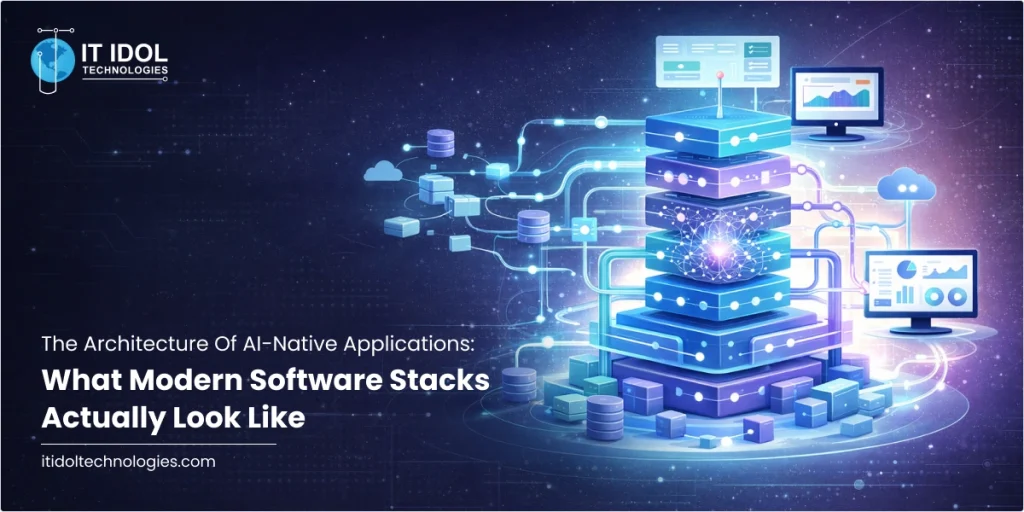
AI integration exposes architectural limitations. Traditional software stacks are designed for deterministic behavior, while AI systems produce probabilistic outputs, creating structural mismatches.
AI-native applications require new infrastructure layers. These include data pipelines, vector databases, model serving systems, orchestration frameworks, and evaluation mechanisms.
Data becomes the central operational layer. AI performance depends heavily on how data is collected, processed, embedded, and delivered during inference.
Model lifecycle management introduces new operational workflows. Training, versioning, evaluation, and monitoring models run parallel to traditional software deployment pipelines.
Inference workloads demand specialized infrastructure. Running large models introduces higher compute requirements, latency variability, and different scaling patterns.
Retrieval systems and vector databases enable contextual intelligence. They allow applications to provide relevant knowledge to models during runtime.
Observability shifts from system metrics to model behaviour. Monitoring hallucinations, response quality, and prompt performance becomes essential in production environments.
AI systems require continuous feedback loops. Real user interactions help refine prompts, retrain models, and improve system performance over time.
Operational risks include model drift, unpredictable outputs, and rising inference costs. Architects must include safeguards, evaluation pipelines, and optimization strategies.
AI-native architecture is shaping the next generation of software stacks. Organizations designing for these patterns early will scale AI capabilities more effectively.
If you spend time inside product and engineering teams today, you’ll hear a familiar story. A company decides to add AI to an existing product. The team connects an API to a large language model, writes a prompt, runs a few internal tests, and the results look promising. At first, it feels like just another feature integration.
Then the feature goes live.
Very quickly, the system begins to behave in ways the original architecture wasn’t designed for. Model responses vary between requests. The application suddenly depends on large amounts of contextual data. Inference introduces new infrastructure demands, and the team realizes they now need to monitor behaviour that isn’t strictly deterministic.
At that point, the existing stack starts to stretch in uncomfortable ways.
This is usually the moment teams recognize something fundamental: AI-powered capabilities are not simply another service you plug into a traditional application. Once AI becomes central to the product experience, the underlying architecture often needs to evolve as well. The growing realization of this mismatch is what’s driving the shift toward AI-native application stacks.
The Core Architectural Mismatch
Traditional application architectures were built around a predictable model of software behaviour. A request enters the system, passes through well-defined business logic, and produces a clear output. When the same input appears again, the system should return the same result. This predictability shaped how modern software platforms were designed, from relational databases to service-based architectures.
AI systems operate under a very different set of assumptions.
When an application relies on machine learning models or large language models, outputs become probabilistic rather than deterministic. The same request can produce slightly different responses depending on the prompt structure, the context supplied, the model version in use, or even subtle changes in input data. That variability alone introduces architectural complexity that traditional systems rarely encounter.
But the deeper issue lies in the capabilities AI systems require. These applications depend heavily on continuous data pipelines, structured model lifecycle management, prompt orchestration, evaluation mechanisms, and monitoring systems that focus on model behaviour rather than just application performance. In a typical SaaS platform, most complexity lives inside application logic. In AI-driven systems, much of that complexity moves into the data layer and the model layer.
This is why attaching AI services to an existing backend often feels awkward. The original architecture simply wasn’t built with these dependencies in mind.
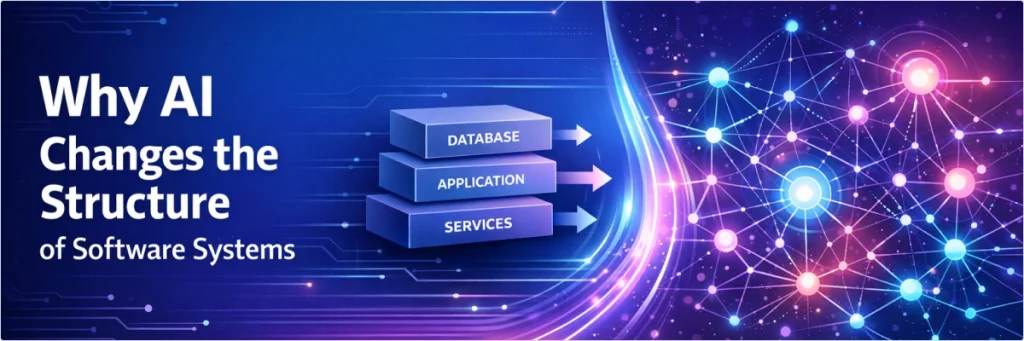
Why AI Changes the Structure of Software Systems
Once AI becomes a meaningful part of a product’s core functionality, the structure of the system begins to shift. The most noticeable change is the role data plays in the architecture. In traditional applications, data mainly supports transactions and operational workflows. It is stored, retrieved, and updated as part of routine application behaviour. AI systems treat data very differently. Data becomes the primary input that drives model performance.
As a result, organizations must build infrastructure capable of collecting, processing, and preparing large volumes of information for AI workloads. This includes pipelines for transforming raw data, systems for managing embeddings or feature stores, and mechanisms for feeding relevant context into real-time inference. Instead of simply storing information, the architecture must continuously prepare and deliver data in forms models can use effectively.
Another major shift involves model lifecycle management. Traditional software systems deploy code updates through development pipelines. AI-driven applications introduce a parallel lifecycle for models. Teams must train or fine-tune models, evaluate their performance, track model versions, and safely deploy improvements without disrupting the product experience.
Over time, models may degrade as data patterns change, which means teams also need mechanisms to detect and correct performance drift. These requirements introduce operational pipelines that rarely exist in traditional application stacks.
Inference infrastructure is another area where architecture begins to diverge. Running models, especially large language models, requires specialized infrastructure capable of handling heavier computational workloads. Inference requests can involve variable latency, higher compute demands, and different scaling behaviour compared to standard application services. Many organizations eventually separate inference workloads from their core application infrastructure, building dedicated systems to manage model execution efficiently.
Finally, AI-native systems often introduce feedback loops that traditional applications rarely include. These systems collect signals from real user interactions, corrections, usage patterns, evaluation metrics, and performance feedback, and feed that information back into training or prompt improvement pipelines. The system is not static; it evolves continuously based on how users interact with it.
What the Emerging AI-Native Stack Looks Like
Because of these architectural demands, a new layer of infrastructure is gradually forming around AI-native applications. While the exact stack varies between organizations, certain components are appearing consistently across modern AI systems.
One of the most visible additions is the rise of vector databases and retrieval systems. Large language models have limited context windows, which means they cannot store all relevant knowledge internally. To solve this, many applications use retrieval-based approaches that provide models with contextual information during inference.
This requires generating embeddings from data, storing them efficiently, and retrieving relevant pieces of information at runtime. Vector databases enable similarity search across large embedding datasets, making them a foundational component of many AI applications.
Another key component is the orchestration layer responsible for managing model interactions. As AI systems grow more sophisticated, simple single-prompt interactions are rarely sufficient. Applications often need to coordinate multiple model calls, combine outputs, execute reasoning steps, or integrate model responses with external tools and APIs. Orchestration layers help manage this complexity by assembling prompts, controlling context, and coordinating multi-step workflows across models and services.
Model serving infrastructure also becomes a central part of the architecture. Running models reliably in production requires systems that manage inference requests at scale. This layer handles responsibilities such as routing requests, managing model versions, distributing workloads across hardware resources, and optimizing latency. For organizations operating their own models, model serving often resembles a specialized platform built specifically to support machine learning workloads.
Another important capability involves evaluation frameworks. In deterministic software systems, automated tests verify whether a system behaves as expected. AI systems introduce a different challenge because outputs cannot always be validated with simple assertions.
Instead, organizations need structured evaluation processes to measure response quality, accuracy, hallucination rates, and task success. These evaluations must run continuously as prompts, models, and data evolve over time.
Observability also takes on a new dimension in AI-driven applications. Traditional observability focuses on metrics such as system latency, error rates, and infrastructure health. AI systems require an additional layer that monitors the behavior of the models themselves. Teams need to understand when outputs begin to degrade, when hallucinations increase, or when certain prompts start producing unreliable responses. Without this visibility, operating AI systems in production becomes extremely difficult.
Operational Realities of Running AI Systems
One of the biggest surprises organizations encounter when deploying AI features is the gap between prototypes and production systems. Early demonstrations often appear straightforward, but real-world deployments introduce operational challenges that traditional software rarely faces.
Model drift is one of the most common issues. Models trained on historical data may gradually lose accuracy as real-world conditions evolve. This is particularly common in recommendation systems, predictive models, and classification systems that depend on patterns in user behaviour or market conditions. Organizations must implement monitoring systems that detect when performance begins to decline and trigger retraining processes before the impact becomes significant.
Another challenge is the inherent unpredictability of model outputs. Even highly capable models occasionally produce incorrect or misleading responses. Because of this, production systems often include safeguards such as validation checks, prompt engineering strategies, fallback mechanisms, or human review processes. Instead of assuming perfect accuracy, the architecture must anticipate imperfect responses and handle them responsibly.
Monitoring model performance introduces additional complexity. Traditional application monitoring focuses on technical metrics like request latency or error rates. AI systems require deeper insights into the quality of model outputs across large volumes of interactions. Teams need tools that can identify anomalies, detect patterns in incorrect responses, and highlight prompts that consistently produce poor results.
Cost management also becomes a significant concern. Inference workloads often depend on GPU infrastructure or external AI APIs, and costs scale directly with usage. If architectures are not designed carefully, inference expenses can grow quickly as products scale. This forces teams to think carefully about optimization strategies such as caching responses, selecting smaller models for appropriate tasks, batching requests, or reducing unnecessary inference calls.
What This Means for Engineering and Product Teams
The rise of AI-native systems is reshaping how engineering and product teams build software. One noticeable shift is that system design becomes increasingly data-centric. Instead of focusing exclusively on service boundaries and API contracts, teams must think carefully about how data flows through the system and how that data interacts with models during inference.
Development workflows also begin to expand. Traditional pipelines revolve around building, testing, and deploying application code. AI-driven systems add additional layers involving data preparation, model training, evaluation pipelines, and prompt iteration. These workflows often require close collaboration between software engineers, ML engineers, and data scientists.
This change naturally affects team collaboration as well. AI-native development rarely fits neatly within traditional organizational boundaries. Product behaviour now depends on both application logic and model performance, which means product managers, engineers, and data scientists must work more closely together. Organizations that treat AI development as a separate silo often struggle to deliver reliable product experiences.
Product iteration cycles also tend to evolve. AI features frequently improve through experimentation. Teams test different prompts, model configurations, or contextual data strategies to determine what produces the best results. Instead of shipping large feature updates at long intervals, many teams adopt continuous refinement cycles where behaviour improves gradually through ongoing experimentation.
Strategic Considerations for Technology Leaders
For technology leaders, the conversation around AI is shifting from simple adoption to architectural strategy. The key question is no longer whether to use AI but how to design systems and organizations that can support it effectively.
In some cases, adapting an existing architecture may be sufficient. If AI plays a relatively small supporting role in the product, integrating external services into the current stack may work well. However, when AI becomes central to the user experience, powering search, recommendations, copilots, or generative capabilities, the architecture often needs deeper structural changes.
Leaders must also make decisions about infrastructure investment. Some organizations rely heavily on external AI platforms, while others build more internal capabilities around model training, serving, and orchestration. Each approach affects long-term costs, performance optimization, data governance, and product flexibility. The right balance depends on the organization’s goals, resources, and strategic priorities.
Another consideration involves how teams are structured. Organizations building AI-driven products increasingly rely on cross-functional teams that combine backend engineers, ML engineers, data scientists, and product managers. These teams work together on end-to-end capabilities rather than separating model development from product delivery. This structure reflects the reality that AI systems cross traditional boundaries between software engineering and data science.
The Direction Software Architecture Is Heading
We are still in the early stages of defining what AI-native architecture will ultimately look like. The ecosystem of tools, platforms, and best practices is evolving quickly, and many patterns are still emerging.
What is already clear, however, is that AI is not simply another layer added to existing software stacks. As AI becomes central to product functionality, modern applications are evolving to support new capabilities such as data pipelines, model lifecycle management, continuous evaluation systems, and observability for probabilistic behavior.
In many ways, the industry is witnessing the next major shift in application architecture. Microservices reshaped how software platforms were designed over the past decade. AI-native architecture is beginning to drive a similar transformation.
The organizations that recognize this shift early and design their systems accordingly will be far better positioned to build reliable, scalable AI products in the years ahead.
An AI-native application is software designed with artificial intelligence as a core component of its functionality rather than an added feature. These systems are architected to support data pipelines, model inference, and continuous learning workflows.
Traditional architectures focus on deterministic logic and predictable outputs, while AI-native architectures handle probabilistic model behavior, requiring specialized infrastructure for data processing, model lifecycle management, and inference.
Vector databases store embeddings generated from text, images, or other data types. They enable similarity search, allowing AI models to retrieve relevant contextual information during inference.
Orchestration layers coordinate interactions between models, prompts, tools, APIs, and workflows. They manage multi-step reasoning tasks and ensure structured execution of AI-driven processes.
Model lifecycle management includes training, versioning, evaluation, deployment, monitoring, and retraining of machine learning models to ensure consistent performance over time.
Inference infrastructure refers to the systems that run trained models in production environments, handling requests, allocating compute resources, managing latency, and scaling workloads.
Model drift occurs when a model’s performance declines because real-world data patterns change over time. Monitoring and retraining processes are required to maintain accuracy.
AI observability helps teams track model behavior, detect hallucinations, monitor response quality, and identify issues that traditional infrastructure monitoring cannot capture.
Feedback loops collect signals from user interactions, evaluations, and corrections to refine prompts, retrain models, and improve system performance continuously.
AI-native stacks allow companies to build scalable AI-powered products by integrating specialized infrastructure for data processing, model management, evaluation, and orchestration.
Deval Rathod
Founder & CEO
|
Deval Rathod is the Founder and CEO of IT IDOL Technologies, a custom software development company. With over a decade of experience in software engineering, solution architecture, and technology leadership, she has worked across custom software development, enterprise applications, AI & ML, and digital transformation. Her expertise includes guiding technology teams, designing scalable software solutions, and helping businesses evaluate and implement emerging technologies. She contributes insights on software engineering, artificial intelligence, enterprise technology, and digital transformation.