AI adoption is increasing system complexity. Enterprises now manage multiple models, agents, vector databases, APIs, and data pipelines across their technology stacks.
Fragmented integrations slow production deployment. Custom connections between AI tools often create fragile systems that are difficult to maintain and scale.
AI orchestration platforms provide a coordination layer. They manage how models, agents, tools, and data pipelines interact within structured workflows.
Dynamic routing improves efficiency and cost control. Requests can be directed to the most appropriate model based on complexity, performance requirements, or cost considerations.
Automated scaling keeps AI workflows responsive. Orchestration platforms allocate resources based on demand, preventing latency spikes and infrastructure waste.
Multi-model pipelines enhance accuracy. Combining outputs from multiple models allows systems to verify results and improve decision quality.
Observability and monitoring are critical capabilities. Telemetry and tracing across AI workflows help teams diagnose failures, measure performance, and optimize pipelines.
Modern orchestration architectures are event-driven and serverless. This design enables AI workflows to respond dynamically to user actions, data updates, or system triggers.
Enterprises gain faster deployment and experimentation cycles. Modular pipelines allow teams to test new models and workflows without rebuilding entire systems.
AI orchestration will likely become a foundational layer of enterprise software. As AI becomes embedded in business operations, orchestration platforms will function as the control plane for AI-native organizations.
Over the past few years, enterprises have rushed to integrate artificial intelligence into their technology stacks. Teams experiment with large language models for customer support, deploy recommendation models in e-commerce platforms, and build agents to automate internal workflows. On paper, this looks like progress. In practice, it often creates fragmentation.
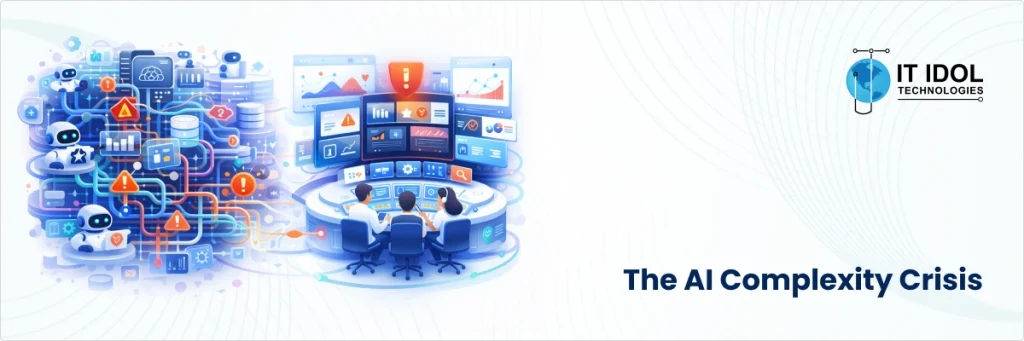
A typical enterprise stack today may include several language models, multiple vector databases, custom APIs, and a growing collection of AI agents performing specialized tasks. Each component solves a specific problem, yet together they form a tangled web of integrations that is difficult to manage.
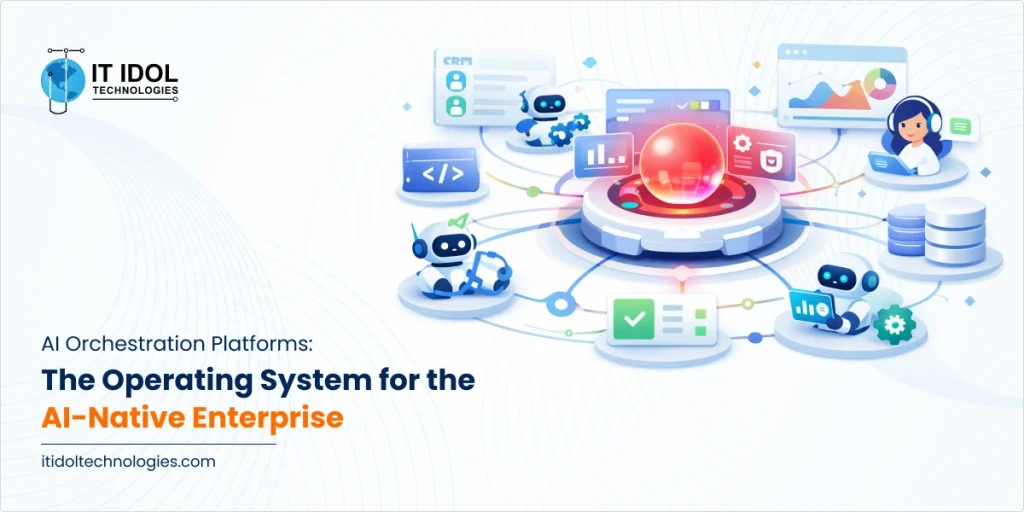
Instead of a cohesive system, organizations end up with a patchwork of disconnected tools. AI orchestration platforms are emerging as the solution to this complexity. These platforms act as an intelligent coordination layer that connects models, agents, tools, and data pipelines into structured workflows.
Rather than relying on ad-hoc integrations, orchestration platforms manage how different AI components interact, when they run, and how their outputs are combined.
In effect, they function as the control plane for AI systems. Just as cloud orchestration tools coordinate containers and microservices, AI orchestration platforms coordinate machine learning models, retrieval pipelines, and autonomous agents. As enterprises adopt more AI capabilities, orchestration becomes essential for controlling costs, maintaining reliability, and enabling experimentation at scale.
Understanding how these platforms work and why they are becoming foundational helps explain the next stage in the evolution of enterprise software.
The AI Complexity Crisis
Explosion of AI Components
The rapid expansion of AI capabilities has created an unprecedented level of technical complexity. Only a few years ago, organizations might deploy a handful of machine learning models in production. Today, teams routinely manage dozens of AI services across multiple environments.
This shift has accelerated as the number of available models has exploded. The open-source ecosystem now includes hundreds of specialized language models, multimodal systems, and domain-specific architectures. Cloud providers continue releasing proprietary foundation models, while startups introduce optimized variants for tasks such as coding, document analysis, and image understanding.
The result is an ecosystem where enterprises can access thousands of models and tools, each optimized for different tasks. While this diversity creates opportunity, it also introduces operational challenges.
Current Pain Points
Without orchestration, integrating these components becomes difficult. Development teams often connect models directly to applications through custom APIs. Over time, these integrations accumulate into fragile systems where changes in one component cascade through the stack. Latency becomes unpredictable as workflows pass through multiple services, and operational costs rise as inference calls multiply.
Data pipelines present another challenge. AI agents frequently rely on external knowledge sources, such as documents, databases, and analytics systems. Ensuring consistent access to these resources while maintaining security controls requires careful coordination.
Operational monitoring also becomes more complicated. When several models and agents collaborate in a workflow, diagnosing performance issues or incorrect outputs requires visibility into every step of the pipeline. Industry research has highlighted the consequences of this complexity. Analysts estimate that roughly 70% of AI initiatives fail to reach full production, often due to deployment and integration challenges rather than model performance.
The gap between experimentation and reliable production systems remains one of the largest obstacles to enterprise AI adoption.
AI orchestration platforms address this gap by providing structured frameworks for managing the entire lifecycle of AI workflows.
What Makes AI Orchestration Platforms Essential
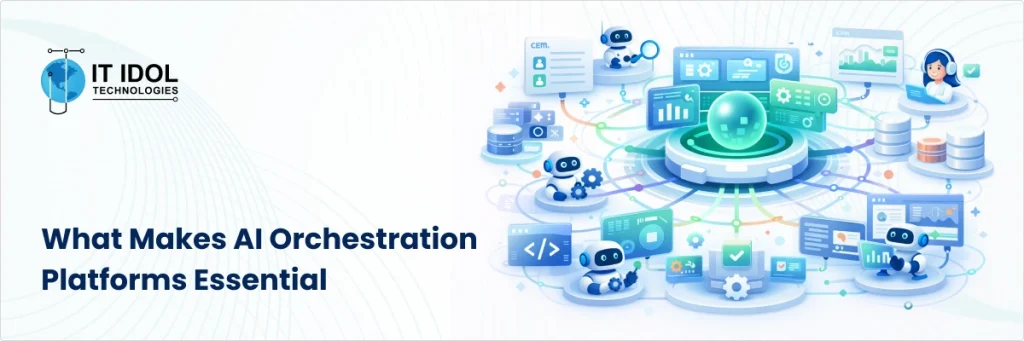
AI orchestration platforms introduce a layer of intelligence that sits above individual models and tools. Their goal is not to replace these components but to coordinate them in a way that improves reliability, efficiency, and scalability.
Core Capabilities
One key capability is dynamic routing. In traditional systems, an application might call a single model for every request. Orchestration platforms can evaluate the request and route it to the most appropriate model based on factors such as cost, performance, or task specialization.
For example, simple queries might be handled by lightweight models, while complex reasoning tasks are routed to more powerful architectures. Another essential feature is automatic scaling. AI workloads fluctuate significantly depending on demand.
Orchestration platforms monitor usage patterns and allocate resources accordingly, ensuring that workflows remain responsive during traffic spikes without overprovisioning infrastructure.
Many platforms also support multi-model fusion, where outputs from multiple models are combined to improve accuracy. In a document analysis workflow, for instance, one model may extract structured data while another verifies the results. Beyond individual model calls, orchestration platforms enable sophisticated workflow automation.
Instead of simple task sequences, organizations can define conditional pipelines where agents trigger additional processes based on intermediate results. A fraud detection system might analyze a transaction, consult external data sources, and escalate suspicious cases to human reviewers, all coordinated through the orchestration layer.
Differentiation from Traditional Orchestrators
Traditional workflow orchestrators rely on static rules. They execute predefined steps in a fixed order, assuming that each component behaves predictably. AI systems, however, operate differently. Models generate probabilistic outputs, and agents may choose different tools depending on context. As a result, orchestration platforms must incorporate adaptive intelligence.
Rather than simply executing workflows, they evaluate outputs, adjust routing strategies, and monitor performance in real time. Some platforms even learn from historical data to optimize model selection and execution strategies.
This adaptive approach has led many practitioners to describe AI orchestration platforms as the “Kubernetes for AI.” Just as container orchestration transformed cloud infrastructure management, AI orchestration platforms aim to bring structure and scalability to complex AI ecosystems.
Leading Platforms and Architectures
As demand for orchestration grows, a new generation of platforms has emerged to address enterprise requirements.
Several open-source projects focus on developer flexibility. Tools such as LangSmith, Haystack, and Flowise provide frameworks for designing AI pipelines, monitoring execution, and debugging model interactions. These platforms allow engineering teams to experiment with new workflows while maintaining visibility into system behavior.
Large technology providers are also entering the space with enterprise-grade offerings. Platforms such as IBM WatsonX, Orchestrate, and Google Vertex AI Pipelines integrate orchestration capabilities directly into broader AI ecosystems. These solutions provide managed infrastructure, security features, and governance tools designed for enterprise environments.
Architectural Breakdown
Despite differences in implementation, most orchestration platforms share several architectural characteristics.
Many rely on event-driven architectures, where workflows are triggered by system events such as user queries, data updates, or application signals. This design allows AI systems to respond dynamically to changing conditions. Serverless infrastructure is also common.
By running tasks on demand rather than maintaining persistent servers, platforms can scale efficiently while reducing operational overhead. Equally important is observability. Modern orchestration systems provide detailed telemetry about every step of an AI workflow, including latency, model outputs, and error rates. These insights allow teams to diagnose issues quickly and optimize performance.
Together, these architectural elements create an environment where AI workflows can operate reliably even as complexity grows.
Business and Technical Advantages
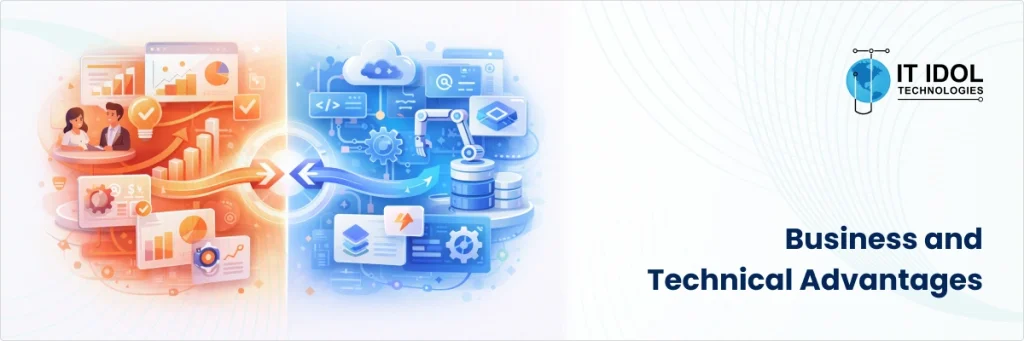
Adopting AI orchestration platforms can produce significant benefits for both engineering teams and business stakeholders.
Efficiency Gains
One of the most immediate advantages is improved deployment speed. By standardizing how models and agents interact, orchestration platforms eliminate much of the custom integration work that slows development cycles.
Organizations using structured orchestration frameworks often report substantial reductions in deployment time, allowing teams to move from prototype to production more quickly.
Cost management also improves. Dynamic routing and model optimization can reduce the number of expensive inference calls, lowering operational expenses without sacrificing performance.
Scalability
AI workloads often grow rapidly as successful use cases expand across departments. Orchestration platforms provide the infrastructure needed to scale these workflows reliably.
With centralized coordination, enterprises can manage large-scale data pipelines, coordinate distributed models, and process massive datasets without losing visibility or control.
This scalability becomes particularly important in environments such as financial analytics, logistics planning, or large-scale customer engagement platforms where data volumes can reach petabyte levels.
Because models and tools are modular, teams can test different configurations without rebuilding entire systems. For example, an organization might run A/B tests between multiple language models to determine which performs best for a specific task.
This experimentation culture can significantly accelerate innovation. Consider an e-commerce platform that personalizes product recommendations for millions of users. By orchestrating multiple models’ behavior analysis, inventory prediction, and content generation, the company can continuously refine personalization strategies and deliver more relevant experiences.
The orchestration layer ensures that these complex workflows remain manageable even as the number of models increases.
Challenges and Mitigation Strategies
Despite their advantages, AI orchestration platforms introduce new considerations.
One challenge is vendor lock-in. Enterprises that rely heavily on a single provider’s orchestration framework may find it difficult to migrate workloads later.
Another obstacle is the skills gap. Designing intelligent AI pipelines requires expertise in machine learning, distributed systems, and software architecture—skills that are still relatively scarce.
Governance is also a concern. When multiple models and agents operate autonomously, organizations must ensure that outputs remain compliant with internal policies and regulatory requirements.
Several strategies can mitigate these risks. Adopting open standards, such as interoperability frameworks for model telemetry and evaluation, helps maintain flexibility across platforms. Some organizations also explore federated learning architectures, where models operate across distributed environments while sharing insights securely.
These approaches help maintain control while benefiting from orchestration capabilities.
The Future: Orchestration as Software DNA
As AI adoption accelerates, orchestration platforms are likely to become a foundational component of enterprise software architecture.
In the coming years, orchestration capabilities may be embedded directly into many SaaS platforms. Instead of manually connecting AI tools, organizations will interact with intelligent systems that automatically coordinate models, agents, and data pipelines.
Another emerging trend is edge-based AI orchestration. As AI capabilities move closer to devices and operational environments, orchestration platforms will need to manage distributed agents across cloud and edge infrastructure simultaneously.
Industry forecasts suggest that the market for AI orchestration technologies could grow rapidly over the next decade, reflecting the central role these platforms play in scaling enterprise AI systems.
Conclusion
The rapid growth of artificial intelligence has created a paradox for enterprises. While AI technologies offer enormous potential, integrating them into coherent systems has become increasingly complex. Multiple models, agents, data pipelines, and APIs must interact seamlessly to deliver meaningful outcomes.
AI orchestration platforms address this challenge by introducing a structured coordination layer across the AI stack. They manage workflows, route tasks dynamically between models, and provide the observability required to maintain reliable operations.
For engineering teams, this means faster development cycles and more efficient infrastructure utilization. For business leaders, it translates into scalable AI capabilities that support innovation without sacrificing control.
Organizations that adopt orchestration early gain another important advantage: the ability to experiment rapidly. When models and agents can be combined and tested quickly, teams can explore new products, services, and operational improvements without rebuilding their technology stack each time.
The alternative is an increasingly fragmented ecosystem of disconnected AI tools, an environment that slows innovation and increases operational risk. As AI becomes embedded in every layer of enterprise operations, orchestration platforms will likely evolve into the central nervous system of modern software.
Applications will no longer rely on isolated models but on coordinated networks of intelligent services. In that future, successful organizations will not simply deploy AI; they will orchestrate it.
An AI orchestration platform is a coordination layer that manages how machine learning models, AI agents, data pipelines, and tools interact within enterprise workflows. It ensures that AI components operate together efficiently and reliably.
Enterprises often use multiple AI models, APIs, and data sources. Orchestration platforms help organize these components into structured workflows, reducing integration complexity and improving reliability.
Traditional orchestrators run predefined workflows with static rules. AI orchestration platforms handle probabilistic outputs from models and dynamically adjust routing, workflows, and execution strategies.
Dynamic routing allows an orchestration system to select the most appropriate AI model or service for each request based on factors such as task complexity, cost, or latency requirements.
By routing requests to optimal models, optimizing resource usage, and reducing redundant inference calls, orchestration platforms help control the operational costs of AI systems.
Observability provides visibility into AI workflows, including model responses, latency, and error rates. This helps teams troubleshoot issues and optimize system performance.
Yes. Many platforms support multi-model pipelines where outputs from different models are combined, validated, or refined to improve overall accuracy and reliability.
Examples include developer-focused tools like LangSmith, Haystack, and Flowise, as well as enterprise solutions such as IBM WatsonX, Orchestrate, and Google Vertex AI Pipelines.
Common challenges include vendor lock-in, limited technical expertise, governance requirements, and the complexity of designing intelligent AI workflows.
Future platforms are expected to integrate directly into enterprise software, manage distributed AI systems across cloud and edge environments, and enable more autonomous coordination between models and agents.
Deval Rathod
Founder & CEO
|
Deval Rathod is the Founder and CEO of IT IDOL Technologies, a custom software development company. With over a decade of experience in software engineering, solution architecture, and technology leadership, she has worked across custom software development, enterprise applications, AI & ML, and digital transformation. Her expertise includes guiding technology teams, designing scalable software solutions, and helping businesses evaluate and implement emerging technologies. She contributes insights on software engineering, artificial intelligence, enterprise technology, and digital transformation.