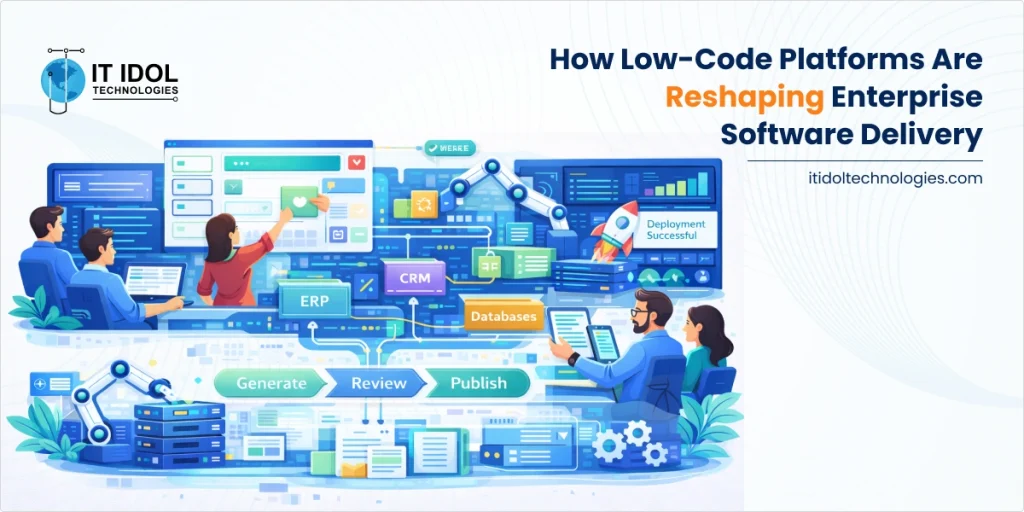
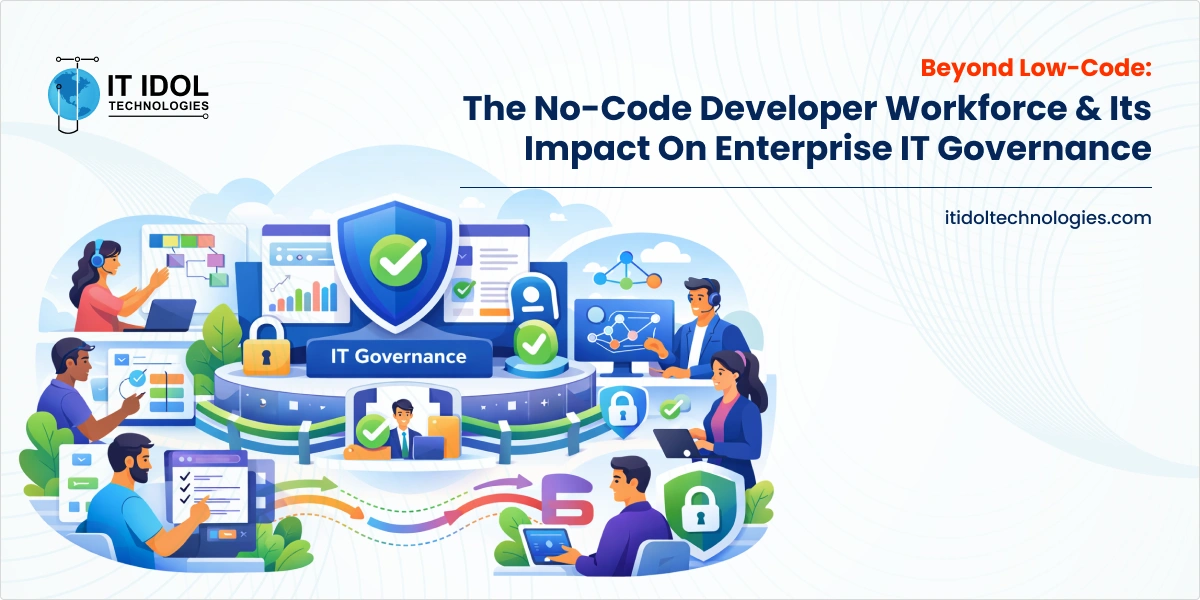
Low-code platforms are changing how enterprises deliver software, shifting development from purely engineering-led projects to a more distributed model across the organization.
Rising demand for internal applications and automation is overwhelming traditional development pipelines, creating backlogs that low-code platforms help reduce.
Low-code tools abstract infrastructure and coding complexity, allowing teams to build applications through visual models, reusable components, and prebuilt integrations.
Business units can develop operational tools themselves, while central engineering teams focus on architecture, platform engineering, and complex systems.
The greatest value appears in rapidly changing processes, such as compliance workflows, operational systems, and enterprise integrations.
Governance becomes critical as adoption grows, requiring strong policies around architecture, security, and application management.
Low-code platforms are evolving into core components of enterprise architecture, enabling faster software delivery while maintaining centralized oversight.
The Quiet Structural Shift in Enterprise Software Delivery
Enterprise software delivery is undergoing a structural shift that many organizations initially misread as a tooling trend. The rise of low-code platforms in enterprise software delivery is not simply about faster application development or reducing the burden on engineering teams. At its core, it represents a bigger change in how enterprises translate operational needs into working software.
For decades, the enterprise software lifecycle followed a predictable path: requirements gathering, development, testing, deployment, and maintenance. This approach served organizations well when digital systems evolved at a manageable pace. Today, however, enterprise environments operate under a very different set of pressures. Regulatory updates, shifting customer expectations, and rapidly changing operational processes require software to evolve continuously rather than periodically.
Traditional development models struggle under these conditions. Even well-resourced engineering teams face mounting backlogs as departments across the enterprise demand new applications, workflow automation, and data integrations. The result is a persistent delivery gap, one that technology leaders increasingly view as a structural problem rather than a temporary resource shortage.
Low-code platforms emerged within this context. Initially positioned as tools for rapid application development, they are now playing a far more strategic role. Many organizations are discovering that these platforms fundamentally alter the economics and operating model of enterprise software delivery, reshaping how technology capabilities are distributed across the business.
Understanding this shift requires looking beyond the productivity narrative that often surrounds low-code. The real impact lies in how these platforms are changing the relationship between architecture, development capacity, and business responsiveness.
Why the Traditional Development Model Is Under Strain
Enterprise application development has always been constrained by a simple reality: skilled engineering capacity is finite. Over the past decade, however, demand for software capabilities has expanded dramatically across every functional unit of the enterprise.
Operations teams require workflow automation. Compliance teams need systems that adapt quickly to regulatory changes. Customer-facing departments depend on rapidly evolving digital interfaces. Data teams expect seamless integration across systems that were never designed to communicate with each other.
What once counted as specialized software projects has gradually become everyday operational infrastructure. Every department now relies on digital systems to perform its core work.
This expansion of demand exposes the limitations of conventional development pipelines. Even organizations with large engineering teams encounter bottlenecks when every new capability must flow through centralized development groups. Backlogs grow, business units look for workarounds, and shadow IT quietly reappears.
Low-code platforms began addressing this pressure by reducing the technical overhead required to build applications. By abstracting infrastructure, data integration, and user interface logic into reusable components, these platforms allow applications to be assembled rather than constructed line by line.
For many enterprises, the appeal is not simply speed. It is the possibility of redistributing development capacity across the organization without compromising architectural oversight. When implemented correctly, low-code platforms shift software creation closer to the operational teams that understand the problems being solved.
That redistribution is where the real transformation begins.
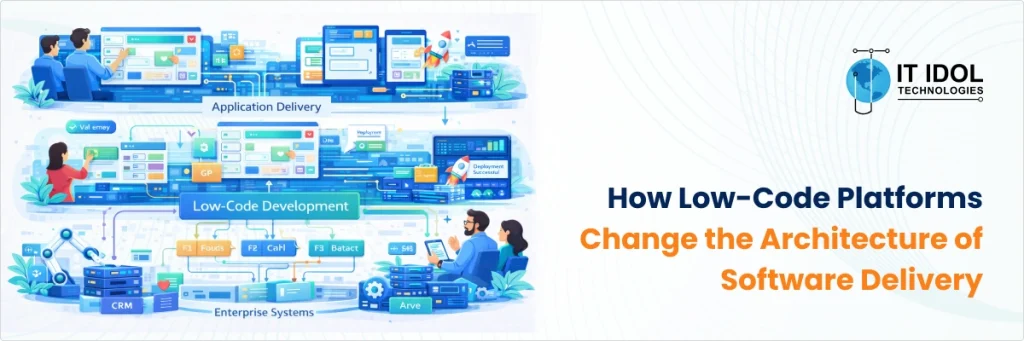
How Low-Code Platforms Change the Architecture of Software Delivery
At a technical level, low-code platforms in enterprise software delivery function as abstraction layers that sit between enterprise infrastructure and application logic. Instead of writing extensive custom code to define workflows, integrations, and user interfaces, development teams configure these capabilities through visual models and prebuilt components.
This architectural shift alters several fundamental aspects of enterprise software development.
First, it reduces the friction involved in building domain-specific applications. Many enterprise systems exist to manage highly specialized processes, procurement approvals, compliance tracking, customer onboarding, or internal logistics coordination. These systems rarely require unique engineering innovation, but they do require constant adjustment as processes evolve. Low-code environments allow these adjustments to be implemented quickly without rewriting entire application layers.
Second, low-code platforms standardize much of the underlying infrastructure. Security frameworks, identity management, integration connectors, and deployment pipelines are built into the platform architecture. This eliminates a significant portion of the engineering effort typically required to operationalize enterprise applications.
Third, they encourage modular design. Applications built within low-code ecosystems often rely on reusable components that can be recombined across different business processes. Over time, this creates internal capability libraries that accelerate subsequent development efforts.
These characteristics collectively reshape the way enterprises think about application architecture. Software becomes less about isolated projects and more about assembling capabilities from an evolving internal platform ecosystem.
For technology leaders, the challenge is no longer purely technical. It becomes an exercise in governance, architectural boundaries, and organizational design.
The Organizational Impact: Development Expands Beyond Engineering
Perhaps the most consequential effect of low-code platforms is not technical but organizational. By lowering the barrier to application creation, these platforms gradually shift parts of the development process toward operational teams.
This shift often begins with simple workflow automation initiatives led by business units. Over time, however, it expands into more sophisticated internal systems that previously required formal software projects.
When managed carefully, this distribution of development capability can significantly reduce the burden on central engineering teams. Business units gain the ability to prototype and deploy applications that directly reflect their operational realities, while core engineering groups focus on complex platform engineering, system architecture, and integration strategy.
However, this decentralization introduces a new set of governance challenges. Without clear architectural oversight, organizations risk creating fragmented ecosystems of loosely governed applications.
Successful enterprises typically address this tension through a hybrid operating model. Central technology teams define platform standards, security policies, and integration frameworks. Business units operate within these guardrails, building applications that address local operational needs.
This model mirrors broader shifts in enterprise IT toward platform thinking, where technology teams provide shared infrastructure and capabilities rather than building every application themselves.
Low-code platforms accelerate that transition.
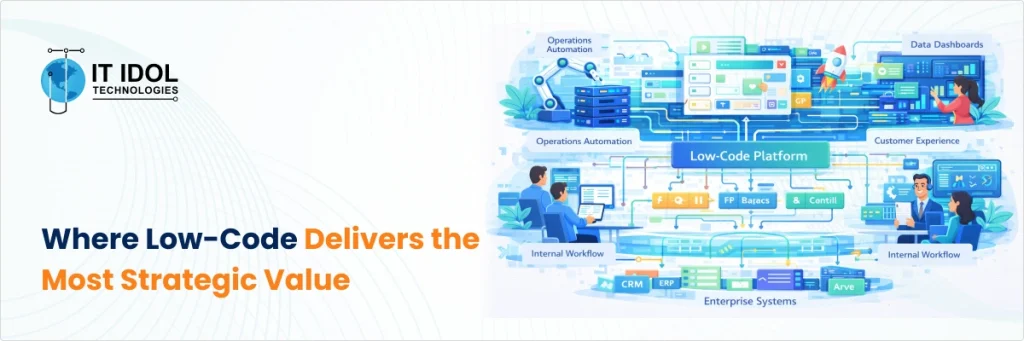
Where Low-Code Delivers the Most Strategic Value
The strategic value of low-code platforms becomes most visible in areas where business processes evolve faster than traditional development cycles can accommodate.
Many enterprise applications fall into this category. Internal systems supporting compliance reporting, partner onboarding, employee workflows, or operational monitoring often require frequent modification. Changes in regulations, organizational structures, or supply chain relationships can quickly render rigid software systems obsolete.
Low-code environments provide a mechanism for adapting these systems without triggering lengthy redevelopment cycles. Process owners can adjust workflows, modify data structures, and update interfaces while preserving underlying integrations and security frameworks.
Another area where low-code platforms create meaningful leverage is integration orchestration. Enterprises operate complex technology stacks composed of ERP systems, CRM platforms, data warehouses, and specialized industry applications. Connecting these systems often requires significant engineering effort.
Low-code integration capabilities simplify this process by providing prebuilt connectors and workflow engines capable of orchestrating data flows between systems. While complex integrations still require engineering expertise, many routine integrations can be configured rather than coded.
The cumulative effect is an enterprise software environment that evolves more fluidly. Applications adapt incrementally rather than undergoing periodic large-scale redesigns.
The Governance Tension Technology Leaders Must Resolve
Despite their advantages, low-code platforms in enterprise software delivery introduce a set of strategic trade-offs that technology leaders must confront.
The most obvious concern is architectural sprawl. When application development expands beyond traditional engineering teams, the number of systems within an organization can grow rapidly. Without careful governance, enterprises risk creating a fragmented landscape of applications with overlapping functionality.
Security oversight also becomes more complex. Low-code environments often simplify development but still interact with sensitive enterprise data. Ensuring that applications comply with security policies requires centralized monitoring and strong platform governance.
Vendor dependency presents another consideration. Many low-code platforms operate as proprietary ecosystems. Applications built within them can become difficult to migrate if organizations later decide to change platforms. Technology leaders must evaluate long-term architectural flexibility when selecting these tools.
These risks do not invalidate the low-code model, but they do reinforce the need for disciplined platform governance. Organizations that treat low-code as an unmanaged productivity tool often encounter problems. Those who treat it as a strategic component of enterprise architecture tend to extract far greater value.
Market Implications and Competitive Positioning
The widespread adoption of low-code platforms reflects broader changes in how organizations compete through technology.
In many industries, differentiation increasingly depends on the ability to adapt operational processes quickly. Retailers adjust supply chain workflows in response to demand fluctuations. Financial institutions update compliance systems as regulations evolve. Logistics companies continuously refine routing and coordination systems.
In such environments, software flexibility becomes a competitive asset. Enterprises that can rapidly translate operational insights into working systems gain a significant advantage over competitors bound by slower development cycles.
Low-code platforms contribute to this agility by compressing the time between identifying a process improvement and deploying a supporting application. Instead of waiting months for development cycles to complete, organizations can implement incremental changes much more quickly.
This capability does not replace traditional software engineering. Core digital products, customer-facing platforms, and complex data systems still require deep engineering expertise. But low-code expands the enterprise’s ability to build the many smaller systems that collectively shape operational efficiency.
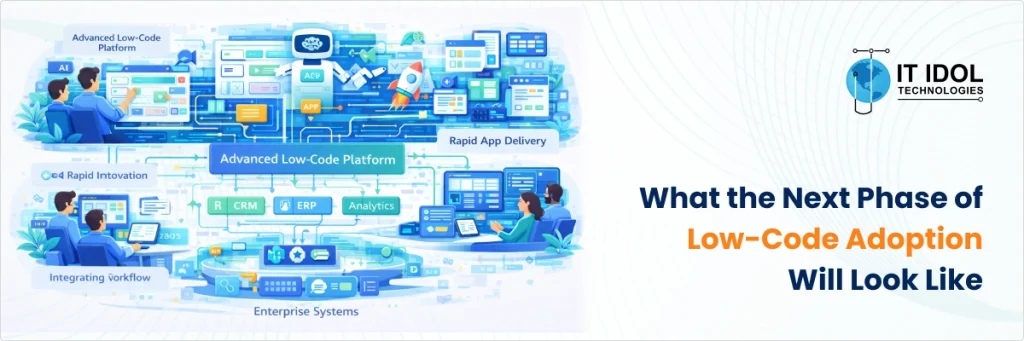
What the Next Phase of Low-Code Adoption Will Look Like
The next phase of low-code adoption will likely focus less on experimentation and more on integration with broader enterprise architecture strategies.
Early adopters often implemented low-code tools within isolated departments to solve specific workflow problems. Over time, organizations are beginning to treat these platforms as core components of their application development ecosystem.
This shift will require stronger alignment between platform capabilities, governance models, and enterprise architecture frameworks. Technology leaders will increasingly evaluate low-code platforms not just for their development speed but for their interoperability with existing infrastructure and their ability to support long-term system evolution.
Artificial intelligence is also beginning to intersect with low-code development environments. Many platforms now incorporate AI-assisted design, automated workflow recommendations, and natural-language application modeling. While these capabilities remain early in their maturity, they point toward a future where application creation becomes even more accessible across the enterprise.
The organizations that benefit most from these developments will be those that approach low-code as part of a coherent technology strategy rather than a standalone productivity tool.
Conclusion
The rise of low-code platforms in enterprise software delivery reflects a deeper shift in how organizations build and manage digital systems. What began as a response to development backlogs has evolved into a broader rethinking of where software capabilities should reside within the enterprise.
These platforms enable a more distributed model of application development, one in which operational teams can directly shape the tools that support their work. At the same time, they challenge technology leaders to design governance models that preserve architectural integrity while encouraging innovation.
For enterprises navigating increasingly complex digital environments, this balance will become a defining leadership challenge. Low-code platforms do not eliminate the need for a strong engineering discipline. Instead, they expand the scope of software creation across the organization, making architectural oversight more important than ever.
Organizations that recognize this shift and adapt their technology strategies accordingly will be better positioned to deliver software at the pace modern business demands.
Low-code platforms are development environments that allow applications to be built using visual interfaces, reusable components, and configuration tools instead of extensive manual coding.
They simplify development by providing prebuilt components, visual modeling tools, and integration connectors, allowing teams to assemble applications much faster than traditional coding methods.
No. Low-code platforms complement traditional development by handling internal applications and workflow systems, while complex products and large-scale platforms still require full engineering teams.
Low-code works well for internal enterprise tools such as workflow automation systems, compliance tracking applications, employee portals, and process management solutions.
They allow business teams to build certain applications independently, while IT teams focus more on governance, architecture, integration, and platform management.
Common challenges include application sprawl, inconsistent architecture, security oversight, and maintaining control over decentralized development initiatives.
Yes. Most low-code platforms include connectors and integration tools that allow them to connect with systems like ERP, CRM, databases, and cloud services.
Industries with rapidly changing operational processes, such as finance, healthcare, retail, and logistics, often gain significant advantages from low-code platforms.
Low-code platforms are expected to become a core part of enterprise application ecosystems, especially as AI-assisted development features and platform governance models continue to evolve.
Deval Rathod
Founder & CEO
|
Deval Rathod is the Founder and CEO of IT IDOL Technologies, a custom software development company. With over a decade of experience in software engineering, solution architecture, and technology leadership, she has worked across custom software development, enterprise applications, AI & ML, and digital transformation. Her expertise includes guiding technology teams, designing scalable software solutions, and helping businesses evaluate and implement emerging technologies. She contributes insights on software engineering, artificial intelligence, enterprise technology, and digital transformation.