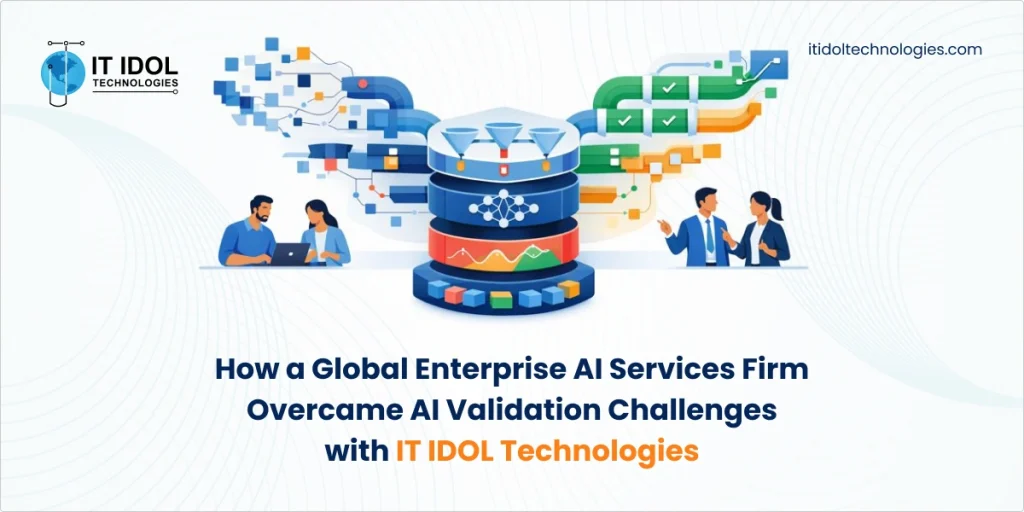
A global enterprise AI services firm faced a growing bottleneck in validating GenAI outputs at scale as AI agents became embedded in healthcare-focused workflows. Manual and synchronous validation methods failed under large datasets and long-running evaluations. By partnering with IT IDOL Technologies, the organization built a scalable, asynchronous AI validation platform that standardized evaluation, enabled collaboration, and made AI deployment faster, auditable, and production-ready.
As generative AI matures inside large enterprises, a quiet but consequential challenge is surfacing. Models are improving, adoption is accelerating, and AI agents are moving into production workflows. Yet the ability to validate AI outputs consistently, at scale, and across environments is falling behind. For many organizations, this gap becomes the real constraint on production-grade AI, not model quality.
This reality emerged for a global enterprise AI services firm supporting healthcare-focused AI initiatives. As AI agents such as Text2API, Text2Doc, and Text2SQL became embedded in operational workflows, the problem was no longer about generating responses. The real challenge was verifying those responses reliably across source and target environments, datasets, and teams without slowing innovation or increasing governance risk.
When AI Validation Stops Being Manual Work
In early AI deployments, validation is manageable. Teams review limited scenarios, manually inspect outputs, and iterate quickly. That approach breaks down once AI systems are expected to operate at enterprise scale.
The organization’s validation workloads reflected a pattern many enterprises encounter. Evaluation datasets arrived as large Excel files containing hundreds of structured questions. Each question needed to be processed by AI agents in multiple environments, then compared against predefined ground truth. Individual evaluations could take up to 45 seconds, making synchronous execution impractical.
At this point, validation stopped being a testing activity and became a systems problem. Manual reviews, scripts, or linear workflows could not keep pace with the volume, duration, and complexity of AI evaluations. Industry research consistently shows that AI initiatives stall not because models underperform, but because organizations lack the operational foundations to test, govern, and scale them reliably.
When Architecture Becomes the Only Viable Answer
Incremental fixes were not enough. Adding scripts or one-off validation tools would only introduce fragility. What was needed was a dedicated AI validation platform, engineered with the same rigor as any enterprise system.
This is where IT IDOL Technologies partnered with the organization. The engagement was not about improving AI models themselves. Instead, the focus was on designing an architecture capable of handling AI validation as a continuous, scalable, and auditable process.
Rather than forcing AI evaluations into synchronous request–response patterns, IT IDOL Technologies reframed validation as a long-running, asynchronous workload that required isolation, resilience, and visibility by design.
Engineering for Long-Running AI Evaluations
The platform was built to absorb heavy evaluation loads without disrupting user workflows. A Python backend using FastAPI handled orchestration, while Celery managed background task execution.
This allowed hundreds of evaluation jobs to run concurrently without blocking APIs or degrading performance. Containerization with Docker and orchestration through Kubernetes enabled dynamic scaling as workloads fluctuated critical given the unpredictable execution times of AI agents.
PostgreSQL stores evaluation results in a structured, auditable format, supporting traceability requirements common in healthcare and regulated environments. The result was an infrastructure that treated AI validation as a first-class workload, not an afterthought.
Turning AI Agent Testing into a Reusable Platform Capability
One of the most meaningful outcomes was the shift from isolated AI testing to a reusable validation framework. Instead of building custom logic for each AI agent, the organization adopted a unified evaluation pipeline.
Text2API, Text2Doc, and Text2SQL agents all followed the same lifecycle:
Structured input ingestion
Source and target response generation
Ground-truth comparison
Configurable pass/fail evaluation
This abstraction allowed new AI agents and use cases to be added without reengineering the validation system. Validation became a platform capability rather than a recurring implementation burden.
Making Validation Usable for Real Teams
Scalability alone was not enough. The platform also had to reflect how enterprise teams actually work.
IT IDOL Technologies helped design a React-based frontend that enabled users to upload large Excel files, configure evaluation environments, preview inputs and outputs, and track progress asynchronously. Results were accessible directly within the interface, with final evaluation reports available for download.
Team-based access controls supported collaboration without confusion. Shared datasets reduced duplication, while clear isolation between teams preserved accountability and control an essential balance in enterprise AI programs.
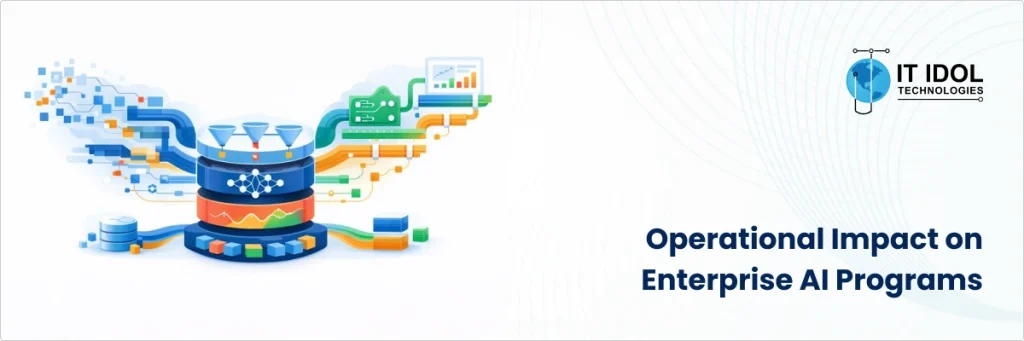
Operational Impact on Enterprise AI Programs
The shift was immediate and structural. AI validation moved from a fragile, manual process to a dependable system capability. Teams gained the ability to evaluate AI agents at scale, compare behavior across environments consistently, and generate auditable reports without slowing experimentation. AI initiatives could progress faster without increasing operational or governance risk.
This aligns with a broader industry insight: organizations that embed validation and governance directly into AI systems early are far more likely to scale those systems successfully.
Why This Matters Beyond a Single Organization
This journey highlights a broader lesson for enterprise AI leaders. The success of AI initiatives depends less on model sophistication and more on the systems that surround them. Validation, orchestration, reporting, and collaboration are not secondary concerns. They determine whether AI remains experimental or becomes operational. By treating AI validation as a platform-level challenge, rather than a patchwork process, enterprises create a foundation for sustainable AI growth.
Closing Perspective
As generative AI expands across enterprise environments, validation will increasingly define the boundary between responsible scale and operational risk. This experience shows that when AI validation is engineered as a system, not stitched together through manual processes, organizations gain the confidence to move faster without losing control. That balance is what ultimately turns AI from promise into performance.
The organization struggled to validate AI agent outputs at scale as datasets grew and evaluations became long-running. Manual checks and synchronous workflows could not handle hundreds of AI queries reliably.
Enterprise AI spans multiple environments, teams, and use cases. Probabilistic outputs, long execution times, and governance requirements make simple validation approaches ineffective.
IT IDOL Technologies designed and built a scalable AI validation platform focused on asynchronous processing, reusable evaluation pipelines, and enterprise-grade architecture.
Validation datasets were structured as large Excel files containing hundreds of questions. Native Excel ingestion aligned with real enterprise workflows.
The solution used a FastAPI backend, React frontend, PostgreSQL database, Celery for background processing, and Docker with Kubernetes for scalability.
Validation shifted from a manual, fragmented process to a standardized platform capability, enabling faster experimentation without increasing governance risk.
Scalable AI depends less on models and more on validation, orchestration, and governance systems. Treating validation as a core platform capability is essential for responsible AI growth.
Deval Rathod
Founder & CEO
|
Deval Rathod is the Founder and CEO of IT IDOL Technologies, a custom software development company. With over a decade of experience in software engineering, solution architecture, and technology leadership, she has worked across custom software development, enterprise applications, AI & ML, and digital transformation. Her expertise includes guiding technology teams, designing scalable software solutions, and helping businesses evaluate and implement emerging technologies. She contributes insights on software engineering, artificial intelligence, enterprise technology, and digital transformation.