Scaling B2B Food Procurement Through Resilient Backend Architecture
- Category - FoodTech
- Location – Bangalore, India
- Employees – 1000+ (Large FoodTech Group)
- Backend - Go, Java, Spring Boot
- Tools - Git, Jira

As the platform expanded across Bangalore, it encountered challenges typical of B2B food supply chains. Unlike consumer commerce, procurement disruptions directly impact daily kitchen operations and revenue cycles.
The organization required backend systems capable of:
Handling high-frequency, repeat ordering without inconsistencies.
Maintaining accurate, near real-time inventory across multiple local suppliers.
Coordinating seamlessly with logistics while isolating downstream failures.
Scaling reliably during peak operational windows.
The priority was not feature expansion, but backend reliability, predictability, and resilience under sustained operational load.
IT Idol Technologies partnered with the client to design and strengthen a backend architecture capable of supporting city-wide B2B procurement at scale.
The solution focused on developing high-throughput, low-latency backend services using Java and Go, with Spring Boot enabling modular and maintainable service design. AWS provided elastic and fault-tolerant infrastructure, while DynamoDB supported fast and horizontally scalable data access for order and inventory workflows.
Backend workflows were restructured to ensure idempotent order handling, asynchronous processing, and clearly defined state transitions. This architectural shift allowed the platform to remain stable even during spikes in ordering activity or temporary downstream delays.
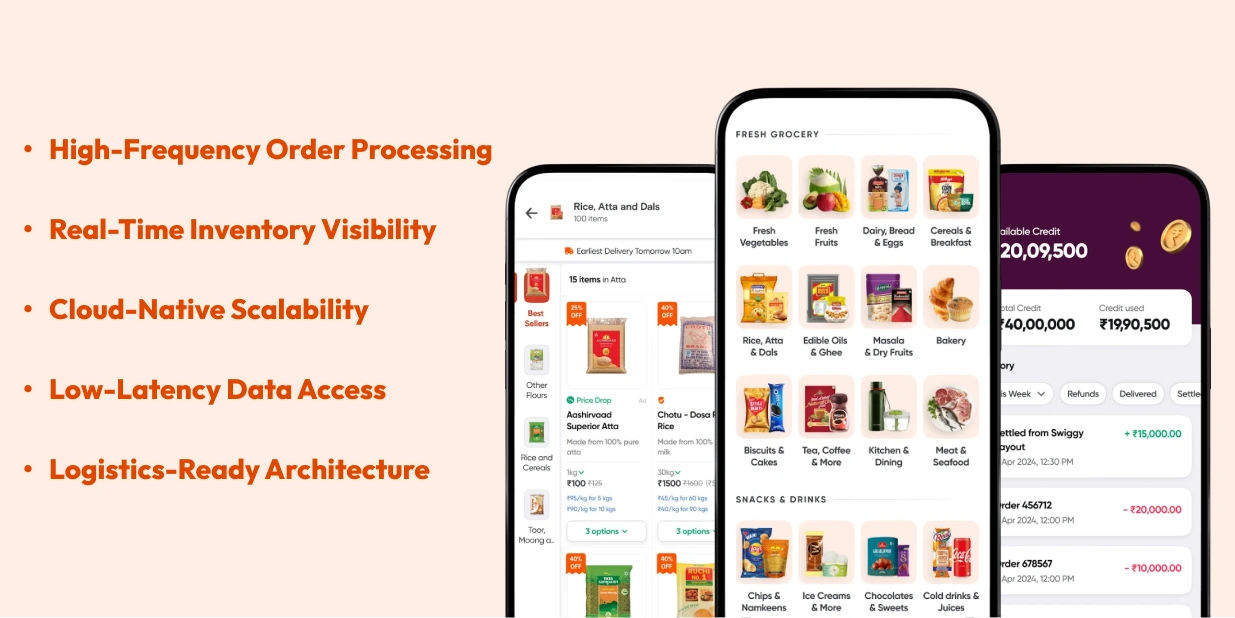
The strengthened backend architecture enabled the platform to support expanding adoption across the HORECA ecosystem without compromising operational stability.
The solution achieved:
Consistent order processing during peak hours.
Improved inventory accuracy across suppliers.
Reduced operational disruptions caused by backend failures.
Scalable growth enabled by modern IoT-backed architecture.
Reliable coordination between procurement and logistics systems.
By prioritizing backend resilience, the platform reinforced its position as a dependable procurement partner for food service businesses, where reliability is critical to daily operations.