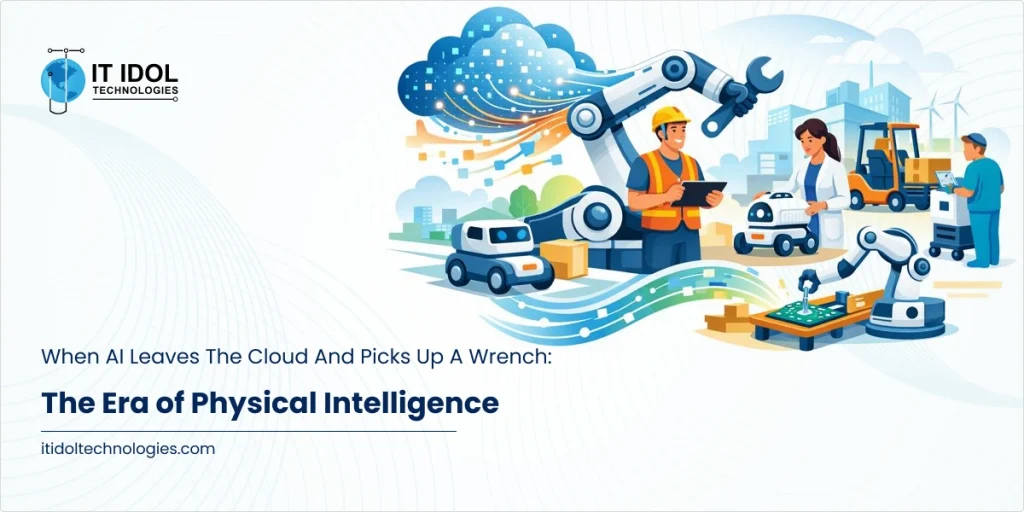
AI is shifting from cloud-centric data processing to systems that interact directly with the physical world, a concept I refer to as physical intelligence.
This shift requires rethinking cost models, talent, risk, and operating structures across the enterprise.
Physical intelligence reframes where value is created, from software abstraction to real-world outcomes.
Leaders must balance cloud advantages with the constraints and opportunities of edge and on-prem intelligence.
Success hinges on governance, incentive alignment, and bridging IT with operational technology teams.
The strategic payoff is sustainable differentiation, not transient efficiency gains.
There’s a disconnect in how most enterprises think about artificial intelligence. In boardrooms and strategy decks, AI lives in the cloud: massive compute clusters, endless data lakes, and ML models churning insights at scale.
We’ve been conditioned to see cloud-centric AI as the apex of modern architecture. But real competitive advantage isn’t coming from more layers of abstraction; it’s emerging where digital systems meet the physical world in meaningful, decision-impacting ways.
Call this physical intelligence AI models and systems embedded at the edge of operations, interacting with machinery, environments, and humans in real time.
This isn’t hypothetical. Autonomous vehicles, robotics in logistics, predictive maintenance in industrial settings, and smart grids are early harbingers of a broader trend: intelligence that no longer resides exclusively in centralised cloud infrastructure, but lives where things actually happen.
Most executives still frame AI purely as a cloud-driven analytics problem. That framing betrays two flawed assumptions: one, that centralized compute always yields the highest ROI; and two, that operational intelligence can be decoupled from the systems executing core business processes. Neither holds when AI must respond within milliseconds, manage safety-critical decisions, or operate where connectivity is intermittent.
The strategic implications are profound. The cloud is excellent for scale, elasticity, and broad data aggregation. But it is structurally misaligned with use cases where latency, reliability, security, and physical interaction are paramount. Leaders who don’t internalise this tension risk architecting elegant AI systems that never deliver tangible, sustainable value.
Understanding the shift to physical intelligence means grappling with uncomfortable trade-offs. It requires reconciling traditional IT incentives with operational technology (OT) realities. It demands new governance, new talent mixes, and a rethinking of cost models long optimised for centralised digital processing rather than distributed, context-sensitive intelligence.
This article argues that embracing physical intelligence isn’t optional; it’s a strategic imperative for enterprises whose value is inseparable from the physical processes that define their industry. The cloud remains a vital part of the stack, but it becomes just one node in a broader topology of cognitive systems.
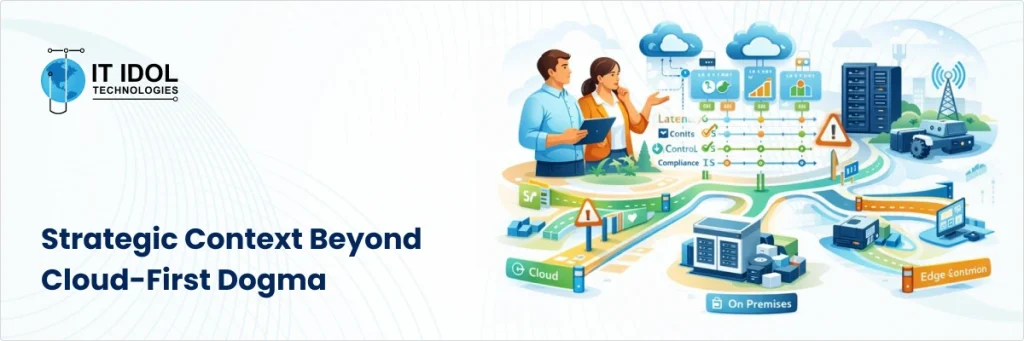
Strategic Context Beyond Cloud-First Dogma
The Limits of a Cloud-Only AI Strategy
The obsession with cloud-first approaches made sense when AI was largely data processing and model training. Centralized infrastructure democratized access to computing and allowed rapid experimentation. But this paradigmatic lens obscures a critical insight: value isn’t always created where models are trained, but where decisions are executed.
Consider a self-driving fleet. Centralized systems can aggregate sensor data and refine models, but the split-second decisions that avoid collisions or optimize routing occur on embedded systems. The business value arises not from analytics dashboards in the cloud, but from sustained, reliable operation at the edge.
The cloud’s architectural strengths become weaknesses when applied to physical systems. Latency constraints, bandwidth limits, and dependency on connectivity create brittle linkages between insight and action. Even with 5G and robust networking, real-world environments, such as factories, mines, and maritime operations, introduce variability that cloud-only architectures can’t tolerate.
Moreover, the cost structure of cloud-centric AI is often misunderstood. Public cloud charges for storage, egress, compute, and orchestration can balloon when systems require continuous inference at scale, especially when sensor data volumes spike or must be processed locally to meet responsiveness criteria.
Shifting Where Intelligence Lives
Physical intelligence reframes the locus of computation and decision-making. It places autonomy, responsiveness, and contextual awareness at the edge of operations. In practice, this can mean:
Embedded AI in machinery and vehicles for local inference and adaptive control.
Hybrid architectures where models are trained centrally but executed across distributed nodes.
Federated learning approaches that update models from edge data without moving raw data to a central repository.
These patterns force architectural stratification: centralised compute remains essential for heavy training and historical analysis, while edge and local systems shoulder real-time decisioning. This hybrid fabric introduces complexity, but that complexity mirrors the complexity of the physical world itself.
Market Signals and Strategic Stakes
Enterprises that recognize physical intelligence early will capture asymmetries others miss. For example:
Manufacturing: predictive maintenance is table stakes; self-optimising production lines that adapt to real-time conditions are differentiators.
Logistics and supply chain: optimizing static routes is trivial; dynamically routing fleets based on local conditions and demand patterns creates strategic agility.
Energy and utilities: centralized forecasting models are useful; intelligent grid nodes that autonomously balance supply and demand reduce operating risk and improve resilience.
Physical intelligence turns operational systems from cost centres into strategic platforms. It makes the enterprise more responsive to external shocks, more efficient in resource utilisation, and more capable of delivering differentiated performance. This is not incremental AI adoption; it’s a redefinition of where and how competitive value accrues.
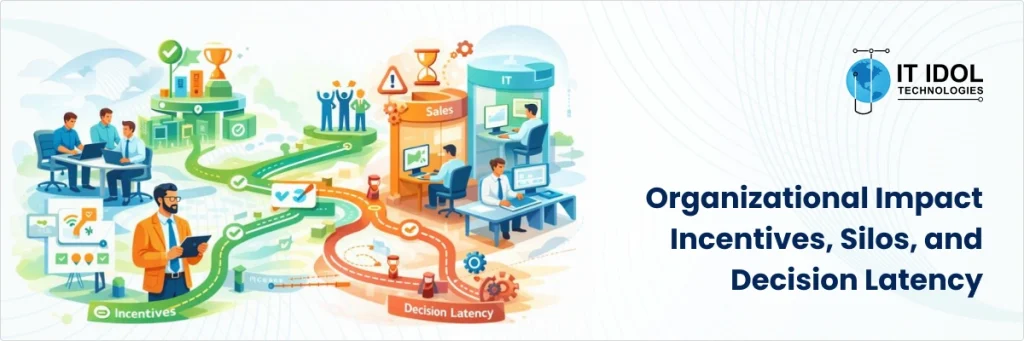
Organisational Impact Incentives, Silos, and Decision Latency
Breaking Organisational Silos
A recurring theme in enterprise transformation is the gap between IT and OT. IT teams focus on enterprise systems, data governance, and centralised platforms. OT teams manage machinery, control systems, and compliance with safety standards. Physical intelligence forces these worlds together in ways that traditional governance models are not equipped to handle.
AI initiatives that live in the cloud can be piloted, iterated, and governed with relative autonomy. Physical intelligence, by contrast, touches every layer of the business: shop floors, field operations, compliance regimes, and risk matrices.
When IT and OT operate in silos, projects falter due to misaligned incentives. IT prioritises uptime and data integrity; OT prioritises safety and deterministic behaviour. These cannot be reconciled without intentional governance design.
Decision Latency and Operational Incentives
Decision latency, the time between insight and action, becomes a strategic variable. In cloud-centric models, decision latency is often treated abstractly: milliseconds here, batch updates there. But in physical systems, latency has real costs: production slowdowns, safety risks, and customer dissatisfaction.
Bridging organisational incentives to reduce decision latency means rethinking performance metrics, reward structures, and leadership accountability.
For example, an OT leader may de-prioritise AI projects because they see them as experimental cost centres. An IT leader may see value in analytics but fail to appreciate the urgency of operational responsiveness. Without a shared understanding of outcomes and aligned incentives, physical intelligence projects stagnate.
Talent and Capability Constraints
Embedding AI into operational contexts demands new skills: real-time systems engineering, control theory, safety assurance, and cross-disciplinary fluency. These capabilities are rare, and traditional talent pipelines, especially those optimised for cloud-centric development, do not readily supply them.
Recruiting for physical intelligence requires bridging domains: hiring data scientists who understand sensors and mechanics, or automation engineers who grasp probabilistic models and runtime inference. Upskilling existing teams is necessary, but slow enterprises should expect long ramp times and invest accordingly.
Leadership must also contend with cultural resistance. Engineers trained in cloud paradigms may unconsciously favour solutions that centralise logic and data, even when operational constraints argue for distributed intelligence. Overcoming this requires experiential learning opportunities, incentives aligned with outcome metrics rather than technical artefacts, and visible senior sponsorship.
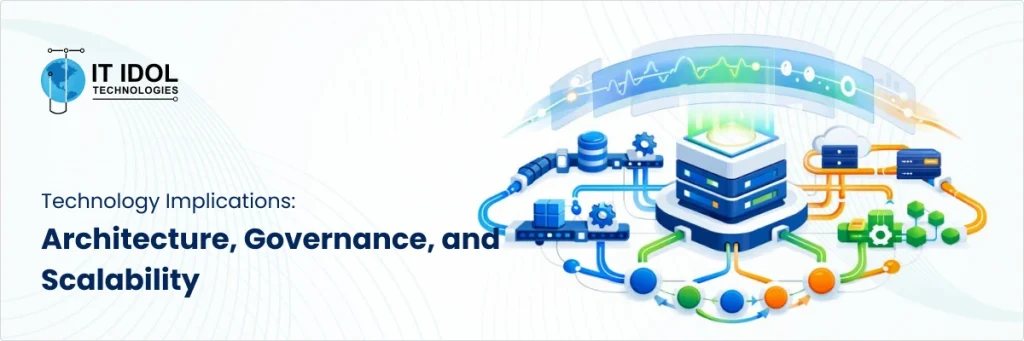
Technology Implications: Architecture, Governance, and Scalability
Hybrid Architectures as Default
Physical intelligence demands hybrid architectures where intelligence is distributed across cloud, edge, and on-prem components. This is not a simple layering exercise; it’s a new topology. Leaders must make explicit decisions about:
What to compute locally vs centrally
How to synchronise state across nodes
How to manage updates and security patches at scale
Federated learning and decentralised model governance are not buzzwords in this context; they are practical necessities. Edge nodes must operate independently when connectivity falters, yet contribute to collective model improvement over time.
This hybrid topology complicates systems integration. Traditional API-centric integration patterns struggle with intermittent connectivity and real-time constraints. Event-driven and mesh networking paradigms become more relevant. Enterprise architects must explicitly model these flows, not treat them as extensions of existing systems.
Governance in Mixed Environments
Governance for AI that interacts with physical systems cannot rely on centralized oversight alone. Safety, compliance, and ethical considerations must be coded into the system and verified at every level. In industries like manufacturing or healthcare, regulatory bodies already require rigorous testing and validation regimes for physical systems. Adding AI to the mix increases complexity and liability risk.
Leaders must adopt governance models that:
Include OT stakeholders in risk assessments
Define clear thresholds for local autonomy vs escalation
Build auditability into edge systems, not just the cloud layer
Incorporate simulation and digital twin testing before deployment
Failing to govern properly risks operational incidents that can have severe financial, legal, and reputational consequences.
Scalability and Platform Choices
Scalability for physical intelligence is not measured solely in compute nodes or storage capacity; it’s measured in the number of autonomous, distributed systems that can be managed coherently. Traditional cloud platforms excel at horizontal scalability in data centres. Physical intelligence platforms must scale horizontally and across heterogeneous operational environments.
This raises questions about platform choices. Open standards and interoperability become strategic levers. Proprietary black-box systems may offer ease of deployment, but they often create lock-in and limit future adaptability.
Conversely, open platforms require more upfront engineering discipline and governance but yield greater long-term flexibility.
Balancing these trade-offs is a leadership task, not a technical one. The choice of platform architecture signals how seriously an enterprise is committing to physical intelligence as a core competency rather than an experimental adjunct.
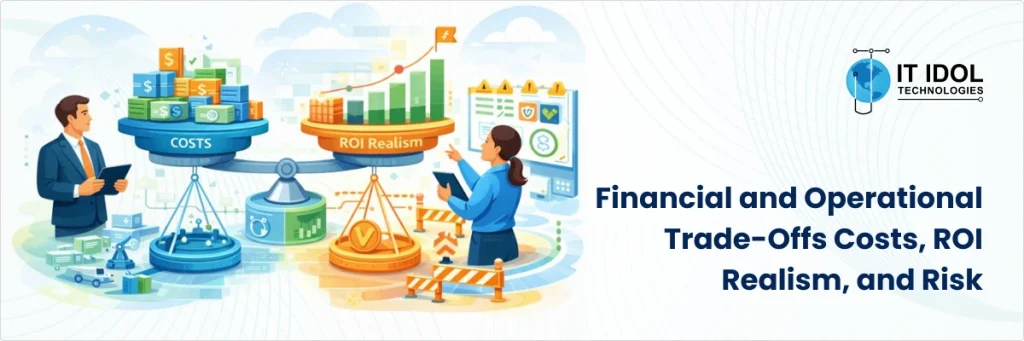
Financial and Operational Trade-Offs Costs, ROI Realism, and Risk
Rethinking Cost Structures
Cloud economics are familiar: pay-as-you-go compute, storage tiers, usage-based billing. These models are predictable in the context of analytics workloads. But when intelligence moves into physical environments, cost structures change fundamentally.
Investing in network infrastructure and redundancy
Engineering integration with legacy control systems
Supporting on-site maintenance and updates
These are not purely operational expenses; they include capital expenditures and ongoing amortisation of physical assets. Moreover, the total cost of ownership includes risk mitigation expenditures, such as safety certifications, continuous testing, and audit trails.
Moreover, the total cost of ownership includes risk mitigation expenditures, such as safety certifications, continuous testing, and audit trails.
Enterprises must adopt a more nuanced view of ROI. ROI is not simply efficiency gains divided by project cost. It must incorporate:
Reduced downtime and its financial impact
Risk exposure and mitigation savings
Value of responsiveness and customer satisfaction
Competitive positioning over a multi-year horizon
Traditional financial models that expect immediate cost savings from automation projects will misinterpret the value creation curve of physical intelligence initiatives.
Risk, Resilience, and Operational Continuity
Physical intelligence introduces new risk vectors. Systems that act on the physical world can cause harm if they malfunction. Risk management must expand beyond data privacy and cybersecurity to include:
Safety engineering
Physical system redundancy
Fail-safe behaviour under degraded conditions
Operational continuity becomes a risk metric. When AI drives critical actions, enterprises must plan for contingencies: What happens when a model fails at the edge? When connectivity is lost? When hardware breaks?
These scenarios are not theoretical. In logistics hubs and manufacturing floors, even short downtime can cost millions. Investments in resilience, redundant compute paths, fallback control logic, and human override mechanisms are essential but often underestimated.
Financial planning must account for these costs explicitly. CFOs should treat physical intelligence initiatives with a risk-adjusted lens, acknowledging that predictable cloud bills are replaced with variable, context-dependent operational expenditures.
Long-Term Platform vs Short-Term Execution
The allure of quick pilots can be dangerous. Pilots that prove technical feasibility without delivering sustained operational value waste capital and erode confidence. Leaders must balance short-term execution with long-term platform thinking.
Physical intelligence can’t be bolted on like a dashboard. It must be woven into the enterprise architecture in a way that supports composability, governance, and scalability. This requires a platform mindset: common services for model deployment, shared data schemas, unified security postures, and consistent operational policies.
The tension is real: leaders feel pressure for quick wins, yet the true payoff of physical intelligence accrues over years, not quarters. Managing expectations internally, especially with boards and investors, is crucial. Transparency about timelines, risk, and capability maturation will prevent reactive, short-sighted decisions that undermine strategic value.
Closing: A New Decision Lens
The emergence of physical intelligence represents more than a technological shift; it forces enterprises to redefine where value is created, how decisions are made, and what constitutes competitive durability. Leaders anchored in cloud-centric paradigms risk missing the deeper implications: that intelligence is most powerful where it shapes real-world outcomes.
This isn’t a manifesto for rejecting cloud AI. The cloud remains indispensable. It’s the strategic fulcrum for heavy computation, centralised governance, and collective learning. But it no longer defines the boundaries of intelligence. That boundary is where computation, perception, and action converge at the systems that run factories, fleets, grids, and facilities.
Thinking in this dual topology requires leaders to confront structural trade-offs they may have long ignored: latency vs. centralisation, governance vs autonomy, short-term wins vs durable capability. Success will go to those who see physical intelligence not as an add-on, but as an essential dimension of enterprise architecture and who build the organisational scaffolding to support it.
Leaders must adopt a sharper decision lens, one that balances cloud and physical layers, aligns incentives across functional domains, and measures value not just in cost saved, but in resilience gained, risk mitigated, and outcomes delivered where it matters most.
FAQ’s
1. What is physical intelligence in enterprise contexts?
Physical intelligence refers to AI systems that interact directly with the physical world, making real-time decisions at the edge of operations.
2. Why can’t cloud AI alone deliver operational value?
Cloud AI excels at centralized compute and analysis, but it struggles with the latency, connectivity, and real-time responsiveness required in physical systems.
3. How does physical intelligence change enterprise architecture?
It necessitates hybrid topologies where edge nodes perform inference and control, while central systems handle training and global coordination.
4. What organisational changes are needed for physical intelligence?
Enterprises must bridge IT and OT, align incentives to reduce decision latency, and cultivate cross-domain talent.
5. Are cloud platforms still relevant to physical intelligence?
Yes. Cloud remains crucial for heavy computing, model training, and governance, but it becomes part of a distributed intelligence fabric.
6. How should leaders assess ROI for physical intelligence?
ROI must include operational impact, risk mitigation, resilience, and long-term platform value, not just upfront cost savings.
7. What governance considerations are unique to physical intelligence?
Safety, compliance, local autonomy thresholds, and auditability across distributed systems become central governance concerns.
8. Can traditional IT teams implement physical intelligence projects?
Not without close collaboration with OT and investments in new skills like real-time systems engineering and control logic.
9. What risks does physical intelligence introduce?
Beyond cybersecurity, it introduces operational and safety risks that require redundancy, fail-safe design, and continuous monitoring.
10. How do enterprises scale physical intelligence systems?
By building consistent platform services, interoperability standards, and governance frameworks that work across distributed environments.
Parth Inamdar is a Content Writer at IT IDOL Technologies, specializing in AI, ML, data engineering, and digital product development. With 5+ years in tech content, he turns complex systems into clear, actionable insights. At IT IDOL, he also contributes to content strategy—aligning narratives with business goals and emerging trends. Off the clock, he enjoys exploring prompt engineering and systems design.