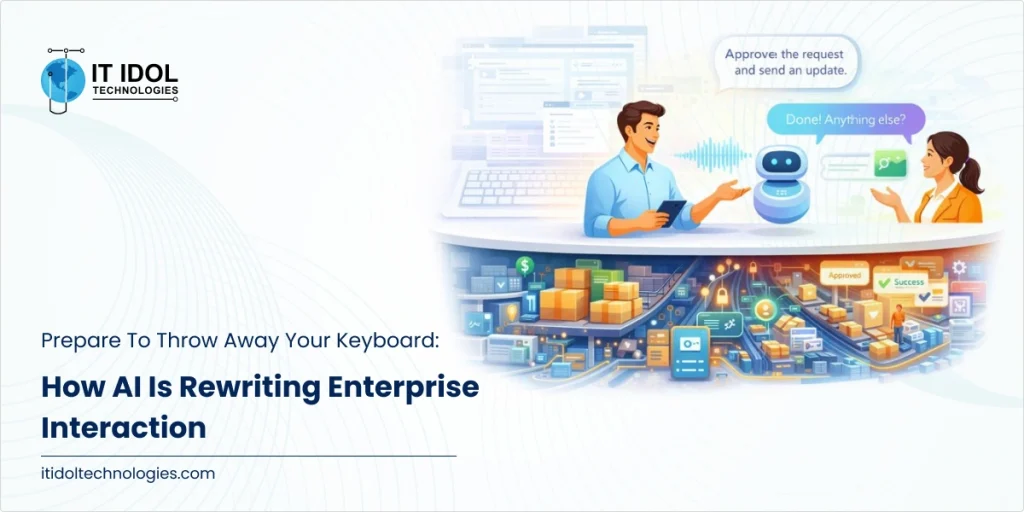
AI is not replacing hardware outright; it is removing hardware from the centre of how work gets done.
Keyboards, screens, buttons, and storage are becoming secondary as intent-driven interaction takes over.
Enterprise risk and value now sit in orchestration, governance, and decision logic not devices.
IT leaders must redesign systems around intent, context, and outcomes, not interfaces.
When Work Stops Starting With a Keyboard
For decades, enterprise computing has begun the same way. Sit down. Wake the screen. Place your hands on a keyboard. Everything that followed applications, workflows, security controls, and productivity metrics assumed that human intent would arrive one keystroke at a time.
That assumption is quietly breaking.
Not because keyboards are suddenly bad tools, but because AI has introduced a fundamentally different way for systems to understand what a user wants.
Increasingly, software no longer needs a sequence of inputs. It can infer intent from speech, context, history, and behaviour. The implication is subtle but profound: interaction is shifting from command execution to intent interpretation.
This is not a user-experience tweak. It is a structural change in how work begins, flows, and completes inside digital systems.
From Tools to Intent: the Shift Most Enterprises Haven’t Modelled
Enterprise IT has lived through interface changes before. Command lines gave way to graphical interfaces. Graphical interfaces absorbed touch. Each shift lowered the skill required to operate software, but the underlying model stayed the same: humans explicitly told machines what to do.
AI breaks that continuity.
Modern AI systems do not wait for perfect instructions. They operate probabilistically. They combine partial signals, spoken requests, prior activity, organisational context, and even timing, to arrive at a reasonable next action. In other words, the system meets the user halfway.
Once that becomes reliable enough, the physical mechanism used to express intent becomes less important. A keyboard is just one possible signal among many. Voice, gaze, gesture, and inferred context become equally valid and often faster paths into execution.
For enterprises, this reframes the conversation. The question is no longer “Which input device is best?” but “How directly can intent flow into outcomes?” Every layer that slows that flow becomes a candidate for redesign.
Why Keyboards Are the First Obvious Pressure Point
Keyboards sit at the centre of modern work, not because they are optimal, but because they were once necessary. They offered precision, repeatability, and compatibility across systems. Those strengths still matter, but their monopoly is fading.
AI-driven natural language systems can now translate loosely phrased requests into structured actions: drafting documents, querying systems, generating code, summarising meetings, and triggering workflows. Computer vision and sensor fusion allow systems to recognise gestures, posture, and attention. Context engines remember what a user is working on and why.
The result is that many tasks no longer require explicit typing at all. A user can describe an outcome rather than assemble it step by step. The system fills in the mechanics.
In practice, this changes how work feels. Instead of stopping to “operate software,” users stay within the problem they are solving. Interaction becomes conversational and continuous rather than interrupt-driven.
From an enterprise perspective, this has cascading effects:
Time compression: fewer micro-steps between intent and execution.
Skill redistribution: less dependence on interface mastery, more focus on judgment.
Standardisation pressure: AI normalises inputs across applications, reducing the importance of app-specific shortcuts and commands.
Keyboards don’t disappear in this model, but they lose their status as the default gateway into systems.
The Counter-Reality: Why Keyboards Won’t Vanish (and Why That’s Not the Point)
It would be naïve to argue that keyboards are about to vanish from enterprise environments. Certain tasks still demand them.
Precision-heavy work, complex coding, financial modelling, and regulated documentation often benefit from tactile feedback and deterministic input. Many industries operate under compliance regimes that require explicit, reviewable actions. Legacy systems are deeply optimised around typed input and will remain so for years.
All of that is true.
But it misses the more important shift.
What changes is not whether keyboards exist, but where they sit in the hierarchy of interaction. They move from the primary interface to the fallback mechanism. From the default starting point to a specialised tool.
This distinction matters because enterprise systems are designed around defaults. Training programs, endpoint strategies, security assumptions, and productivity metrics all reinforce whatever interface is considered primary. Once that centre of gravity moves, even partially, everything around it starts to realign.
The organisations that struggle with this transition will not be the ones that “lose keyboards.” They will be the ones that keep designing workflows that assume every task begins with typing, even as employees increasingly bypass that path.
Intent as Infrastructure, Not Convenience
There is a tendency to frame voice and AI interaction as convenience features, nice to have, but optional. That framing underestimates what is happening.
When intent becomes machine-readable, it becomes infrastructure. It can be logged, analysed, governed, and optimised.
Systems can learn not just what users did, but what they were trying to do when friction appeared. That insight was largely invisible in keyboard-centric environments.
Once intent is elevated to a first-class signal, enterprises gain new levers:
Workflows can adapt in real time based on user goals.
Security policies can evaluate purpose, not just actions.
Automation can be triggered earlier, before a task is fully specified.
None of this requires eliminating keyboards. It requires decentering them.
The Strategic Question for IT Leaders
The real question facing CIOs and CTOs is not whether to support new input methods. Most already do, experimentally or informally. The question is whether core systems are being redesigned to treat intent as the primary unit of interaction.
If they are not, AI becomes an overlay useful, but constrained by interfaces built for a different era. If they are, keyboards naturally recede without being forcibly removed.
This is why the conversation belongs at the architecture and operating-model level, not in device procurement discussions.
Once intent flows more directly into systems, hardware starts to matter less, and the rest of the enterprise stack starts to change with it.
“Voice interfaces and soft keyboards on mobile/tablets are growing quickly, indicating a broader preference shift away from typing in certain contexts, even as physical keyboards remain important in enterprises.”
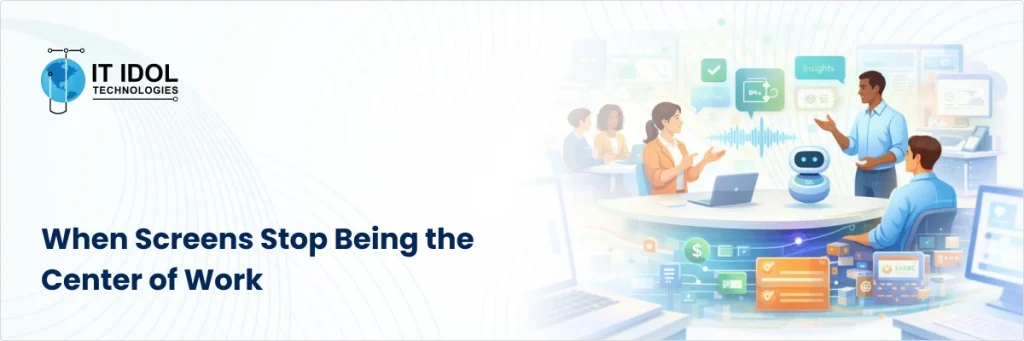
When Screens Stop Being the Centre of Work
If keyboards are the most visible input device under pressure, screens are the most taken-for-granted output device. Enterprise computing still assumes that work happens on a display, one person, one desk, one or more monitors arranged just so. Entire productivity ecosystems are optimised around this geometry.
AI, combined with spatial computing, is quietly loosening that assumption.
The shift is not about replacing monitors with headsets tomorrow. It is about breaking the idea that information must be flattened onto rectangles to be usable.
Screens Were a Constraint, Not a Goal
Monitors became central because they solved a problem: how to present complex information in a way humans could process. Over time, they hardened into infrastructure. Applications were designed for fixed resolutions. Security models assumed visible sessions. Collaboration assumed everyone was “looking at the same screen.”
But screens were always a compromise. They forced three-dimensional work into two dimensions. They required users to switch windows, tabs, and contexts constantly. They made spatial reasoning so natural to humans unnaturally abstract.
AI changes this by handling the cognitive overhead that screens once managed. Instead of users navigating information, systems can surface what matters based on task, role, and moment. The display no longer needs to show everything, all the time.
This is where virtualised and spatial work environments begin to matter not as futuristic novelties, but as practical responses to information overload.
Virtual Workspaces: From More Screens to Fewer Interruptions
Early experiments in virtual workspaces focused on abundance: infinite monitors, floating dashboards, immersive rooms. That framing missed the point. The real value is not more visual real estate, but better prioritisation.
AI-managed workspaces can decide:
Which information deserves persistent visibility
What can remain latent until needed
When attention should shift and when it should not
In this model, “screens” become dynamic surfaces rather than fixed hardware. A user may interact with multiple information layers, but only a subset is rendered at any moment. The rest exists as context, retrievable instantly without visual clutter.
For enterprises, this has subtle but important consequences. Productivity stops being measured by how much information is visible and starts being measured by how little unnecessary information interrupts decision-making.
The Hidden Cost of Physical Workspaces
The conversation around screens often gets trapped in experience design. What it misses is the economic layer.
Physical displays come with lifecycle costs that are rarely questioned:
Procurement and refresh cycles
Desk space and ergonomics
Power consumption and heat
Support complexity across remote and hybrid teams
Multiply this across thousands of employees, and screens become a material line item, not just a convenience. They also anchor work to specific locations. Even in hybrid models, productivity is implicitly optimised for “desk time.”
AI-managed virtual workspaces change the math. Once displays are abstracted, the marginal cost of adding another “workspace” drops dramatically. Onboarding accelerates. Role-based environments can be provisioned instantly. Work continuity improves because context travels with the user, not the desk.
This is not about eliminating monitors to save money. It is about reducing the structural dependency on physical setups that slow adaptation.
Collaboration Without the Shared Screen Myth
One of the strongest arguments for traditional displays is collaboration. Shared screens feel concrete. Everyone can see the same thing.
AI challenges that assumption by enabling shared context without shared visuals. Participants no longer need identical views; they need aligned understanding. AI can summarise, translate, highlight discrepancies, and track decisions across participants, even if each person interacts differently.
In practice, this means collaboration becomes less about synchronising interfaces and more about synchronising intent and outcomes. Meetings produce fewer artefacts but clearer decisions. Follow-ups are generated automatically. Visual alignment becomes optional rather than mandatory.
This does not eliminate screens, but it changes their role. They support collaboration rather than define it.
Why This Matters More Than It Seems
The decline of screen-centric work is not a hardware story. It is an organisational one.
When work is no longer anchored to physical displays:
Location matters less, but governance matters more
Accessibility improves, but control must be redesigned
Flexibility increases, but accountability needs new signals
Enterprises that treat screens as immutable infrastructure will keep optimising around them, adding more monitors, more dashboards, more tools, while employees quietly route around them using AI assistants and secondary devices.
Those who recognise screens as one possible output among many will start designing systems where information adapts to the worker, not the other way around.
This is the inflexion point. Not the disappearance of monitors, but the end of their monopoly on attention.
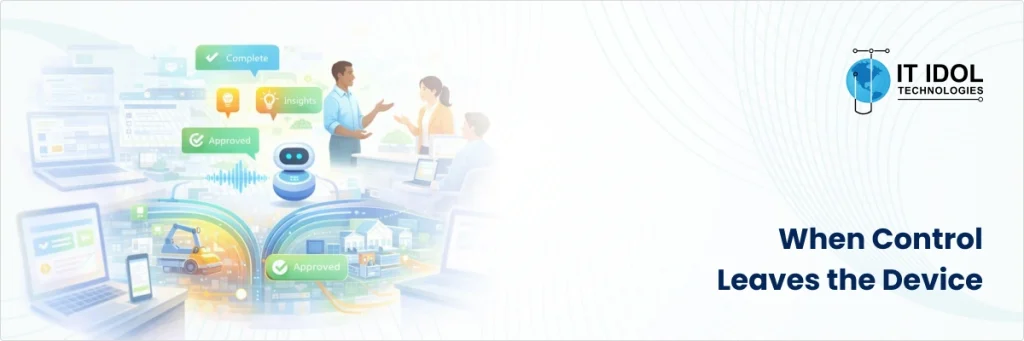
When Control Leaves the Device
Remote controls, buttons, switches, and even dedicated input panels have long served a single purpose: translate human intention into machine action in a controlled, observable way. Press this. Toggle that. The system responds. Cause and effect are visible, auditable, and localised to a device.
AI breaks that containment.
As intent-driven interaction becomes viable, control migrates away from hardware surfaces and into orchestration layers that sit above devices. Voice assistants, context engines, and automation frameworks increasingly decide when an action should happen, not just how it is triggered.
This is where many enterprises begin to feel uneasy, and rightly so.
From Explicit Commands to Implied Action
Traditional controls assume a clear boundary. A user presses a button. The system executes a predefined response. Responsibility is easy to assign.
AI-mediated systems operate differently. A spoken request may trigger multiple downstream actions. A gesture may be interpreted differently depending on context. In some cases, systems act proactively, without a direct command at all.
This is not accidental overreach. It is the logical outcome of systems designed to reduce friction. If AI can predict what a user is trying to accomplish, waiting for a manual trigger becomes inefficient.
In consumer environments, this often looks like convenience. In enterprise environments, it looks like a risk unless it is deliberately governed.
Why Physical Controls Are Losing Strategic Importance
Buttons and switches persist because they offer certainty. They are deterministic. They fail visibly. They make accountability straightforward.
But they also fragment control. Each device becomes its own island of interaction, with its own logic, permissions, and failure modes. As enterprises adopt more connected systems, smart facilities, autonomous equipment, and intelligent endpoints, that fragmentation becomes expensive to manage.
AI-driven control systems unify these islands. Instead of interacting with each device individually, users express intent at a higher level: secure the floor, prepare the room, initiate the workflow. The system decides which devices need to respond.
In this model, physical controls do not disappear. They become overridingly important, but secondary. The strategic control plane moves upstack.
The Governance Gap No One Can Ignore
Here is where the narrative often breaks down.
When interfaces disappear, visibility disappears with them unless it is deliberately reintroduced elsewhere. Enterprises that adopt intent-based control without rethinking governance risk create systems that act intelligently but opaquely.
New risks emerge:
Intent ambiguity: Did the system interpret the request correctly?
Action chaining: One inferred action triggers several others.
Spoofing and manipulation: Voice and gesture can be imitated.
Attribution loss: Who approved what, and when?
These risks are not reasons to slow adoption. There are reasons to move control up the stack, not leave it embedded in devices.
Effective governance in this environment requires different primitives:
Intent logging instead of button presses
Policy boundaries instead of hard-coded commands
Traceability of AI decisions, not just outcomes
Human-in-the-loop checkpoints for high-impact actions
Without these, enterprises end up compensating by reintroducing manual controls, undoing the very efficiency gains AI promised.
Control as an Enterprise Capability, Not a UI Feature
The deeper shift here is conceptual. Control is no longer a property of an interface. It is a property of the system as a whole.
This forces uncomfortable but necessary questions:
Where does authority reside when actions are inferred?
How much autonomy is acceptable in different contexts?
Which decisions must remain explicitly human?
Answering these questions requires cross-functional alignment of IT, security, operations, and legal, not just better interfaces.
The organisations that navigate this well will not be the ones with the most advanced AI. They will be the ones who treat control as a design discipline, not an afterthought.
Physical buttons will still exist. Remote controls will still ship. But their role will be symbolic rather than central assurance mechanisms in a world where intelligence, not hardware, does most of the work.
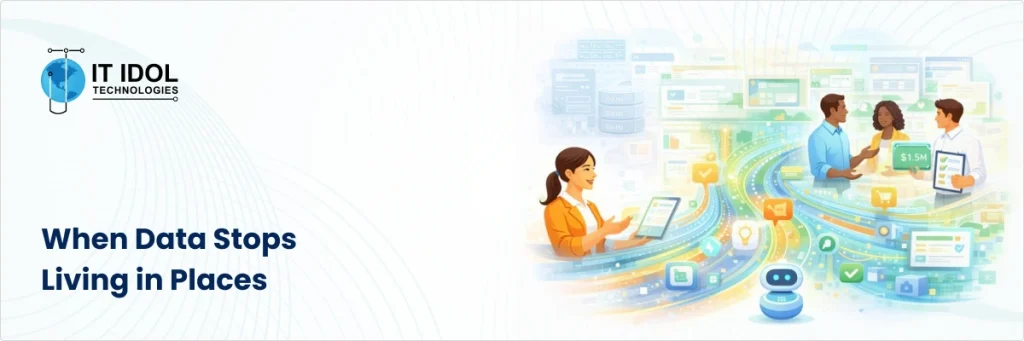
When Data Stops Living in Places
Few enterprise concepts feel as concrete as storage. Files live somewhere. Systems point to locations. Access is granted or denied based on where the data resides. Entire governance models are built on this spatial logic.
AI quietly dissolves it.
As intelligence moves closer to the user’s intent, data stops behaving like an object that must be retrieved and starts behaving like a resource that is made available. Location becomes an implementation detail, not a decision point.
From Files to Availability
Traditional storage models assume that users know what they are looking for and where it lives. They navigate folders, mount drives, request access, and manage versions. This works when work is document-centric and linear.
AI-driven systems invert the flow.
Instead of asking users to find data, systems assemble the relevant information automatically based on task, role, and context. The user no longer opens files. They ask questions, request outputs, or initiate decisions, and the system pulls what it needs from wherever it resides.
This shift is subtle but destabilising. Once users stop thinking in terms of files, many long-standing storage assumptions begin to erode:
Folder hierarchies lose meaning
File ownership becomes ambiguous
“Latest version” stops being a visible concept
What matters instead is confidence: that the information presented is complete, current, and appropriate for the decision at hand.
Data Location Is Becoming an Implementation Detail
In AI-mediated environments, systems optimise for latency, relevance, and compliance automatically. Data may be cached locally, streamed from the cloud, reconstructed from minimal signals, or synthesised on demand. The user does not and increasingly cannot tell the difference.
For enterprises, this reframes storage strategy. The old questions on-prem versus cloud, centralised versus distributed, do not disappear, but they recede from daily operations. They become architectural choices rather than user-facing constraints.
The risk is not loss of control, but misplaced control. Organisations that continue to manage storage primarily through location-based rules will find themselves enforcing policies that users no longer understand or experience directly.
Why Traditional Storage Metrics Start to Fail
As data becomes abstracted, familiar KPIs lose relevance.
Capacity utilisation says little about decision readiness. Access frequency does not reflect value. Backup success does not guarantee usability.
AI-driven work environments reward different measures:
Time to insight
Confidence in data completeness
Decision latency under uncertainty
Ability to surface relevant information without explicit search
These metrics align poorly with file-based thinking but closely with business outcomes. They also expose a gap: many enterprises have invested heavily in storage infrastructure without investing equally in data interpretation and relevance.
AI makes that imbalance visible.
Governance Without Geography
The immediate concern this raises is governance. If data is everywhere and nowhere, how is it controlled?
The answer is that governance moves from geography to policy. Instead of enforcing rules based on where data sits, enterprises enforce rules based on:
Who is asking
Why are asking
What decision is being supported
What downstream actions may follow
This requires richer context and stronger identity frameworks, not tighter storage silos. It also requires accepting that visibility must be reconstructed through logs, lineage, and intent tracking, not through folder trees and access lists.
Organisations that resist this shift often respond by locking data down further. The result is predictable: users route around controls using AI tools that pull information indirectly, creating shadow flows that are harder to govern than the original problem.
Storage as Decision Enablement
The strategic reframing is this: storage is no longer about preservation. It is about enablement.
AI turns stored data into a live asset, one that is continuously evaluated for relevance, risk, and usefulness. The value of storage lies not in how safely data is kept, but in how reliably it can inform action when needed.
Enterprises that internalise this will start investing differently. Less emphasis on managing where data lives. More emphasis on ensuring that when intent arises, the right information surfaces quickly, correctly, and within policy.
This is the quiet disappearance of another physical metaphor. Not because storage vanishes, but because its presence is no longer felt by the people doing the work.
When Hardware Becomes Invisible and Strategy Can’t
Across keyboards, screens, controls, and storage, a pattern has emerged. AI does not destroy hardware. It makes it disappear from conscious interaction.
What fades is not the device itself, but its role as the focal point of work. Hardware retreats into the background while intelligence moves forward. For enterprises, this is the most dangerous moment, not because the technology is immature, but because the shift is easy to misread as incremental.
It isn’t.
The Rise of Invisible Hardware
“Invisible hardware” does not mean less hardware. It means hardware that no longer demands attention.
Sensors replace buttons. Minimal displays replace multi-monitor rigs. Lightweight compute replaces specialised devices. Cameras become software-defined. Storage becomes ambient. Interaction flows through intent, not interfaces.
In this model, hardware serves three functions only:
Sensing: capturing signals from the environment and the user
Compute: providing just enough processing to support AI inference
Connectivity: staying continuously linked to orchestration layers
Everything else, the complexity, the logic, the decision-making moves up the stack.
This is why many traditional devices feel increasingly redundant. Not because they stop working, but because they duplicate capabilities that AI can provide more flexibly without physical constraints.
A Framework for What Comes Next: The Invisible Hardware Stack
To make this shift actionable, it helps to reframe enterprise architecture around three layers that reflect how work is actually evolving.
1. Interaction Layer (Intent Capture)
This is where human intent enters the system: voice, gesture, gaze, behaviour, context. The goal is not precision input, but a sufficient signal for interpretation.
2. Orchestration Layer (Context and Decision Logic)
AI lives here. It interprets intent, manages workflows, prioritises actions, applies policy, and coordinates across systems. This layer determines whether invisible hardware feels empowering or uncontrollable.
3. Minimal Hardware Layer (Execution and Feedback)
Sensors, endpoints, and compute resources execute decisions and provide feedback. They are interchangeable, replaceable, and deliberately unremarkable.
Enterprises that still design from the bottom up, starting with devices and working upward, will struggle. The ones that design from the orchestration layer outward will find that hardware choices become simpler, cheaper, and less strategic over time.
Why This Forces New Leadership Decisions
This transition exposes a leadership gap.
Most IT organisations are structured to manage assets: endpoints, networks, applications, and storage. Invisible hardware shifts the emphasis toward managing behaviour: how systems act on intent, how decisions propagate, how accountability is preserved when interaction is indirect.
This has implications that extend beyond IT:
Security must evaluate intent and outcome, not just access.
Procurement must prioritise adaptability over specifications.
Workforce design must assume tools will change faster than roles.
Governance must become continuous rather than checkpoint-based.
None of these changes is driven by a single device upgrade. They are driven by a recognition that interaction itself has become programmable.
What This Means for CIOs, CTOs, and IT Leaders
The most important takeaway is not to rush toward new interfaces. It is to stop optimising for old ones.
Practical steps begin with uncomfortable questions:
Which workflows assume typed input when intent would suffice?
Where do controls live today in devices, or in policy?
Which metrics reflect infrastructure health rather than decision effectiveness?
How much of the user experience is designed, and how much is accidental?
Pilots should focus less on hardware experiments and more on intent-based workflows: voice-first operations, AI-mediated collaboration, context-aware access, and automated decision support. These surface architectural gaps will occur far faster than device rollouts ever will.
The Keyboard Is Not the Story
It is tempting to anchor this conversation on the keyboard because it is familiar, visible, and symbolic. But the keyboard is just the opening act.
The real story is that enterprise computing is shedding its physical rituals. Work no longer needs to begin with a device. It begins with intent. Everything else, screens, controls, storage, even hardware itself, reorganises around that fact.
Organisations that recognise this early will redesign work around intelligence rather than tools. Those that don’t will keep investing in interfaces that employees increasingly ignore.
The future of enterprise technology will feel quieter, less tactile, and far more fluid. And that is precisely why it demands more deliberate strategy, not less.
FAQ’s
1. Is AI really making keyboards obsolete in enterprises?
Not obsolete, but secondary. Keyboards remain essential for precision tasks, compliance-heavy work, and legacy systems. What’s changing is their role, from default interface to fallback tool, while intent-driven interaction becomes primary.
2. Why is intent more important than interfaces now?
AI systems can interpret goals from partial signals like voice, context, and behaviour. This reduces friction between what users want and what systems execute, making explicit step-by-step input less critical.
3. Are screens actually going away in enterprise environments?
Screens will persist, but they lose their monopoly. AI-managed workspaces reduce dependence on fixed displays by surfacing only relevant information when needed, rather than everything all the time.
4. How does this shift affect enterprise collaboration?
Collaboration moves from shared visuals to shared context. AI aligns understanding, tracks decisions, and generates follow-ups even when participants interact through different interfaces.
5. What are the biggest risks of intent-driven systems?
Key risks include intent misinterpretation, action chaining, spoofing, and loss of accountability. These require governance models focused on intent logging, traceability, and policy-driven controls.
6. How does AI change data storage strategy?
Users stop thinking in terms of files and locations. Data becomes something systems assemble on demand based on relevance, role, and task, making location an architectural concern rather than a user concern.
7. Do traditional storage KPIs still matter?
Less than before. Metrics like capacity or access frequency matter less than time to insight, confidence in completeness, and decision speed, which outcomes AI-enabled systems directly influence.
8. What is “invisible hardware”?
It refers to hardware that still exists but no longer demands attention. Sensors, compute, and connectivity remain, while interaction and decision-making move into AI orchestration layers.
9. How should CIOs and CTOs respond to this shift?
By focusing less on device upgrades and more on intent-based workflows, orchestration architecture, governance frameworks, and metrics tied to decisions rather than usage.
10. What’s the biggest mistake enterprises can make right now?
Optimising old interfaces instead of redesigning interaction models. The risk isn’t losing keyboards or screens, it’s building systems around assumptions users and AI are already bypassing.
Parth Inamdar is a Content Writer at IT IDOL Technologies, specializing in AI, ML, data engineering, and digital product development. With 5+ years in tech content, he turns complex systems into clear, actionable insights. At IT IDOL, he also contributes to content strategy—aligning narratives with business goals and emerging trends. Off the clock, he enjoys exploring prompt engineering and systems design.