Traditional automation has limits: Tools like RPA and rule-based workflows work well for predictable tasks but struggle with exceptions, incomplete data, and context-dependent decisions.
Complex enterprise processes require interpretation: Many operational workflows involve judgment, coordination across systems, and collaboration between teams.
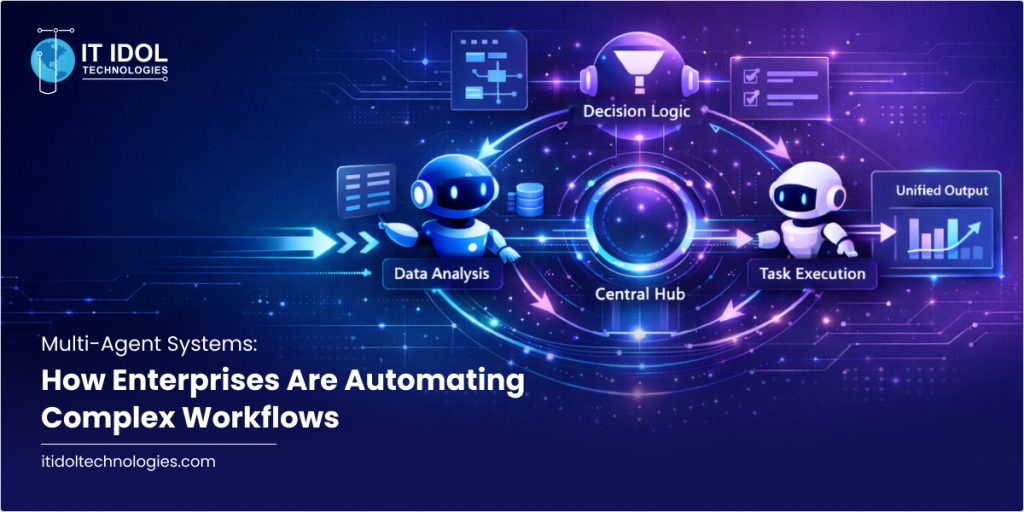
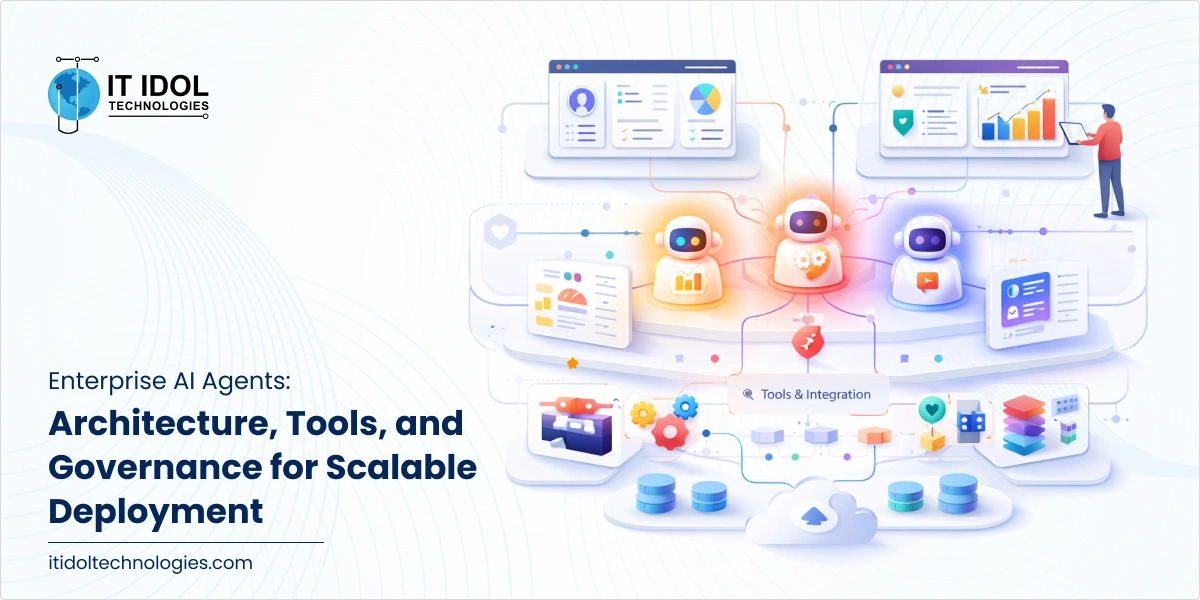
Multi-agent systems introduce a new automation model: Instead of one rigid workflow, multiple specialized AI agents collaborate to complete complex processes.
Agents perform distinct roles: Examples include data retrieval, contextual analysis, policy evaluation, and executing actions within enterprise systems.
Automation shifts from task replacement to workflow orchestration: The focus moves toward coordinating entire processes rather than automating isolated steps.
AI advancements make this possible: Large language models and modern AI systems can interpret unstructured information and support contextual reasoning.
Enterprise IT environments are ready: APIs, microservices, and event-driven architectures enable agents to interact with systems across the enterprise stack.
Orchestration becomes critical: Enterprises need a control layer to manage agent interactions, workflow state, and decision flows.
Governance and oversight remain essential: Monitoring, context management, and human review are required to ensure reliability and compliance.
The future of automation is collaborative: Multi-agent systems allow enterprises to automate complex workflows that previously required human coordination.
When Automation Meets the Real World
A few years ago, I was in a meeting with an operations team at a large financial services company reviewing an automation initiative that had been running for almost eighteen months. On paper, the project looked successful. Several robotic process automation bots had been deployed, a workflow engine was orchestrating approvals, and multiple back-office tasks had been automated.
But the reality was more complicated.
Every time an exception appeared in the process, an incomplete customer record, a conflicting data field, or a regulatory flag, the entire workflow stalled. Someone had to step in, review the case, make a judgment call, and push the process forward manually.
Over time, the automation layer started to resemble a fragile chain of scripts and rules that worked well under predictable conditions but struggled the moment real-world variability entered the picture.
This situation is common inside large organizations. For years, enterprise automation has focused on replacing repetitive tasks. But many business processes are not simply sequences of predictable actions. They involve interpretation, coordination, and decision-making across multiple steps and teams.
As companies push automation further into operational workflows, they are discovering that traditional approaches start to break down when processes become complex. That realization is one of the forces behind the growing interest in multi-agent systems.
The Limits of Traditional Automation
Enterprise automation has historically been built around the idea of task replacement. If a process contains a repetitive step, the goal is to automate that step as efficiently as possible. Technologies like robotic process automation (RPA), workflow engines, and rule-based scripts have been widely adopted for exactly this purpose.
They work well when the process being automated follows a clear structure: inputs are predictable, decisions can be expressed as rules, and the sequence of steps rarely changes.
For example, processing standardized invoices, transferring data between systems, or triggering notifications based on predefined conditions are all ideal candidates for this kind of automation. The difficulty appears when organizations try to automate processes that involve multiple decision points, incomplete information, or collaboration between different functions.
Take a typical enterprise workflow, such as handling a complex customer service escalation. The process might involve gathering information from several internal systems, interpreting the context of a customer interaction, checking policy rules, coordinating with a compliance team, and communicating a resolution back to the customer.
Each step requires interpretation and judgment rather than simply executing predefined instructions. Traditional workflow tools can orchestrate steps, but they struggle when the process requires reasoning about context. As a result, companies often end up creating increasingly complicated rule trees or manual exception paths that undermine the original goal of automation.
Over time, automation initiatives start to accumulate layers of patches and workarounds. What began as a clean automation design becomes a brittle system that requires constant maintenance.
The fundamental limitation is that most traditional automation approaches treat processes as static sequences of tasks. Real business operations rarely behave that way.
The Emergence of Multi-Agent Systems
Multi-agent systems represent a different way of thinking about automation.
Instead of building a single automated workflow that attempts to handle every scenario, organizations can design multiple specialized agents that collaborate to complete a broader process. Each agent is responsible for a specific capability, retrieving information, analyzing context, making a recommendation, or performing an action within a system. The workflow then becomes a coordinated interaction between these agents.
For example, in a complex operational workflow, one agent might gather relevant data from internal systems, another might analyze the context of a request, a third might evaluate policy constraints, and a fourth might generate a response or trigger an operational action. What makes this model powerful is that it mirrors how many enterprise processes already operate with human teams.
Different roles contribute specific expertise to a shared objective, passing context and decisions between them as the work progresses.
Multi-agent systems replicate that structure in software. Instead of encoding every possible scenario into rigid rules, the system distributes responsibility across agents that can reason about context and collaborate dynamically.
This approach does not eliminate the need for structured workflows, but it allows workflows to adapt to complexity rather than forcing complexity into rigid automation structures.
From Task Automation to Workflow Orchestration
The rise of multi-agent architectures reflects a deeper shift in how enterprises think about automation. For years, the focus has been on automating individual tasks. Organizations identify a manual activity, introduce a tool to replace it, and measure success by the reduction in human effort required to complete that step.
But as digital operations become more complex, the real challenge is no longer individual tasks. It coordinates entire workflows that involve multiple systems, data sources, and decision points. Multi-agent systems push automation toward workflow orchestration rather than task replacement.
In this model, the automation layer is responsible for coordinating interactions between agents, maintaining context across steps, and ensuring that the overall process progresses toward completion. The agents themselves contribute specialized capabilities within that broader orchestration.
This begins to resemble an organizational structure rather than a linear process diagram. Each participant has a role, information flows between them, and the outcome emerges from collaboration rather than a rigid sequence of steps.
For enterprise technology teams, this introduces a new architectural layer: the orchestration layer that manages how agents interact, how context is shared, and how decisions move through the system. Designing this layer well becomes critical. Without clear orchestration, multi-agent systems can easily become chaotic collections of autonomous components.
Why This Shift Is Happening Now
Several forces are converging to make multi-agent systems a practical option for enterprises. The most obvious catalyst is the progress in large language models and related AI technologies.
These models can interpret unstructured information, reason through instructions, and generate structured outputs in ways that were difficult to achieve with traditional rule-based automation. That capability allows software agents to handle tasks that previously required human interpretation.
At the same time, enterprise operations have become far more complex. Modern organizations operate across dozens or even hundreds of interconnected systems, each containing partial views of operational data. Business processes increasingly span multiple functions, geographies, and regulatory environments.
Traditional automation tools were designed for a more predictable operational environment. As complexity grows, static workflows struggle to capture all the necessary decision paths. There is also increasing pressure to scale knowledge work.
Many operational processes rely on experienced employees who interpret context, navigate systems, and make decisions based on incomplete information. These tasks are difficult to automate with traditional methods, but they are precisely the areas where organizations face scaling constraints.
Multi-agent systems provide a way to distribute these responsibilities across software agents capable of reasoning about context and coordinating actions.
Finally, the broader shift toward platform-based architectures in enterprise IT has made it easier to experiment with modular automation approaches. APIs, event streams, and service-oriented systems provide the infrastructure needed for agents to interact with enterprise applications in flexible ways.
In other words, the technology environment is now mature enough to support this kind of architecture.
Practical Implications for Enterprises
While the concept of multi-agent systems is appealing, implementing them inside large organizations introduces several new challenges. One of the most important is orchestration. When multiple agents are involved in a workflow, there must be a clear mechanism for coordinating their activities.
This includes determining which agent should act at each step, managing the flow of information between agents, and resolving conflicts when agents produce competing outcomes. The orchestration layer effectively becomes the control system for the entire automation environment.
Another major consideration is context management. Agents need access to shared information about the state of a workflow, the data associated with a specific task, and the decisions that have already been made. Without reliable context management, agents may produce inconsistent or redundant actions. Monitoring and observability also become significantly more important.
Traditional automation systems typically execute deterministic processes, which makes their behaviour relatively predictable. Multi-agent systems introduce a degree of autonomy and reasoning that requires more sophisticated monitoring. Technology teams must be able to understand what agents are doing, why they made certain decisions, and how those decisions affect the overall workflow.
Human oversight is another critical component. In many enterprise environments, particularly those involving regulatory or financial risk, fully autonomous decision-making is not acceptable. Multi-agent systems must be designed to incorporate human review at appropriate points in the workflow.
This means designing processes where agents assist with analysis and recommendations while humans retain ultimate control over high-impact decisions. Finally, governance becomes an architectural concern. Enterprises need clear policies for how agents access data, how their behavior is constrained, and how outcomes are validated.
Without these safeguards, automation can create new operational risks rather than reducing them.
Strategic Considerations for Technology Leaders
For technology leaders evaluating multi-agent architectures, the most important question is not whether the technology works. The underlying capabilities are advancing rapidly, and experimentation is already happening across industries.
The more important question is where these systems create meaningful value. Multi-agent systems tend to be most effective in workflows that combine structured operations with contextual decision-making. Processes such as customer operations, compliance review, procurement workflows, and complex IT service management often fit this pattern. These environments already involve multiple participants who interpret information and coordinate actions across systems.
Another key consideration is how experimentation is approached. Multi-agent systems introduce new architectural patterns, and organizations benefit from exploring them in controlled environments before attempting large-scale deployment.
Pilot initiatives focused on well-defined workflows can help teams understand how agents behave in practice, where orchestration challenges emerge, and how governance mechanisms should be designed. Technology leaders should also think about long-term platform implications.
If multi-agent architectures become a core automation strategy, enterprises will likely need shared infrastructure for agent orchestration, context management, monitoring, and security.
In many ways, this resembles the early evolution of cloud platforms and microservices. The initial experiments often start within individual teams, but over time, organizations recognize the need for a centralized platform that supports consistent standards and tooling.
Designing that platform thoughtfully can determine whether multi-agent systems remain isolated experiments or evolve into a scalable enterprise capability.
The Next Phase of Enterprise Automation
Enterprise automation is entering a new phase. For years, the focus has been on replacing repetitive tasks with scripts, bots, and workflow engines. That approach delivered real efficiency gains, but it also revealed the limits of static automation models when processes become complex.
Multi-agent systems point toward a different future. Instead of trying to encode every possible decision into rigid workflows, organizations can design systems where specialized agents collaborate to interpret context, coordinate actions, and move work forward.
This shift does not eliminate the need for structure, governance, or human oversight. If anything, those elements become more important as automation systems grow more capable. But it does expand the range of workflows that can realistically be automated. For enterprises struggling to scale complex operational processes, that possibility is becoming increasingly difficult to ignore.
FAQ’s
1. What is a multi-agent system in enterprise automation?
A multi-agent system is an architecture where multiple specialized software agents collaborate to complete complex workflows. Each agent performs a specific role, such as data retrieval, analysis, or decision support, while an orchestration layer coordinates their interactions.
2. How do multi-agent systems differ from traditional automation?
Traditional automation typically relies on deterministic rules and linear workflows. Multi-agent systems distribute tasks across intelligent agents that can interpret context, collaborate dynamically, and adapt to variability in business processes.
3. Why are enterprises adopting multi-agent architectures?
Organizations are adopting them to automate complex workflows that involve decision-making, interpretation of unstructured data, and coordination across multiple systems, areas where traditional automation tools struggle.
4. What role do large language models play in multi-agent systems?
Large language models enable agents to understand natural language, interpret context, analyze documents, and generate structured outputs, allowing them to handle tasks previously requiring human judgment.
5. What types of enterprise workflows benefit most from multi-agent systems?
Processes involving multiple decision points and cross-system coordination, such as customer service escalation, compliance reviews, procurement operations, and IT service management, often benefit the most.
6. What is the orchestration layer in a multi-agent architecture?
The orchestration layer coordinates how agents interact, determines task sequencing, manages workflow state, and ensures that the overall process progresses toward completion.
7. How is context managed in multi-agent systems?
Context is maintained through shared data layers or workflow state management systems that allow agents to access relevant information about the task, prior decisions, and operational data.
8. Are multi-agent systems fully autonomous?
Not necessarily. Many enterprise implementations include human oversight for high-impact decisions, ensuring compliance, accountability, and operational control.
9. What challenges arise when implementing multi-agent systems?
Common challenges include designing effective orchestration mechanisms, maintaining shared context, ensuring observability, and implementing governance controls for security and compliance.
10. What is the future of multi-agent systems in enterprise technology?
As AI capabilities and enterprise platforms evolve, multi-agent systems are expected to become a foundational architecture for automating complex operational workflows and scaling knowledge-intensive processes.
Parth Inamdar is a Content Writer at IT IDOL Technologies, specializing in AI, ML, data engineering, and digital product development. With 5+ years in tech content, he turns complex systems into clear, actionable insights. At IT IDOL, he also contributes to content strategy—aligning narratives with business goals and emerging trends. Off the clock, he enjoys exploring prompt engineering and systems design.