Checkout infrastructure is a critical revenue driver, directly influencing e-commerce conversion rates and customer retention.
Complex checkout workflows, slow performance, and payment friction contribute to nearly 70% cart abandonment across digital commerce platforms.
Cash on Delivery (COD) continues to drive order volume in emerging markets, but significantly increases Return-to-Origin (RTO) and operational risks.
Omnichannel commerce demands checkout systems that integrate messaging platforms, social commerce, and real-time customer communication workflows.
API-first checkout architecture is essential for scalable integrations, high transaction volumes, and merchant-specific customization.
A rapidly growing commerce platform faced scalability, integration stability, and COD optimization challenges while supporting increasing merchant adoption.
IT IDOL Technologies strengthened backend infrastructure through REST API optimization, checkout customization frameworks, and plugin integrations.
Intelligent COD workflow enhancements improved order reliability and helped reduce fulfillment losses.
Platform performance optimization enabled support for high traffic loads while maintaining checkout stability and merchant onboarding efficiency.
Modern e-commerce success depends on treating checkout as a strategic infrastructure layer rather than a transactional endpoint.
Checkout Infrastructure Is Becoming the Biggest Revenue Risk in E-commerce
E-commerce companies today operate in an environment where customer expectations are shaped by instant gratification, personalized experiences, and seamless multi-channel engagement. While brands invest heavily in customer acquisition and marketing technology, checkout infrastructure often becomes the hidden bottleneck limiting revenue growth.
Industry research consistently shows that checkout friction remains one of the most expensive operational gaps for digital commerce platforms. According to Baymard Institute research, the average documented online cart abandonment rate is nearly 70%, with complicated checkout flows, limited payment flexibility, and performance issues cited as primary reasons for drop-offs.
Beyond user experience, checkout systems have evolved into complex transaction orchestration layers that must simultaneously handle payment processing, order validation, fraud detection, merchant customization, and communication workflows across multiple digital channels.
As transaction volumes grow and customer engagement expands across platforms like WhatsApp, Instagram, and social commerce ecosystems, checkout infrastructure must transform into a scalable, API-driven, high-availability system. Companies that fail to modernize checkout operations risk conversion loss, operational inefficiencies, and long-term brand trust erosion.
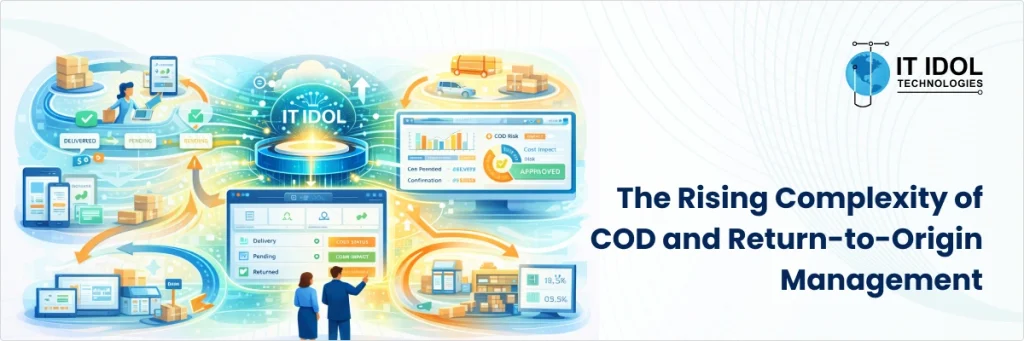
The Rising Complexity of COD and Return-to-Origin Management
In many high-growth digital commerce markets, Cash on Delivery (COD) remains a critical payment channel. COD lowers purchase barriers and expands digital accessibility, particularly among first-time buyers and customers in emerging markets.
However, COD introduces significant operational challenges. Industry analyses indicate that COD orders can drive Return-to-Origin (RTO) rates between 20% and 40% in certain markets, creating substantial logistics and fulfillment losses.
This creates a complex balancing act for e-commerce platforms:
Expanding COD accessibility while minimizing fraudulent or unreliable orders
Maintaining checkout speed while integrating verification workflows
Organizations that fail to optimize COD workflows often experience declining profitability despite rising order volumes.
Omnichannel Commerce Is Redefining Checkout Architecture
Today’s customers no longer interact with brands through a single digital touchpoint. Shopping journeys span multiple platforms, including messaging apps, social commerce channels, email campaigns, and traditional web storefronts. Salesforce research shows that over 73% of customers expect consistent interactions across all channels, making unified commerce infrastructure essential for competitiveness.
For commerce platforms, this means checkout systems must now integrate:
Transaction notifications across messaging ecosystems
Order tracking synchronization
Cross-platform identity verification
Marketing and engagement automation triggers
Real-time order orchestration across channels
Traditional checkout architectures were not designed to handle this level of distributed complexity, making backend modernization a strategic necessity rather than a technical upgrade.
Why Scalability and API Architecture Define Modern Commerce Platforms
Digital commerce infrastructure has shifted toward API-first ecosystems that allow seamless integrations between payment providers, logistics networks, marketing automation tools, and merchant-specific plugins. Gartner emphasizes that API-driven platforms are critical to enabling digital business expansion and supporting distributed ecosystem integration.
High-performing checkout systems must therefore support:
Real-time data exchange between external systems
High concurrency transaction handling
Flexible merchant onboarding frameworks
Plugin-based customization without platform instability
Continuous feature deployment without downtime
This shift requires deep engineering expertise and infrastructure optimization strategies that extend beyond traditional development approaches.
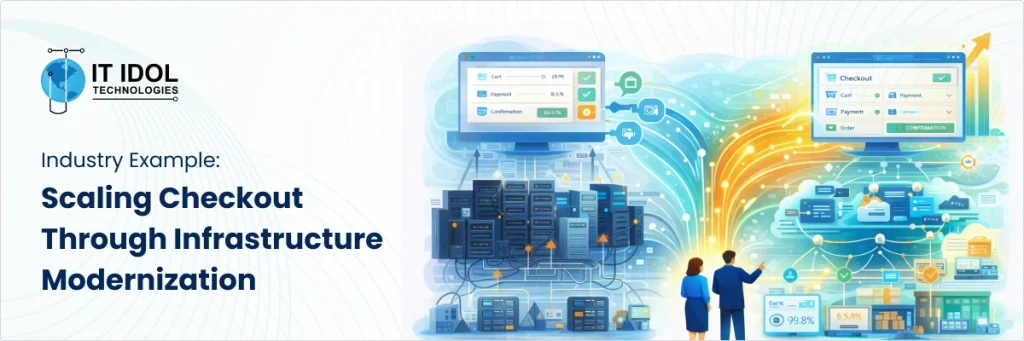
Industry Example: Scaling Checkout Through Infrastructure Modernization
A rapidly growing commerce enablement platform faced the industry-wide challenge of scaling infrastructure while maintaining merchant flexibility and multi-channel engagement.
To strengthen platform capabilities, the organization partnered with IT IDOL Technologies to enhance backend performance, integration architecture, and customization frameworks.
Rather than implementing isolated fixes, IT IDOL Technologies approached the transformation through platform-level modernization strategies.
Strengthening API and Integration Infrastructure
IT IDOL Technologies optimized REST API frameworks and webhook integrations to improve transaction reliability and real-time data synchronization. Strong API performance ensures stable communication between payment systems, logistics providers, merchant dashboards, and communication channels.
Improved API reliability reduces integration failures and enables faster feature expansion, allowing commerce platforms to scale merchant onboarding without increasing technical complexity.
Enabling Merchant-Level Checkout Customization
Balancing standardization with personalization is one of the most complex challenges in multi-merchant platforms. Different brands require unique checkout rules, payment workflows, shipping configurations, and verification processes.
By implementing flexible checkout customization frameworks, IT IDOL Technologies enabled platform-wide scalability while allowing merchant-specific configurations. This ensured operational stability while supporting brand differentiation and localized business requirements.
To address RTO challenges and improve fulfillment reliability, backend logic enhancements were introduced to strengthen COD workflows. These improvements supported stronger order verification, improved fraud detection, and optimized COD eligibility validation.
Intelligence-driven COD frameworks help reduce fulfillment losses while maintaining customer trust and accessibility, an increasingly important capability in COD-dominant markets.
Supporting Multi-Channel Commerce Integration
With digital engagement expanding beyond traditional storefronts, IT IDOL Technologies enhanced the platform’s ability to support seamless integrations across WhatsApp, social commerce channels, messaging workflows, and customer communication systems.
This unified communication infrastructure enabled merchants to deliver consistent engagement experiences while improving order transparency and communication efficiency.
Improving Platform Scalability and Performance Stability
To support high-volume transaction environments, backend optimizations were implemented using scalable PHP and Laravel frameworks combined with a secure plugin integration architecture.
These improvements strengthened platform stability during traffic spikes, promotional campaigns, and merchant onboarding surges ensuring checkout reliability remained consistent under high-demand conditions.
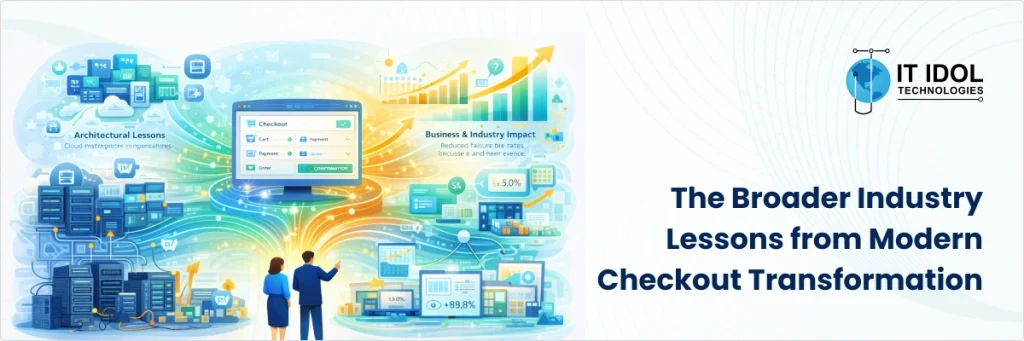
The Broader Industry Lessons from Modern Checkout Transformation
The transformation highlights a key industry shift: checkout is no longer a transactional endpoint; it is a strategic growth infrastructure layer.
Modern checkout ecosystems must support:
Real-time distributed transaction orchestration
Intelligent payment and COD decision engines
Merchant-level personalization frameworks
Omnichannel customer engagement integration
High-availability backend infrastructure
Companies that invest in checkout modernization often see measurable improvements in conversion rates, customer retention, operational efficiency, and merchant satisfaction.
Why Technology Partnerships Are Critical for Commerce Platform Evolution
Building enterprise-grade checkout infrastructure requires specialized expertise in distributed architecture, payment orchestration, API ecosystems, and high-performance backend optimization. Strategic technology partners play a vital role in helping commerce platforms scale faster while reducing operational risk.
The collaboration demonstrates how platform-focused engineering transformation can unlock measurable improvements in reliability, performance, and merchant enablement.
The Future of Checkout Infrastructure in Digital Commerce
As digital commerce continues expanding globally, checkout systems will evolve into intelligent orchestration layers powered by AI-driven verification, predictive fraud detection, and hyper-personalized payment experiences.
Platforms that prioritize scalability, customization, flexibility, and omnichannel integration will lead the next phase of e-commerce innovation. Organizations that delay infrastructure modernization risk falling behind in conversion optimization, operational efficiency, and customer experience competitiveness.
Conclusion
E-commerce growth is no longer driven solely by customer acquisition or marketing innovation. Checkout infrastructure has emerged as a critical revenue enabler that directly impacts conversion success, operational efficiency, and customer trust.
By strengthening backend architecture, enabling intelligent COD workflows, and supporting omnichannel commerce integration, IT IDOL Technologies helped transform checkout scalability and reliability within a rapidly evolving digital commerce landscape.
As commerce ecosystems grow more interconnected and customer expectations continue rising, companies that treat checkout modernization as a strategic priority will gain lasting competitive advantages in the digital economy.
FAQ’s
1. Why is checkout infrastructure critical for e-commerce platforms?
Checkout infrastructure directly impacts conversion rates, customer experience, and revenue generation. Slow or complex checkout systems increase cart abandonment and reduce customer trust.
2. What causes high cart abandonment rates in e-commerce?
Complicated checkout flows, limited payment options, slow performance, lack of trust signals, and forced account creation are leading contributors.
3. What is COD optimization, and why is it important?
COD optimization improves order verification, fraud prevention, and eligibility validation for Cash on Delivery transactions, helping reduce Return-to-Origin rates.
4. How do Return-to-Origin (RTO) orders impact profitability?
5. What role do APIs play in modern checkout systems?
APIs enable real-time communication between payment gateways, logistics platforms, merchant dashboards, and engagement tools, supporting scalability and integration.
6. Why is checkout customization important for multi-merchant platforms?
Different merchants require unique workflows and business rules. Customization ensures flexibility while maintaining system-wide stability.
7. How does omnichannel commerce influence checkout infrastructure?
Checkout systems must integrate across messaging platforms, social channels, and storefronts to ensure consistent experiences.
8. How did IT IDOL Technologies improve platform performance?
Through REST API optimization, backend modernization, checkout customization frameworks, plugin integrations, and enhanced COD workflows.
9. What technologies are commonly used for scalable checkout systems?
Frameworks like Laravel and PHP, API integrations, webhook systems, plugin-based architectures, analytics tools, and secure infrastructure.
10. What future trends will shape checkout systems?
Parth Inamdar is a Content Writer at IT IDOL Technologies, specializing in AI, ML, data engineering, and digital product development. With 5+ years in tech content, he turns complex systems into clear, actionable insights. At IT IDOL, he also contributes to content strategy—aligning narratives with business goals and emerging trends. Off the clock, he enjoys exploring prompt engineering and systems design.