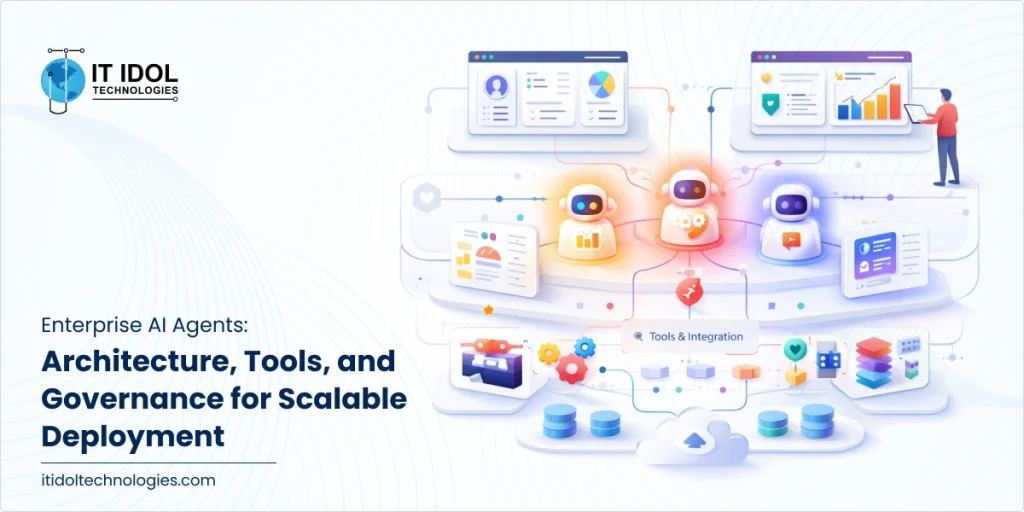
Enterprise AI agents shift software from rule-based automation to autonomous decision-making, allowing systems to interpret data, choose actions, and adapt workflows dynamically.
Scalable AI agent systems rely on four architectural components: perception (data intake), reasoning (model-driven decisions), action (system execution), and memory (context retention).
Multi-agent architectures enable complex enterprise automation, where specialized agents collaborate through hierarchical or swarm-based orchestration models.
Open-source frameworks such as LangChain, LlamaIndex, and AutoGen support flexible agent development, while managed platforms like Google Vertex AI Agents, Azure AI Foundry, and AWS Bedrock simplify enterprise deployment.
Enterprise data integration is critical, often using Retrieval-Augmented Generation (RAG) and vector databases to provide agents with accurate, real-time knowledge.
Security-first architecture is essential, requiring API gateways, zero-trust access models, and strict authentication for system integrations.
Governance frameworks address risks such as bias, hallucinations, and model drift, ensuring transparency and accountability in automated decisions.
Regulatory compliance is increasingly important, with standards such as the EU AI Act and GDPR shaping enterprise AI deployment strategies.
Successful implementation typically begins with low-risk pilot use cases, followed by gradual scaling supported by monitoring and performance metrics.
The future of enterprise AI agents will include multimodal capabilities, edge deployments, and deeper integration across operational systems.
The Enterprise AI Agent Revolution
Enterprise software has always been designed for predictability. Platforms like ERP, CRM, and supply chain systems run on clearly defined workflows: when inventory drops below a threshold, a purchase order is generated; when a support ticket is created, it moves through a predefined escalation path. For decades, this rule-driven approach has helped organizations maintain operational consistency at scale.
But real business environments rarely behave according to rigid rules.
Supply chains get disrupted. Customer demand shifts overnight. Systems fail in unexpected ways. When those moments occur, traditional software often reaches its limits. The workflows stop being sufficient, and human teams step in to interpret the situation, connect the dots across multiple systems, and decide what should happen next.
This is the gap AI agents are beginning to fill.
Instead of following fixed instructions, AI agents are designed to observe what is happening across business systems, analyze incoming signals, and determine the next best action. They operate with a level of contextual awareness that traditional automation lacks.
In a supply chain environment, for example, an AI agent could continuously analyze shipment data, supplier performance, and demand forecasts to recommend adjustments before disruptions escalate. In IT operations, agents can monitor system alerts, diagnose potential root causes, and initiate remediation steps automatically.
At their core, AI agents are autonomous software systems that can perceive information, reason about it, and act through connected tools, APIs, or enterprise platforms. They combine machine learning models, often large language models (LLMs), with structured data, external systems, and memory layers that allow them to maintain context and improve decisions over time. The result is software that does not simply execute workflows but actively participates in managing them.
Yet building these systems for enterprise use is far more complex than plugging an LLM into existing software. Reliability, security, governance, and integration with legacy infrastructure all become critical considerations. Organizations must design architectures that allow agents to operate safely within complex environments while maintaining visibility and control.
As more enterprises experiment with AI-driven automation, a new question is emerging: how do you move from isolated AI tools to scalable, production-ready AI agents that can operate within real business workflows?
This article explores that journey. We will look at how enterprise AI agents are structured, the tools used to build them, the governance models required to deploy them responsibly, and the architectural decisions that determine whether these systems succeed at scale.
Core Architecture of Enterprise AI Agents
For AI agents to operate reliably inside enterprise environments, they cannot be built as a single monolithic system. Instead, they rely on a modular architecture that mirrors how people work: gathering information, analyzing it, deciding what to do next, and remembering what happened. These four capabilities, perception, reasoning, action, and memory, form the foundation of how enterprise AI agents function.
Think of it as a continuous loop. The agent observes what is happening in the business environment, interprets the information, takes action through connected systems, and then learns from the outcome. This cycle allows the agent to move beyond static automation and participate more actively in operational workflows.
The first part of this architecture is perception. For an AI agent, perception is about understanding what is happening across the organization. In enterprise settings, that usually means pulling data from multiple sources such as APIs, databases, document repositories, and real-time data streams.
An agent might read customer records from a CRM, analyze support tickets, monitor system logs, or review financial transactions. Much like employees rely on dashboards, reports, and alerts to understand a situation, agents depend on these data inputs to build situational awareness.
Once the agent gathers information, it moves into the reasoning phase. This is where AI models interpret the data and determine what should happen next. Large language models and other machine learning systems evaluate patterns, consider possible actions, and decide on the most appropriate response. Modern agent frameworks often structure this process using planning strategies, tool-selection mechanisms, or step-by-step reasoning approaches that help guide the model through complex decisions rather than jumping directly to a conclusion.
The next step is action. Insight alone is not useful unless the system can actually do something with it. Enterprise AI agents interact with other software systems through APIs, automation tools, or internal workflows. Depending on the situation, an agent might query a database, generate a report, trigger a business process, or send instructions to another application.
For example, an AI agent monitoring IT infrastructure could detect an anomaly, run diagnostic scripts, restart affected services, and notify engineers if the issue requires human attention.
Finally, there is the memory capability that allows agents to retain context and improve over time. Memory can take several forms. Short-term memory helps the agent maintain context during ongoing tasks or conversations, while long-term memory stores knowledge in systems such as vector databases or enterprise knowledge bases. This allows agents to recall previous interactions, reference historical data, and build a deeper understanding of how the organization operates.
When these four components work together, AI agents begin to function less like simple automation tools and more like intelligent digital collaborators, systems that can observe, interpret, and act within the complex environments that define modern enterprises.
Scalable Design Patterns
While a single AI agent can automate specific tasks, most enterprise processes involve multiple steps, systems, and decisions. To handle this complexity, organizations often rely on multi-agent systems, where several specialized agents work together to complete a workflow.
One common approach is a hierarchical model. Here, a coordinating agent manages the overall objective and assigns tasks to other agents with specific roles. In a customer service scenario, for example, one agent might classify incoming tickets, another could handle troubleshooting, and a third may manage escalations. The coordinating agent ensures each step happens in the right order and that the issue is resolved efficiently.
Another model is the swarm architecture, where multiple agents operate in parallel without a strict hierarchy. These systems are useful for exploratory tasks such as market research or product analysis, where agents gather information from different sources simultaneously and combine their findings.
To manage these interactions, developers use orchestration frameworks such as LangGraph. These tools allow teams to define agent workflows as structured processes, making them easier to monitor, debug, and scale. By organizing agents around clear cycles, perceive, reason, act, and learn, organizations can build systems that remain reliable even as workflows become more complex.
Essential Tools and Frameworks
The rapid development of AI agents has produced a growing ecosystem of frameworks and platforms. These tools fall into two broad categories: open-source development frameworks and enterprise-grade managed platforms.
Open-Source Powerhouses
Open-source frameworks have become the primary starting point for many agent developers.
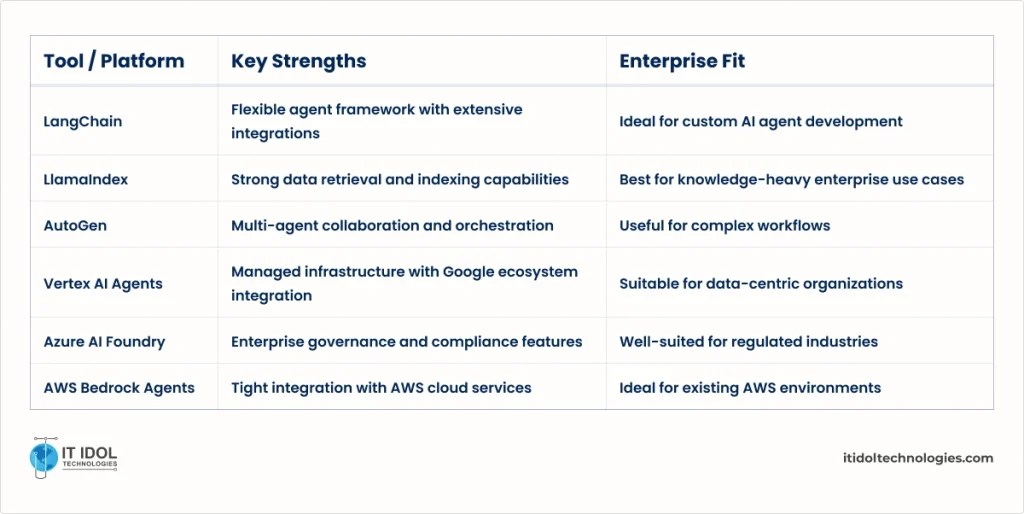
LangChain is widely used for building LLM-powered applications that integrate with external tools and data sources. It provides modular components for prompt management, memory systems, and tool execution, making it easier to construct agent workflows.
LlamaIndex focuses on connecting language models to enterprise data. It provides indexing and retrieval mechanisms that allow agents to query large document repositories efficiently. For organizations dealing with extensive internal documentation, this capability is essential.
AutoGen, developed by Microsoft Research, introduces a framework for creating collaborative multi-agent conversations. Developers can define different agent roles, such as planner, executor, or reviewer, and allow them to coordinate tasks through structured interactions.
These frameworks give teams flexibility and transparency, but they also require engineering expertise to manage infrastructure, monitoring, and scaling.
Enterprise-Grade Platforms
For organizations seeking fully managed environments, major cloud providers have introduced dedicated platforms for agent development.
Google Vertex AI Agents allows developers to build autonomous agents integrated with Google Cloud services, including BigQuery, Cloud Functions, and data pipelines.
Azure AI Foundry provides a comprehensive environment for developing and deploying AI applications, with built-in support for governance, monitoring, and enterprise security.
AWS Bedrock Agents enable organizations to orchestrate workflows using foundation models while connecting directly to AWS services such as Lambda, DynamoDB, and API Gateway.
These platforms simplify deployment and security but may introduce vendor lock-in and cost considerations.
Tools Comparison
Choosing the right stack depends on factors such as security requirements, infrastructure preferences, and internal engineering expertise.
Data and Integration Strategies
Enterprise AI agents are only as effective as the data they can access. Building robust data pipelines is, therefore, a foundational step in any deployment.
Handling Enterprise Data Volumes
Most enterprise environments contain large amounts of unstructured data, such as documents, reports, emails, and support transcripts. AI agents must be able to retrieve relevant information.
A common approach is Retrieval-Augmented Generation (RAG). In this architecture, enterprise documents are embedded into vector databases and retrieved dynamically when the agent needs context. Instead of training models directly on proprietary data, the system retrieves relevant knowledge at runtime.
In some cases, organizations may also fine-tune models on domain-specific datasets to improve performance in specialized areas such as financial analysis, medical documentation, or technical support.
Security-First Integrations
Because AI agents interact directly with enterprise systems, integration architecture must be designed with security as a priority. These agents often access operational data and trigger actions across business platforms, which means every interaction needs to be carefully controlled.
To manage this, many organizations place agents behind API gateways that enforce authentication, rate limiting, and activity monitoring. This layer helps ensure that every action performed by an agent remains traceable, controlled, and compliant with internal policies.
At the same time, enterprises are increasingly adopting zero-trust security models. Instead of assuming that systems within an internal network are inherently safe, zero-trust frameworks require every request between services to be verified and authorized. This approach reduces the risk of unauthorized access and ensures that AI agents operate within clearly defined permissions.
Knowledge retrieval systems also play an important role in secure agent architectures. Vector databases such as Pinecone and Weaviate are commonly used to store and retrieve contextual knowledge for AI agents. These platforms support scalable storage while allowing organizations to enforce strict access controls over sensitive information.
By combining secure data pipelines with well-defined access policies, enterprises can allow AI agents to operate effectively across systems without exposing critical business data or compromising security standards.
Governance Frameworks for Trust and Compliance
As AI agents take on more operational responsibilities, governance becomes essential to ensure reliability, transparency, and regulatory compliance.
Risk Management Essentials
Organizations must address risks such as model bias, inaccurate outputs, and performance drift.
Bias audits evaluate whether models produce unfair or discriminatory results across different groups. These audits are particularly important in domains such as hiring, lending, or customer support.
Explainability techniques such as SHAP and LIME can help teams understand why a model generated a particular decision. While not perfect, these tools provide visibility into model behavior and support internal accountability.
Drift detection systems monitor whether model performance degrades over time due to changing data patterns. Continuous monitoring ensures agents remain reliable even as business conditions evolve.
Regulatory Alignment
Regulatory frameworks are also shaping how enterprises deploy AI.
The EU AI Act establishes risk-based requirements for AI systems, including documentation, transparency, and oversight mechanisms. Similarly, GDPR requires organizations to protect personal data and provide explanations for automated decisions in certain contexts.
To support compliance, enterprises often implement model versioning and rollback mechanisms. If an agent begins producing unexpected results, teams can revert to a previous stable version while investigating the issue.
Organizational Guardrails
Governance also involves operational controls within the organization.
Role-based access control (RBAC) ensures that only authorized users can modify agent configurations or approve automated actions. Audit logs record every interaction, enabling the tracing of decisions and the investigation of anomalies.
Many enterprises also adopt human-in-the-loop workflows, in which agents handle routine tasks while escalating complex or high-risk decisions to human reviewers.
These guardrails allow organizations to benefit from automation while maintaining oversight and accountability.
Implementation Roadmap
Deploying AI agents successfully requires a gradual, structured rollout rather than an overnight large-scale transformation.
Step-by-Step Deployment
The first step is identifying low-risk pilot use cases. Internal IT helpdesks, document summarization, and knowledge retrieval are common starting points because they involve repetitive tasks and limited operational risk.
Once a pilot agent demonstrates reliability, organizations can expand their responsibilities and integrate additional systems.
Monitoring and Performance Management
Operational monitoring is critical. Tools such as Prometheus can track metrics including response times, API calls, and system resource usage.
Custom metrics may also measure agent performance for example, ticket resolution time or workflow completion rate.
Measuring Success
Enterprises typically evaluate AI agents using operational KPIs such as:
Task completion rate
Error frequency
User satisfaction scores
Time saved compared to manual processes
In many operational scenarios, a task completion rate above 90% indicates that an agent can reliably handle routine workflows while escalating exceptions to human operators.
Challenges, Solutions, and Future Trends
Despite rapid progress, enterprise AI agents still face several challenges.
One persistent issue is hallucinations, in which language models generate plausible but incorrect outputs. Organizations mitigate this risk by grounding agents in verified data sources through RAG pipelines and strict validation layers.
Another concern is cost management. Running large models at scale can be expensive, particularly when agents perform frequent reasoning steps. Efficient caching, smaller specialized models, and optimized prompts can reduce operational costs.
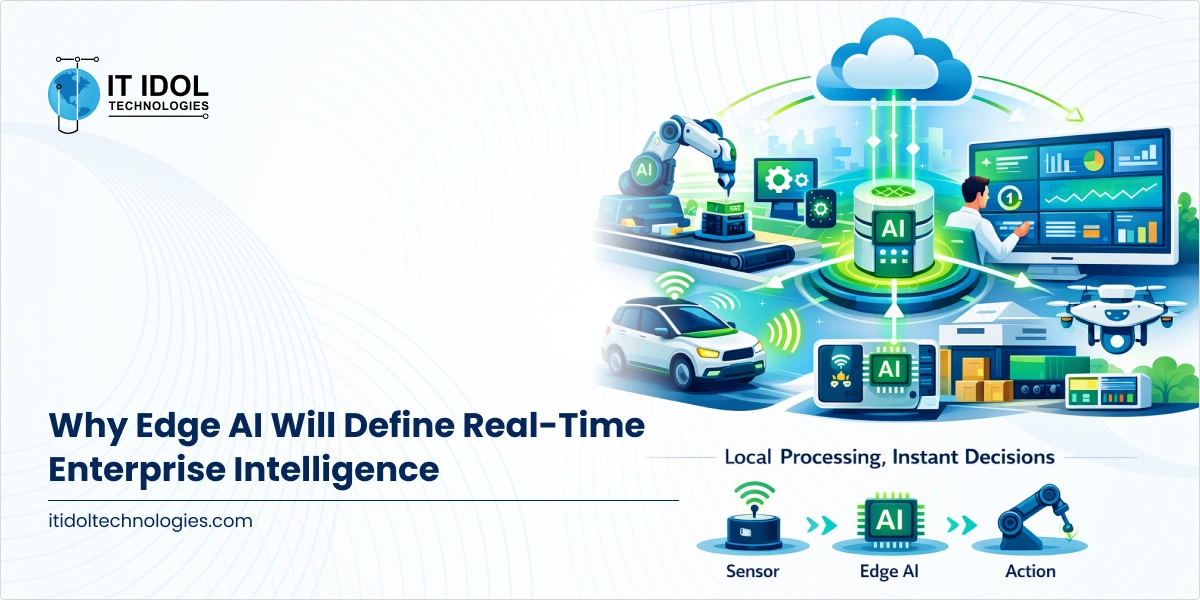
Looking ahead, the next wave of innovation is likely to focus on multimodal agents capable of processing text, images, and structured data simultaneously. Additionally, edge deployment running lightweight agents closer to devices or operational systems may enable real-time automation in environments such as manufacturing, logistics, and healthcare.
Conclusion
AI agents represent a significant evolution in enterprise software. Instead of rigid systems that simply execute predefined workflows, organizations can now deploy adaptive systems capable of interpreting data, coordinating tasks, and learning from outcomes.
However, realizing this potential requires thoughtful architecture and disciplined implementation. Enterprises must design agent systems around core capabilities perception, reasoning, action, and memory while adopting scalable patterns such as multi-agent orchestration.
Equally important is the surrounding ecosystem. Development frameworks like LangChain and LlamaIndex accelerate experimentation, while cloud platforms such as Vertex AI, Azure AI Foundry, and AWS Bedrock simplify deployment and infrastructure management.
Yet technology alone is not enough. Responsible deployment depends on strong governance frameworks that address bias, ensure transparency, safeguard security, and uphold regulatory compliance. Role-based controls, audit logging, and human oversight ensure that automation enhances decision-making rather than replacing accountability.
Organizations that approach AI agents with this balanced perspective, combining innovation with governance, are likely to unlock significant operational value. Customer service workflows can become faster and more responsive, IT operations more resilient, and data analysis more scalable.
In the coming years, AI agents may evolve into the connective tissue of enterprise operations: coordinating systems, interpreting signals across departments, and continuously optimizing processes. Companies that begin building this capability today will be better positioned to adapt as intelligent automation becomes a foundational layer of modern enterprise technology.
FAQ’s
1. What is an enterprise AI agent?
An enterprise AI agent is an autonomous software system that can observe data, reason about possible actions, execute tasks through APIs or tools, and learn from outcomes within business environments.
2. How are AI agents different from traditional automation tools?
Traditional automation relies on predefined rules and scripts, while AI agents use machine learning models and contextual data to make decisions and adapt workflows dynamically.
3. What are the core components of an enterprise AI agent architecture?
Most enterprise AI agents are built around four capabilities: perception (data ingestion), reasoning (model-based decision-making), action (execution through tools or APIs), and memory (context retention).
4. What is a multi-agent system in enterprise environments?
A multi-agent system comprises multiple specialized AI agents that collaborate to complete complex workflows, often coordinated via orchestration frameworks or hierarchical task structures.
5. Which frameworks are commonly used to build AI agents?
Popular frameworks include LangChain for building LLM-powered workflows, LlamaIndex for data retrieval and indexing, and AutoGen for collaborative multi-agent systems.
6. What role does Retrieval-Augmented Generation (RAG) play in enterprise AI agents?
RAG enables AI agents to retrieve relevant enterprise data from vector databases in real time, improving accuracy and reducing hallucinations by grounding responses in verified information.
7. How do enterprises secure AI agent integrations?
Security strategies include API gateways, authentication controls, zero-trust architectures, and strict access management policies to ensure agents interact safely with enterprise systems.
8. Why is governance important for enterprise AI agents?
Governance frameworks help manage risks such as biased outputs, inaccurate decisions, and regulatory violations by implementing monitoring, explainability tools, and human oversight.
9. How should organizations begin implementing AI agents?
Most enterprises start with low-risk pilot projects such as internal helpdesk automation or document summarization before scaling agents across more complex workflows.
10. What future developments are expected for enterprise AI agents?
Future advancements will likely include multimodal agents capable of processing text, images, and structured data, as well as edge deployments enabling real-time automation in operational environments.
Parth Inamdar is a Content Writer at IT IDOL Technologies, specializing in AI, ML, data engineering, and digital product development. With 5+ years in tech content, he turns complex systems into clear, actionable insights. At IT IDOL, he also contributes to content strategy—aligning narratives with business goals and emerging trends. Off the clock, he enjoys exploring prompt engineering and systems design.