Custom AI SaaS delivers high ROI for complex, data-intensive applications, driving precision, scalability, and long-term strategic advantage.
No-code platforms excel in speed, operational efficiency, and rapid prototyping, providing immediate ROI for business units.
Hybrid strategies, combining no-code experimentation with custom AI deployment, maximize both agility and strategic impact.
ROI depends on aligning technology choice with business complexity, scalability needs, workforce readiness, and long-term goals.
The enterprise technology landscape is undergoing a seismic shift, driven by the accelerated adoption of artificial intelligence (AI) and low-code/no-code tools. According to Gartner, global enterprise software spending is expected to surpass $700 billion in the coming years, with AI-powered solutions accounting for an increasing share of that investment.
Enterprises face a strategic choice: whether to invest in custom AI SaaS solutions tailored, algorithmically optimized platforms, or leverage no-code platforms that allow rapid deployment with minimal technical expertise.
Both options promise improved efficiency, reduced operational costs, and enhanced data-driven decision-making, but their potential for return on investment (ROI) varies significantly depending on business complexity, scalability needs, and integration requirements.
Custom AI SaaS solutions offer bespoke intelligence engineered around specific business workflows. They typically require longer development cycles, higher upfront costs, and specialized teams, but deliver tailored insights, competitive differentiation, and end-to-end process optimization.
Conversely, no-code platforms appeal to business units seeking speed and agility. By enabling citizen developers to create applications without deep programming skills, these platforms reduce deployment timelines and operational overhead, albeit sometimes at the cost of advanced functionality or scalability.
For executives and decision-makers, understanding the nuanced trade-offs between these two approaches is critical. A misaligned technology choice can lead to underutilized software, inflated costs, or missed strategic opportunities.
For example, a McKinsey study highlighted that 70% of digital transformation initiatives fail to deliver expected business outcomes, often due to mismatched tools and unclear ROI metrics.
This article synthesizes real-world evidence, industry research, and practical lessons to answer the question: Which approach, custom AI SaaS or no-code platforms, delivers better ROI for enterprises? By examining case studies across sectors, we provide a framework for evaluating investment decisions and optimizing technology outcomes.
Case / Evidence Sections
1. Netflix: Custom AI SaaS for Personalized Recommendations
Lesson: Tailored AI drives customer retention and revenue growth.
Netflix’s recommendation engine exemplifies how a custom AI SaaS approach can create significant ROI through highly personalized user experiences. The company invests heavily in proprietary machine learning models that analyze viewing habits, search behaviors, and engagement patterns to predict content preferences.
According to MIT Technology Review, Netflix’s algorithm accounts for over 75% of user content consumption, directly contributing to subscription retention and revenue stability.
Key strategic actions included:
Building a scalable AI infrastructure optimised for streaming data.
Integrating real-time recommendation algorithms across devices.
Continuous model retraining to reflect user behaviour shifts.
Quantitative impact: Netflix estimates that its recommendation engine reduces churn by at least 10%, equating to hundreds of millions of dollars in annual revenue retention.
Takeaway: For businesses where user engagement drives revenue, a custom AI SaaS solution can deliver measurable ROI through precise personalization and deep integration with core business processes.
2. Unilever: No-Code Platforms for Rapid Marketing Automation
Lesson: No-code platforms accelerate deployment and reduce operational overhead.
Consumer goods giant Unilever has adopted no-code automation platforms to streamline marketing campaign creation and execution across multiple regions. By using platforms like Zapier and Airtable, business units were empowered to automate repetitive workflows such as email sequences, social media posting, and lead management without relying on IT development cycles.
Key strategic actions included:
Implementing centralized no-code dashboards for campaign performance tracking.
Training marketing teams as “citizen developers” to configure automation rules.
Rapidly scaling campaigns across regional markets with minimal technical support.
Quantitative impact: Internal reports indicate a 50% reduction in campaign deployment time and 30% cost savings on external software development and support.
Takeaway: No-code platforms excel in environments requiring agility, iterative experimentation, and rapid time-to-market, providing ROI through operational efficiency rather than deep technical differentiation.
3. JP Morgan Chase: Custom AI SaaS in Fraud Detection
Lesson: Custom AI delivers ROI in high-stakes, data-intensive applications.
JP Morgan Chase leverages proprietary AI models for real-time fraud detection in financial transactions. Rather than adopting off-the-shelf or no-code solutions, the bank invested in a custom AI SaaS framework that integrates historical transaction data, machine learning anomaly detection, and adaptive rules engines.
Key strategic actions included:
Deploying deep learning models optimized for large-scale financial data streams.
Implementing continuous monitoring and model refinement to adapt to evolving fraud patterns.
Integrating AI outputs directly into transaction approval workflows to enable instant decision-making.
Quantitative impact: According to IBM Research, the AI system has reduced false positives by 40% and detected fraudulent activities 30% faster than traditional rule-based systems, saving millions annually in fraud losses and operational costs.
Takeaway: Custom AI SaaS provides superior ROI for enterprises where accuracy, risk mitigation, and integration with complex business processes are critical. Off-the-shelf or no-code solutions may lack the precision needed for high-stakes applications.
4. Airbnb: Hybrid Approach with No-Code Prototyping
Lesson: Combining no-code and custom AI maximizes flexibility and investment efficiency.
Airbnb frequently experiments with new user experience features using no-code platforms to prototype concepts before committing to full-scale AI development. For example, the company tested predictive pricing and personalized search suggestions using low-code tools before implementing proprietary models.
Key strategic actions included:
Using no-code platforms for A/B testing new features with minimal engineering overhead.
Transitioning successful prototypes into custom AI SaaS solutions for production deployment.
Leveraging cross-functional collaboration between product managers, data scientists, and citizen developers.
Quantitative impact: While Airbnb does not publicly disclose exact numbers, case reports suggest that prototype-to-production cycles decreased by 60%, accelerating feature deployment without compromising model sophistication.
Takeaway: Strategic hybrid approaches allow enterprises to balance speed, experimentation, and tailored intelligence, enhancing overall ROI by reducing development risk and shortening time-to-value.
5. Schneider Electric: No-Code for Operational Efficiency
Lesson: No-code platforms deliver measurable ROI in internal process automation.
Global energy management leader Schneider Electric deployed no-code platforms to automate internal workflows, including asset tracking, maintenance scheduling, and compliance reporting. By leveraging tools like Microsoft Power Platform, the company empowered business units to create apps that improved operational efficiency.
Key strategic actions included:
Rolling out low-code dashboards for real-time monitoring of energy assets.
Enabling non-technical staff to configure automation and alerts.
Integrating apps with legacy enterprise systems to avoid large-scale IT investments.
Quantitative impact: Reports indicate up to 35% improvement in operational productivity and a reduction in manual error rates by 25%, translating to substantial cost savings and faster decision-making.
Takeaway: No-code platforms are highly effective for internal optimization where speed, cost reduction, and workforce enablement are the primary ROI drivers, even if they cannot fully replicate the sophistication of custom AI models.
Cross-Cutting Insights
Analyzing the case studies above reveals several consistent patterns that inform strategic decisions around AI adoption and no-code platforms. These insights help executives evaluate ROI not just in financial terms, but across operational efficiency, scalability, and strategic differentiation.
1. Alignment of Complexity and Solution Type
A clear theme emerges: the more complex and high-stakes the business process, the greater the ROI from a custom AI SaaS approach.
Netflix’s recommendation engine and JP Morgan Chase’s fraud detection models illustrate that when predictive accuracy, real-time decision-making, and integration with core business processes are critical, bespoke AI delivers superior value.
Custom solutions allow for fine-tuning of models, access to proprietary data, and architecture optimized for specific workflow capabilities that no-code platforms cannot replicate at scale.
Conversely, simpler, repetitive, or process-driven applications often achieve higher ROI via no-code platforms. Schneider Electric’s internal operational tools and Unilever’s marketing automation highlight that when speed, ease of use, and cost containment are the primary goals, no-code adoption can outperform custom AI in efficiency and adoption metrics.
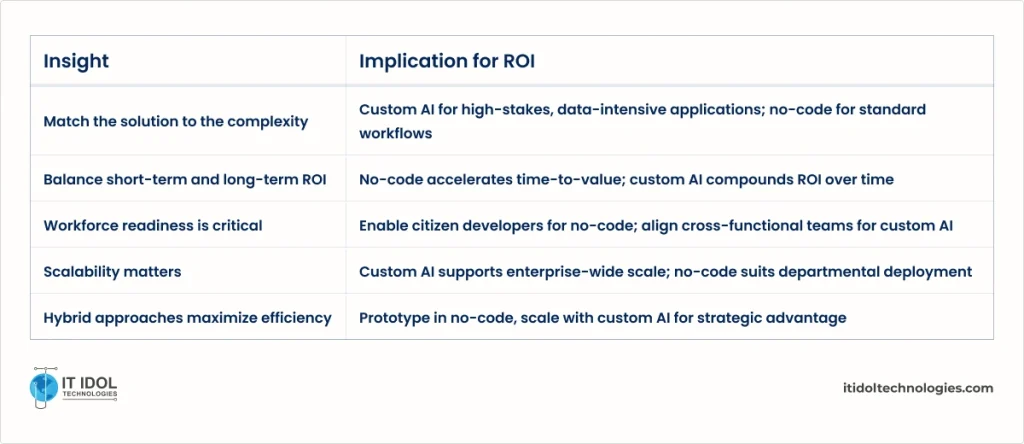
Actionable implication: Enterprises should classify initiatives based on complexity, risk, and strategic importance, then match the technology approach accordingly. High-impact, complex, or differentiation-driven projects merit custom AI investment; standardizable workflows can leverage no-code solutions.
2. Time-to-Value vs. Long-Term Strategic ROI
Another key insight concerns the trade-off between immediate results and long-term competitive advantage. No-code platforms accelerate deployment, enabling rapid testing, experimentation, and operational gains.
Airbnb’s hybrid approach demonstrates that using no-code for prototyping accelerates experimentation cycles and reduces development risk, delivering early ROI while providing a pathway to full-scale AI deployment.
Custom AI SaaS, by contrast, requires more time and resources upfront but often generates a compounding ROI effect over time. Netflix’s personalization engine exemplifies this: the initial investment in algorithm development and infrastructure is substantial, but the long-term payoff in user retention and revenue stability far exceeds the initial cost.
Actionable implication: Executive decisions should consider both short-term impact and strategic horizon. No-code solutions can be ideal for immediate wins or pilot programs, while custom AI should be pursued for long-term differentiation where scale and precision are crucial.
3. Operational and Workforce Considerations
The success of both approaches is strongly tied to organizational readiness and workforce enablement. No-code platforms are most effective when business users or “citizen developers” are trained and incentivized to innovate. Unilever and Schneider Electric highlight that empowering non-technical teams drives adoption and ROI.
Custom AI projects, in contrast, require specialized teams of data scientists, engineers, and DevOps specialists, but also demand cross-functional collaboration with business units to ensure models address actual pain points.
Misalignment between technical capabilities and business needs is a common cause of underperformance in AI initiatives, as McKinsey notes, with 65% of enterprise AI projects failing due to inadequate change management or business integration.
Actionable implication: ROI depends not only on technology choice but also on organizational alignment. No-code adoption should be accompanied by training and governance frameworks, while custom AI requires structured collaboration and ongoing stakeholder engagement.
4. Scalability and Integration
Scalability emerges as a decisive factor in ROI realization. Custom AI SaaS solutions, built on cloud-native architectures or containerized platforms, scale horizontally across regions, departments, or product lines. Netflix’s AI infrastructure, for instance, supports millions of concurrent users worldwide, maintaining consistent performance and predictive accuracy.
No-code solutions excel at horizontal adoption within specific business units but may struggle with enterprise-scale integration, data governance, or high-frequency transactional processing. Gartner warns that “while low-code/no-code platforms increase agility, they may introduce technical debt if not architected with scalability in mind”.
Actionable implication: Decision-makers must evaluate scalability needs upfront. If applications are expected to support enterprise-wide operations, custom AI provides a more sustainable ROI over time, whereas no-code may suffice for departmental-level or niche workflows.
5. Hybrid and Modular Approaches Maximize ROI
Airbnb’s experience illustrates the potential of combining no-code prototyping with eventual custom AI deployment. By using no-code platforms for early experimentation and iterating based on user feedback, enterprises can validate ideas quickly, reduce development risk, and optimize resource allocation before committing to larger AI investments.
This hybrid approach reflects a broader trend in enterprise IT: modular architectures and iterative investment models often outperform monolithic approaches in ROI and adoption. It balances the speed of no-code with the precision and scalability of custom AI, mitigating risk while accelerating time-to-value.
Actionable implication: Organizations can adopt a staged approach start with no-code for exploration and internal efficiency, then transition validated solutions to custom AI for strategic differentiation and long-term scalability.
Summary of Cross-Cutting Insights:
Conclusion
The comparison between custom AI SaaS solutions and no-code platforms underscores a central principle: ROI is contingent on alignment between technology choice, business complexity, and strategic goals. Neither approach is universally superior; each excels under different circumstances, and enterprise decision-makers must evaluate investments with both operational and strategic lenses.
Custom AI SaaS demonstrates its value in high-impact, data-intensive scenarios where predictive accuracy, real-time decision-making, and proprietary insights generate sustainable competitive advantage.
Netflix’s recommendation engine and JP Morgan Chase’s fraud detection AI highlight that when precision and integration with core workflows are critical, bespoke AI provides measurable long-term ROI, often far exceeding initial development costs.
While upfront investment is significant, the compounding effect of enhanced customer retention, risk mitigation, or operational optimization creates enduring financial and strategic value.
No-code platforms, by contrast, excel in agility, rapid deployment, and operational efficiency. Unilever’s marketing automation and Schneider Electric’s internal workflow tools illustrate how non-technical teams can drive substantial cost savings, productivity gains, and accelerated time-to-value without heavy IT involvement.
No-code solutions are particularly well-suited for pilot programs, routine workflows, and departmental initiatives where speed and flexibility matter more than deep technical differentiation.
A hybrid approach leveraging no-code for prototyping and experimentation, then transitioning validated solutions to custom AI SaaS, emerges as a highly effective strategy for balancing speed, risk mitigation, and strategic impact.
Airbnb’s case demonstrates that staged investments allow organizations to test hypotheses quickly, engage business users, and then commit resources where ROI potential is highest. This methodology aligns with modern enterprise IT practices, emphasizing modular architectures, iterative development, and cross-functional collaboration.
For executives, the practical implications are clear:
1. Classify initiatives by complexity and risk: Use custom AI for mission-critical, high-stakes applications; deploy no-code platforms for operational efficiency and rapid experimentation.
2.Consider time-to-value and long-term ROI: Prioritize no-code for early wins and prototyping; invest in custom AI for sustainable, strategic outcomes.
3. Enable organizational readiness: Provide training and governance for citizen developers, while fostering cross-functional collaboration for custom AI projects.
4. Plan for scalability and integration: Ensure that selected solutions can handle enterprise-wide adoption or are modular enough to evolve into larger AI deployments.
5. Leverage hybrid models where appropriate: Combine no-code and custom AI to maximize both agility and long-term differentiation, minimizing risk while accelerating adoption.
Ultimately, the choice between custom AI SaaS and no-code platforms is not binary. Executives who make decisions grounded in business context, data-driven evaluation, and strategic alignment are best positioned to extract maximum ROI from technology investments.
In an era where digital transformation is both urgent and complex, the most successful enterprises will adopt a nuanced, evidence-based approach balancing speed, sophistication, and scalability to achieve tangible, measurable outcomes.
FAQ’s
1. What is the difference between custom AI SaaS and no-code platforms?
Custom AI SaaS solutions are tailored, algorithm-driven applications built for specific enterprise workflows, while no-code platforms enable rapid app creation without programming skills. Custom AI emphasizes precision and scale, whereas no-code focuses on speed and accessibility.
2. Which option provides better ROI for enterprises?
ROI depends on context: custom AI SaaS delivers higher long-term returns in complex, high-stakes applications, while no-code platforms generate fast, cost-effective ROI for operational or departmental use cases.
3. Can no-code platforms handle enterprise-scale operations?
No-code platforms are effective for departmental workflows but may struggle with enterprise-wide scalability, complex integrations, and high-frequency transactional processing. Custom AI SaaS is generally better suited for large-scale, mission-critical deployments.
4. How can companies combine no-code and custom AI effectively?
Enterprises can prototype and test solutions using no-code platforms, then transition validated workflows to custom AI for production-scale deployment. This hybrid approach balances speed, risk mitigation, and long-term ROI.
5. What industries benefit most from custom AI SaaS?
Industries such as streaming services, financial services, healthcare, and e-commerce gain high ROI from custom AI due to the need for predictive analytics, real-time decision-making, and personalized customer experiences.
6. Are no-code platforms suitable for internal process automation?
Yes. Companies like Unilever and Schneider Electric have achieved measurable ROI by automating workflows, scheduling, and compliance reporting using no-code platforms, reducing operational costs and errors.
7. How does workforce readiness affect ROI?
ROI depends on organizational adoption: no-code requires citizen developers and governance frameworks, while custom AI requires skilled data scientists and cross-functional collaboration to ensure alignment with business needs.
8. What are the risks of choosing no-code over custom AI?
Potential risks include limited functionality, lower predictive accuracy, scalability challenges, and technical debt if applications are not properly governed.
9. How long does it take to see ROI from custom AI SaaS?
Custom AI typically requires longer initial development cycles but produces compounding ROI over time through enhanced precision, efficiency, and competitive differentiation.
10. Should enterprises always choose a hybrid approach?
Not always. A hybrid approach is ideal when organizations want to balance experimentation, speed, and long-term strategic impact. The decision should be based on project complexity, risk, and scalability requirements.
Parth Inamdar is a Content Writer at IT IDOL Technologies, specializing in AI, ML, data engineering, and digital product development. With 5+ years in tech content, he turns complex systems into clear, actionable insights. At IT IDOL, he also contributes to content strategy—aligning narratives with business goals and emerging trends. Off the clock, he enjoys exploring prompt engineering and systems design.