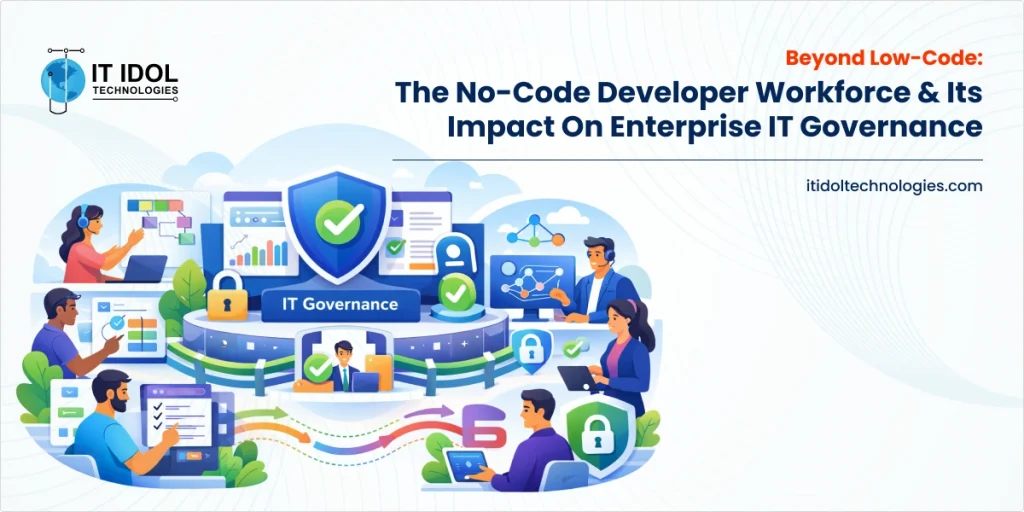
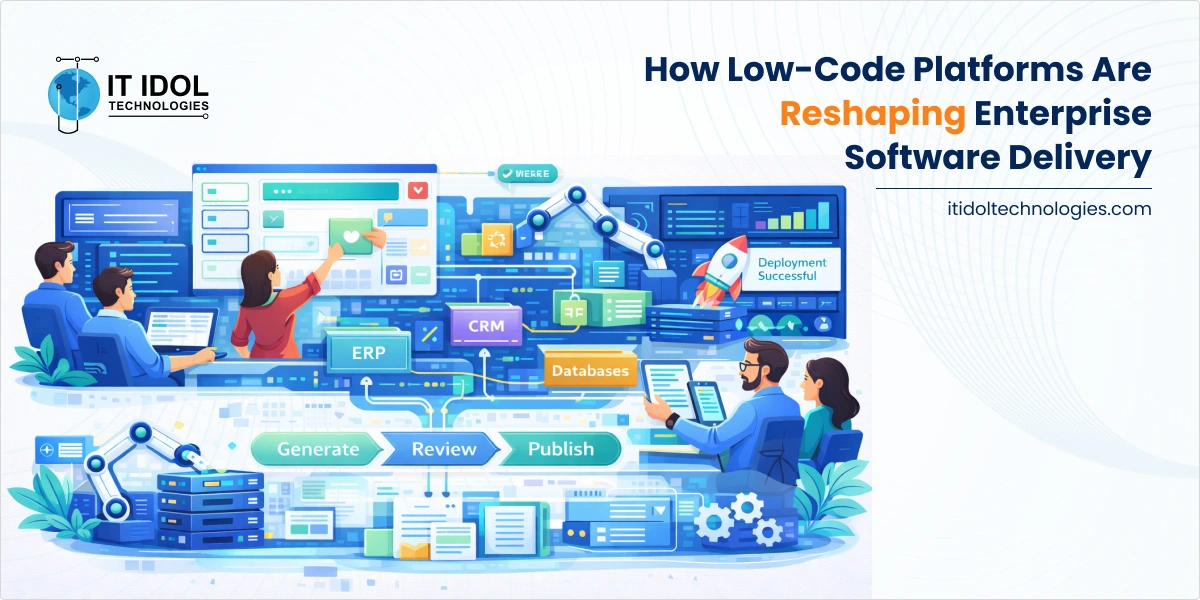
The rise of no-code developer workforces accelerates innovation and reduces IT delivery backlogs, but it upends traditional IT governance. Strategic frameworks that balance citizen development with risk control are essential. This article provides deep insights, comparative analyses, real case lessons, and actionable governance strategies for enterprise leaders.
In the current digital transformation climate, enterprise leaders must manage accelerating expectations for innovation while maintaining IT operational integrity.
No-code development, where business users build applications without formal programming, is no longer a fringe concept. It has become a strategic force reshaping how organisations deploy technology, allocate talent, and govern IT ecosystems.
For technology strategists, CIOs, and enterprise architects, understanding this shift is critical: the traditional frontier between business units and IT is dissolving as no-code adoption spreads across departments.
In this comprehensive deep dive, you will learn what defines the no-code developer workforce, how it differs from low-code and traditional development models, and how its rise affects enterprise IT governance frameworks.
We’ll examine why this matters now: digital demand outpaces developer capacity, citizens are building mission-critical solutions, and governance gaps are emerging as business units innovate independently of IT.
The risks from shadow IT and security blind spots to compliance failures are real, but so are the opportunities to harness speed, agility, and cost efficiency if governance evolves in step.
This article anchors its insights in market research and industry analysis to help leaders prepare for strategic decisions that balance innovation with control, ensuring that no-code evolution strengthens, rather than undermines, IT governance.
Market or Context Analysis
No-code development is transitioning from experimental project work to enterprise strategic capability. Market growth reflects not just broader adoption of visual platforms, but the ascendancy of a new developer cohort: citizen developers building applications previously the exclusive realm of professional IT teams.
By the mid-20s, industry analysts projected that a large majority of new applications would be delivered via low-code and no-code platforms, a dramatic jump from earlier years when traditional coding dominated development portfolios.
This shift has significant implications for governance, security, and IT operating models.
Market data underscores the scale and pace of this change.Gartner forecasts that a substantial percentage of enterprise application development will employ low-code or no-code tools in the near future, signalling widespread adoption across industries.
Related market estimates show no-code and low-code platforms rapidly expanding in both revenue and enterprise penetration, with projections targeting tens of billions in global market value and broad enterprise integration by the end of this decade.
This evolution is driven by multiple forces: a persistent developer skills shortage, demand for faster delivery of digital solutions, and the promise of accelerated business outcomes such as reduced backlog and enhanced agility.
Around half or more of enterprises are reported to be using no-code tools for workflow automation, CRM enhancements, and internal dashboards functions that historically required conventional development cycles.
However, this democratization of development has not come without friction. Governance, security, and compliance challenges are rising as no-code applications proliferate outside centralised IT oversight.
Security teams are warning that many no-code apps evade visibility, with a significant share of organizations reporting gaps in understanding how applications access and process enterprise data.
Strategic Takeaway: The no-code moment is not a fad; it reflects structural shifts in how enterprise software is created. But without governance adaptation, rapid adoption risks technical debt, security exposure, and regulatory non-compliance.
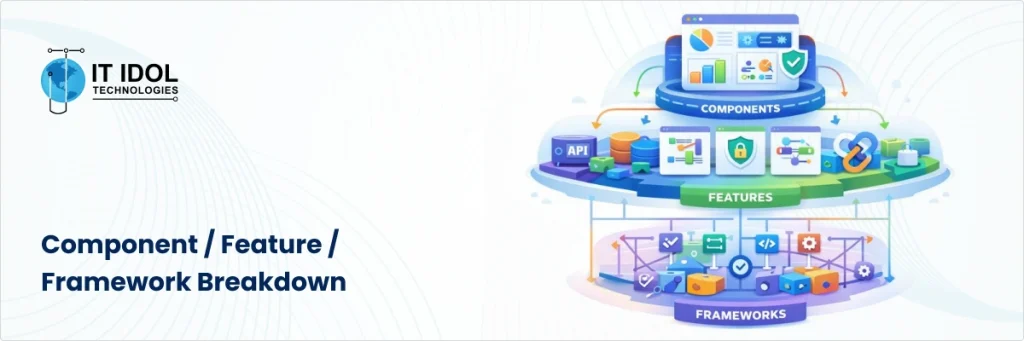
Component / Feature / Framework Breakdown
To understand the impact on IT governance, we must unpack the key components underpinning the no-code developer workforce and how they interact with enterprise systems.
1. The No-Code Developer Workforce
The no-code developer workforce consists of non-IT professionals, often business analysts, operations leads, and domain experts who use visual development tools to create applications.
Unlike traditional developers, they don’t read or write code in text editors; instead, they assemble logic through interfaces, templates, and drag-and-drop modules.
This workforce expands capacity and accelerates the delivery of routine solutions.
For example, HR teams can build onboarding apps; finance teams can craft budgeting workflows, all without waiting for scarce developer resources.
But their tools often lack the structured practices of traditional SDLC (Software Development Life Cycle), complicating governance. Thus, defining roles, responsibilities, and competencies becomes essential.
2. No-Code Platforms and Their Features
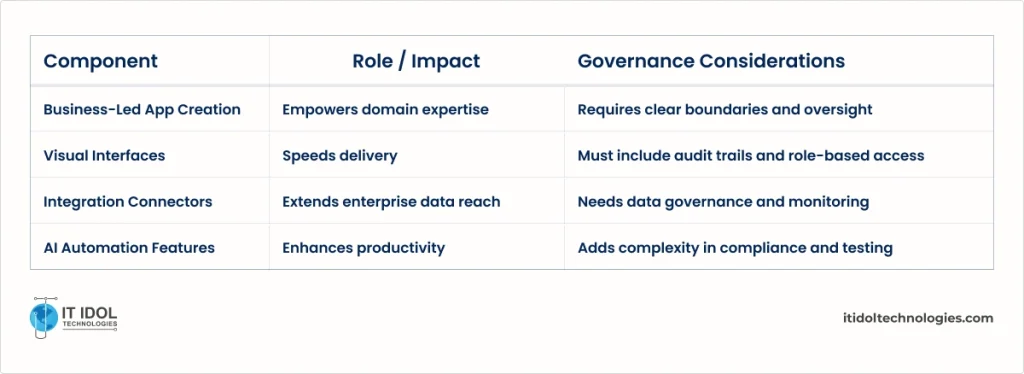
No-code platforms offer features like visual builders, workflow engines, form designers, and integration connectors. These features reduce friction for building business logic while interfacing with enterprise systems (CRM, ERP, identity management).
Tools vary in complexity: some are suited for simple departmental automation while others support sophisticated integrations with AI and predictive logic.
However, these same features enable rapid app sprawl if not controlled. Without governance mechanisms such as versioning, auditing, and SLAs (Service Level Agreements), data access applications may proliferate in ways that complicate IT oversight.
3. Governance Frameworks for Distributed Development
Enterprises require governance structures that enable innovation while managing risk. Effective frameworks often include:
Policy Definitions: Clear criteria for what types of applications may be developed via no-code, including thresholds based on data sensitivity and regulatory requirements.
Review and Approval Processes: Lightweight but rigorous review cycles before deployment, ensuring alignment with enterprise architecture.
Security and Compliance Controls: Embedded identity, encryption, and access rules, with automated scanning and compliance checks.
Inventory and Monitoring Tools: Dashboards that catalog no-code apps, usage patterns, and risk profiles, providing visibility for IT leaders.
4. Cost and Resource Implications
While no-code tools can reduce upfront development costs and speed delivery, total cost of ownership (TCO) includes governance, integration, and maintenance. IT budgets must allocate for platform licensing, training, and security tooling.
Additionally, technical debt can accumulate if shadow applications proliferate without lifecycle management, increasing long-term costs.
Actionable Recommendations:
Establish centralized governance councils or centers of excellence (CoEs) to set policies and guidelines.
Build automated compliance checks into no-code development paths.
Prioritize no-code solutions for standardized, repeatable workflows while reserving complex integrations for IT-led projects.
Comparative Analysis
To navigate the no-code landscape strategically, enterprise leaders must compare distinct approaches to development and governance:
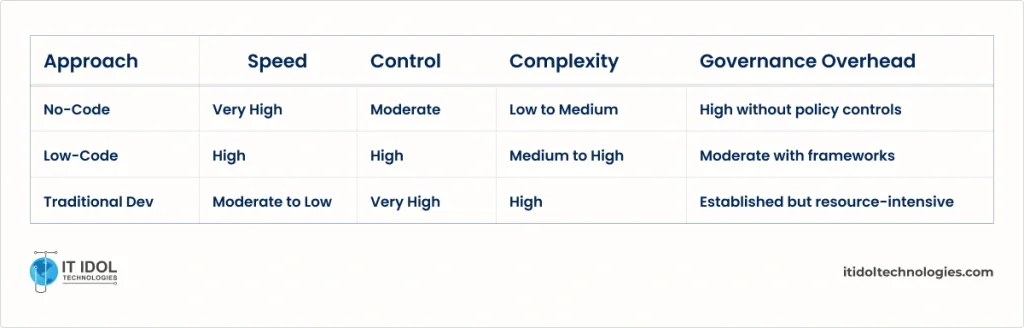
No-Code vs Low-Code vs Traditional Development
No-code tools allow rapid assembly of applications without programming skills, making them ideal for simple to moderately complex workflows.
Low-code platforms provide visual tools with the option to inject custom code, making them better suited for applications that require bespoke logic or integrations.
Conversely, traditional development excels in complex, performance-critical systems but demands more time and expertise.
No-code development offers unmatched speed, but traditional methods offer the greatest control. Low-code strikes a balance, but the governance model must adjust accordingly.
Top-Down IT Governance vs Bottom-Up Citizen Dev Models
A top-down governance model gives IT ultimate control over applications, enforcing security, architecture standards, and compliance. However, overly rigid governance can stifle innovation, delaying delivery and preserving backlogs.
In contrast, a bottom-up citizen development model empowers business units to rapidly solve their problems, but without guardrails, it can lead to shadow IT, compliance gaps, and data silos.
The optimal governance strategy blends both empowering citizen developers within clearly defined policies and tooling support from IT.
For example, enterprises that implement platform-level guardrails can enable secure innovation while preserving architectural coherence.
Monolithic vs Platform-Ecosystem Governance
Some organizations centralize governance in a monolithic fashion (one team makes all decisions), while others distribute governance through federated teams with shared standards.
Federated governance paired with common policies and tooling can provide scale without compromising consistency, particularly relevant as no-code platforms proliferate across units.
Persona-Oriented Recommendation:
For enterprise IT leaders, the most effective model is a hybrid governance framework, one that includes centralized policy definitions, distributed execution through empowered teams, and embedded automated controls.
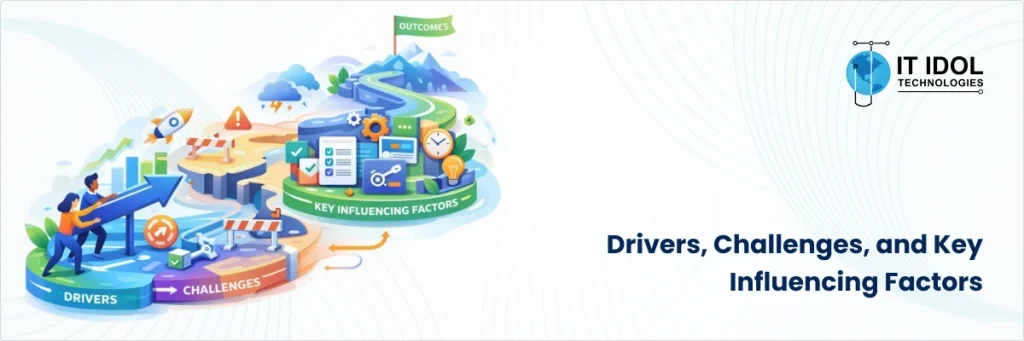
Drivers, Challenges, and Key Influencing Factors
1. Drivers of No-Code Adoption
The primary drivers include talent shortages in professional development, demand for accelerated delivery, and business expectations for autonomy.
With global developer gaps and digital pressures intensifying, business and IT leaders are turning to no-code to bridge capacity constraints.
Integration with AI and cloud technologies amplifies no-code’s value by enabling automated workflows and smarter applications.
AI embedding not only expedites development but also increases the sophistication of what no-code tools can handle, further driving adoption.
2. Governance Challenges
Security and compliance risks represent the most pointed challenges. A significant portion of enterprises lack visibility into how no-code apps access and use enterprise data, exposing vulnerabilities and compliance blind spots.
Similarly, failing to incorporate identity, access, and encryption standards into citizen developer tools can result in weak security postures.
Shadow IT and application sprawl also complicate portfolio management. When business units independently adopt platforms, IT loses visibility, leading to duplicated efforts, inconsistent standards, and potential data siloes.
3. Organizational and Cultural Barriers
Establishing shared responsibility between IT and business units requires cultural change. Traditional IT teams accustomed to centralized control may resist distributing development capabilities, while business units might bypass governance.
Clear role definitions, incentives for governance compliance, and shared success metrics help mitigate this challenge.
4. Hidden Costs and Pitfalls
Hidden costs include platform licensing at scale, integration maintenance, and remediation of poorly designed applications.
Moreover, the absence of lifecycle standards such as version control, testing, and documentation can create technical debt, increasing future workload and risk.
Tactical Strategies for Mitigation:
Deploy discovery tools that inventory no-code applications across the enterprise.
Integrate governance checks into CI/CD pipelines and platform workflows.
Offer training and certification for citizen developers on secure practices.
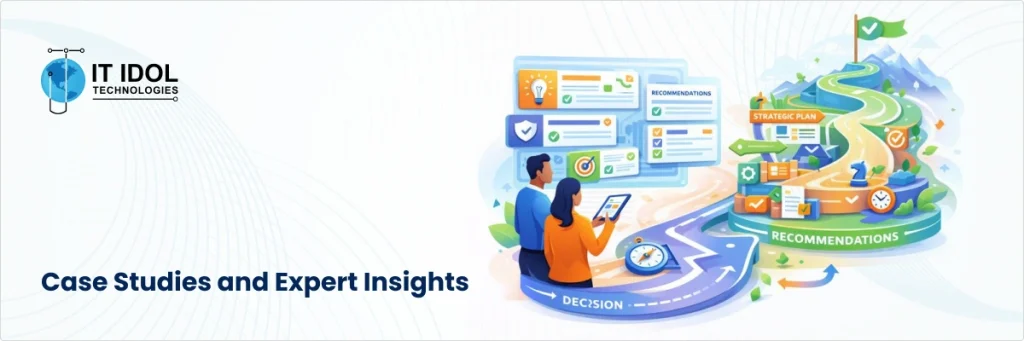
Case Studies and Expert Insights
Case Study 1: Financial Services Firm Reduces Backlog, Faces Governance Gaps
A large financial institution implemented a suite of no-code tools to accelerate internal process automation. Business units quickly developed solutions for reporting and customer service workflows, reducing IT backlog by significant margins.
However, within two quarters, compliance and security teams identified numerous applications that processed sensitive data without appropriate approvals or encryption.
IT instituted a governance centre of excellence to define policies, implement monitoring dashboards, and enforce role-based access, reducing risk without stalling innovation.
Lesson: Rapid adoption delivers tangible benefits but requires governance evolution to manage risk effectively.
Case Study 2: Mid-Market SaaS Company Balances Speed and Control
A mid-market SaaS provider embraced no-code for internal tooling while maintaining professional development for customer-facing product enhancements.
They established a federated governance framework where business units proposed applications through a shared platform, and IT reviewed them for risk and integration impact.
Applications meeting governance criteria were fast-tracked, while others looped through IT development. This balance enabled business autonomy without compromising system architecture or security.
Expert Insight: “Governance needs to sit inside the platform, not around it,” reflects industry leaders, underscoring the trend toward embedded controls that empower users without manual oversight.
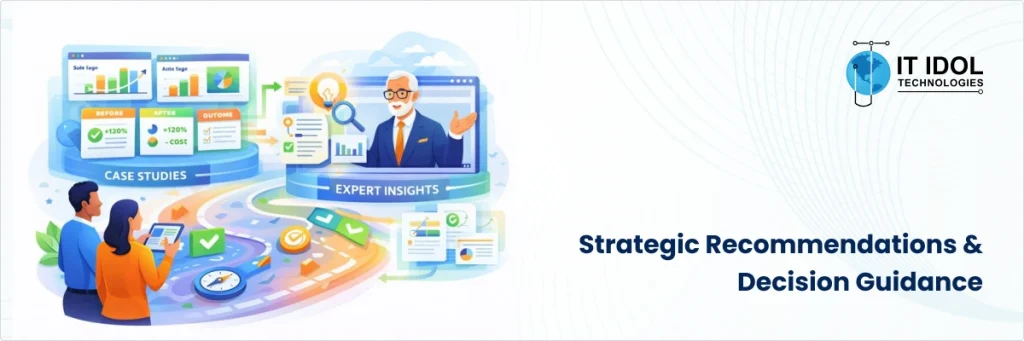
Strategic Recommendations & Decision Guidance
To harness the no-code revolution while preserving governance integrity, leaders should adopt a strategic roadmap:
Step 1: Define Clear Governance Principles
Establish baseline policies that delineate categories of applications suitable for no-code, define data handling standards, and set risk tolerance levels.
Step 2: Build a Governance Operating Model
Form a governance council comprising IT architects, security leads, and business stakeholders. Define review cadences, audit requirements, and risk criteria.
Step 3: Implement Tooling for Transparency
Invest in discovery, monitoring, and compliance tools that provide visibility into no-code app inventories and risk metrics. Ensure governance rules can be enforced automatically where possible.
Step 4: Empower With Education
Train citizen developers on secure design patterns, data privacy principles, and enterprise integration expectations. Certification programs can formalize competencies and accountability.
Step 5: Align Incentives Across Teams
Reward compliance with governance processes, and build shared KPIs that promote collaboration between IT and business units.
Priority Framework:
Prioritize initiatives by risk category (e.g., internal workflow vs external customer apps), data sensitivity, and integration complexity. Applications with high data sensitivity or external exposure should default to IT partnership models.
Conclusion
The emergence of the no-code developer workforce marks a structural shift in enterprise technology execution. It empowers business units, relieves IT bottlenecks, and accelerates digital delivery, but not without challenges to governance, compliance, and long-term sustainability.
Enterprise leaders must evolve governance frameworks to accommodate distributed innovation, blending centralized standards with autonomy and embedding controls directly within platforms.
By adopting structured governance, strategic tooling, and shared accountability, organizations can leverage no-code development as a catalyst for growth rather than a source of risk.
The future belongs to enterprises that balance speed with stewardship, enabling innovation at scale without compromising security or integrity.
FAQ’s
1. What defines a no-code developer workforce?
A no-code developer workforce consists of business professionals using visual development tools to build applications without writing traditional code, expanding development capacity, and accelerating delivery.
2. Why is no-code adoption important for enterprises now?
No-code platforms address developer shortages, reduce IT backlogs, and support faster application deployments, making them strategic assets for digital transformation.
3. How does no-code affect IT governance?
No-code decentralizes development, creating risks in security, compliance, and integration. Without governance frameworks, applications can proliferate unmanaged, leading to shadow IT and data exposure.
4. What governance models work best for no-code?
Hybrid governance models balance centralized policy with distributed execution, embedding automated compliance and risk controls into no-code platforms.
5. What risks are associated with no-code applications?
Security vulnerabilities, compliance failures (e.g., data privacy laws), and unmanaged application sprawl are key risks without robust governance.
6. How can enterprises monitor no-code app proliferation?
Using discovery tools, dashboards, and inventories to track no-code applications, including usage metrics and risk profiles, improves oversight.
7. Do all applications suit no-code development?
No. Business workflow automation and internal tools often fit no-code, while complex systems with critical integrations or high security demands may require traditional development.
8. What role does IT play with a no-code workforce?
IT shifts from gatekeeper to enabler: setting policies, providing platform support, ensuring compliance, and facilitating secure citizen development.
9. How can citizen developers be trained for secure no-code use?
Enterprises should offer governance training, certification programs, and best-practice resources focused on secure design and data stewardship.
10. What’s the future of no-code and enterprise IT governance?
As no-code adoption grows, governance will become more automated, integrated into platforms via embedded controls, and coordinated across federated teams to balance agility with control.
Parth Inamdar is a Content Writer at IT IDOL Technologies, specializing in AI, ML, data engineering, and digital product development. With 5+ years in tech content, he turns complex systems into clear, actionable insights. At IT IDOL, he also contributes to content strategy—aligning narratives with business goals and emerging trends. Off the clock, he enjoys exploring prompt engineering and systems design.