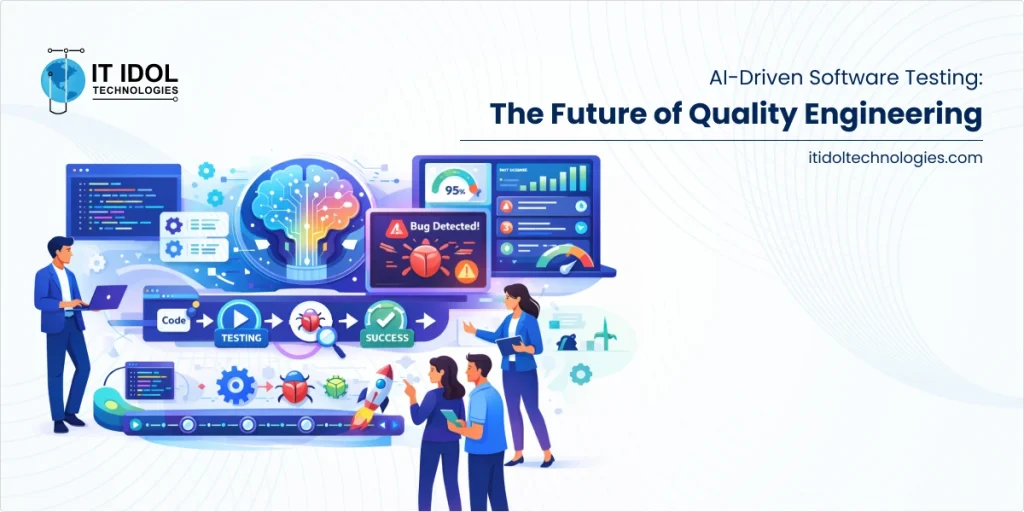
AI-driven software testing is changing how engineering teams approach quality by automating test creation, maintenance, and analysis.
Traditional testing struggles to keep up with modern release cycles and complex architectures.
AI augments QA teams rather than replacing them, enabling faster feedback loops and broader test coverage.
The future of quality engineering lies in human-guided AI systems embedded directly into development workflows.
Software testing used to be a clearly defined phase in the delivery cycle. Developers wrote code, QA teams validated it, and once the tests passed, the product moved toward release. That model worked when releases happened every few months and applications were relatively contained.
Modern software development looks very different.
Today’s engineering teams ship updates weekly, sometimes daily. Applications run across distributed cloud environments, integrate with dozens of external services, and rely heavily on APIs and microservices. Under these conditions, traditional testing approaches start to show their limits.
This is where AI-driven software testing is beginning to reshape the discipline of quality engineering. Rather than treating testing as a largely manual activity supported by automation scripts, organizations are increasingly experimenting with AI systems that can generate tests, analyze system behaviour, detect anomalies, and even predict where defects are most likely to appear.
The change is subtle but important. Instead of simply speeding up testing, AI is starting to change how teams think about quality itself.
Why Traditional Testing Approaches Struggle in Modern Development
Anyone who has spent time inside a growing engineering organization has seen the same pattern play out. A product starts small. Test cases are manageable. Manual QA works reasonably well.
Then the system evolves. New services are added. APIs expand. Front-end logic becomes more dynamic. Suddenly, the original testing framework becomes difficult to maintain. Automated test suites begin to break frequently. QA engineers spend more time updating scripts than actually validating functionality.
The core problem is scale.
Modern software systems generate an enormous number of potential test paths. Even a relatively simple web application can produce thousands of user interaction scenarios once different devices, browsers, authentication states, and edge cases are considered.
Traditional automation frameworks rely heavily on deterministic scripts. They assume that engineers can define the right test cases in advance. But as systems become more dynamic, that assumption becomes fragile. Two operational realities make this particularly challenging:
First, test maintenance becomes expensive.
Automated tests are useful only when they remain stable. In fast-moving codebases, UI changes, API updates, and evolving workflows often cause automated tests to fail for reasons unrelated to real defects.
Second, coverage gaps grow silently.
Teams typically focus on testing the scenarios they know about. But modern software failures often appear in unexpected interactions between services or edge-case conditions that weren’t originally anticipated.
This is where AI starts to offer something fundamentally different.
How AI-Driven Software Testing Changes the Testing Model
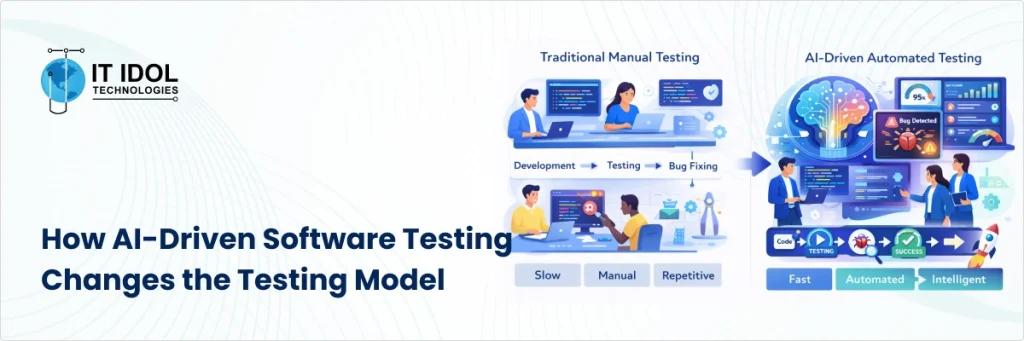
The promise of AI-driven software testing isn’t simply automation. Test automation has existed for decades. What AI introduces is the ability to learn from system behaviour.
Instead of relying entirely on predefined scripts, AI-enabled testing tools analyze application structure, usage patterns, and historical defect data to generate and evolve tests dynamically. In practice, this tends to show up in several ways.
One common example is automated test generation.
By analyzing application interfaces and user flows, AI systems can generate large sets of test scenarios that would be difficult for human testers to enumerate manually. This doesn’t eliminate human input; engineers still define critical business workflows, but it expands coverage beyond the obvious paths.
Another shift happens in test maintenance.
In many AI-driven testing platforms, the system learns how UI elements or APIs change over time. When a component is modified, the AI can update the associated test logic automatically instead of breaking the entire test suite.
From an operational perspective, this is a big deal.
In many organizations, test maintenance consumes a significant portion of QA resources. When that burden decreases, teams can spend more time exploring edge cases, performance issues, and real user scenarios. Then there is intelligent failure analysis.
Anyone who has dealt with large automated test suites knows that failure reports can quickly become overwhelming. AI systems can analyze test failures, correlate them with recent code changes, and identify likely root causes.
Instead of engineers manually investigating dozens of failing tests, the system can highlight the most relevant signals.
The result is faster feedback loops across development teams.
Quality Engineering Is Becoming a Continuous Activity
One of the more interesting effects of AI-driven testing is how it reshapes the role of quality engineering within the development lifecycle. Historically, QA teams were positioned toward the end of the development process. Their job was to validate that features worked before release. That model breaks down in continuous delivery environments.
Today, engineering teams deploy code frequently. Waiting for a separate testing phase simply slows down the entire pipeline. AI-driven testing systems help embed quality checks directly into development workflows.
For example, when a developer commits code, an AI-enabled testing platform might automatically generate new test scenarios based on the modified logic. These tests can run alongside existing automated suites within the CI/CD pipeline.
If the system detects unusual behaviour patterns or potential regression risks, it can flag them immediately. In other words, testing shifts from being a downstream activity to a continuous signal throughout development.
From an operational standpoint, this has two benefits.
First, defects are detected earlier, when they are easier to fix.
Second, developers receive more contextual feedback about how their changes affect the broader system.
The Human Role in AI-Driven Quality Engineering
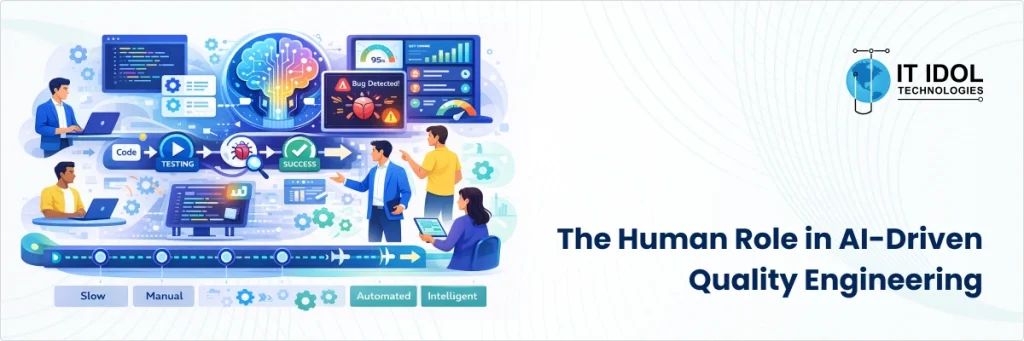
Whenever AI enters a workflow, the conversation inevitably turns to automation replacing people. In software testing, that narrative tends to miss the point. In practice, AI-driven software testing works best when it augments experienced QA engineers rather than replacing them.
Testing is not purely a technical exercise. It requires understanding user behaviour, business logic, and system risk. AI systems are good at analyzing patterns and generating scenarios. But they don’t inherently understand which workflows are mission-critical for a business or which edge cases could cause reputational damage.
That’s where human judgment remains essential.
A typical workflow in organizations adopting AI-assisted testing often looks like this:
The AI generates large sets of potential test scenarios based on application structure and historical usage data.
QA engineers review and refine these scenarios, focusing attention on high-risk workflows such as payment processing, authentication, or regulatory compliance features.
During execution, AI systems monitor system behaviour and highlight anomalies or unusual performance patterns.
Engineers then interpret these signals within the context of product requirements and user expectations.
In other words, the AI handles scale. Humans provide context.
Real-World Constraints Teams Encounter
While the promise of AI-driven testing is compelling, adoption rarely happens without friction. In practice, teams encounter several practical constraints. One challenge is data quality. AI systems rely heavily on historical testing data, system logs, and usage patterns.
Organizations that lack mature observability practices may struggle to provide the necessary inputs for effective AI analysis. Another issue is integration with existing development pipelines. Many large enterprises have deeply entrenched testing frameworks and CI/CD environments. Introducing AI-driven testing tools requires careful integration to avoid disrupting existing workflows.
There’s also the matter of trust.
Engineering leaders are understandably cautious about allowing automated systems to influence release decisions. Teams often begin by using AI tools in advisory roles, suggesting test cases or analyzing failures, before gradually allowing deeper automation.
Finally, there’s a cultural shift involved. Traditional QA models emphasize deterministic control over test scenarios. AI introduces probabilistic behaviour, where the system suggests possibilities rather than executing fixed scripts.
For some teams, adjusting to that mindset takes time.
The Strategic Implications for Engineering Leaders
For CTOs and engineering leaders, the rise of AI-driven testing raises broader strategic questions. The first is about speed versus reliability. As organizations push toward faster release cycles, maintaining quality becomes increasingly difficult.
AI-driven testing offers a way to expand coverage without proportionally increasing QA headcount. But that advantage only materializes if teams integrate AI into development workflows rather than treating it as an isolated tool.
The second question involves developer productivity. High-performing engineering teams spend less time debugging regressions and more time building new capabilities. By identifying defects earlier and reducing test maintenance overhead, AI-assisted testing can significantly reduce the friction developers experience during releases.
Finally, there’s the question of engineering scalability.
As software systems grow more complex, manual testing approaches simply don’t scale. Organizations that invest early in intelligent testing infrastructure may find themselves better positioned to support large distributed systems and rapid product evolution.
Where AI-Driven Software Testing Is Heading Next
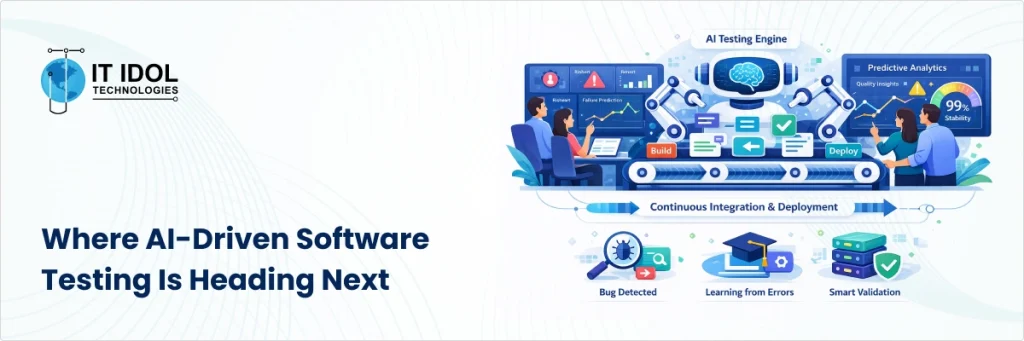
Looking ahead, the evolution of AI-driven software testing will likely mirror broader trends in software development. One emerging direction is deeper integration with development environments. Instead of existing as separate testing platforms, AI systems are beginning to appear directly inside developer tools.
Imagine writing a new API endpoint and immediately receiving suggested test cases generated from the code structure. Another direction involves production-aware testing. By analyzing real user interactions in production environments, AI systems can continuously identify new edge cases and feed those scenarios back into automated test suites.
This creates a feedback loop between real-world usage and testing strategies. Finally, we’re likely to see tighter integration between testing, observability, and reliability engineering.
In complex distributed systems, quality isn’t just about verifying functionality. It also involves monitoring performance, resilience, and system behaviour under load. AI systems that can correlate testing results with production telemetry will become increasingly valuable.
Conclusion
Quality engineering is evolving from a specialized testing discipline into an integrated part of the entire software delivery process. In that shift, AI-driven software testing plays an important role. It allows engineering teams to expand test coverage, reduce maintenance overhead, and detect issues earlier in the development cycle.
But its real value lies in enabling a new model of collaboration between machines and engineers. AI handles the scale and pattern recognition. Human experts provide context, judgment, and domain understanding.
For organizations building increasingly complex software systems, that combination may become the foundation of the next generation of quality engineering.
FAQ’s
1. What is AI-driven software testing?
AI-driven software testing uses machine learning and intelligent algorithms to generate tests, analyze failures, and improve software quality with minimal manual intervention.
2. How does AI improve traditional test automation?
AI enhances test automation by generating new test scenarios, adapting to application changes, and identifying patterns in failures that traditional scripts may miss.
3. Can AI replace QA engineers?
No. AI assists QA engineers by automating repetitive tasks and analyzing data, but human expertise remains critical for understanding business logic and risk.
4. What types of testing benefit most from AI?
Areas such as regression testing, UI testing, exploratory testing, and anomaly detection often benefit significantly from AI-assisted approaches.
5. Does AI reduce the need for manual testing?
AI can reduce repetitive manual testing, but it does not eliminate the need for human-driven exploratory testing and validation of complex user workflows.
6. How does AI help maintain automated test suites?
AI systems can detect UI or API changes and update test scripts automatically, reducing the maintenance effort required for large test suites.
7. What challenges do organizations face when adopting AI-driven testing?
Common challenges include integrating AI tools into existing pipelines, ensuring high-quality data inputs, and building trust in automated decision-making.
8. Is AI-driven testing suitable for enterprise systems?
Yes. Large enterprise systems often benefit the most because AI helps manage complex architectures and large numbers of potential test scenarios.
9. How does AI improve CI/CD testing pipelines?
AI can automatically generate new tests based on code changes and analyze results quickly, providing faster feedback to developers.
10. What is the future of AI in quality engineering?
AI will likely become deeply integrated with development environments, production monitoring systems, and CI/CD pipelines to create continuous quality feedback loops.
Parth Inamdar is a Content Writer at IT IDOL Technologies, specializing in AI, ML, data engineering, and digital product development. With 5+ years in tech content, he turns complex systems into clear, actionable insights. At IT IDOL, he also contributes to content strategy—aligning narratives with business goals and emerging trends. Off the clock, he enjoys exploring prompt engineering and systems design.