For years, the build vs buy decision felt settled.
Buying software, especially in the form of SaaS, was seen as the rational, modern choice. It reduced time to market, eliminated the need for internal development, and allowed companies to focus on their core business instead of managing technology.
“Don’t build what you can buy” became a widely accepted principle.
But that principle is being re-examined.
Not because buying software is wrong, but because the assumptions that made it the default are no longer holding up under scale, complexity, and long-term cost analysis. What’s changing is not just opinion; it’s the data organizations are now seeing after years of operating within SaaS-heavy environments.
And that data is forcing a more nuanced question:
Not “should we build or buy?”
But “what should we build, and what is actually worth buying?”
Why “Buy” Became the Default in the First Place
To understand why this debate is resurfacing, it’s important to look at why it disappeared.
The rise of SaaS solved several real problems. Traditional software required significant upfront investment, long deployment cycles, and ongoing maintenance that many companies were not equipped to handle. SaaS removed these barriers by offering ready-to-use solutions that could be deployed quickly and scaled as needed.
For early-stage and growing companies, this was transformative.
Instead of spending months building internal systems, teams could adopt tools that were already optimized, tested, and continuously updated. The opportunity cost of building time, talent, and capital made buying the obvious choice.
At that stage, the trade-offs were acceptable because speed mattered more than optimization.
What the Data Is Revealing at Scale
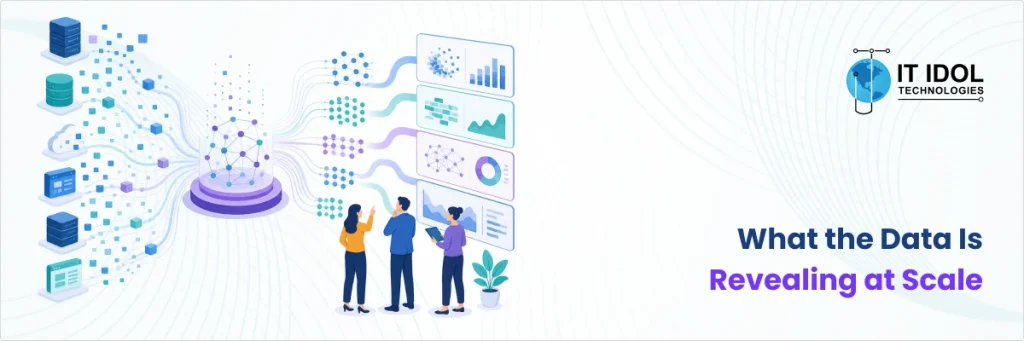
The shift back toward reconsidering “build” is not driven by theory. It is emerging from operational data that companies are now able to observe after years of relying heavily on external tools.
Three patterns are becoming increasingly difficult to ignore.
The first is cost accumulation.SaaS sprawl and hidden software costs, Subscription pricing models, particularly those tied to users or usage, scale in direct proportion to organizational growth. What starts as a manageable expense becomes a significant line item as teams expand and systems become more deeply embedded in daily operations.
Over a multi-year horizon, the total cost of ownership often exceeds initial expectations, especially when multiple tools are involved.
The second is system fragmentation. As different teams adopt specialized tools, the technology stack grows in a decentralized way. Data becomes distributed across platforms, workflows span multiple systems, Data fragmentation from multiple systems and integrations are required to maintain continuity.
The cost of managing this environment, both in terms of engineering effort and operational inefficiency, rarely appears in initial ROI calculations, but becomes substantial over time.
The third is constraint. SaaS products are designed to serve broad use cases, which means they cannot fully adapt to the specific needs of every organization. As processes become more complex or differentiated, companies begin to encounter limitations in how tools can be configured or extended. At that point, the software no longer supports the business; it starts shaping it.
Individually, these issues are manageable. Together, they change the economics of the build vs buy decision.
The Misconception That’s Breaking Down
The traditional framing of the debate has been overly simplistic.
“Build” is often associated with high cost, long timelines, and ongoing maintenance burden.
“Buy” is associated with speed, efficiency, and lower risk.
This binary view ignores an important reality: both options have costs, and those costs behave differently over time.
Buying minimizes upfront investment but introduces recurring, often expanding expenses. Building requires an initial investment but can stabilize costs over the long term. More importantly, buying transfers control to the vendor, while building retains it internally.
As organizations accumulate more data about their own operations, they are better positioned to evaluate these trade-offs with greater accuracy. What they are finding is that the long-term cost and constraint of buying can, in certain contexts, outweigh the short-term benefits.
Where Building Starts to Make Strategic Sense
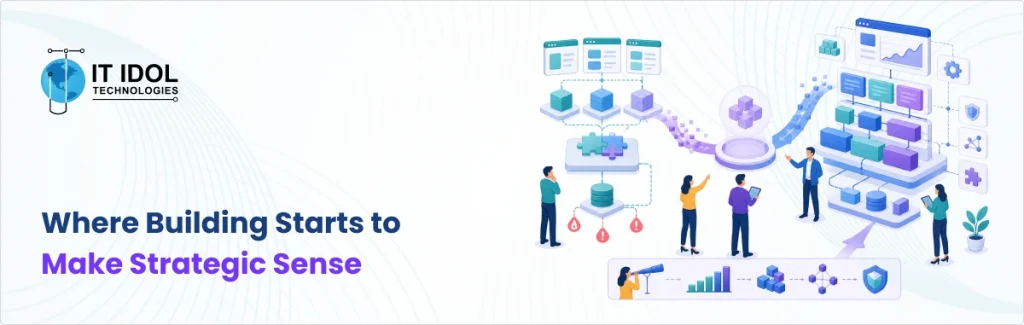
The renewed push toward building software is not about replacing SaaS wholesale. It is about recognizing where ownership delivers tangible, long-term value. These opportunities tend to surface in areas where technology is deeply embedded in how the business actually runs.
In environments where workflows are complex, highly tailored, or closely tied to competitive differentiation, off-the-shelf tools often struggle to keep up. Teams end up relying on patches, manual workarounds, disconnected tools, or layered integrations that gradually introduce inefficiencies.
This is where investing in custom software development services begins to make strategic sense. Systems built around real operational needs can eliminate friction and enable smoother execution.
While cost is part of the equation, it is rarely the primary driver. The real advantage lies in alignment. Custom-built solutions are designed to fit existing processes, integrate cleanly with internal systems, and adapt as the business evolves without being limited by external vendor roadmaps.
Over time, this level of alignment leads to stronger operational efficiency and a more predictable cost structure, making the initial investment far more justifiable from a long-term perspective.
Where Buying Still Wins And Why It Will Continue To
Despite the renewed interest in building, buying remains the right choice in many situations.
Standardized functions such as payroll, basic CRM capabilities, or widely used collaboration tools benefit from the scale and specialization of SaaS providers. These are areas where differentiation is minimal, and the cost of building would outweigh the benefits.
In these cases, the value of buying is not just convenience, but access to continuously improved products that are maintained by dedicated teams. Replicating that level of investment internally would rarely make sense.
The key is recognizing that not all systems require the same level of control or customization.
The Emergence of a More Strategic Approach
What is changing is not the availability of options, but how companies evaluate them.
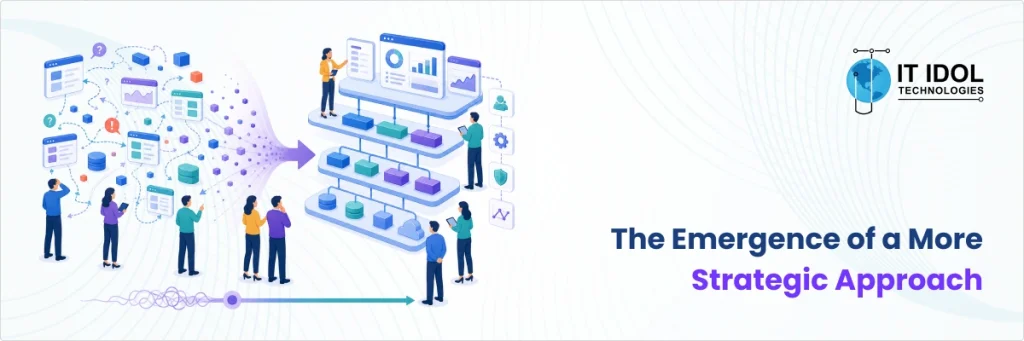
Instead of defaulting to buy, organizations are beginning to assess decisions based on a more strategic framework:
How central is this system to our core operations?
Does it need to adapt to our processes, or can we adapt to it?
What does the total cost look like over multiple years?
How much control do we need over its evolution?
These questions shift the conversation from convenience to long-term impact.
The result is a hybrid model where companies deliberately choose which systems to build and which to buy, based on their role within the business. This approach reduces unnecessary complexity while ensuring that critical systems remain aligned with organizational needs.
A Broader Shift in Technology Ownership
At a deeper level, the resurgence of the build vs buy debate reflects a broader shift in how companies think about technology.
In earlier stages, technology is often viewed as a support function, something that enables operations but is not central to differentiation. In that context, outsourcing as much as possible makes sense.
As companies grow, this perspective changes.
Technology becomes embedded in how the business delivers value, interacts with customers, and operates internally. At that point, decisions about software are no longer purely operational; they become strategic.
Owning certain systems is not just about cost control; it is about maintaining the ability to evolve without external constraints.
Conclusion
The build vs buy debate was never truly resolved; it was simply paused during a period when the benefits of SaaS were overwhelmingly clear.
Today, the conversation has returned, not as a rejection of buying, but as a more informed evaluation of its limits.
The data organizations now have from years of operating with SaaS-heavy stacks are reshaping how decisions are made. It is revealing that while buying accelerates the start, it can introduce costs and constraints that become more significant over time.
Building, in the right contexts, offers a way to regain alignment, control, and long-term efficiency.
The real shift is not toward building everything, but toward making deliberate choices about what matters enough to own.
Move Beyond the Default Decision
If your current approach to software decisions still defaults to “buy first,” it may be time to re-evaluate that assumption.
The right decision today isn’t about following a trend; it’s about understanding where your business needs flexibility, where it needs control, and where standard tools are no longer enough.
IT IDOL Technologies works with organizations that are navigating this exact shift from tool-driven decisions to strategy-driven architecture.
Whether you’re:
Reassessing long-term SaaS costs
Evaluating whether a critical system should be built instead of bought
Or trying to reduce complexity across a fragmented tech stack
The goal isn’t to choose one side of the debate. It’s to design a system that fits how your business actually operates.
If you’re at that decision point,
Connect with IT IDOL Technologies to explore how a more intentional build vs buy strategy can create long-term efficiency and control.
The build vs buy decision evaluates whether to develop software in-house or purchase an existing solution, based on cost, time, scalability, and strategic control.
Rising SaaS costs, tighter budgets, AI-driven development tools, and the need for customization are pushing companies to reassess earlier “buy-first” strategies.
Building is ideal when the software is central to competitive advantage, requires deep customization, or needs tight integration with internal systems.
Buying works best for standardized functions like CRM, HR, or accounting, where speed, reliability, and lower initial costs matter more than differentiation.
AI tools are reducing development time and costs, making in-house builds more feasible while also enhancing off-the-shelf platforms with smarter capabilities.
Key factors include total cost of ownership, time-to-market, scalability, security, vendor lock-in risks, and alignment with long-term business strategy.
Deval Rathod
Founder & CEO
|
Deval Rathod is the Founder and CEO of IT IDOL Technologies, a custom software development company. With over a decade of experience in software engineering, solution architecture, and technology leadership, she has worked across custom software development, enterprise applications, AI & ML, and digital transformation. Her expertise includes guiding technology teams, designing scalable software solutions, and helping businesses evaluate and implement emerging technologies. She contributes insights on software engineering, artificial intelligence, enterprise technology, and digital transformation.