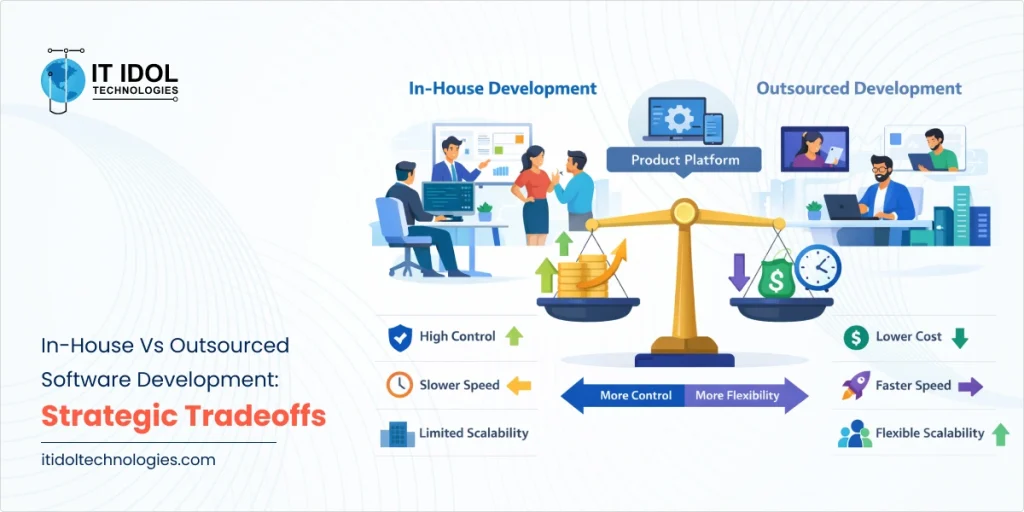
In-house development uses internal engineering teams; outsourcing relies on external vendors or development partners.
Internal teams offer stronger product ownership and institutional knowledge.
Outsourcing provides faster scaling and access to specialized technical expertise.
Cost savings from outsourcing can be offset by coordination and governance challenges.
Many organizations adopt hybrid models combining internal product leadership with external engineering capacity.
For years, the debate around in-house versus outsourced software development has been framed as a straightforward operational choice, one that hinges on cost, control, and convenience. It is often reduced to a simple comparison: build internally for quality and ownership, or outsource for speed and efficiency.
That framing is not just incomplete; it is misleading.
At a strategic level, this decision has far less to do with cost arbitrage or team structure and far more to do with how an organization allocates its most constrained resources, time, expertise, and managerial attention under conditions of uncertainty. Companies that treat it as a procurement decision tend to optimize for short-term gains. Those who approach it as a systems design problem make choices that shape their ability to scale, adapt, and compete over time.
“If you rely too much on people in other companies… ” You are outsourcing your brains.” — Bill Gates (Network World)
This warning, delivered in the context of global software development, still captures the essence of the challenge. The real tension is not between internal and external teams; it is between control and velocity.
Organizations that prioritize in-house development often do so to retain control over their intellectual property, architectural decisions, and long-term product direction. Over time, this creates a compounding advantage: teams build deep familiarity with systems, decision-making becomes faster, and architectural coherence improves. But this same model can become a constraint when speed is critical. Hiring takes time. Onboarding takes longer. And as internal teams grow, coordination overhead increases in ways that are rarely visible at the outset.
Outsourcing, by contrast, is typically adopted to accelerate execution. External teams can be deployed quickly, scaled up or down with relative ease, and brought in to deliver against clearly defined scopes. In environments where timelines are compressed and requirements are stable, this can provide a meaningful advantage.
As Steve Ballmer once emphasized, global talent, particularly in engineering hubs like India, has become central to scaling modern software operations. (The Economic Times)
And yet, the tradeoff is rarely as clean as it appears.
“Do what you do best and outsource the rest.” — Peter Drucker (Uplers)
This widely cited principle is often interpreted too literally. While it captures the economic logic of outsourcing, it does not address the operational complexity that follows. As development work moves outside the organization, so does a portion of the contextual understanding required to make good decisions.
What begins as a speed advantage can, over time, introduce friction, particularly when requirements evolve or when alignment breaks down. This is where many organizations encounter difficulty. The problem is not that outsourcing inherently reduces quality or that in-house teams are inherently slower.
It is that the decision is often made without a clear understanding of which parts of the system actually matter most.
Not all software carries equal strategic weight. Within any product or platform, some components define competitive advantage and others simply enable it. The failure to distinguish between the two leads to predictable outcomes: critical systems are handed off too early, or internal teams become overloaded with work that does not justify their attention. A more effective approach begins with a different lens, one that separates what is core from what is contextual.
Defining the Non-Negotiables: What Must Stay In-House
The distinction between core and contextual work becomes actionable only when it is translated into clear boundaries.
Certain components consistently prove too critical to delegate without long-term consequences:
Core product logic and differentiation layers
System architecture and design authority
Data models and data pipelines
Security-sensitive components
Customer experience decision layers
If losing control over a component weakens your ability to compete, it is not a candidate for outsourcing.
The mistake many organizations make is not outsourcing itself but outsourcing too close to the core before the boundaries are fully understood.
A Clear View of the Tradeoffs
While the decision should not be reduced to a checklist, the underlying differences between in-house and outsourced models can be distilled into a set of structural tradeoffs:
Dimension
In-House Development
Outsourced Development
Control
High ownership over code, architecture, and decisions
Indirect control through contracts and communication
Speed
Slower to scale due to hiring and onboarding
Faster ramp-up with ready teams
Knowledge Retention
Strong institutional memory and continuity
Knowledge distributed externally
Cost Structure
Higher fixed costs (salaries, infrastructure)
Variable costs, but hidden coordination overhead
Flexibility
Harder to scale up/down quickly
Easier to adjust team size dynamically
Innovation Alignment
Strong alignment with long-term product vision
Better suited for execution-focused work
The table clarifies a critical point: neither model is inherently superior. Each optimizes for a different dimension of performance.
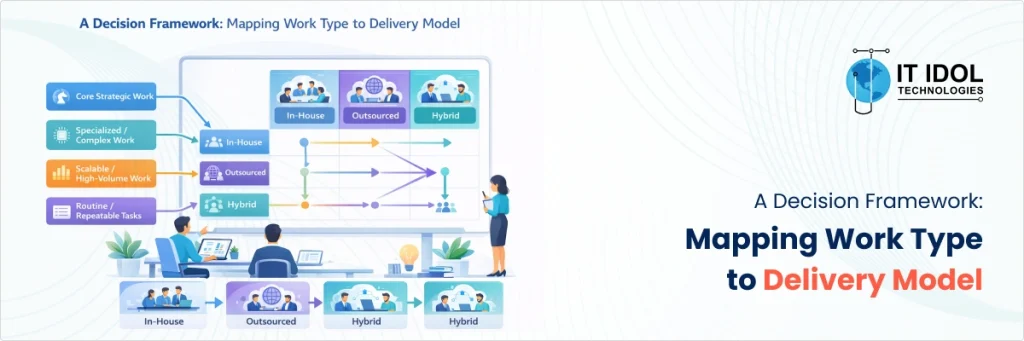
A Decision Framework: Mapping Work Type to Delivery Model
At a practical level, the question is not whether to build in-house or outsource. It is the model that aligns with the stage of the product, the nature of the work, and the level of uncertainty involved.
A more reliable way to approach this decision is to map delivery models to real operating contexts:
Early-Stage / MVP Phase
Primary constraint: time to market
Recommended model: outsourced or hybrid
Rationale: speed of iteration outweighs long-term maintainability
Risk: premature architectural decisions made without internal ownership
Product-Market Fit Stage
Primary constraint: learning velocity
Recommended model: hybrid
Rationale: core product insights begin to compound and should move in-house
External teams remain effective for execution-heavy modules
Scale-Up Phase
Primary constraint: system stability and architectural coherence
Recommended model: predominantly in-house with targeted outsourcing
Rationale: coordination costs increase, and architectural decisions carry long-term consequences
Enterprise / Regulated Environments
Primary constraint: compliance, security, and risk management
Recommended model: in-house dominant
Rationale: external dependencies introduce risk across legal, operational, and data boundaries
The key shift here is conceptual:
You are not choosing a model; you are assigning work to the model that can execute it most effectively under current constraints.
The Hidden Variable: Knowledge as a Strategic Asset
One of the least discussed but most consequential factors in this decision is knowledge retention. Software development is not simply the act of producing code. It is the process through which organizations accumulate understanding of their systems, their users, and the tradeoffs embedded in their architecture.
In-house teams, by design, retain and build upon this knowledge. External teams, however capable, are not structured to serve as long-term repositories of institutional memory. Over time, this creates a dependency dynamic that can limit flexibility and increase risk.
This is why many organizations that aggressively outsource eventually reverse course, a pattern observed in industry research on “backsourcing,” where companies bring previously outsourced capabilities back in-house to regain control and quality.
The Cost Illusion: Why Headcount Cost Is the Wrong Metric
Cost is often the most cited reason for outsourcing, yet it is also the most misunderstood.
Most comparisons focus on visible cost differences. In practice, the higher costs are indirect and accumulate over time:
Coordination cost
Rework cost
Knowledge loss cost
Dependency cost
Switching cost
Outsourcing remains cost-effective when work is well-defined and stable. As uncertainty increases, hidden costs rise and often offset initial savings.
A More Nuanced Reality: Outsourcing Can Also Create Control
It would be a mistake, however, to assume that outsourcing always reduces control. In organizations where internal processes are unclear or execution is inconsistent, a structured external partner can introduce discipline, define scope, enforce timelines, and create accountability where it was previously lacking.
In such cases, outsourcing acts not as a loss of control, but as a mechanism to restore it. The outcome depends less on the model itself and more on how well it is implemented.
Execution Risk Is a Governance Problem, Not a Sourcing Problem
Many outsourcing failures are attributed to vendor capability. In reality, they are more often the result of weak governance models.
Three common models illustrate this:
Project-based outsourcing (low control)
Dedicated team model (moderate control)
Embedded partner model (high control)
The difference between success and failure in outsourcing is rarely the vendor; it is the operating model imposed on them.
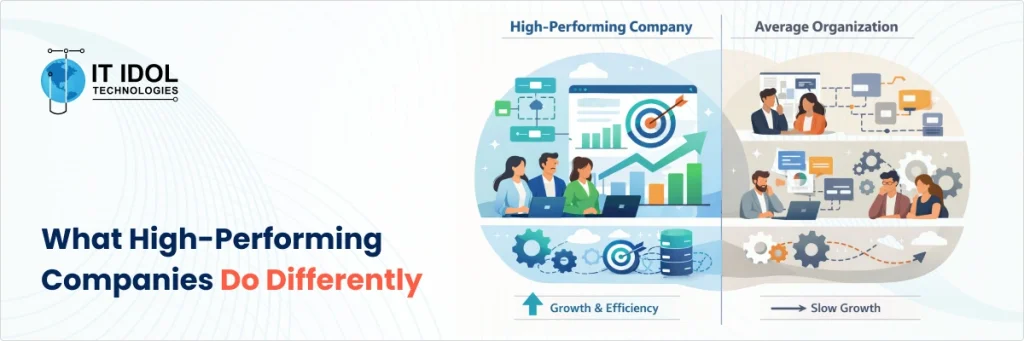
What High-Performing Companies Do Differently
The most effective organizations do not treat this as a binary decision. Instead, they design hybrid systems. Core product development, where differentiation, rapid iteration, and strategic alignment matter most, remains in-house. Contextual work where requirements are stable and execution is the priority is delegated to external teams.
This approach allows companies to balance speed with control, without overcommitting to either extreme.
But it requires discipline:
Clear architectural boundaries
Strong technical leadership
Well-defined interfaces between teams
Without these, even the best sourcing strategy will fail in execution.
The Real Challenge: Designing Clean Interfaces Between Internal and External Teams
Hybrid models introduce coordination complexity.
Key design principles include:
API-first boundaries
Clear ownership
Defined decision rights
Documentation discipline
Escalation clarity
Most hybrid models fail not because of talent gaps, but because of poorly defined interfaces.
Risk Surface Expansion in Outsourced Models
As development moves externally, the risk surface expands:
IP risk
Vendor lock-in
Delivery dependency
Security exposure
Compliance challenges
Mitigation requires structured governance, not avoidance of outsourcing.
A Strategic Perspective for Decision-Makers
Ultimately, the choice between in-house and outsourced development is not about preference. It is about alignment.
Alignment between the nature of the work and the team executing it
Alignment between short-term delivery pressure and long-term capability building
Alignment between speed and sustainability
Organizations that treat outsourcing as a cost-saving tactic often find themselves disappointed. Those that view it as a strategic extension of their engineering system, one that complements rather than replaces internal capability, are better positioned to capture its benefits.
A Practical Way Forward
For companies navigating this decision, the most effective path is rarely choosing one model over the other. It is designing the boundary between them with intent. This is where implementation matters more than theory.
At IT IDOL Technologies, the focus is not on pushing a single delivery model, but on helping organizations structure their engineering systems effectively, balancing in-house strengths with external scalability.
Whether it involves augmenting internal teams, building dedicated offshore units, or executing well-defined development streams, the objective remains the same: to increase delivery velocity without compromising long-term control.
How to Measure If Your Development Model Is Actually Working
The effectiveness of a sourcing strategy should be measured through system performance:
Lead time for changes
Deployment frequency
Defect rate
Rework ratio
Knowledge dependency
If velocity increases but rework also rises, the system is scaling effort, not effectiveness.
Final Thought
The most common mistake companies make is assuming this is a one-time decision. It isn’t. It is an evolving strategy, one that must adapt as products mature, teams grow, and markets shift. Because in the end, the question is not where your developers sit. It is whether your development model is designed to scale with your business or quietly constrain it.
In-house development uses engineers employed directly by a company, while outsourced development relies on external vendors or contractors to build software systems
In-house development is often preferred when software is a core business asset that requires long-term ownership, security control, and continuous innovation.
Yes. As global engineering ecosystems expand, outsourcing will likely remain an important strategy for scaling development capacity.
Deval Rathod
Founder & CEO
|
Deval Rathod is the Founder and CEO of IT IDOL Technologies, a custom software development company. With over a decade of experience in software engineering, solution architecture, and technology leadership, she has worked across custom software development, enterprise applications, AI & ML, and digital transformation. Her expertise includes guiding technology teams, designing scalable software solutions, and helping businesses evaluate and implement emerging technologies. She contributes insights on software engineering, artificial intelligence, enterprise technology, and digital transformation.