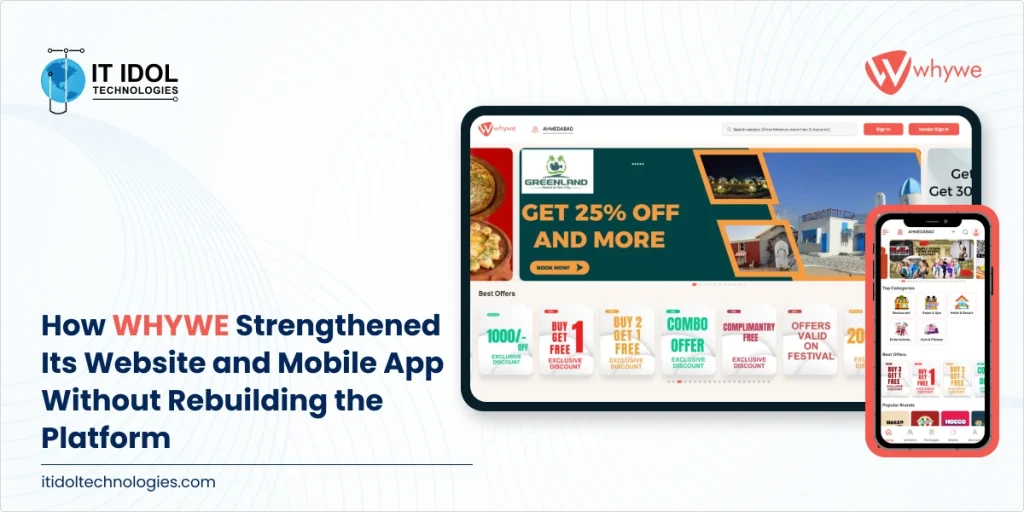
Whywe improved its platform experience across both web and mobile
Website enhancements focused on API development, page optimization, and bug resolution
Mobile improvements included payment gateway integration and coupon module fixes
IT IDOL Technologies worked within the existing system to strengthen functionality
The result was a more consistent, reliable, and complete user experience
Digital products rarely reach a point where everything needs to be replaced. More often, they reach a stage where what already exists needs to work better, more consistently, more efficiently, and with fewer gaps between user intent and system response.
That’s the situation Whywe found itself in as it continued building its presence across both web and mobile. The platform has already delivered on a clear, practical use case: helping users discover nearby deals and redeem them at restaurants, hotels, spas, gyms, and salons. The core flow from browsing offers to purchasing packages and redeeming coupons was already in place.
What required attention wasn’t the product direction. It was how reliably different parts of the system executed that journey in real-world usage.
Instead of introducing new layers or reworking the platform entirely, the decision was to improve the existing system. That meant looking closely at how the website handled interactions, how the mobile app supported transactions, and how both environments connected to the same underlying logic.
Tech Stack Overview
To support both web and mobile experiences, Whywe was built on a combination of established technologies. Rather than replacing these, the improvements were implemented within the same stack:
The work carried out by IT IDOL Technologies focused on optimizing this existing architecture, strengthening API communication, improving performance, and stabilizing functionality across both environments without introducing a new stack.
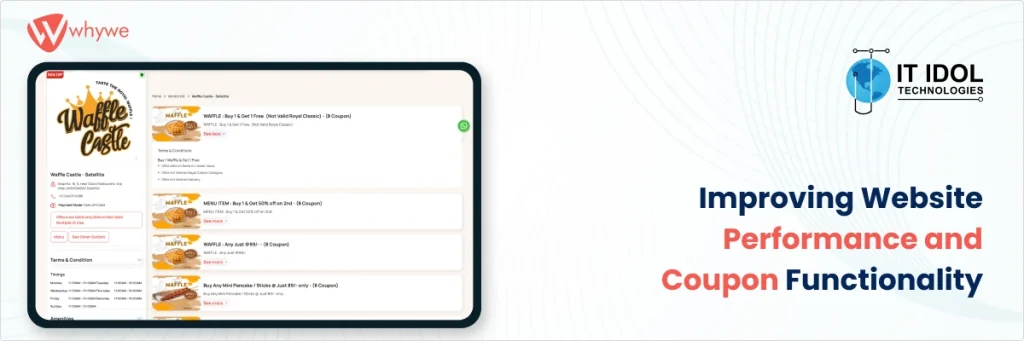
Improving Website Performance and Coupon Functionality
The Whywe website functioned as the primary interface for discovery and account-level interactions. Users could register, explore offers, purchase packages, and access their coupons all from a single environment. It also supported administrative operations such as managing offers, vendors, and coupon availability.
From a functional standpoint, the system was complete. But as the platform evolved, it became clear that some areas needed refinement to maintain a smooth and predictable experience.
A significant part of that experience depended on how efficiently the system handled data. Every interaction, loading offers, accessing coupon details, and completing a purchase, relied on backend processes triggered through APIs. When those processes are not optimized, the effect shows up in subtle but important ways: slower responses, inconsistent loading behavior, or delays in reflecting updated information.
IT IDOL Technologies focused on strengthening this layer by working directly on the APIs that powered these interactions. Their role wasn’t to expand the feature set, but to improve how existing features communicated with the backend. By refining API behavior and improving how requests were handled, they enabled more consistent data flow between the frontend and server-side logic.
These changes influenced how the platform felt to users. Actions such as browsing deals or accessing account information became more responsive, not because the interface changed, but because the system behind it operated more efficiently.
Alongside API improvements, attention was given to page-level performance. Certain pages required optimization to ensure smoother navigation and faster rendering. This involved improving how data was retrieved and processed before being presented to users. Rather than applying superficial changes, the effort focused on how the system handled requests at a structural level.
The coupon system required a more targeted approach. As the central element of the platform, it connects purchasing behaviour with real-world redemption. Any inconsistency in how coupons behave, whether during purchase, storage, or redemption, can affect both user experience and operational clarity.
Adjustments were made to address existing bugs and improve how coupon-related functionality behaved in practice. This included ensuring that once a user purchased a package, the corresponding coupons were correctly reflected in their account, with accurate details and validity. It also meant improving how redemption-related actions aligned with system records.
The result wasn’t a new feature set. It was a more dependable system, where users could complete actions and see expected outcomes without confusion or delay.
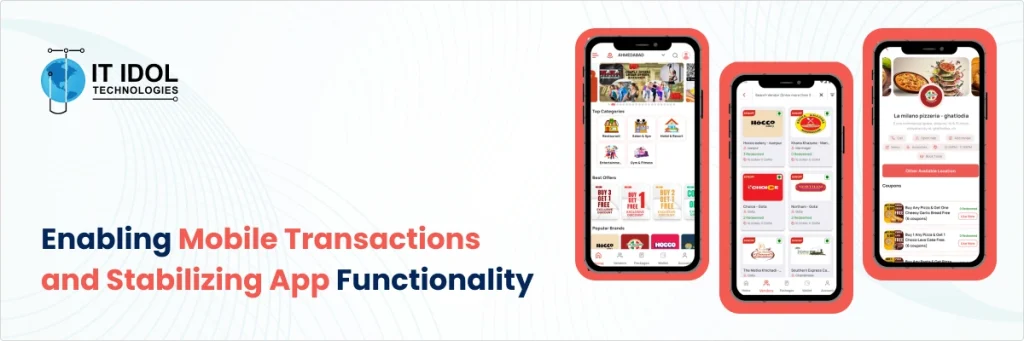
Enabling Mobile Transactions and Stabilizing App Functionality
While the website handled a large part of discovery and account management, the Whywe mobile app extended the same experience into a more immediate, user-driven context. It allowed users to explore deals on the go and interact with the platform in situations where timing and convenience mattered more.
The app already supported browsing and general interaction, but certain elements of the user journey required completion to make the experience fully functional. The most important of these was the ability to complete transactions seamlessly within the app itself.
Without integrated payments, users could explore offers but faced limitations when attempting to move from interest to purchase. In a platform where buying discounted packages is a core action, this gap affected how effectively the app could support the overall experience.
IT IDOL Technologies addressed this by implementing a payment gateway within the application. This addition allowed users to complete purchases directly, without needing to shift contexts or rely on external processes. The change aligned the app with the platform’s core flow, making it possible to move from discovery to transaction in a single, continuous interaction.
Beyond payments, the app also required improvements within specific modules, particularly those related to coupons. Some of these modules needed adjustments to ensure that they functioned correctly under different usage conditions. Others required bug fixes to resolve inconsistencies that affected how features behaved.
These updates were not about adding complexity, but about making sure that existing functionality worked as intended. By refining how modules interacted with backend systems and resolving issues at the code level, IT IDOL Technologies improved the overall stability of the app.
As a result, users engaging with the platform through mobile experienced a more complete and reliable journey. Actions such as purchasing a package or accessing coupon details produced consistent results, reinforcing confidence in how the system responded.
Bringing Website and Mobile Into Alignment
One of the less visible challenges in platforms like Whywe is maintaining consistency across different environments. The website and mobile app serve different usage contexts, but they rely on shared logic and data. If improvements are made in isolation, the experience can become uneven.
In this case, the work carried out across both platforms contributed to a more aligned system overall. Improvements to APIs and backend handling supported both web and mobile interactions. Fixes to coupon functionality ensured that behaviour remained consistent regardless of where the action originated. Payment integration on mobile brought its capabilities closer to what users could already do on the web.
From a user perspective, this alignment simplifies the experience. There is no need to adjust expectations based on the platform being used. Browsing, purchasing, and redeeming follow a predictable pattern, whether accessed through a desktop interface or a mobile device.
This kind of consistency is not always visible as a feature, but it plays a central role in how users perceive reliability.
Refinement Over Replacement
What stands out in Whywe’s approach is the decision to work within the existing system rather than replace it. The platform already had the necessary components, user flows, administrative controls, and core functionality. The task was to ensure that these components operated efficiently and consistently.
IT IDOL Technologies approached this by focusing on areas that directly influenced system behaviour: APIs, page performance, payment functionality, and module-level stability. Each improvement addressed a specific need, but together they contributed to a more cohesive platform.
This approach avoided unnecessary disruption. Users did not need to adapt to a new interface, and internal teams did not need to transition to a completely different system. Instead, the platform evolved through targeted enhancements that improved how it functioned without altering its foundation.
Conclusion
The development path followed by Whywe reflects a practical understanding of how digital products mature. Growth does not always require expansion. In many cases, it requires making existing systems more reliable, more efficient, and easier to use.
existing systems more reliable, more efficient, and easier to use.
By improving APIs, optimizing key pages, integrating payments into the mobile app, and resolving functional issues within core modules, IT IDOL Technologies helped strengthen the platform in ways that directly impact everyday usage.
For teams building or managing similar platforms, the takeaway is grounded in execution. Before adding new features or scaling outward, it is worth ensuring that the current system performs consistently across all key interactions. When users can rely on a platform to behave as expected, whether they are browsing, purchasing, or redeeming, it creates the kind of stability that supports long-term growth.
Whywe is a FoodTech platform that helps users discover and redeem discount coupons across restaurants, hotels, spas, gyms, and salons through its website and mobile app.
Focusing on refining existing systems can significantly improve performance and user experience without requiring a complete rebuild.
Deval Rathod
Founder & CEO
|
Deval Rathod is the Founder and CEO of IT IDOL Technologies, a custom software development company. With over a decade of experience in software engineering, solution architecture, and technology leadership, she has worked across custom software development, enterprise applications, AI & ML, and digital transformation. Her expertise includes guiding technology teams, designing scalable software solutions, and helping businesses evaluate and implement emerging technologies. She contributes insights on software engineering, artificial intelligence, enterprise technology, and digital transformation.