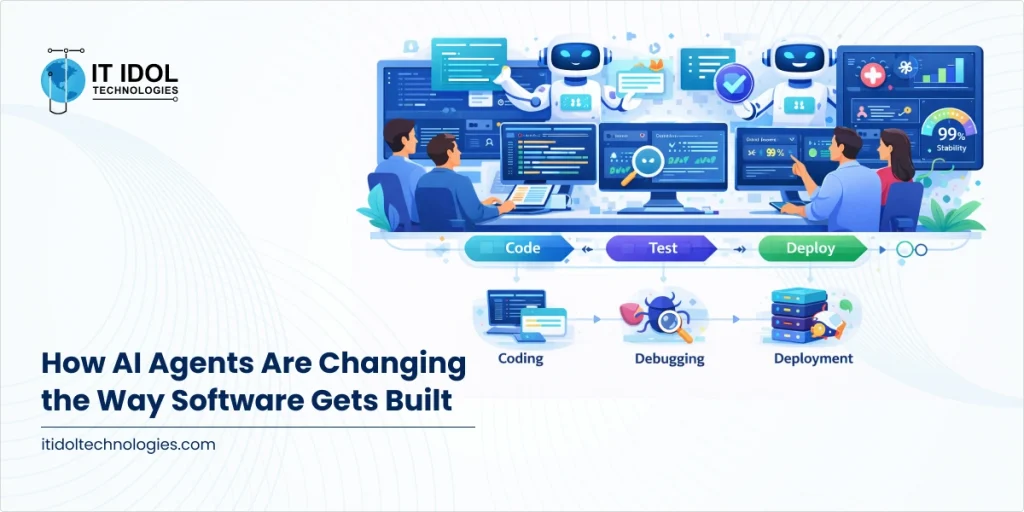
AI agents are transforming software development workflows by automating tasks such as code generation, testing, debugging, and deployment monitoring.
Unlike traditional automation, AI agents can interpret goals and adapt to changing development environments, making them useful in complex and evolving software projects.
These systems help accelerate development by handling repetitive work, allowing engineers to focus on architecture, product design, and problem-solving.
AI-powered tools also improve code quality through automated reviews, bug detection, and continuous analysis within DevOps pipelines.
The future of software development is likely to be collaborative, with developers and AI agents working together to build faster, more reliable, and scalable software systems.
Software development has always involved a large amount of repetitive work. Writing boilerplate code, running tests, reviewing pull requests, fixing small bugs, and managing deployments often consume far more time than the creative engineering work developers actually enjoy. Over the years, teams have tried to solve this through automation, introducing build pipelines, testing frameworks, and deployment scripts to reduce manual effort.
Artificial intelligence is now taking that automation further. Instead of simply executing predefined steps, a new generation of AI agents can interpret goals, interact with their environment, and perform sequences of tasks with minimal supervision. In practice, this means systems that can assist with code generation, monitor software behaviour, analyze logs, identify problems, and even recommend fixes.
The difference between traditional automation and agent-based systems is subtle but important. Traditional automation works well when workflows are predictable and sequential. Software development rarely fits that model. Requirements change, dependencies break, and unexpected issues appear at every stage of the lifecycle. AI agents are designed to operate within this uncertainty, adjusting their actions based on context and feedback.
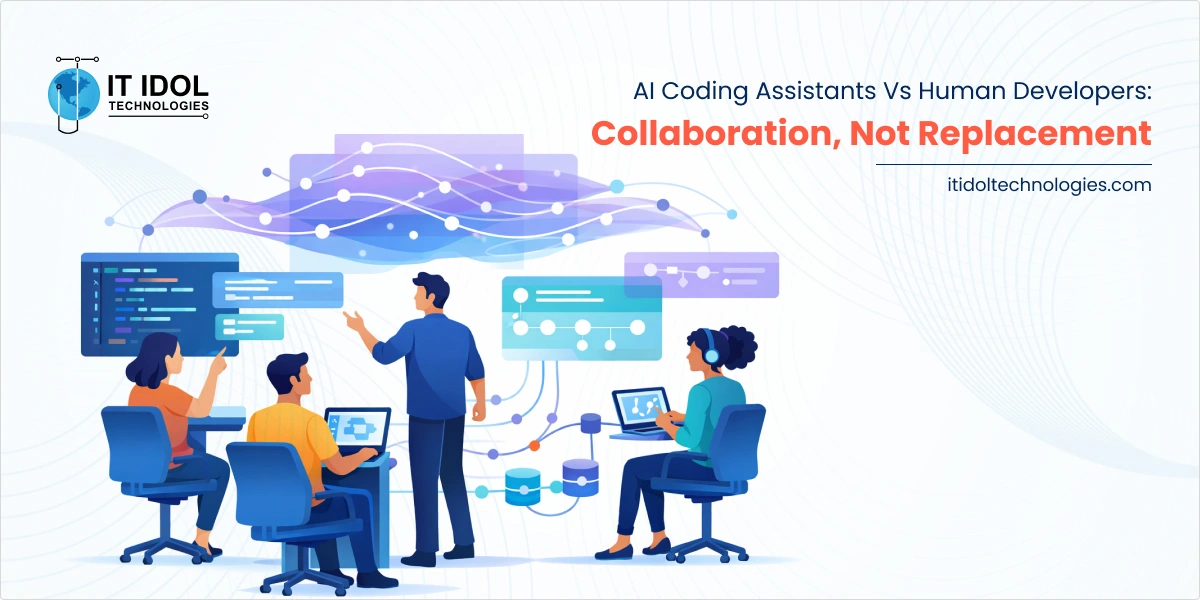
For development teams, this shift has real implications. When routine tasks such as writing standard code patterns, reviewing pull requests, or running diagnostic checks can be delegated to intelligent systems, developers can focus more on architecture, problem-solving, and product innovation. Rather than replacing developers, AI agents are gradually becoming collaborators in the engineering process.
The Growing Role of AI in Development Workflows
Interest in AI-driven development tools has accelerated quickly over the past few years. Organizations across industries are experimenting with integrating intelligent systems into their engineering processes, particularly in areas such as code generation, testing, and operational monitoring.
Market forecasts reflect this momentum. Industry research suggests that the global market for AI agents could grow from roughly $5.4 billion in 2024 to more than $50 billion by 2030, driven largely by enterprise adoption of autonomous software systems. Analysts also expect a significant portion of enterprise applications to incorporate agent-based functionality within the next few years.
Developers themselves are adopting these tools at a rapid pace. Surveys from developer communities show that more than four-fifths of developers either already use AI-assisted tools or plan to use them in the near future, and over half report using such tools daily. Many of these tools are already integrated into everyday development activities, from writing code snippets to reviewing changes or identifying potential errors.
However, adoption does not automatically translate into productivity gains. While many teams report improvements in development speed, concerns about accuracy, security, and reliability remain common. Developers often treat AI assistance as a starting point rather than a final answer, reviewing and refining the outputs before integrating them into production systems.
Even with those limitations, the productivity impact can be significant. Studies on AI-assisted coding tools have shown that developers can complete certain programming tasks substantially faster when supported by intelligent code suggestions. Mature engineering teams integrating AI into their DevOps practices also report more frequent deployments and fewer post-release defects.
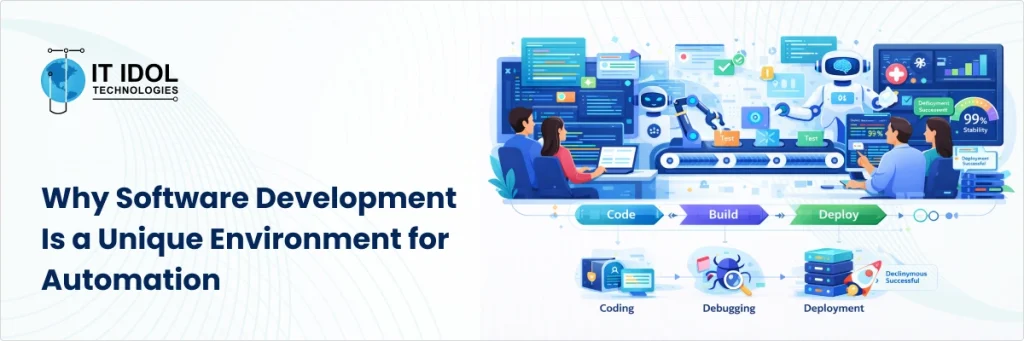
Why Software Development Is a Unique Environment for Automation
Automation is not new in enterprise environments. Manufacturing, logistics, and financial systems have relied on automated processes for decades. These environments are often stable and predictable, which makes them ideal for rule-based automation.
Software development is fundamentally different.
The development process is inherently dynamic. Requirements evolve as products mature. Frameworks and libraries are constantly updated. Teams experiment with new architectural approaches. Communication gaps between product managers, designers, and engineers frequently introduce misunderstandings that must be resolved along the way.
Consider a few typical scenarios that occur during development:
A product requirement might change late in the release cycle, requiring adjustments across several components.
A framework update might unexpectedly affect a user interface behavior.
An operating system patch could introduce compatibility issues in a containerized deployment environment.
These situations rarely have predefined solutions. They require investigation, experimentation, and collaboration across teams. This complexity explains why modern development methodologies such as Agile emphasize continuous communication and adaptation.
AI agents are particularly well-suited to operate in such environments because they can monitor multiple signals simultaneously, interpret patterns in system behavior, and respond to evolving conditions. Rather than executing fixed instructions, they can participate in the decision-making process by analyzing data and suggesting possible actions.
Simulating Team Roles with Autonomous Agents
One emerging approach in agent-based software development is the idea of modeling software teams themselves. Instead of relying on a single general-purpose AI assistant, systems can assign specialized agents that mirror the roles typically found in engineering teams.
For example, an agent might focus on understanding product requirements and prioritizing development tasks, similar to a product manager. Another agent could generate or modify code based on those requirements. Additional agents might monitor deployment pipelines or analyze test results to identify potential issues.
In this model, agents collaborate in ways that resemble the interactions within real development teams. Each agent has access to a specific context and responsibilities, and they communicate with one another to complete larger tasks. When a problem arises, the issue can be escalated between agents or passed to human engineers for review.
This layered structure allows automation to operate at several levels simultaneously. Individual agents can handle specific technical tasks, groups of agents can coordinate activities across a project, and the overall system can manage workflows across multiple teams. By reflecting the way human teams already work, these systems make it easier to identify gaps, correct errors, and maintain visibility into complex processes.
For developers, this means that tasks that previously required manual coordination across several tools and team members can gradually become more autonomous.
Automated Code Generation and Development Acceleration
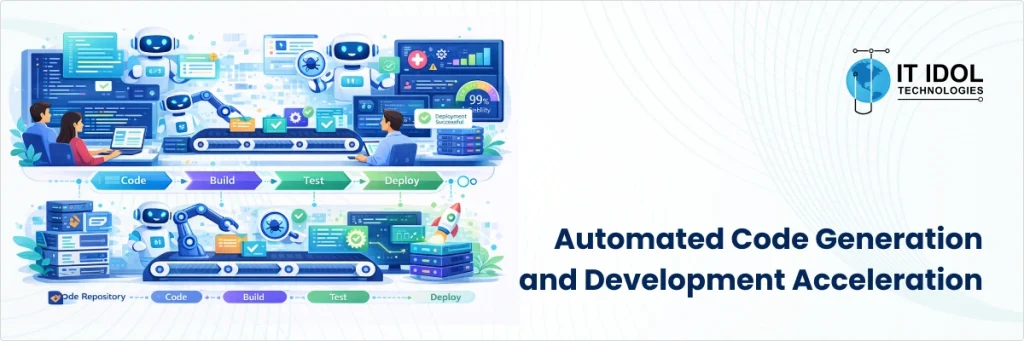
One of the most visible applications of AI in software engineering is automated code generation. Modern development tools powered by large language models can interpret natural language instructions and translate them into working code snippets.
Developers can describe a feature or function in plain language and receive a draft implementation almost instantly. These tools are particularly effective at producing repetitive patterns such as configuration files, data models, or standard API structures. By removing the need to write this boilerplate code manually, developers can spend more time refining architecture and solving complex design challenges.
Research into AI-assisted coding has shown notable improvements in development speed. Controlled studies have demonstrated that developers supported by tools such as GitHub Copilot can complete certain programming tasks significantly faster than those working without assistance. Adoption among large organizations also continues to grow, with thousands of companies integrating these tools into their engineering environments.
The benefits extend beyond speed. AI systems can also help maintain consistency across codebases, suggest alternative implementations, and provide explanations that help developers understand unfamiliar libraries or frameworks. For junior developers, this guidance can accelerate learning. For experienced engineers, it can reduce the cognitive load associated with routine tasks.
Smarter Code Reviews and Early Bug Detection
Code generation is only one part of the development lifecycle. Ensuring that software works reliably once it is written remains one of the most time-consuming aspects of engineering.
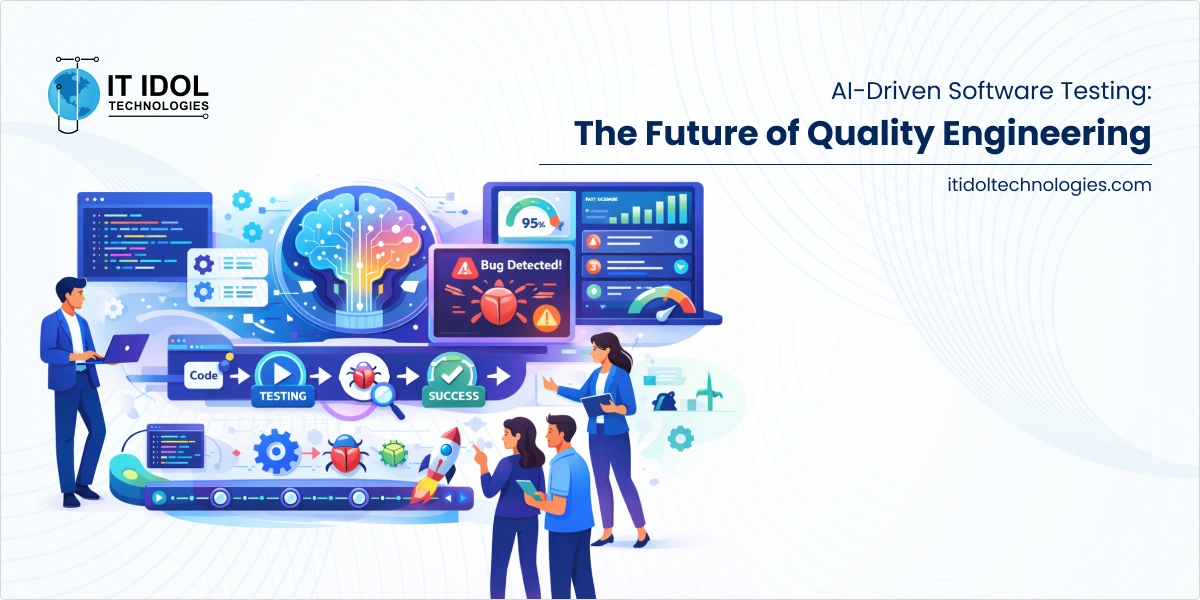
AI-driven analysis tools are beginning to play a larger role in this area as well. Systems trained on large datasets of code can analyze new changes and identify patterns that may lead to bugs, security vulnerabilities, or performance issues. Tools such as DeepCode and SonarQube already use machine learning techniques to support automated code reviews and quality checks.
These tools can detect problems that might be difficult for human reviewers to notice, particularly in large codebases where thousands of lines of code are modified across multiple components. Studies suggest that machine learning-based review systems can significantly reduce the number of defects that reach production environments.
When integrated into continuous integration and continuous deployment pipelines, these systems continuously analyze code as it is written and deployed. Developers receive immediate feedback on potential issues, allowing them to address problems earlier in the development cycle. This reduces the need for lengthy manual reviews and helps teams maintain consistent coding standards across large projects.
The result is a development process that is both faster and more reliable.
Improving Collaboration and Knowledge Sharing
Another area where AI agents are beginning to make an impact is team collaboration. Large software projects often involve dozens or even hundreds of developers working across distributed teams. Maintaining a shared understanding of a codebase can become difficult, especially when experienced engineers move to other projects.
AI systems can help bridge this gap by analyzing code and automatically generating documentation that explains how different components work. Instead of relying solely on manually written documentation, teams can use AI to translate complex code structures into clear descriptions of system behaviour.
This capability can significantly improve onboarding for new developers. Rather than spending weeks deciphering unfamiliar codebases, new team members can quickly understand a project’s architecture and functionality through AI-generated explanations.
AI agents can also analyze historical code changes and development patterns to provide recommendations based on past decisions. This effectively captures institutional knowledge that might otherwise be lost when team members leave or move into other roles. For organizations with distributed engineering teams, this kind of shared intelligence can reduce communication overhead and improve coordination.
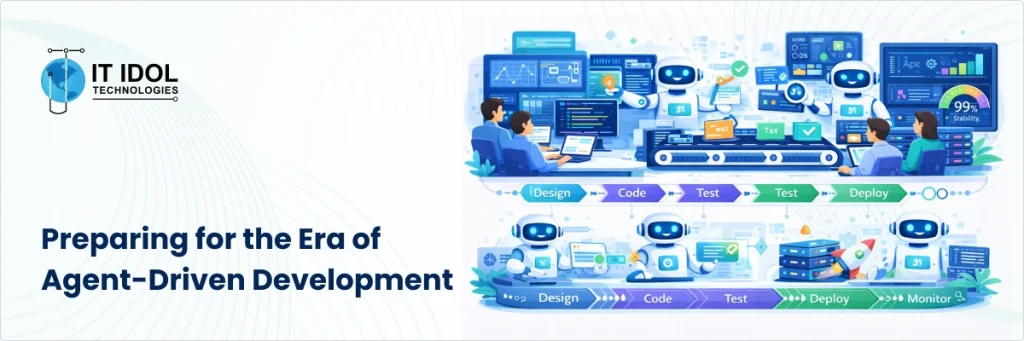
Preparing for the Era of Agent-Driven Development
Despite the rapid progress in AI-driven development tools, the technology is still evolving. Standards for agent-based systems are emerging, and organizations are still learning how best to integrate these capabilities into existing development environments.
For companies considering deeper adoption of agentic systems, the most important starting point is understanding where these tools create real value. Rather than implementing AI everywhere, successful organizations typically begin by identifying specific development tasks where automation can meaningfully improve productivity or reduce risk.
Data access and integration are also critical. AI agents rely on accurate and comprehensive data to operate effectively, whether they are analyzing system logs, reviewing code repositories, or monitoring deployment pipelines. Without a reliable data infrastructure, even the most advanced tools will struggle to deliver meaningful results.
Security and governance considerations are equally important. As AI systems gain greater autonomy within development workflows, organizations must ensure that clear policies and safeguards are in place to manage risk and maintain accountability.
Finally, teams must remain adaptable. The pace of innovation in AI development tools is rapid, and organizations that build flexible infrastructure will be better positioned to adopt new capabilities as they emerge.
A New Layer of Intelligence in Software Engineering
AI agents are not replacing software developers. Instead, they are introducing a new layer of intelligence within the development process itself. By automating routine work, analyzing system behavior, and assisting with decision-making, these systems allow engineering teams to focus on the aspects of development that require human creativity and judgment.
As tools continue to mature, the relationship between developers and machines will likely become more collaborative. Developers will define goals and architecture, while AI systems assist with execution, monitoring, and optimization.
The result may be a development environment where software is not only written faster, but also built with greater reliability and adaptability. For organizations navigating increasingly complex digital ecosystems, that shift could fundamentally reshape how software is designed, delivered, and maintained.
FAQ’s
1. What are AI agents in software development?
AI agents are autonomous or semi-autonomous systems that can perform development tasks such as writing code, debugging, testing, and managing workflows. Unlike traditional tools, they can plan actions, execute tasks, and adapt based on outcomes.
2. How do AI agents differ from traditional coding assistants?
Traditional coding assistants primarily provide suggestions or autocomplete code. AI agents go further by executing multi-step tasks such as generating entire modules, running tests, fixing bugs, and coordinating development workflows.
3. What tasks can AI agents automate in the software development lifecycle?
AI agents can assist with requirements analysis, code generation, refactoring, automated testing, debugging, documentation, and even deployment workflows.
4. Are AI agents replacing software developers?
No. AI agents are designed to augment developers rather than replace them. They handle repetitive or time-consuming tasks while developers focus on system design, architecture, and complex problem-solving.
5. How do AI agents improve developer productivity?
By automating routine tasks and reducing manual work, AI agents allow developers to build, test, and iterate faster. This shortens development cycles and helps teams focus on higher-value engineering work.
6. What technologies enable AI agents in software engineering?
AI agents typically rely on large language models, code understanding models, orchestration frameworks, and integrations with development tools such as repositories, CI/CD pipelines, and testing systems.
7. What are the risks of using AI agents in software development?
Key concerns include code quality, security vulnerabilities, over-reliance on automated outputs, and the need for human oversight to ensure correctness and maintainability.
8. How are development teams integrating AI agents into their workflows?
Teams often integrate AI agents into IDEs, DevOps pipelines, and collaborative development platforms where they assist with coding, testing, and project management tasks.
9. Can AI agents help with legacy code maintenance?
Yes. AI agents can analyze large codebases, identify dependencies, suggest refactoring strategies, and help modernize legacy systems more efficiently.
10. What does the future of AI-driven software development look like?
The future likely involves increasingly autonomous development environments where AI agents collaborate with developers, manage workflows, and continuously optimize software throughout its lifecycle.
Parth Inamdar is a Content Writer at IT IDOL Technologies, specializing in AI, ML, data engineering, and digital product development. With 5+ years in tech content, he turns complex systems into clear, actionable insights. At IT IDOL, he also contributes to content strategy—aligning narratives with business goals and emerging trends. Off the clock, he enjoys exploring prompt engineering and systems design.